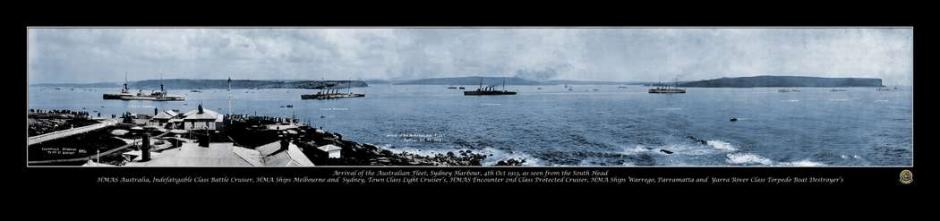
1913 Fleet Entry

The centrepiece of Australia’s new Fleet Unit, the Indefatigable class battlecruiser HMAS Australia, commissioned at Portsmouth on 21 June 1913. Two days later she hoisted the flag of Rear-Admiral (later Admiral Sir) George Patey, RN, already destined to become the first Flag Officer Commanding the Australian Fleet.

Before sailing for Australia, Patey hosted an inspection by King George V and, in a ceremony not seen since the time of Sir Francis Drake, he knighted Patey on Australia‘s quarterdeck. With a complement of 820 men, just less than half the ship’s company were regarded as Australian, either through birth or having transferred to the Royal Australian Navy from the Royal Navy. There was, however, no doubt that the departing battlecruiser was an Australian warship. Immediately after the cheers for the official party, a rating perched astride one of Australia‘s eight 12-inch guns shouted, ‘Three cheers for Wallaby Land’.
On 25 July 1913, Australia sailed from England in company with the new light cruiser HMAS Sydney. Rather than proceed by way of the Suez Canal the two ships made a successful visit to South Africa, where their appearance was expected to act as an inducement to naval development.
Australia and Sydney reached the sheltered anchorage of Jervis Bay, New South Wales, on 2 October 1913. There they were joined by the cruisers: Encounter andMelbourne, and the destroyers Warrego, Parramatta, and Yarra. Last minute preparations continued for the official entry into Sydney.
Early on 4 October 1913 the various units of the fleet got underway, took up station astern of Australia, and steamed north in single column. The spring weather was perfect, and once off Sydney the long grey line of ships turned towards the coast and materialised punctually out of a thinning sea mist in the east.
Sydney Harbour was no stranger to imperial and foreign warships, but the formation led by Australia, both majestic and forbidding at the same time, was something different. It was the embodiment of the Commonwealth’s own sea power and representative of something far greater than the sum of its parts. For the first time, Australia would have a real and independent voice on the world stage.
Extract from ‘The Daily Telegraph’, October 6, 1913:
“They came from due east. They rose up from the bosom of the sea – the distant horizon. Not a sound to announce the approach of the procession. Silently they glided, rather than ploughed, their way. Just outside the Heads the oncoming line deployed so as to take the guiding marks of the eastern channel. It was a splendid spectacle to watch. Each ship equidistant and following in its predecessors wake. On the precise spot where the flagship veered in her course the others as they reached it, veered also. So precise were the movements that the ships might have been railway engines running on a railway track. Those who had admired the skilful manoeuvring of the American fleet found equal praise for our own ships, which without exception took up their moorings in splendid style. Every detail was carried out with the mechanical precision of a clock work. It was all highly creditable to the young Navy.”
Extract from ‘The Daily Telegraph’, October 6, 1913:
“From every flagstaff, north, south, east and west flew the British – Australian colours. It was truly Australia’s national day, a day that meant much to its history. And notable, too, was the pride which the younger generation, seen on almost every vessel afloat, took in this spectacular demonstration that signified the realisation of ambitious hopes.”
As the fleet entered the harbour, hundreds of small craft provided an eager escort, while hundreds of thousands of sightseers crammed the many headlands to stare at their new warships. The event evoked a nationalistic euphoria never before experienced. “The sight of the Fleet meant more to the Australian people than the visit of any foreign fleet. It was our expression of patriotism, ships of defence bought in love of country and empire.” wrote the Sydney Mail, while the Australian Prime Minister, Joseph Cook, remarked:
“Since Captain Cook’s arrival, no more memorable event has happened than the advent of the Australian Fleet. As the former marked the birth of Australia, so the latter announces its coming of age, its recognition of the growing responsibilities of nationhood, and its resolve to accept and discharge them as a duty both to itself and to the Empire. The Australian Fleet is not merely the embodiment of force. It is the expression of Australia’s resolve to pursue, in freedom, its national ideals, and to hand down unimpaired and unsullied the heritage it has received, and which it holds and cherishes as an inviolable trust. It is in this spirit that Australia welcomes its Fleet, not as an instrument of war, but as the harbinger of peace.”
Since 1913, the RAN has many times conducted ceremonial fleet entries into Sydney Harbour, often to commemorate particular naval or national anniversaries. Such entries have also formed an important part of the procedure for a subsequent Fleet Review.

Discover more from JCs Royal New Zealand Navy Ships and New Zealand Defence, Also other World Defence Updates
Subscribe to get the latest posts sent to your email.

