Share on emailShare on twitterShare on facebookShare on digg|More Sharing ServicesMore
|November 18, 2013
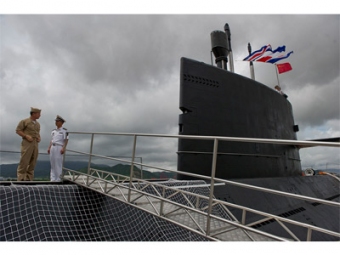
 On October 27, China’s state-run Xinhua news agency released a slideshow showing what the Chinese People’s Liberation Army Navy (PLAN) touted as the country’s first nuclear ballistic-missile submarine (SSBN). Though the “unveiling” of China’s Type 092 Xia-class SSBN comes as no surprise, Beijing’s open display of the submarine, coupled with technical improvements to the Chinese JL-2 submarine-launched ballistic missile (SLBM), raises the question of whether China is approaching a credible sea-based nuclear deterrent.
Although the Xia-class SSBN received much fanfare in both Chinese andWestern sources alike, the PLAN envisions the Type 094 Jin-class submarine as playing the primary role in China’s sea-based nuclear-deterrence strategy. Even Xinhua has admitted that the Xia-class SSBN does not comprise a viable nuclear second-strike force. According to the U.S. Office of Naval Intelligence, China maintains three operational Jin-class SSBNs and is currently constructing two more, all five of which will be outfitted with twelve JL-2 SLBMs. According to U.S. defense officials, the Jin-class SSBN is expected to begin sea patrols as early as 2014.
For China to acquire a credible survivable sea-based nuclear deterrent, the country must overcome two technical challenges that the country has been unable to surmount since first launching an SLBM from a submarine in 1988. China must build a submarine stealthy enough to avoid U.S. antisubmarine warfare (ASW) assets and design a JL-2 SLBM capable of penetrating US ballistic missile defense (BMD) with high probability.
Both the Xia-class and Jin-class SSBNs are not quiet enough to avoid detection by U.S. ASW assets. The Jin-class SSBN design if fundamentally flawed in that the large missile compartment at the rear of the vessel and the flood openings below the missile hatches create a detectable sonar signature. A 2009 U.S. Office of Naval Intelligence report comparing the low-frequency noise level for China’s SSBN force to that of Russian 1970s-era SSBNs found that out of the twelve submarines profiled, the Xia-class SSBN was the most detectable and the Jin-class SSBN the fourth-most detectable. China’s JL-2 SLBM has repeatedly failed launch tests and it is still unclear whether the PLAN successfully tested the SLBM on August 16, as it claimed.
Even if China acquires the technical capacity necessary for a survivable sea-based nuclear deterrent, the highly centralized PLA has no operational experience in maintaining deterrence patrols on the open seas. China has traditionally relied exclusively on its land-based intercontinental ballistic missiles (ICBMs) for deterrence and thus has never confronted the existential question of whether to predelegate SLBM launch authority to submarine commanders in case of crisis.
MORE BY
- Show full page
- Login or register to post comments
Discover more from JCs Royal New Zealand Navy Ships and New Zealand Defence, Also other World Defence Updates
Subscribe to get the latest posts sent to your email.

