Photo not verified

HMNZS James Cosgrove (AK1295, 6, T10) was a Castle-class trawler built for the United Kingdom for use as a minesweeper. She was purchased by Sanford Ltd in 1920 for use in New Zealand as a fishing trawler, being used as a minesweeper again during World War II. She was scrapped at the Western Viaduct in the 1950s, with her hulk being sunk in 1952.
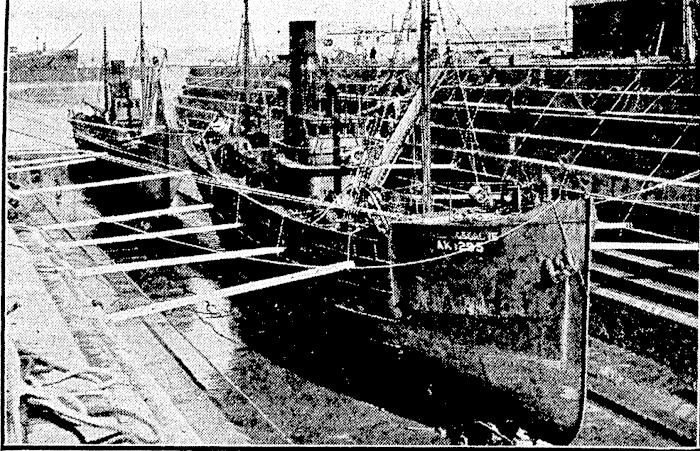
Thomas Currell (centre / right) and James Cosgrove (left) in Calliope Drydock, Devonport, New Zealand.
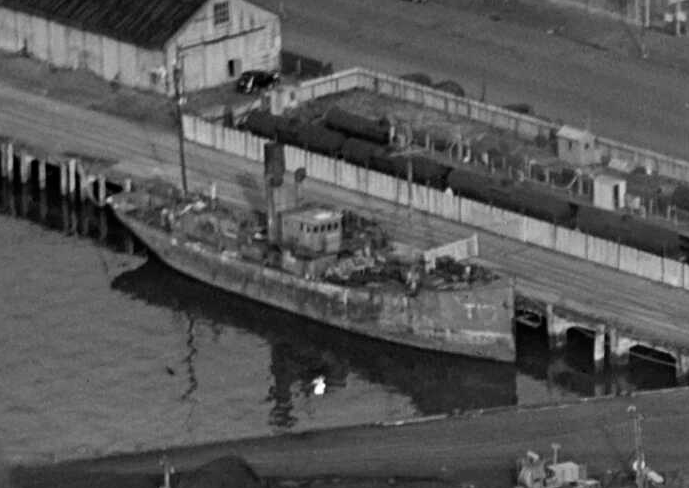
James Cosgrove laid up at the Viaduct Basin, 1949
Early operational history
The James Cosgrove was built by the Ailsa Shipbuilding Company, located in Ayr, for use as a minesweeper, being converted into a fishing trawler after World War I had ended.[1] She was purchased by Sanford in 1920 and sailed to Auckland from Glasgow in May 1920, arriving at Auckland on 2 July 1920. [1][2] In March 1928, the James Cosgrove was mistaken to have been in distress after the inspector of police in Napier received a call about the vessel, which appeared to be in trouble four miles (6.4 km) offshore, later seen steaming south.[3] Once the James Cosgrove arrived back in Auckland a few days later, the officers stated that there were no grounds whatever for the reports that she was in distress, with the probable explanation that the locals were unfamiliar with trawling and mistook it as the ship breaking down.[4] On 24 May 1936 the cook of the James Cosgrove disappeared from the vessel while she was trawling in the Bay of Plenty.[5] James Cosgrove would turn back and would retrace the ship’s course for an hour, also searching the entire ship, but the cook was never found.[5] With it being likely that he fell overboard.[5]
World War II[edit]
Within a day of war being declared against Germany on 3 September 1939, the Marine Department would requisition the James Cosgrove along with the other Sanford trawlers, Thomas Currell, and Humphrey, which would be converted for minesweeping duties and fitted with 4-inch guns, depth charges, and minesweeping equipment, also being given a wireless telephone and telegraph equipment.[6] James Cosgrove would be commissioned on 10 October 1939, being the first of the Sanford trawlers to be commissioned.[6] On 28 February 1940, James Cosgrove would be towed back to Auckland by the Humphrey after a serious engine fault.[7] On the morning of 19 June 1940, a distress signal was received from the passenger ship RMS Niagara, reporting it had struck a naval mine between Bream Head, and the Moko Hinau Islands and was sinking.[8][7] The James Cosgrove and Thomas Currell were ordered to sea, steaming at full speed towards her, arriving at 12:50 PM with minesweeping gear being deployed at 2:48 PM.[8][7] She and Thomas Currell discovered two contact mines that been laid recently, both were destroyed by rifle fire.[7][8] In December 1943, James Cosgrove was found to have major boiler faults and was immediately withdrawn for disposal.[7]
Post war[edit]
.png)
After World War II, James Cosgrove was offered back to Sanford Ltd, but because of her age, the cost of conversion, and that she was a heavy coal burner (11-12 tons daily) the company never took up ownership of the trawler.[1] Instead, she was laid up at the Viaduct Basin until the 1950s, when she was sold for scrap in 1951, with her hulk being towed to sea to be sunk.[1][7] But a later report in June 1961, the Marine Department advised the Coromandel Country Council that the submerged hulk of the James Cosgrove would need to be removed as it was near the Coromandel wharf, being a danger to navigation.[7] As she had been placed there as part of proposed harbor works years earlier, being filled with concrete.
Further info below
https://www.clydemaritimeforums.co.uk/james-cosgrove-1918-hmnzs-admiralty-trawler-t8073.html
HMS James Cosgrove
Admiralty Trawler, Castle Class – Ad No 3716
HMNZS James Cosgrove
Auxiliary Minesweeper – T.10
Boom Gate Vessel
Launched by Ailsa Shipbuilding Company, Yard No: 332A, on 5/3/1918. Scuttled in 1952
360t light, 547t deep load.
125 ft 6in pp x 23ft 6in x 12ft 6in (depth of hold)
1 Shaft reciprocating VTE, 480 ihp, giving 10.5 knots
1 x 12 pdr
Crew 18 approx, depending on role
1919 sold as a mercantile, same name.
1922 Sanford Ltd
10/10/1939 commissioned in the RNZN as a Minesweeper based at Aukland with the First Group
14/11/1940 joined Group III based at Lyttelton as a Port Minesweeper
She then became part of the 96th Auxiliary Minesweeping Group, 25th Minesweeping Flotilla
1941 purchased by the RNZN
April 1944 converted to a BGV
1946 returned to Sanford Ltd
Discover more from JCs Royal New Zealand Navy Ships and New Zealand Defence, Also other World Defence Updates
Subscribe to get the latest posts sent to your email.

