HMS Prince of Wales Pacific is underway in a last series of test to prove the operational capability of the Royal Navy’s carrier strike group.
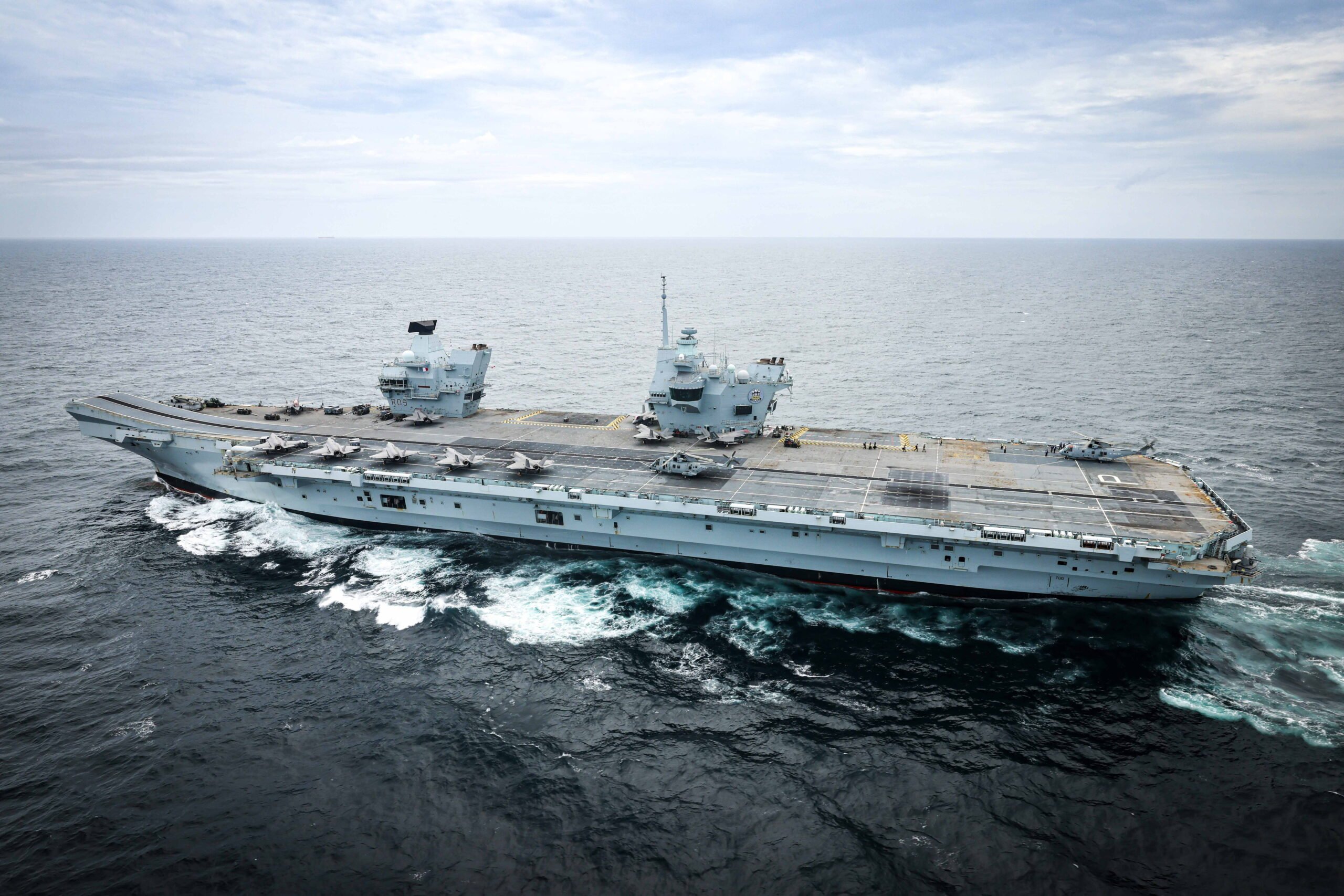
HMS Prince of Wales (R09)off the coast of India whilst on Op Highmast. Royal Navy Photo
June 27, 2025 7:00 PM
ABOARD AIRCRAFT CARRIER HMS PRINCE OF WALES – The U.K.’s first Carrier Strike Group will operate for four months in the Indo-Pacific to complete the full operational capability milestone for the Royal Navy’s carrier strike group concept. The exercises, which are a part of Operation Highmast, also demonstrate the U.K.’s commitment to the region, strike group commander Commodore James Blackmore said on Tuesday.
“Highmast is about developing in three key areas for us: It’s about developing full operational capability of the U.K. Carrier Strike Group; it’s about partnerships and allies in the Indo-Pacific region, where we are right now; and there’s an element about NATO forces as well, particularly when we are back in the Euro-Atlantic region,” said Blackmore in a media session on the flight deck of Prince of Wales while docked in Singapore. He was joined by the commanding officer of Prince of Wales, Capt. Will Blackett and Capt. Colin McGannity, Commander Air Group.
Blackmore added that the first phase of the deployment in the Mediterranean and Atlantic was meant to build the capabilities the UKCSG would bring to the Indo-Pacific, culminating in Exercise Mediterranean Strike with the Italian Navy Cavour CSG. Following a port visit to Souda Bay, Crete, the UKCSG transited the Suez Canal into the Indo-Pacific region on June 12 and arrived in Singapore on Monday.
Transit through the Red Sea was quiet, “Just the way we hoped for,” said Blackmore. The ships and aircraft of the UKCSG maintained a full alert posture during the transit.
“All of our assets were deployed airborne and our ships were in a posture that you would expect them to be in. We had to, in some ways, expect the worst, but we planned for everything,” stated COMUKCSG. He added that he was pleased with all the UKCSG teams’ performance thanks to thorough training for potential Houthi attacks in the Red Sea. The UKCSG’s three embarked Merlin Mk2 Airborne and Control (ASaC) helicopters, known as “Crowsnest,” were deployed to provide the CSG with long-range, over-the-horizon air, sea and land surveillance, detection and tracking. Blackmore said the Crowsnest “provides us with an incredible airborne surveillance control function so we understand what’s going on in the air environment.”.
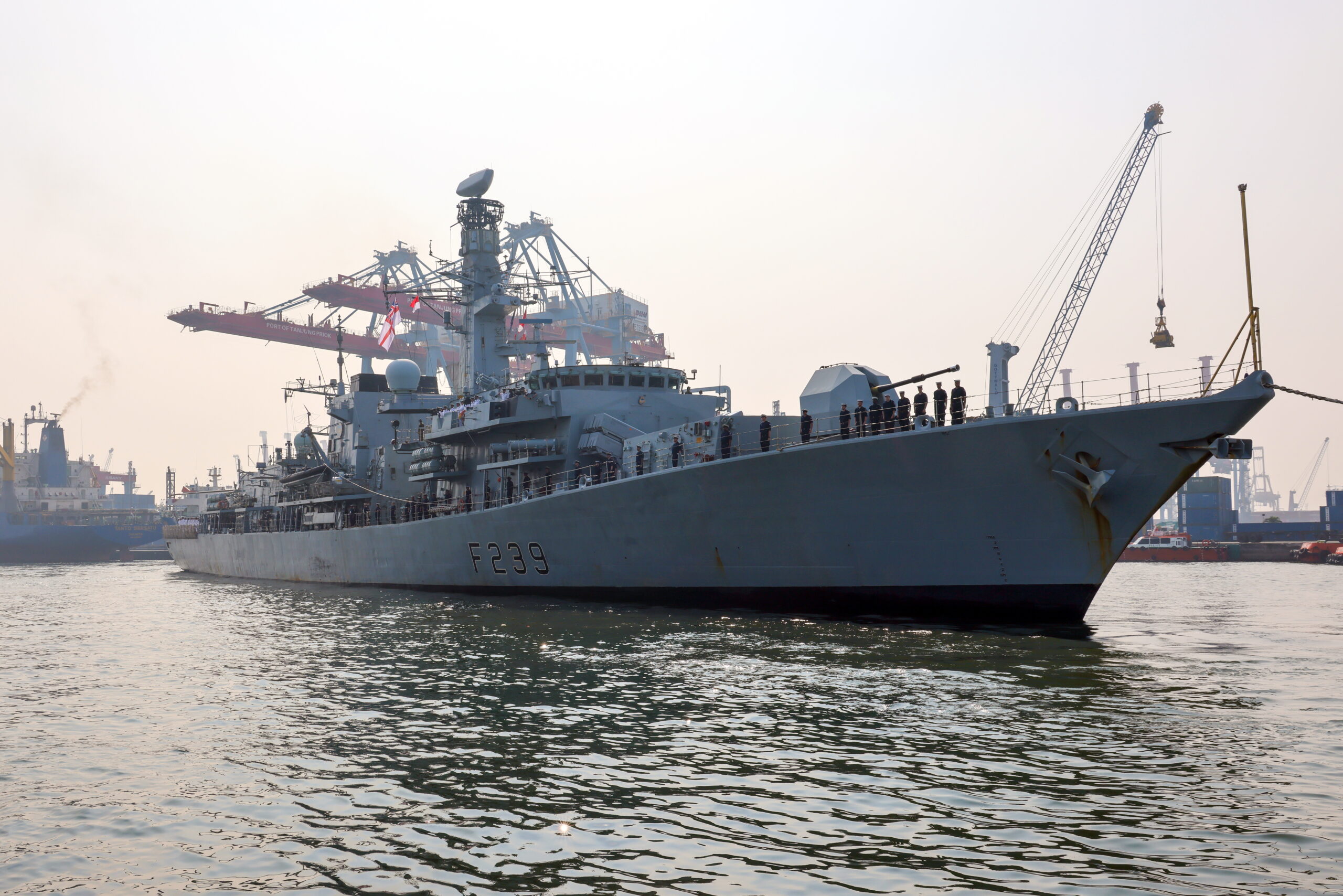
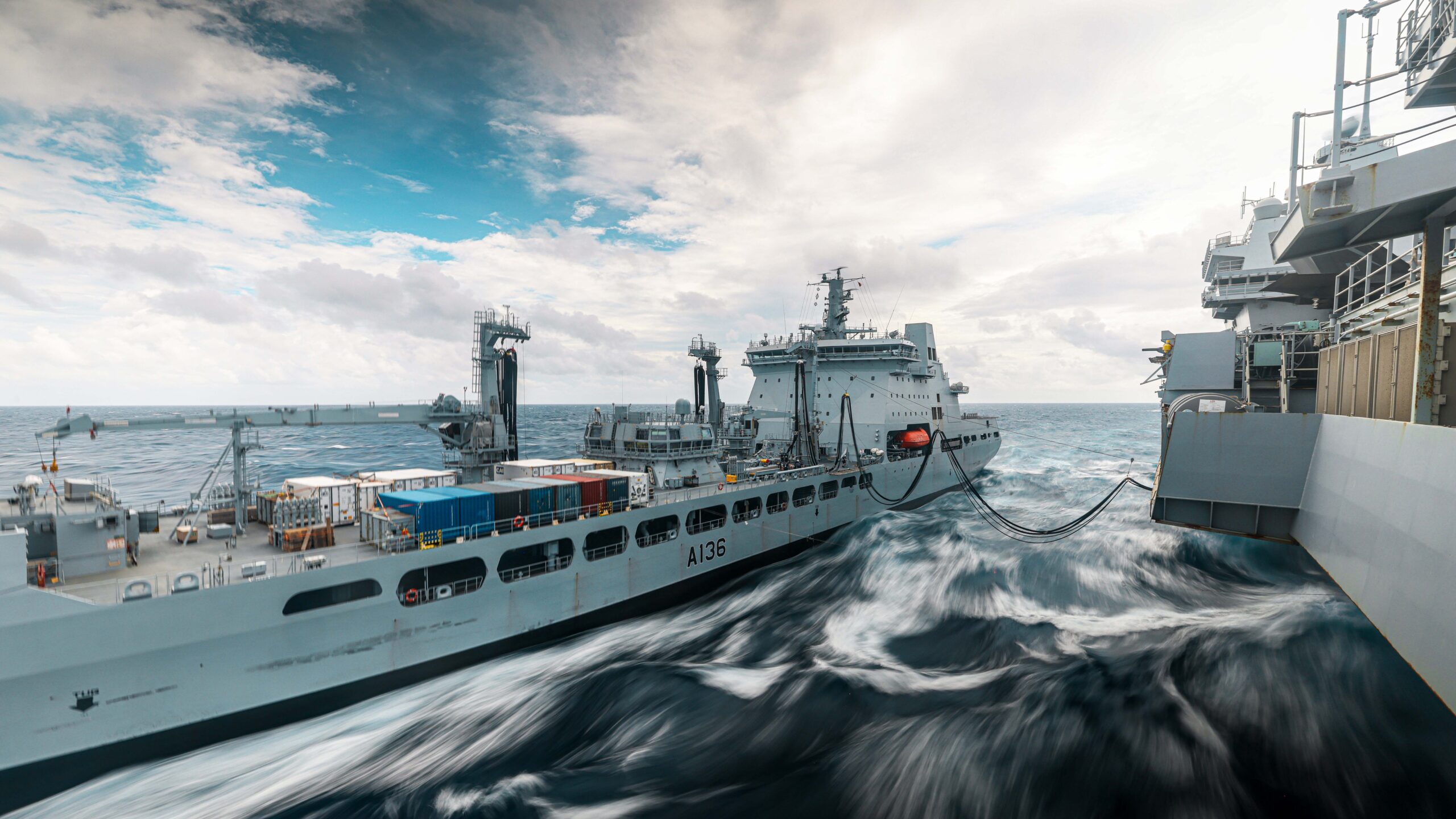
The UKCSG consists of the carrier Prince of Wales, RN destroyer HMS Dauntless (D33), RN frigate HMS Richmond (F239), Royal Canadian Navy frigate HMCS Ville De Quebec (FFH332), Royal New Zealand Navy frigate HMNZS Te Kaha (F77), Royal Norwegian Navy frigate HNoMS Roald Amundsen (F311), Spanish Navy frigate ESPS Mendez Nunez (F-104) and fleet oiler RFA Tidespring (A136). Richmond and Mendez Nunez are now in Jakarta on a port visit while Ville De Quebec is at Port Klang, Malaysia for a port visit with the rest of the UKCSG in Singapore. Royal Australian Navy destroyer HMAS Sydney (DDG42) will join the CSG as it departs Singapore on Sunday along with the other detached escorts rejoining the CSG. Then the group will head to Australia to participate in the U.S.-Australian-led multilateral exercise Talisman Sabre from July 13 – Aug.4.
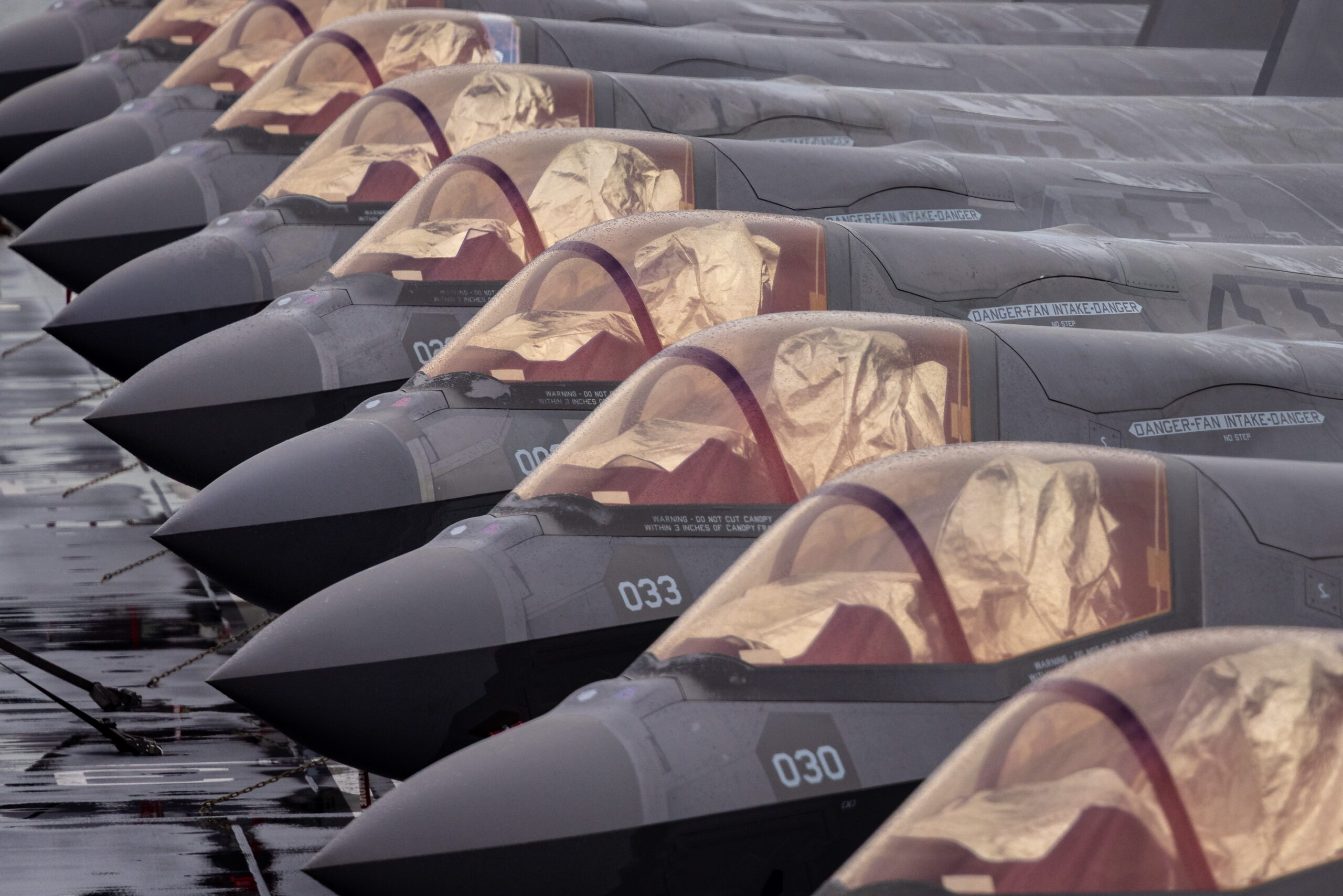
“This will develop some of the key evidence towards our capability development of the Carrier Strike Group. It’s heavily focused on our fifth-generation F-35Bs,” said Blackmore.
Capt. Will Blackett, commanding officer of Prince of Wales, stated that a key point that separates navies is the ability to deploy anywhere globally.
“Anyone can do this in their backyard but being able to be truly global means being able to bring all that complexity to the other side of the planet, which is why Talisman Sabre is an additional challenge, as we had to go all that way to get there, and still maintain our capability, which I’m confident we can do,” said Blackett.
Capt. Colin McGannity, Commander Air Group, said that one of the Talisman Sabre objectives is to launch eight F-35Bs Lightning IIs at a single time along with other unspecified high-end activities. McGannity also said the UKCSG’s F-35Bs will also link up with the aircraft of other nations participating in the exercise, “So it is certainly not a sort of sovereign U.K. endeavour of eight of our jets going in and exercising. We’re expecting to see some really big large force packages where they are working together to achieve their training objectives,” he said.
The UKCSG’s carrier air wing is comprised of seven squadrons, totalling 750 personnel with two F-35B squadrons – the “Dambusters” of RAF Squadron 617 and the “Phoenix” of Naval Air Squadron 809 – with a total of 18 F-35Bs currently embarked. The number is set to grow to 24 when the UKCSG returns to the Mediterranean. The carrier air wing also has 16 helicopters, including Merlin Mk 2 Anti-Submarine warfare (ASW) and Merlin Mk. 2 ASaC helicopters of 820 Naval Air Squadron embarked on Prince of Wales, Merlin Mk 2 ASW helicopters of 814 Naval Air Squadron on escort ships, Wildcat maritime attack helicopters of 815 Naval Air Squadron on both Prince of Wales and the escorts and Commando Merlin HC4 assault helicopters of the Commando Helicopter Force on Prince of Wales. Rounding out the air wing are the Malloy and Puma unmanned air vehicles of Naval Air Squadron 700X.
Currently, the F-35B complement is short one aircraft because an F-35B diverted to Thiruvananthapuram airport, India, due to bad weather on June 14. The plane subsequently developed a technical fault and was stranded there. McGannity stated that the aircraft was one of three airborne at the same time that night. The other two aircraft made it back.
“I’m really proud that the team that made the decision decided that the best thing to do was to put it ashore in India,” he said. After landing, it was determined the aircraft required maintenance to return it to operational status. McGannity stated the plane’s fate would depend on the technical team’s assessment, “I think for the moment, there are 17 plans on what could happen,” he quipped, adding that he was keen for the aircraft to rejoin the carrier.
Following Talisman Sabre and a port visit to Darwin, the UKCSG sails to Japan and South Korea for its next phase of operations.
“We’ll be working closely with the U.S. Navy, in particular,” he said, “and it’s where we’ll start to see many of the other strike groups come together, in particular the United States strike groups there but also some of the Japanese strike groups as well.”
When the Nimitz CSG departed for the Middle East, it left the George Washington CSG as the sole CSG in the region. Blackmore said that UKCSG would integrate with other U.S. strike groups in the Indo-Pacific region and the UKCSG would integrate with them along with Japan Maritime Self-Defense Force destroyer carrier JS Kaga (DDH-184). “In that respect, [I have] no concerns whatsoever,” said Blackmore.
He said that the UKCSG would integrate with F-35Bs of Marine Fighter Attack Squadron (VMFA) 242 ‘Bats.’ VMFA-242 conducted the first F-35B launches and landings for a JMSDF ship, deploying on destroyer carrier JS Izumo (DDH-183) in October 2021. Japan will receive its first F-35Bs at the end of the year, so the UK F-35Bs may have to conduct cross-deck landings and launches on Kaga as part of the JMSDF’s preparation for its own F-35B operations.
The UKCSG will carry out a maintenance and rest period in Japan before sailing back to Singapore to carry out the fifth phase of its deployment, taking part in the Five Power Defence Arrangements (FPDA) Bersama Lima exercise in September. FPDA member countries include Australia, Malaysia, New Zealand, Singapore and the U.K.. After Bersama Lima, Blackmore said the group will make a port visit to Singapore and then sail on to India for a series of exercises and a port visit to Mumbai.
The UKCSG will then sail through the Middle East and in the Mediterranean where it will carry out Exercise Falcon Strike, “Where we will be able to deliver the full operating capability back into the U.K. government,” said Blackmore.
Blackmore said he expected to encounter Chinese military and coastguard vessels given that the UKCSG would be operating in international sea and air spaces., “ I expect perhaps China comes and take a look at what we do, said Blackmore. “In fact, why wouldn’t they? They’ll be interested in the way we operate. We are a highly capable, well-trained task group. We’ll be operating in the Indo-Pacific. We’ll be operating in international waters, undertaking exercises with partners and allies, so I fully expect [an encounter], but I also know it will be safe and professional throughout in the way that we operate in the maritime environment.”
Discover more from JCs Royal New Zealand Navy Ships and New Zealand Defence, Also other World Defence Updates
Subscribe to get the latest posts sent to your email.

