New Zealand’s largest Navy logistics ship joins PH, US, Australia in WPS exercise

Story by JP SORIANO, GMA Integrated News

New Zealand’s largest naval logistics vessel the HMNZS Aotearoa, which docked at the Port of Manila on Friday and departed Monday, was among the ships that took part in the 12th Multilateral Maritime Cooperative Activity (MMCA) in the West Philippine Sea, its commanding officer has confirmed.

more

Commander Rob Welford said the Aotearoa’s participation in the MMCA included joint maneuvers with ships from the Philippines, the United States, and Australia.

“We took part in another multinational maritime cooperative activity. So we’ve actually already done another one this visit before we came in yesterday with the Philippine Navy ship Jose Rizal,” Welford told GMA Integrated News.

He added that their exercises with the Armed Forces of the Philippines (AFP) were focused on humanitarian assistance and disaster response, areas where New Zealand’s navy has extensive experience.

“The Jose Rizal and an American ship, USS Fitzgerald, and an Australian ship, HMAS Ballarat. We met up in the morning at first light,” he said.

The AFP earlier confirmed that the MMCA was conducted in partnership with the United States, Australia, and New Zealand as part of broader efforts to uphold international law and promote peace and stability in the region.

call to action icon
more

“This latest exercise reflects the four nations’ commitment to strengthening maritime cooperation, enhancing interoperability, and championing a rules-based international order in the Indo-Pacific,” the AFP said in a statement.

The goodwill visit of HMNZS Aotearoa comes six months after the Philippines and New Zealand signed the Status of Visiting Forces Agreement (SOVFA)—a defense pact enabling both countries to hold more joint military activities and exchanges.

GMA Integrated News was among the few media organizations invited aboard t. The ship can carry up to 10 million liters of fuel and produce potable water from seawater through reverse osmosis purification, allowing it to assist nations affected by natural disasters.

The Aotearoa serves primarily as a replenishment vessel capable of refueling and resupplying allied warships.ds

ds

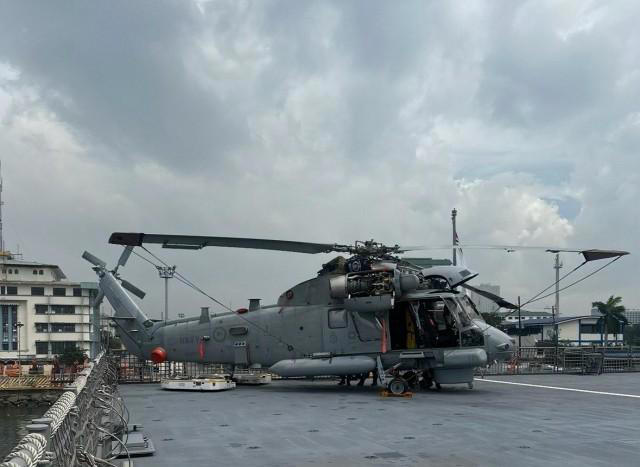
A C-Sprite helicopter used for evacuation and search and rescue operations sits on the Aotearoa’s flight deck.

“The one thing we can really offer the Philippines is practice in training in replenishment at sea—that is our primary mission,” Welford said.

Ad

Seniors Life Insurance

Seniors Life Insurance

call to action icon
more

“New Zealand urges all parties to abide by international rules and norms, including UNCLOS the UN Convention on the Law of the Sea,” she said.

HMNZS Aotearoa previously joined similar multilateral maritime activities in 2023 with the Philippines and allied nations in the West Philippine Sea. China had earlier criticized such cooperative exercises, claiming they do not help resolve disputes in the South China Sea.

Welford, however, maintained that New Zealand’s deployment serves a clear purpose.

“This part of the world is extremely important to New Zealand. We’ve got our friends here, and we’re going to operate with them,” he said.

“ If someone else feels that’s provocative, I would say that’s up to them,” he added. — BM, GMA Integrated News

This article New Zealand’s largest Navy logistics ship joins PH, US, Australia in WPS exercise was originally published in GMA News Online.

Sponsored

chrome view card

Sponsored

Sponsored Content

Flying over the headquarters of the New Zealand navy and the dominion air force at Auckland – 1932-09-28

Left: The Fairy III. F. Air Force machine above the Hobsonville Air Base. The landing field for land machines has a white circle marking its centre. Right: Above the Devonport Naval Base, the headquarters of the New Zealand Division of the Royal Navy. In the foreground the cruisers Diomede and Dunedin are berthed together. behind them are the sloops Veronica and Laburnum, while further back H.M.S. Philomel and the mine-sweeper Wakakura can be seen. The cable steamer Recorder is also in the distant background.

Date of Image1932-09-28

Arrival of HMNZS Otago, Devonport Naval Base, 1961

Crowds gathered at Devonport Naval Base (HMNZS Philomel) for the arrival of HMNZS Otago (F111), the Royal New Zealand Navy’s new Whitby-class anti-submarine frigate.
Date of Image 1961-01-27

Việt Nam, New Zealand navies hold maritime drill off HCM City

October 27, 2025 – 20:49

The two sides carried out a series of coordinated operations, including formation maneuvering, at-sea salute procedures, information exchange, and training in international signal communication, alongside following the Code for Unplanned Encounters at Sea.

HCM CITY — The Vietnamese Navy’s Vessel 379 from Brigade 167 of Naval Region 2 conducted a joint drill with the Royal New Zealand Navy’s largest support vessel HMNZS Aotearoa in waters southeast of HCM City on Monday.

The Vietnamese vessel was led by Sen. Lieut. Col. Phạm Văn Phương, Deputy Brigade Commander and Chief of Staff of Brigade 167, while the guest side was captained by Lieut. Col. Robert Welford, with a crew of 109 sailors.

The two sides carried out a series of coordinated operations, including formation maneuvering, at-sea salute procedures, information exchange, and training in international signal communication, alongside following the Code for Unplanned Encounters at Sea (CUES). All operations adhered closely to a pre-agreed plan.

Earlier from October 23 to 27, HMNZS Aotearoa made a courtesy port call at Nhà Rồng Wharf in HCM City, where its crew engaged in exchange and goodwill activities with representatives from Việt Nam’s Naval Region 2 Command. Brigade 167 also sent a working group aboard HMNZS Aotearoa to finalise the joint exercise plan and share expertise in logistics and technical operations.

Phương said the drill helped bolster Vietnamese naval officers and soldiers’ foreign language skills, ship-handling capabilities, collision-avoidance techniques, and readiness for unexpected maritime encounters. It also supported proficiency in signal flags, semaphore, and international maritime communications, while raising knowledge about maritime safety and improving coordination, thus fostering mutual understanding, trust, and cooperation between the Việt Nam People’s Navy and the Royal New Zealand Navy.

He added that the exercise showcased the professionalism and competence of Brigade 167 personnel, contributing to the continued enhancement of friendship, cooperation, and development for the sake of peace, stability, security, and safety at sea. — VNA/VNS

New Zealand Navy and Babcock reactivate offshore patrol vessel Otago for early 2026 return.


Babcock and the Royal New Zealand Navy have started reactivation work on HMNZS Otago at Devonport, forming an integrated team to overhaul engines, replace obsolete systems, and upgrade navigation, sensors, and controls. The OPV is slated to rejoin the fleet in early 2026, improving New Zealand’s maritime presence and law enforcement capacity across the South Pacific.

Babcock and the New Zealand Defence Force say HMNZS Otago’s regeneration is underway at the company’s Devonport facility, where Babcock serves as Strategic Maritime Partner to the NZDF. The scope includes heavy maintenance on propulsion and power generation, plus modernisation of navigation, sensors, and control automation, with handback to NZDF targeted for early 2026. Officials describe an integrated RNZN industry team on the project, a model used across the fleet to lift availability in the Pacific region. Follow Army Recognition on Google News at this link

Otago is an 85 metre offshore patrol vessel of roughly 1,900 tonnes, configured for Exclusive Economic Zone (EEZ) surveillance and at sea law enforcement tasks. (Picture source: Zew Zealand Navy)Ezoic


Otago is an 85 metre offshore patrol vessel of roughly 1,900 tonnes, configured for Exclusive Economic Zone (EEZ) surveillance and at sea law enforcement tasks. Propulsion relies on two MAN B&W 12RK280 diesel engines, providing a maximum speed of about 22 knots and a range close to 6,000 nautical miles. The primary armament is a stabilized Rafael Typhoon 25 mm naval gun, remotely controlled from the bridge, supplemented by small arms for boarding teams. Aviation facilities support a Kaman SH 2G(I) Super Seasprite helicopter for surveillance, winching, and logistics, which is useful when sea state limits the use of small craft.

Within RNZN service, the Offshore Patrol Vessel (OPV) combines endurance, fuel economy, and useful deck volume for multi-agency operations. Otago carries two rigid hull inflatable boats for inspections and has a flight deck sized for the Seasprite, which helps extend the Recognised Maritime Picture/Common Operating Picture (RMP/COP) by embarking liaison officers from fisheries, customs, police, and conservation. Coordination with maritime patrol aviation assets, which cue interceptions, further strengthens the system. When required, crews apply Electromagnetic Emissions Control (EMCON) to reduce detectability and limit the information signature in contested environments.

The decision to reactivate Otago follows an extended period in care and custody and addresses the need to stabilise offshore unit availability while training and maintenance cycles weigh on a fleet with constrained manpower. In recent weeks, Babcock and the RNZN have launched a work package that combines heavy overhaul of engines and generators, replacement of obsolete systems, and modernisation of navigation, sensors, and control automation. The aim is not only to restore baseline performance but also to improve reliability, increasing mean time between failures and reducing corrective maintenance at sea. For a small navy, each completed package matters, since it frees time for training and returns sea days to operational planning.

Otago’s return adds depth to demanding theatres. The South Pacific imposes long transits, sparse infrastructure, and variable weather. A hull with a 6,000 nautical mile range and a usable flight deck enables sustained patrols near the sub-Antarctic islands and rapid presence after cyclones, where seaworthiness, endurance and lift capacity shape outcomes. The boarding fit, the stabilized 25 mm gun and the embarkation of civilian agencies suit maritime law enforcement, from illegal, unreported, and unregulated fishing to search and rescue. By bringing the OPV back into the rotation, the RNZN can rebalance tasking among inshore patrol vessels, Anzac class frigates, and the fleet tanker Aotearoa, restoring margin for training, maintenance, and interoperability within regional partnerships.

The Devonport ecosystem is central for New Zealand’s Defence Industrial and Technological Base (BITD). Babcock’s role as Strategic Maritime Partner formalises asset management, project planning and production support delivered with mixed teams of RNZN personnel and NZDF civilians. The Otago reactivation fits this framework, including replacement of life expired equipment, refurbishment of the propulsion train and renewal of navigation and control systems. Over the platform life cycle, these choices translate into shorter maintenance periods, better controlled downtime and a faster return to sea, outcomes that, taken together, improve fleet effectiveness.

New Zealand does not seek power projection, yet it borders vital sea lines of communication, island groups exposed to natural disasters and an information space shaped by great power competition and climate effects. A reliable OPV broadens presence options with partners and supports interoperability, from common procedures to data exchanges that feed the RMP/COP. The signal is continuity, with Wellington investing to maintain a credible constabulary profile at sea while force structure decisions proceed. In the Indo-Pacific policy debate, this steady approach matters because transparent surveillance, routine patrols,and predictable humanitarian response form the fabric of a durable maritime order. Reactivating Otago is less an announcement than the restoration of a regional security tool that delivers daily effects.


JCs Royal New Zealand Navy Ships and New Zealand Defence, Also other World Defence Updates

Ships and Defence News Past and Present

Skip to content ↓