HMNZS Aotearoa first trip to her home port of Taranaki
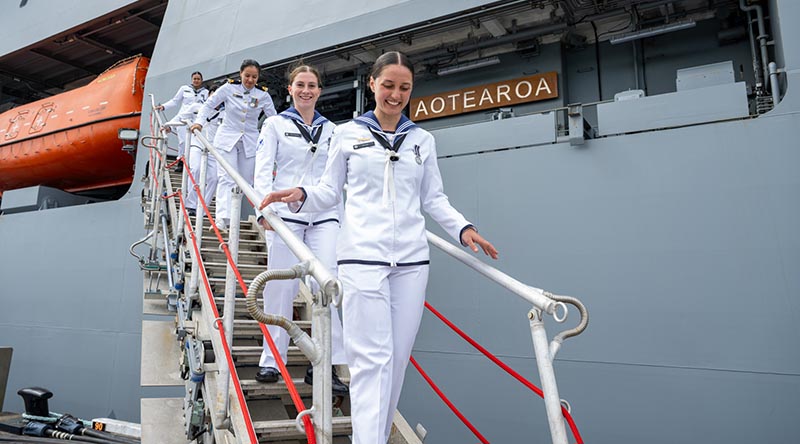
The Royal New Zealand Navy’s logistics ship HMNZS Aotearoa, commanded by Commander Rob Welford, docked at Nha Rong-Khanh Hoi International Port on Thursday, beginning a five-day friendly visit to Ho Chi Minh City to mark the 50th anniversary of diplomatic relations between Vietnam and New Zealand.
The Ho Chi Minh City Border Guard Command welcomes the crew at Nha Rong–Khanh Hoi International Port. (Photo: Luu Son/VOV in HCMC)
The two countries have recently agreed to upgrade their relationship to a Comprehensive Strategic Partnership, effective from February 2025.
The visit demonstrates the strong commitment of both nations to fostering mutual understanding and friendship, including through defense cooperation.
Representatives of the two crews pose a group photo. (Photo: Luu Son/VOV in HCMC)
During the stay, the ship’s officers are scheduled to pay courtesy calls on leaders of the municipal People’s Committee, Military Zone 7 Command, and Naval Region 2 Command.
The crew will also participate in cultural and sports exchanges, visit local landmarks, and conduct a joint exercise on the Code for Unplanned Encounters at Sea (CUES) with the Vietnam People’s Navy.
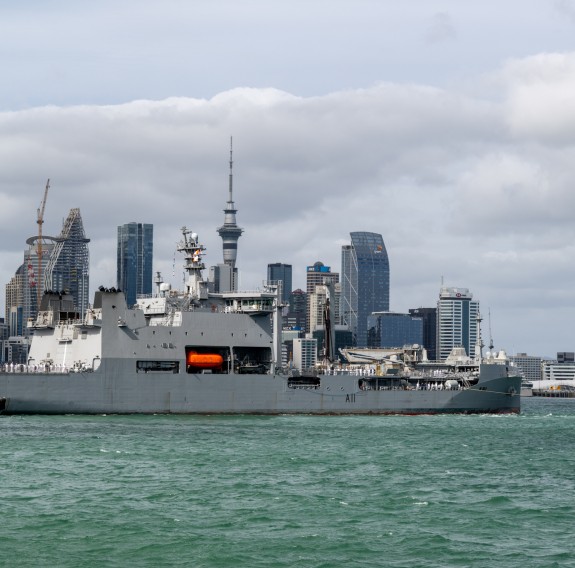
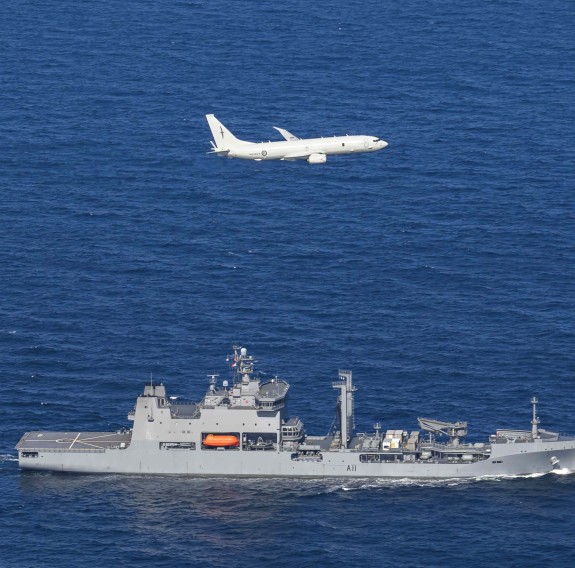
HMNZS Aotearoa, measuring 173.2 metres in length and 24.5 metres in width with a displacement of 26,000 tons, is the largest tanker and replenishment vessel of the Royal New Zealand Navy.
In addition to providing logistical support for naval operations, the ship is designed to carry out humanitarian assistance and disaster relief missions.
This marks the second visit by HMNZS Aotearoa to Ho Chi Minh City in three years, following a joint visit in 2023 alongside the frigate HMNZS Te Mana.
The New Zealand Defence Force will shortly deploy air and naval assets to support United Nations monitoring of North Korea as it also conducts operations, training and engagements with partners while in the region.
22 October, 2025
The NZDF regularly deploys assets and personnel throughout the Indo-Pacific as part of New Zealand’s commitment to supporting a secure and prosperous region.
A Royal New Zealand Air Force P-8A Poseidon will this month participate for the first time in a Japanese Maritime Self-Defense Force-led Annual Exercise. The tactical exercise, involving anti-submarine and anti-surface warfare, is a multilateral exercise involving Japan, the United States, Australia, Canada, France and New Zealand.
It takes place around Japan and will involve about 20 vessels and 20 aircraft.
Air Component Commander Air Commodore Andy Scott said the exercise was “a fantastic opportunity to train with partners in the region, demonstrate interoperability, build on our relationships, and strengthen cooperation between our forces”.
Following the exercise, the Poseidon and personnel will continue to be based in Japan to contribute to operations detecting and deterring evasions of United Nations Security Council (UNSC) sanctions resolutions on North Korea.
The sanctions are intended to persuade North Korea to denuclearise and abandon its ballistic missile weapons capabilities.
Patrols, over international waters, look for violations of the sanctions resolutions including illicit ship-to-ship transfers of banned goods such as oil and coal.
For the second year, Royal New Zealand Navy sustainment vessel HMNZS Aotearoa will also contribute to the UNSC efforts.
After time in Singapore and fresh from the Five Power Defence Arrangements’ Exercise Bersama Lima, HMNZS Aotearoa, with an embarked Seasprite helicopter, has been readying for its contribution to UNSC monitoring.
A Royal New Zealand Air Force P-8A Poseidon (file photo)
Last year, the ship located four vessels of interest, questioned 62 vessels and broadcast 52 deterrent messages. It also conducted nine operational replenishments at sea to allow partner nations’ warships to stay at sea longer and increase the effectiveness of the overall effort.
Commanding Officer, Commander Rob Welford, said the ship would again conduct surveillance patrols and reporting as well as replenishments of partner nation vessels, operating in the region.
“Last year, there was considerable interest shown by Chinese Peoples’ Liberation Navy ships and we also saw Russian Federation Navy vessels as well. And then on top of that there’s the unpredictability of the country we’re enforcing sanctions on,” he said.
“Supporting the international rules-based order is a very real statement when you’re on the water up here doing the mahi.”
“I know I can talk on behalf of everybody aboard the ship when I say we’re looking forward to playing our part again,” he said.
The ship will also conduct official visits to Vietnam and the Philippines while in the region.
New Zealand contributes to the Pacific Security Maritime Exchange, a multinational coalition formed in 2018 to monitor UNSC sanctions. The NZDF has been deploying its long-range maritime patrol aircraft to conduct UNSC monitoring missions since then.
Computer rendering of the New FFM. Note the new mast and bridge configuration and the added VLS. Japanese MoD image.
On October 20, Royal New Zealand Navy (RNZN) Chief of Navy Rear Admiral Garin Golding met with Japan’s Defense Minister Gen Nakatani and conveyed Wellington’s interest in introducing the upgraded version of the Japan Maritime Self-Defense Force’s Mogami-class frigate, known as New FFM, according to Japanese media reports. In response, Nakatani expressed his appreciation, according to Kyodo News.
Golding voiced concern over China’s growing maritime assertiveness and underscored the need for closer cooperation with Japan, the Japanese news agency reported. Nakatani, for his part, described New Zealand as “a highly important partner” and expressed his intention to further deepen defense cooperation.
Australia plans to acquire 11 new general purpose frigates. The first three ships will be built in Japan, with the first to be delivered to the Royal Australian Navy (RAN) in 2029 and enter service in 2030. The remaining eight will be built at Henderson shipyard in Western Australia.
DM Nakatani received a courtesy call from RADM Golding, Chief of Royal NZ Navy, and CDRE Scott, Air Component Commander on Oct 20 and welcomed the progress of defense cooperation such as bilateral exercise. (Japanese MoD picture)
Meanwhile, the Royal New Zealand Navy currently operates two ANZAC-class frigates commissioned also in the 1990s and plans to introduce new frigates to replace them.
Australia and New Zealand are military allies under the Australia, New Zealand and United States Security Treaty, or ANZUS Treaty, which was signed in 1951 to protect the security of the Pacific. Thus, in terms of a high level of interoperability between the two Oceanian navies, it should be quite natural for New Zealand Navy to express its interest in Japan’s upgraded Mogami-class frigate as well.
On June 18, 2024, New Zealand Prime Minister Christopher Luxon already visited the Yokosuka Base of the Japan Maritime Self-Defense Force with then Japanese State Minister of Defense Makoto Oniki and inspected the interior of JS Kumano, the second ship of the MOGAMI class frigate, thus showing strong interest.
The leaders of the two countries have agreed that strengthening cooperation in the Indo-Pacific region on a bilateral basis, which share fundamental values, is important for realizing a free and open Indo-Pacific.
For Japan’s government and defense industry, securing even a small number of orders for the new FFM from New Zealand would not only strengthen security and economic cooperation between the two countries, but also help reinforce Japan’s defense industrial base by boosting its record of overseas exports.
Welding, bolting and construction – it gets a lot more complex when it’s underwater.
20 October, 2025
A team of 11 divers from HMNZS Matataua have just returned from a two-week training exercise in Guam, tackling underwater construction tasks alongside US Navy and Republic of Korea divers.
Exercise Mureng (Multinational Underwater Repair Engagement) is designed to test and improve the interoperability and skills of military divers and underwater construction teams.
Officer in Charge, Lieutenant John Duncan, says military divers are trained in welding, and an overseas exercise with partners provides an excellent opportunity to demonstrate their skills.
The exercise involved real time pier maintenance tasks. The teams undertook inspections on the main fueling pier at Naval Base Guam, using a marine growth removal tool called a “barnacle buster” to remove built-up encrustation.
A weightier task involved welding and bolting replacement zinc anodes to the pier, at 1.6 metres in length and weighing 60kg. Metals in saltwater are naturally electrically reactive and will corrode, so zinc blocks – a far more reactive metal than the pier fittings – are used as a more attractive ‘sacrifice’ to prevent other metals being eaten away.
The team undertook buoy inspections, following the chain down from buoy to the mooring on the sea floor and checking for wear and tear.
Divers equipped with surface-supplied breathing apparatus undertake engineering tasks on a fuelling pier in Guam.
While it sounds more like custodial maintenance, the tasks provide training in two kinds of diving: scuba for mooring inspections and ‘surface-supplied’ diving for tasks involving concentrated engineering and hydraulic tool tasks.
Outside of these tasks, the team also had the opportunity to test their maritime explosive ordnance disposal expertise by participating in a US Navy-led underwater demolition exercise.
Lieutenant Duncan says wharf infrastructure maintenance and repair are core skillsets for Matataua’s clearance divers.
“These tasks are conducted in a similar way as they would be on the surface however, when overlaid with diving they become inherently more complex and require particular attention to detail to ensure they are completed safely to achieve the desired effect,” he says.
“It’s a capability we train for, but it’s not something we routinely get to practise in New Zealand. So this exercise provided an amazing opportunity to train with our partners and further develop some of the many skills required of a clearance diver.”