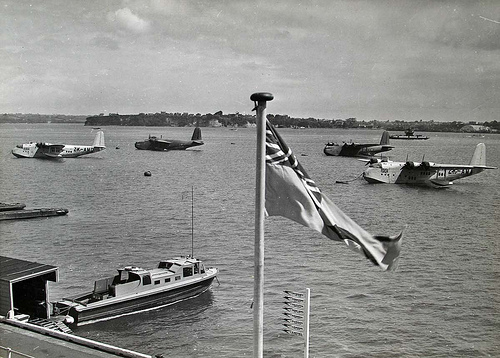
The aircraft were operated by the Royal New Zealand Air Force (RNZAF) and later by the New Zealand National Airways Corporation for transport and passenger services.
The Short Sunderland was a military long-range maritime reconnaissance flying boat widely used during the Second World War.
The Short Sandringham was a civilian version of the military Sunderland.
The aircraft operated from bases including Hobsonville, Auckland, and Lauthala Bay, Fiji, from the 1940s to the 1960s.
One of the remaining Sunderlands is now a significant artifact of New Zealand’s aviation history.
Help Restore the Sunderland V NZ4115 – GivealittleThe Sunderland V is an artefact of national and international significance and is part of New Zealand’s Military Aviation History.Givealittle
Short Sunderland in New Zealand service – WikipediaThe Short Sunderland was developed as a long range maritime reconnaissance flying boat and was widely used during the Second World…Wikipedia
Wings of desire | New Zealand GeographicIt was the Sandringham, a civilian version of the military Sunderlands used by the RNZAF and by 1947 already, in the puffery of Sh…New Zealand Geographic
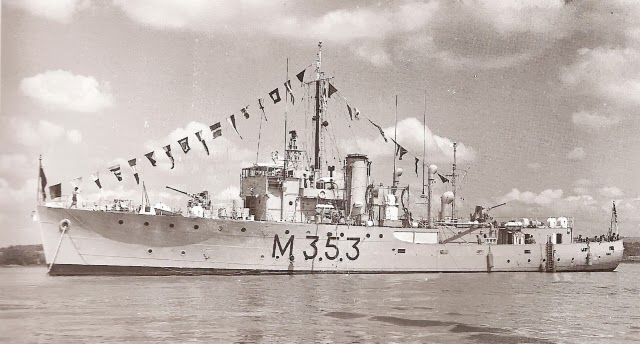
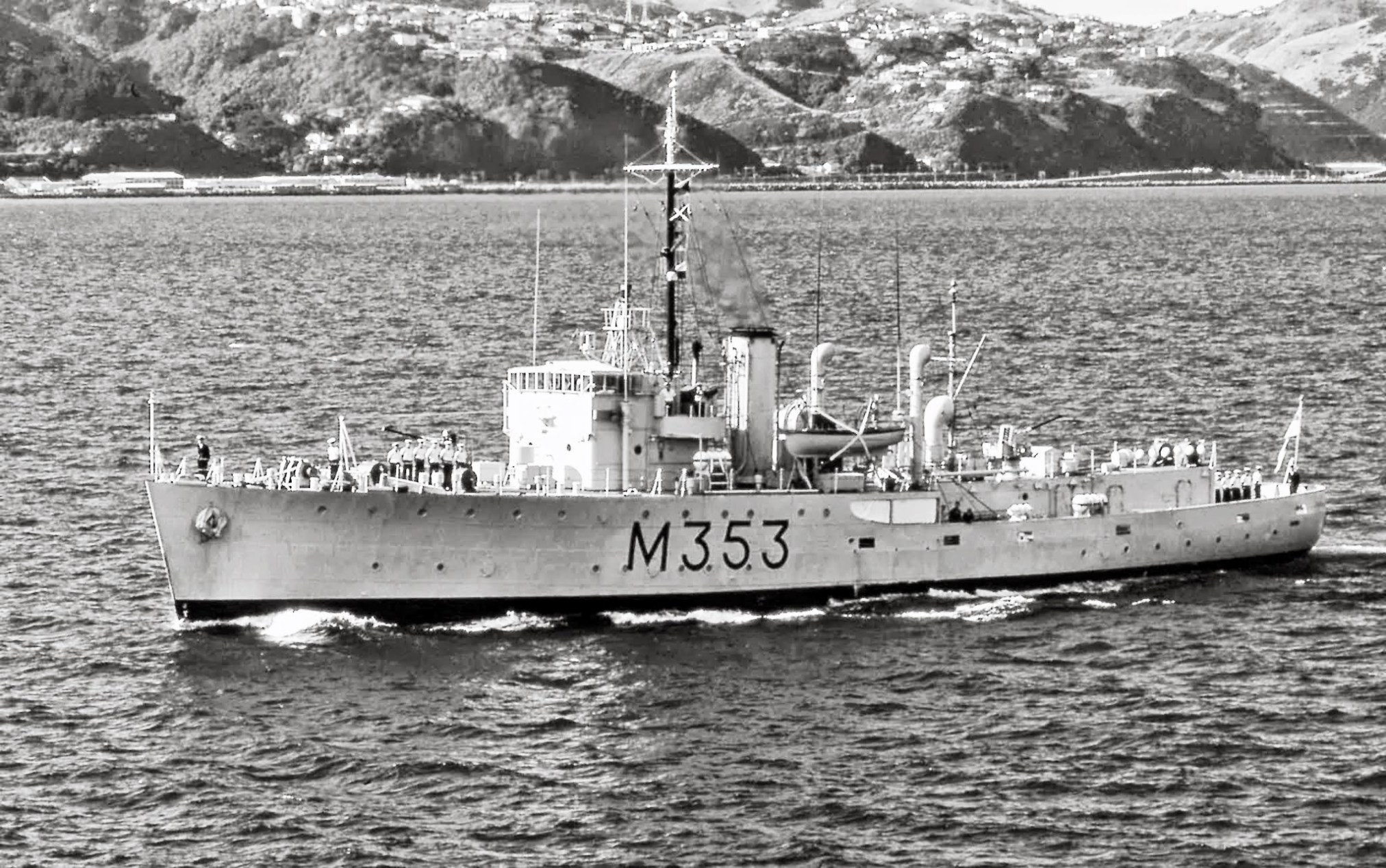
HMNZS KiamaHMNZS KiamaHMNZS KiamaHMNZS Kiama in 1944 as HMAS Kiama
HMAS Kiama, named for the coastal town of Kiama, New South Wales, was one of 60 Bathurst-class corvettes constructed during World War II, and one of 36 initially manned and commissioned solely by the Royal Australian Navy (RAN).[1]
After World War II, the corvette was one of four sold to the Royal New Zealand Navy (RNZN). She served as HMNZS Kiama from 1952 until 1976, when the corvette was paid off and marked for disposal.
Design and construction Main article: Bathurst-class corvette In 1938, the Australian Commonwealth Naval Board (ACNB) identified the need for a general purpose ‘local defence vessel’ capable of both anti-submarine and mine-warfare duties, while easy to construct and operate.[2][3] The vessel was initially envisaged as having a displacement of approximately 500 tons, a speed of at least 10 knots (19 km/h; 12 mph), and a range of 2,000 nautical miles (3,700 km; 2,300 mi)[4] The opportunity to build a prototype in the place of a cancelled Bar-class boom defence vessel saw the proposed design increased to a 680-ton vessel, with a 15.5 knots (28.7 km/h; 17.8 mph) top speed, and a range of 2,850 nautical miles (5,280 km; 3,280 mi), armed with a 4-inch gun, equipped with asdic, and able to fitted with either depth charges or minesweeping equipment depending on the planned operations: although closer in size to a sloop than a local defence vessel, the resulting increased capabilities were accepted due to advantages over British-designed mine warfare and anti-submarine vessels.[2][5] Construction of the prototype HMAS Kangaroo did not go ahead, but the plans were retained.[6] The need for locally built ‘all-rounder’ vessels at the start of World War II saw the “Australian Minesweepers” (designated as such to hide their anti-submarine capability, but popularly referred to as “corvettes”) approved in September 1939, with 60 constructed during the course of the war: 36 (including Kiama) ordered by the RAN, 20 ordered by the British Admiralty but manned and commissioned as RAN vessels, and 4 for the Royal Indian Navy.[2][7][8][9][1]
Kiama was constructed by Evans Deakin & Co, at Brisbane, Queensland.[1] She was laid down on 2 November 1942, and launched on 3 July 1943 by Mrs. G. Lawson, wife of the Minister for Transport.[1] Kiama was commissioned into the RAN on 26 January 1944.[1] The coastal community of Kiama, after which the vessel was named, donated recreational materiel for her crew including a radio set, books, and a 16 mm movie projector.[10][11]
Operational history World War II Kiama’s first deployment was in March 1944 to Milne Bay in New Guinea.[1] From her arrival until September 1944, the corvette’s main duty was to escort convoys along the New Guinea coastline, although a reassignment for the duration of June saw Kiama perform anti-submarine patrols in the Solomon Sea.[1] In September, Kiama was used to transport soldiers between New Guinea and New Britain.[1] On conclusion, she resumed her convoy escort role until the end of 1944, when she departed for Sydney.[1] During her eight months in New Guinea waters, Kiama travelled over 30,000 nautical miles (56,000 km), was at sea for more than 3,000 hours.[1]
In September 1944 ‘C’ Troop and a small detachment from ‘B’ Troop, from the 2/8th Commando Squadron were landed from HMAS Kiama on a reconnaissance operation at Jacquinot Bay on the island of New Britain, to collect intelligence in preparation for an assault by the 5th Division.[12]
The corvette arrived in Sydney on 21 December 1944.[1] On 25 December, the crew was recalled from leave to go to the assistance of the liberty ship SS Robert J. Walker, which had been torpedoed by German submarine U-862.[1] Kiama, along with Quickmatch, Yandra, and USS PC597 were dispatched to the last known location of the ship and began to search the area for the liberty ship’s crew and the attacking submarine; finding the 67 survivors of the attack at 05:45 on 26 December but failing to locate U-862.[13] Kiama was assigned to anti-submarine patrols near Sydney for the final days of the year, before sailing to Adelaide for a month-long refit on 3 January 1945.[1]
Post-refit, Kiama was assigned to Fremantle for two months of anti-submarine warfare exercises with the United States Navy, before returning to New Guinea on 7 May 1945.[1] In May and June, the corvette performed several coastal bombardments in the Bougainville area.[1] In July, Kiama transported Prince Henry, Duke of Gloucester from New Guinea to the Solomon Islands, then spent the rest of the month moving troops and military cargo between these two locations.[1] From 5 to 24 August, the corvette was based in Brisbane, before returning to New Guinea waters.[1] Kiama spent the rest of 1945 as a troop and supply transport, minesweeper, and general duties vessel.[1] When the war ended, Kiama took part in the Japanese surrender at Rabaul.[14] In November, Kiama was assigned to escort demilitarized Japanese cruiser Kashima as the cruiser embarked Japanese soldiers in New Guinea for repatriation.[15]
Kiama returned to Sydney on 29 January 1946.[1] In February she paid a six-day farewell visit to the town of Kiama, ahead of her decommission into the Reserve on 3 April.[1][16] During her wartime service, the ship had been at sea for 6,369 hours, and had sailed a distance of 60,822 nautical miles (112,642 km).[1] She earned two battle honours: “Pacific 1944–45” and “New Guinea 1944”.[17][18]
Transfer to RNZN On 5 March 1952, Kiama and three other Bathurst-class corvettes (Echuca, Inverell, and Stawell) were transferred to the Royal New Zealand Navy.[19] Kiama was commissioned into the RNZN,[when?] receiving the prefix HMNZS. Upon acquisition by New Zealand, the corvette was converted into a training ship.[20] Kiama’s 4-inch gun and aft minesweeping equipment were removed, and replaced with two 40 mm Bofors anti-aircraft guns.[20] This is contradicted by a 1996 newspaper article which said it had been mothballed by the New Zealand Navy and converted to a training ship and for use on fisheries patrols in 1966.[21]
In 1966, Kiama was re-commissioned under command of Lieutenant-Commander E Burrows in the 27th Fisheries Protection Squadron to join her sister ship HMNZS Inverell.[22][23] Other duties included search-and-rescue operations and transportation of scientific teams to small island along New Zealand’s coastline.[24][25]
In May 1966 the Kiama was involved in the search for the Kaitawa which was lost with all hands near 90 mile beach.[26] Apart from the initial search, the Kiama formed part of Operation Seabed, along with the Inverell and the frigate Taranaki.[27]
The corvette revisited her namesake town in Australia in late 1966.[28]
RNZN Commanders 1966 Lt Commander E Burrows 1967 Lt-commander M C Verran 1968 Lt-Commander L J Tempero[29] 1970 Lt-Commander F D Arnott[30] 1971 Lt-Commander D L Douglas[31] 1973 Lt Commander N Cameron[32] Fate On 27 May 1968 the Chief of Naval Staff, Rear Admiral J O Ross, described the Kiama and Inverell as obsolete and no longer fit for purpose.[33] The Kiama remained in service until 1975 when it was placed in reserve. The ship was paid off for disposal on 19 August 1976 and broken up in 1979.[
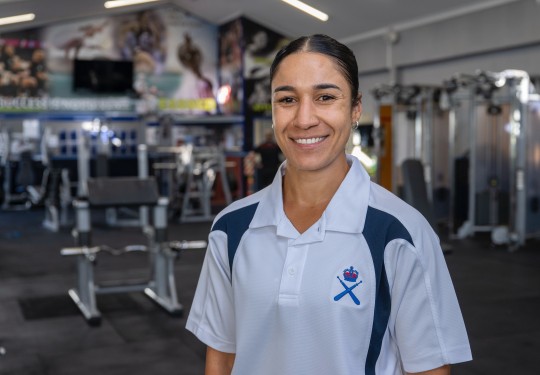
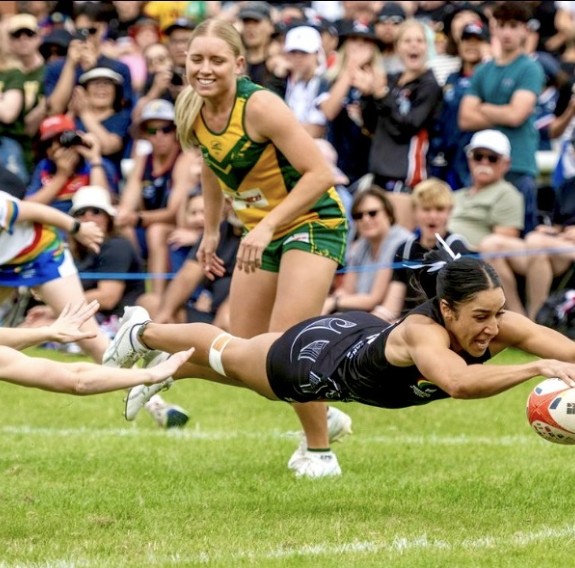
For Royal New Zealand Navy (RNZN) Physical Training Instructor, Petty Officer Deena-Ranginui Puketapu, sport has never been just a pastime.
03 December, 2025
Sport has been the heartbeat of her life, her connection to whānau, and the vehicle that has taken her from Hawke’s Bay to the world stage.
This year, her remarkable contribution to sport – both on and off the field – has been recognised with the 2025 New Zealand Defence Force Sportsperson of the Year Award, honouring an athlete whose achievements, leadership, and embodiment of NZDF values set the highest possible standard.
In July last year, Petty Officer Puketapu played for the NZ Touch Blacks Women’s Team, winning silver at the 2024 Federation of International Touch World Cup in Nottingham, England.
She went on to have a stellar 2025, where she:
represented New Zealand in the NZ Open Mixed Touch Team – earning the NZ Open Mixed Female MVP.
played for the 2025 NRL Māori All Stars, and was named in the NRL All Stars Team of the Match.
represented the NZ Māori Open Women’s Touch Team in Sydney
“Playing for the Māori All Stars… that was special,” she says. “It wasn’t just sport. It was representing my iwi, my hapu – the whole kaupapa was amazing.”
With 33 caps playing for New Zealand Touch Blacks, she says she’s looking ahead with her eye on 50 caps, before she thinks about starting to hang up her boots.
For the provinces she played for the Premier Touch League Northern Strikers and North Harbour Open Women’s Team, and she represented the RNZN in rugby and netball, and captained both the RNZN Open Women’s Touch Team, and the RNZN Women’s Basketball Team, where she was awarded Services Women’s MVP for both tournaments.
Born in Napier, and raised between there and her home in Patangata, Hawke’s Bay, Petty Officer Puketapu (Ngāti Porou/ Ngāti Kahungunu) grew up with a ball in her hand.
“My koro always said as soon as I could walk, I was playing something,” she laughs.
At Hukarere Māori Girls College, she became head girl and sports prefect, representing Hawke’s Bay in basketball, netball, and touch.
Scroll to previous imageScroll to next image
In 2011 after homesickness and injury guided her back to Aotearoa from a US basketball scholarship, she briefly considered the New Zealand Police, but was too young, so she joined the Royal New Zealand Navy seeking challenge, sport, and adventure.
“I just wanted something different,” she says. “To play sport, travel, and challenge myself. Navy felt like throwing myself in the deep end – in a good way.”
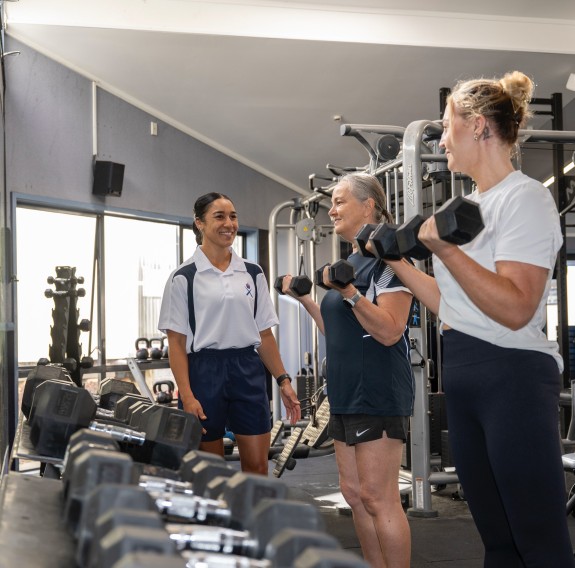
Alongside her elite sporting achievements, she has developed and led an NZDF-wide “Wāhine Whakamarohirohi” strength and wellness programme, creating dedicated space to educate and empower women within the gym environment to live fitter, stronger, healthier lifestyles. Her vision has already influenced planning for future women-focused physical capability training across the Services.
Her dedication to mentorship, especially supporting junior athletes and first-time players, was highlighted in her nomination and strongly praised by the selection panel.
Petty Officer Puketapu’s elite performance, leadership, teamwork, humility, and service to others makes her an extremely deserving recipient of the NZDF’s highest sporting honour.
Givealittle
Wikipedia
New Zealand Geographic