
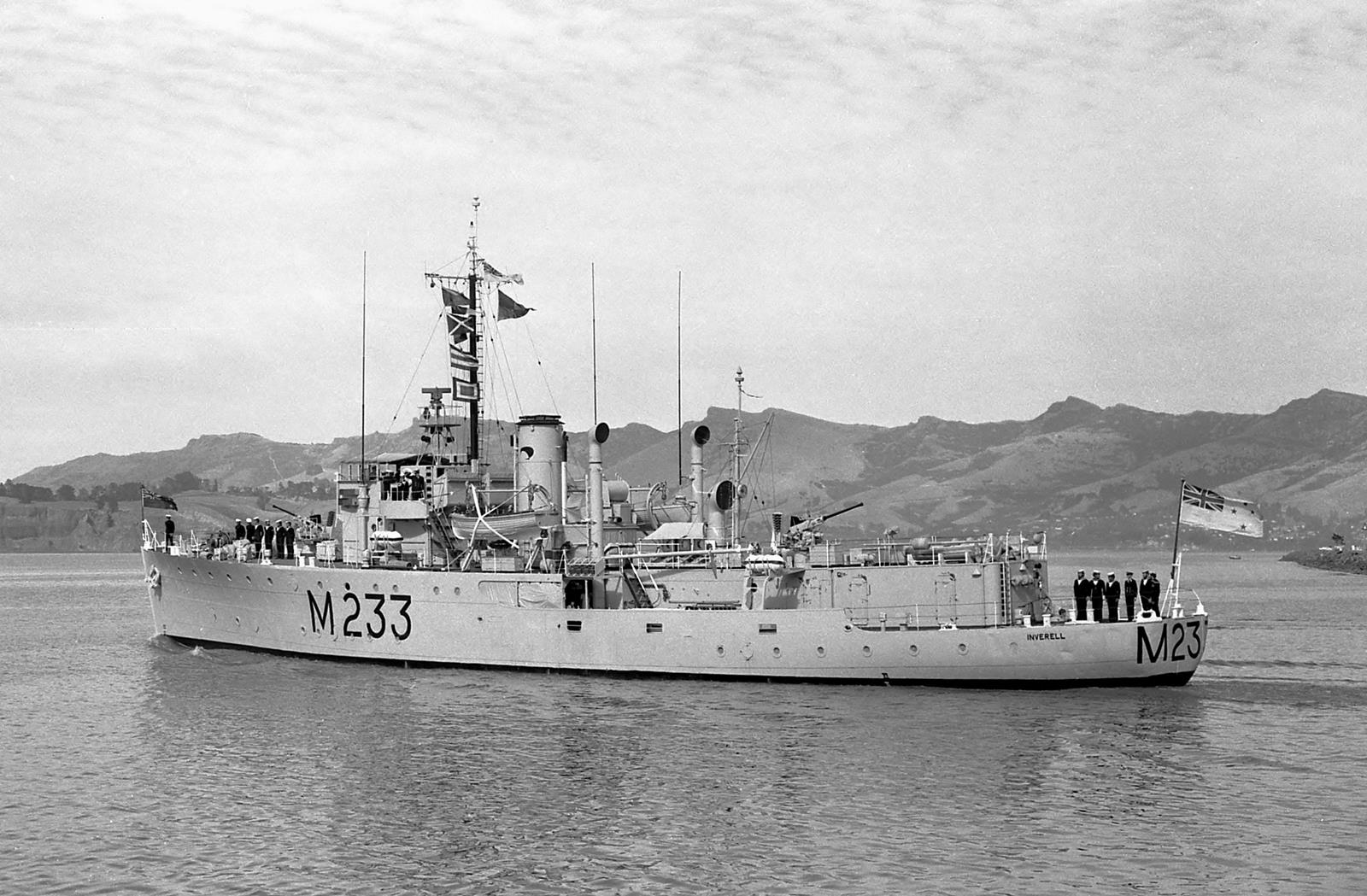
Ships and Defence News Past and Present

The New Zealand Defense Force conducting fleet maneuvers in the Hauraki Gulf in 2010, including the HMNZS (Protector-class offshore patrol vessels) Otago (foreground), Wellington, Pukaki, Rotoiti, Hawea, Taupo, and Manawanui.LAC Grant Armishaw/NZ Defence

Published on:
02 Dec 2025, 6:56 pm
The New Zealand Navy will return to service in the third quarter of 2026 one of two offshore patrol vessels idle since 2021, the chief of the defence force said on Tuesday, at a cost running into millions of dollars.
Tony Davies told a select committee of parliament the decision to bring HMNZS Otago out of care and custody arrangements followed the embarrassing sinking of the specialist dive and hydrographic vessel, the Manawanui.
COLUMN | DEI: a flawed policy in crewing ships [An Innocent Australian]
“Before you put it back to sea, it has to have quite a bit of work and money spent on it,” Davies added. “It requires tens of millions of dollars.”
The Otago can operate in the country’s exclusive economic zone, the Southern Ocean and the Pacific, on tasks such as patrolling, surveillance, search and rescue, disaster relief and peacekeeping support, the defence force says on its website.
The ship was one of three idled in 2021 and 2022 as the military struggled to man them amid historically high levels of attrition that have since dropped off, with sufficient staff for the Otago after the Manawanui sinking.
Davies said the navy used satellites and uncrewed system to monitor a huge maritime area but the presence of a ship was indispensable to help monitor transnational serious organised crime and illegal fishing.
New Zealand’s government, which has committed to increase defence spending over the next eight years, has boosted deployments as tension grows worldwide.
Last month, its largest ship, the oiler Aotearoa, made a rare transit through the sensitive Taiwan Strait.
(Reporting by Lucy Craymer; Editing by Clarence Fernandez)
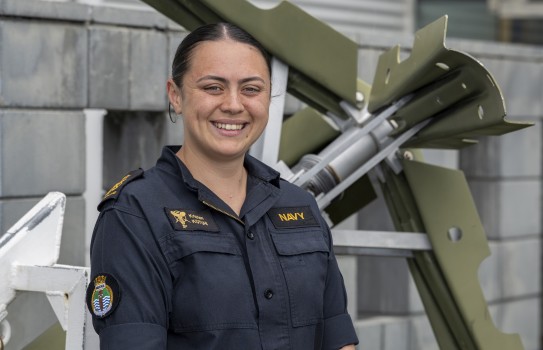
Royal New Zealand Navy Marine Technician Acting Petty Officer Kristen Kotuhi (Ngāti Raukawa) has been named the 2025 New Zealand Defence Force Sailor of the Year, for her professionalism, outstanding leadership and technical mastery.
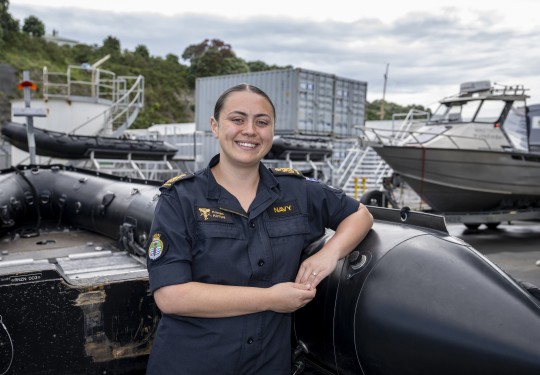
“I was pleasantly shocked when I heard my name being called for the award. I thought if I’m there for a reason, so were the other finalists.”
Based in the Navy’s littoral warfare unit, HMNZS Matataua, Acting Petty Officer Kotuhi is naturally drawn to roles where she is able to help and look after others. Those around her say her conduct and leadership extend well beyond her substantive rank.
Her citation says: “She coached junior rates, set fair tasking, and fostered a culture where people felt supported and standards mattered. She organised regular department sports activities, breakfasts, and simple team-building activities kept morale high during demanding periods. Her conduct consistently reflects the Navy’s core values: Courage, Commitment, Comradeship and Integrity.”
“She translated command intent into safe, reliable outputs that enabled boat, diving operations and Maritime Explosive Ordnance Disposal (MEOD) tasks.”
She said she was grateful to have the capacity to take on the role.
Growing up in Tokoroa and Kawerau, as the oldest of eight daughters, Acting Petty Officer Kotuhi said recruiting drives at school motivated her to look at the military as a career.
“I found out I could play sport, travel the world and make money. It sounded like a win-win. I enlisted as soon as I had finished at Trident High School in Whakatāne.”
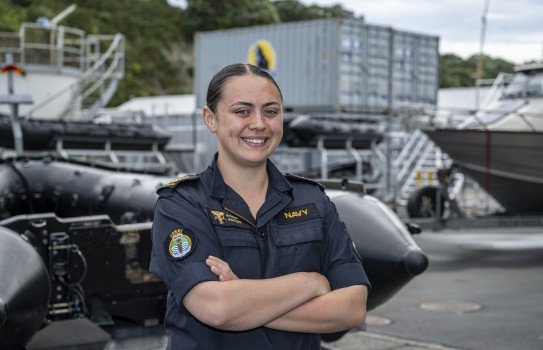
Looking at her career so far, she said she has gained a lot over the years.
“Being in the Navy comes with challenges, but the reward and consequences of those challenges have only made me a better person, helped me grow.
“I’m very lucky in the sense that my fiancé is also in the military, so he understands those challenges.”
Her fiancé Leading Diver Luke Lambe is also based in HMNZS Matataua, and Acting Petty Officer Kotuhi credits him for being her main support in her career.
“He definitely reins me in when I need it, but he is the first to lift me up too.”
Her citation noted how she goes above and beyond to help others.
“She builds an inclusive team that looks after one another and delivers together, and isn’t afraid to take charge under pressure when senior staff are absent.
“She stays with a job until equipment is safe to operate and follows through on training and documentation. She isn’t afraid to hold the line on safe systems and standards, instructing only what is right, addressing minor misses openly, and giving command the information needed for better decision making.”
New Zealand Navy’s largest ship transited through strait, defence minister says

HMNZS Aotearoa
Published on:
27 Nov 2025, 10:02 pm
The New Zealand Navy’s largest ship, the oiler HMNZS Aotearoa, made a rare transit through the sensitive Taiwan Strait earlier this month, Defence Minister Judith Collins told Reuters.
One source with knowledge of the situation said the ship was tracked and followed by Chinese forces as it sailed through the strait.
Collins did not comment on any Chinese activity but said the transit was conducted in accordance with international law. “This includes exercising the right to freedom of navigation, as guaranteed under the United Nations Convention of the Law of the Sea,” she said in an e-mail.
The ship sailed from the South China Sea to the North Asian region via the Taiwan Strait on November 5, the minister added.
The mission has not been previously reported.
China, which claims democratically governed Taiwan as its own, says it alone exercises sovereignty and jurisdiction over the strait. Both the US and Taiwan say the strait – a major trade route through which about half of global container ships pass – is an international waterway.
The last publicised strait transit by New Zealand’s navy, accompanied by an Australian Navy ship, took place in September last year. That was the first time a New Zealand naval ship had passed through the strait since 2017.
The source said that during the sailing, Chinese ships and aircraft monitored the Aotearoa, with Chinese jets carrying out simulated attacks.
The Chinese defence ministry did not respond to a request for comment.
Taiwan’s defence ministry said in a statement that its armed forces, “maintain comprehensive awareness of all military activities across the region and respond appropriately, ensuring national defence security”. It did not elaborate.
The transit coincided with Taiwan reporting that China had, on November 6, carried out another “joint combat readiness patrol” around the island involving J-16 fighter jets, with the activity concentrated in the strait and to Taiwan’s southwest.
The South Korea-built Aotearoa is not armed with heavy weapons, but is equipped to carry a helicopter. It is used for replenishment of fuel and other goods at sea.
The New Zealand Defence Force said last month the ship was planning to take part in United Nations sanctions enforcement missions related to North Korea around Japan.
New Zealand, like most countries, has no formal diplomatic ties with Taiwan, but Taipei sees it as an important like-minded democratic partner and both maintain de facto embassies in each other’s capitals.
New Zealand is also one of only two major countries, along with Singapore, to have a free trade agreement with Taiwan.
US warships sail through the strait every few months, drawing the ire of Beijing, and some US allies like Canada and Britain have also made occasional transits.
China, which has never renounced the use of force to bring Taiwan under its control, has over the past five years stepped up military activities around the island, including staging war games.
Taiwan’s democratically-elected government rejects Beijing’s sovereignty claims.
(Reporting by Greg Torode, Yimou Lee and Lucy Craymer; Additional reporting by Ben Blanchard; Editing by Raju Gopalakrishnan)

By John Lewis

Royal New Zealand Navy Anzac-class frigate HMNZS Te Kaha will be holding a public open day in Dunedin on Saturday. PHOTO: SUPPLIED
After spending much of this year monitoring a Chinese Task Group in the Tasman and conducting an anti-piracy deployment in the Arabian Sea, HMNZS Te Kaha and its crew are looking forward to a less combative environment during their visit to Dunedin this week.
It is the first time in 20 years the Royal New Zealand Navy Anzac-class frigate has visited the city.
Te Kaha will arrive at the T/U Wharf, in Fryatt St, tomorrow for a four-day port visit which includes a public open day on Saturday, from 10am until 2pm.
Commander Andy Hunt said it would be a great opportunity for the public to see inside a naval warship and meet the crew, some of whom are from Otago.
“There’ll be a guided tour of the ship to get up close to some of the ship’s new defensive and combat capability.”
Queues were expected, so visitors were advised to arrive early and to wear closed-toe footwear. A good level of fitness was also required to traverse the gangway and negotiate a series of steep ladders and narrow corridors.
Cmdr Hunt said it had been a busy year for Te Kaha.
Aside from monitoring the Chinese task group and spending three months on an anti-piracy deployment, the ship and its crew worked alongside a United Kingdom carrier task group in the Indian Ocean and participated in Exercise Talisman Sabre, off the coast of Australia, one of the largest multinational military exercises in the world.
The 28-year-old vessel is one of 10 Anzac-class frigates and one of two in the Royal New Zealand Navy.
The 118m-long ship can travel at 50kmh, with a range of 11,000km, and is armed with guns and missiles including a 54-calibre Mark 45 gun; a Phalanx CIWS that can fire 4500 rounds per minute (75 rounds per second); eight M2 50-calibre Browning machine guns; Sea Ceptor surface-to-air missiles, and torpedoes.
Ships and Defence News Past and Present


