|
Naval Today >> The industry’s seaborne news provider by Naval Today / 2h // keep unread // hide // preview
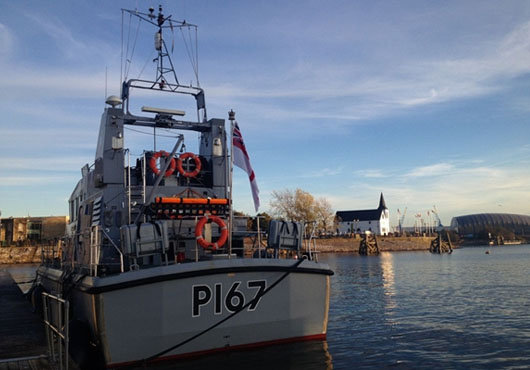
Cardiff based P2000 HMS Exploit has returned to the front line Fleet after a period of refit in Holyhead. HMS Exploit successfully finished her Annual Slip and Repair Period at Holyhead Boatyard which sees her ready for another busy year of high tempo URNU operations.Starting as she means to go on, Exploit welcomed the new intake of first year students from Birmingham URNU on board for two indoctrination weekends. Following on from their weekends at BRNC Dartmouth and at HMNB Portsmouth, the new intake from Birmingham URNU embarked in Exploit on a cold and bitter Friday night in Penarth. The weekend programme saw the students exposed to life on board ship at a slow and cautious pace – deliberately so to aide the professional development of the students. The first year intake were made up of students from University of Birmingham, University of Leicester, De Montford University, Birmingham City University and Aston University.
To give the first year a taste of driving the ship, Exploit sailed through the Cardiff Barrage locks into the Bristol Channel. Each first year drove the ship as quartermaster in the vicinity of Flatholm and Steepholm Islands under the watchful supervision of third year students. Exploit’s home port in Penarth offers the perfect training ground in nearby Cardiff Bay – a man made fresh water lagoon. This two mile by two mile lake is not affected by tide, sea state or wind. So after a morning in the Bristol Channel, Exploit returned to Cardiff Bay for man overboard exercises and damage control scenarios. Thereafter Exploit berthed at Mermaid Quay for the night in the public eye.
On the third day of the First Year sea weekend, the new entry students were given engineering briefs by Exploits engineering team of CPO Tug Wilson and LET(ME) Paul Shingleton. Thereafter the students again enjoyed some time on the wheel and a navigation lesson from the embarked training officer in the surroundings of Cardiff Bay.
HMS Exploit is one of two P2000’s based in Penarth, Cardiff. Along with Express, she forms one of only a handful of Wales based Royal Navy units. Exploit has been assigned to Birmingham URNU since 1994 and celebrates her 25th Birthday this year. Follow Naval Today via:           
+TAG
|


VIDEO: USCG Seizes 5,000 Pounds of Marijuana
Posted on Dec 5th, 2013 with tags .

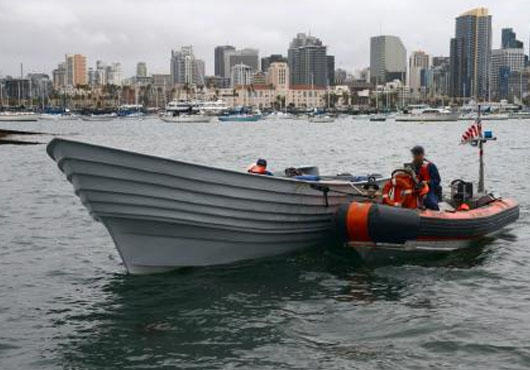
The U.S. Coast Guard interdicted a panga boat with 201 bales of marijuana and two suspected smugglers aboard approximately 140 miles southwest of San Diego, Monday evening.
After a Sacramento-based Coast Guard HC-130 Hercules patrol aircraft detected the 30-foot boat around 3:40 p.m., the Coast Guard Cutter Active launched an interceptor boat to investigate.
A brief chase ended after the Active’s boat crew used disabling gunfire on the vessel’s engines. The panga, suspects and contraband were transferred to the 87-foot Coast Guard Cutter Sea Otter crew and taken to San Diego.
In addition to the HC-130, a Customs and Border Protection Office of Air and Marine Multi-role Enforcement Aircraft provided aerial support.
The suspects and drugs were turned over to the San Diego Marine Task Force, which includes federal, state and local law enforcement agencies.
“The Coast Guard and our dedicated federal, state and local partners use every officer, agent, cutter, boat, aircraft, vehicle and piece of equipment at our disposal to stop smugglers, save lives, and provide the American people the protection they expect and deserve,” said Rear Adm. Karl Schultz, 11th Coast Guard District commander. “This case is a great example of how we are working together every day to secure the California coastal region and beyond.”
The interdiction occurred on the one-year anniversary of the death of Senior Chief Petty Officer Terrell Horne who was killed in the line of duty when the Coast Guard boat he was aboard was struck by a panga-style vessel suspected of illicit activities near Santa Cruz Island, Calif.
The Active is a 210-foot cutter based in Port Angeles, Wash. The Sea Otter is based in San Diego.
Counter-smuggling and law enforcement efforts in the San Diego area are coordinated through a Regional Coordinating Mechanism comprised of the U.S. Coast Guard, CBP’s Office of Air and Marine, Office of Field Operations, U.S. Border Patrol, U.S. Immigration and Customs Enforcement’s Homeland Security Investigations and state and local law enforcement partners. The ReCoM utilizes the fusion of intelligence, planning and operations to target the threat of transnational crime along the coastal border.
Share this:

Australian Navy Intercepts Illegal Foreign Fishing Boats
|
Naval Today >> The industry’s seaborne news provider by Naval Today / 2h // keep unread // hide // preview
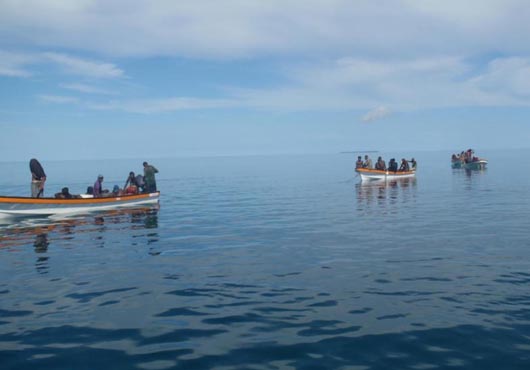
A joint agency operation targeting illegal foreign fishing in the Torres Strait has led to the apprehension of seven illegal foreign fishing boats from Papua New Guinea and the return of almost one tonne of live sea cucumbers to Warrior Reef.Sea cucumbers (also known as bech de mer) are considered a delicacy in most cultures in East and South East Asia and are highly regarded for their perceived health benefits. The joint agency operation included the Australian Customs and Border Protection Service (ACBPS), Royal Australian Navy, and the Australian Fisheries Management Authority (AFMA). The fishing boats were located by HMAS Wollongong and a Customs and Border Protection helicopter and were intercepted on Friday, 22 November 2013, and Saturday, 23 November 2013, on the Warrior Reef, in the Torres Strait. HMAS Wollongong, operating under the control of Border Protection Command, boarded four of the vessels on Friday and seized approximately 200 kilograms of live sea cucumbers, along with other catch, which included three giant clams. A further amount of live sea cucumber, believed to be in the vicinity of 200 kilograms, was thrown overboard by the foreign fishers. On Saturday, HMAS Wollongong boarded a further three vessels and seized over 200 kilograms of live sea cucumbers and other catch, along with one large live sea turtle. An estimated further 350 kilograms of sea cucumbers was also thrown overboard by the foreign fishers. Over the two days, the seven vessels and 60 crew members were detained and transferred to the custody of Australian Customs Vessel Holdfast Bay. The fishers have now been transferred to Papua New Guinea (PNG) authorities in Daru, PNG. The seven vessels are being held at Thursday Island by AFMA awaiting the outcome of prosecutions under PNG law. Deputy Commander Border Protection Command, Terry Price, said the apprehensions were a direct result of joint agency cooperation to target illegal foreign fishing.
AFMA General Manager Fisheries Operations, Peter Venslovas, said that these operations do act as a strong deterrent to illegal foreign fishing.
The seized sea cucumbers and large live sea turtle were all returned to the reef after the vessels were intercepted by HMAS Wollongong. Follow Naval Today via:
+TAG
|

Share this:

UK: Royal Navy Helicopter Helps Injured Lifeboat Crew Member
|
Naval Today >> The industry’s seaborne news provider by Naval Today / 2h // keep unread // hide // preview
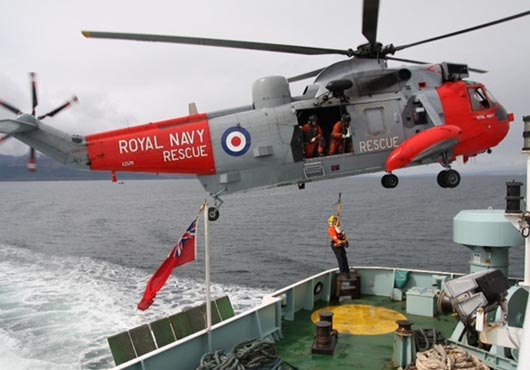
A Royal Navy helicopter has winched an injured lifeboat crew member to hospital in strong winds and heavy seas around five miles west of the Mull of Kintyre.The crew of Campbeltown Lifeboat, a Severn-Class vessel, was called to the aid of a 60 metre, 2000 tonnes fish farm boat which had lost rudder steerage late on Thursday night (November 28). The vessel was adrift in difficult conditions west of Kintyre. With the ship under tow, the lifeboat was making steady progress towards Campbeltown Habour when one of the crew suffered an injury to his leg and they called for assistance. At 1.05am, the duty crew of HMS Gannet’s search and rescue Sea King from Prestwick in Ayrshire was airborne. Flying into a strong westerly headwind – gusting up to 45 knots – the crew arrived on scene 35 minutes later at 1.40am. Making a radar approach due to a lack of visual references and working on night vision goggles, they found the lifeboat towing the larger vessel. The injured casualty was inside of the lifeboat, which, due to the rough sea state, was pitching violently in the waves. With the larger vessel under tow, the lifeboat’s manoeuvrability was severely impaired and it became clear it was going to be a very difficult job. It took several approach attempts to find a safe position for the helicopter to go into a hover above the lifeboat in order to deliver the winchman Petty Officer Shaun Knights, who is also an ambulance technician, to the deck.
By now the helicopter was fuel critical and had to shut down at the hospital while the casualty was taken to a waiting ambulance and safely delivered to the care of medical staff. The injured crewman has since been discharged from hospital and is making a good recovery. Campbeltown Lifeboat continued to assist the stricken ship, which was delivered to Campbeltown Harbour at 12 noon today (Friday November 29). The helicopter returned to HMS Gannet at 4.30am after almost three and a half hours. The full HMS Gannet crew was pilots Lieutenant Commander Lloyd Shanahan and Lieutenant Jon Lynas, observer [navigator] Lieutenant Angela Lewis and Petty Officer Shaun ‘Boogie’ Knights, winchman and ambulance technician. Follow Naval Today via:
+TAG
|

Share this:

Australian Warships to Change Colour
|
Naval Today >> The industry’s seaborne news provider by Naval Today / 2h // keep unread // hide // preview
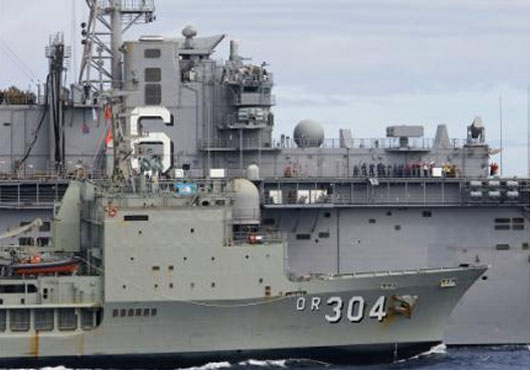
The Australian Navy will progressively change the colour of its surface fleet to meet modern war-fighting and regional environmental conditions, the Chief of Australian Navy, Vice Admiral Ray Griggs, has announced.While not normally apparent to the bystander, the recent International Fleet Review with 17 international ships visibly demonstrated that colour schemes do vary significantly between nations. These are mainly due to the regional environmental conditions faced by national navies such as the percentage of cloud cover or sunlight. The Royal Australian Navy has traditionally used the Storm Grey colour based upon a traditional northern hemisphere ‘Light Grey’ which was developed to deter detection under overcast skies. That paint scheme was adopted in the 1950’s. With predominant sunlit conditions faced in Australian waters and significant improvements in paint technologies, the Chief of Navy decided to introduce a more appropriate paint scheme. The revised scheme and new paint technologies were reviewed through extensive consultation with the Defence Science and Technology Organisation (DSTO) Maritime Group. The basis for the new scheme is around the regionally compatible Haze Grey colour, utilising new technologies in polysiloxane paints with Near Infrared Reflecting Pigments (NIRR). Research has shown that the polysiloxane paints provide improved durability and fire resistance over older polyurethane systems. The use of reflecting pigments in the Haze Grey formulation reduces external shipboard temperatures by up to 20 degrees Celsius compared to the traditional Storm Grey. This contributes to decreased demand on shipboard environmental systems, a reduced infrared signature for the ship which decreases detection ability, a desirable outcome in combat. The scheme will be implemented by a phased introduction in scheduled maintenance periods and will yield operational improvements as well as reduce costs and improve technical performance.
+TAG
|


