
|
Naval Today >> The industry’s seaborne news provider by Naval Today / 2h // keep unread // hide // preview
On Tuesday 3 December, Spanish Ocean Patrol Vessel, ESPS Tornado joined the European Union’s counter piracy task force operating off the coast of Somalia. The warship will be part of the EU Naval Force for four months as Spain’s contribution to Operation Atalanta.Commissioned in 2012, ESPS Tornado is the fourth in the series of modern and multipurpose OPVs in the Spanish Navy. She is 95 metres in length and has a displacement of 2,500 tonnes. She can accommodate a crew of 86 and has 11 marines and an AB 212 helicopter embarked. This is the first time that ESPS Tornado has taken part in the EU Naval Force to fight piracy, but it’s not the first time for the class of ship. The other three ships of the Meteoro class have all participated in Atalanta, the last one being ESPS Meteoro, which was part of the 15th rotation of Operation Atalanta for the past four months. Talking about joining the EU Naval Force, the Commanding Officer of ESPS Tornado, Lieutenant Commander Juan Jose Belizón Izquierdo, said:
Before joining EU Naval Force, ESPS Tornado conducted an intensive programme of training, including “Calificación Operativa” (CALOP) in Cartagena and Rota, Spain. Follow Naval Today via:           
+TAG
|


Japan: GWSG Finishes 2013 Patrol
|
Naval Today >> The industry’s seaborne news provider by Naval Today / 3h // keep unread // hide // preview
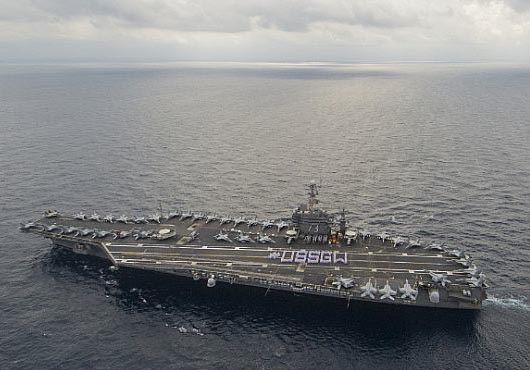
The USS George Washington Strike Group (GWSG) returned to its forward-operating location of Commander, Fleet Activities Yokosuka, Japan, Dec. 5, to conclude the second half of its 2013 patrol.The GWSG participated in three joint-training exercises with regional partners, conducted three goodwill port visits, and provided humanitarian assistance and disaster relief to the Republic of the Philippines.
The GWSG most recently finished Annual Exercise (Annual Ex) 13, designed to increase the defensive readiness and interoperability of Japanese and U.S. Naval forces through training in air and sea operations. The strike group also conducted exercises in Oct. with the Republic of Korea navy and Japan Maritime Self-Defense Force (JMSDF) in the waters around the Korean peninsula.
The GWSG also conducted three goodwill port visits to Busan, Republic of Korea, Singapore, and Hong Kong, where the ship’s crew conducted 39 community service events.
The GWSG departed Hong Kong Nov. 12 to assist the Republic of Philippine government in disaster relief efforts in the aftermath of super Typhoon Haiyan during Operation Damayan.
USS George Washington (CVN 73) also embarked more than 200 distinguished visitors from Republic of Korea, Malaysia, Singapore, Hong Kong and Japan to provide a first-hand look at the day-to-day operations of an underway aircraft carrier.
Press Release, December 05, 2013; Image: US Navy Follow Naval Today via:
+TAG
|

Share this:

Australia’s LHD02 prepares for transit down-under
|
Navy Daily 3h // keep unread // hide // preview
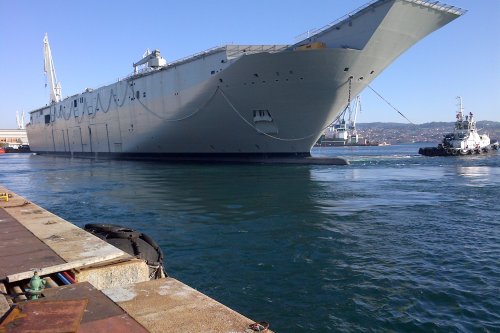
 The second Landing Helicopter Dock (LHD) under construction for the Royal Australian Navy has departed the Navantia Ferrol Dockyard in Spain and will soon be transported to Australia.
+TAG
|
Share this:

Russia Launched New Submarine

|
Naval Today >> The industry’s seaborne news provider by Naval Today / 10h // keep unread // hide // preview
Russia has launched a new submarine in St Petersburg – the first in a series of six to be delivered to the Russian Black Sea fleet over the next two years.The diesel-electric submarine Novorossiysk is the latest example of non-atomic technology. It is well armed and hard to detect when submerged. A new submarine was launched by Russia last week, the BBC reports. The submarine, named Novorossiysk, was launched at Admiralty Shipyard, located in Saint Petersburg. Construction of the submarine started at Admiralty Shipyard in August 2010, followed by the Rostov-on-Don sub in November 2011 and the Stary Oskol in August 2012, according to the RIA Novosti. Novorossisyk (Varshavyanka-class submarine) is an improved version of the Kilo-class submarines. The submarine embodies the latest example of non-atomic technology. Armed with 18 torpedoes and eight surface-to-air missiles, Novorossisyk’s main missions will be anti-shipping and anti-submarine operations. It will be able to endure a month and a half without the need to refuel. The submarine will become the first of six diesel-electric stealth subs to be delivered to the Russian Black Sea fleet in the next two years. Naval Today Staff, December 04, 2013; Image: admship Follow Naval Today via:
+TAG
|

Share this:

VIDEO: Sunken Japanese Submarine Discovered
Posted on Dec 4th, 2013 with tags .

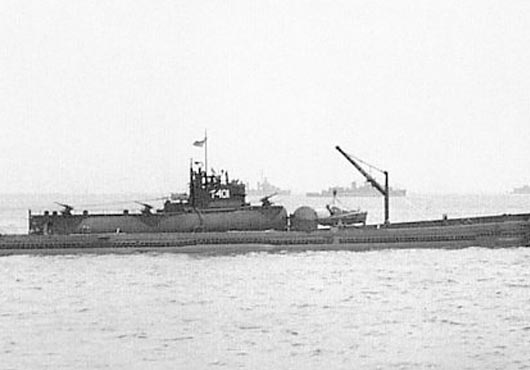
A sunken Japanese submarine was discovered by US researchers off the coast of Hawaii in more than 2,300 feet (700 meters) of water, as reported by the RIA Novosti.
The submarine, named Sen-Toku (I-400), was scuttled by the United States after the WWII and disappeared in 1946.
I-400 was the largest submarine ever built until the 1960s, since nuclear-powered submarines were popularized.
The submarine was one of five Japanese submarines captured and sank by the US Navy in 1946.
She was designed to surface, launch her planes, then quickly dive again before she was discovered.
She also carried torpedoes for close-range combat.
The I-400-class was designed with the range to travel anywhere in the world and return.

