|
Naval Today >> The industry’s seaborne news provider by Naval Today / 8h // keep unread // hide // preview
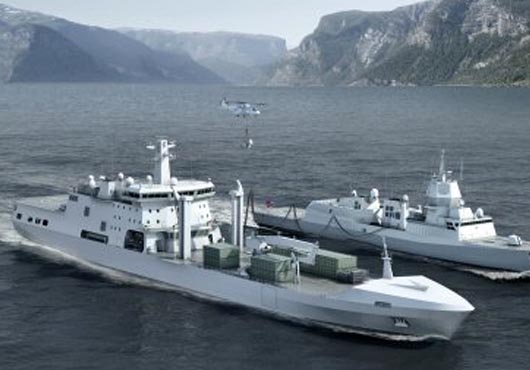
AVEVA announced today that BMT Defence Services Ltd (BMT) has chosen AVEVA Marine software to better serve its current and future customers through improved design efficiency. BMT has selected AVEVA Marine to enable tighter integration between its hull and outfitting disciplines, aiming to improve design efficiency through closer collaboration between disciplines.
BMT is the leading independent centre of engineering design that provides complex engineering and design capabilities for UK and international defence customers. It is the design contractor for the Norwegian Defence Logistics Organisation’s logistics and support vessel which will be built by Daewoo Shipbuilding and Marine Engineering (DSME) in South Korea, who have been using AVEVA software for more than 20 years. One of the main reasons behind BMT’s decision to adopt 3D software was the ability to produce an accurate weight estimate from the model, which was previously done using a combination of 2D and spreadsheets. This alone saved BMT around two to three man-months of effort on this project. AVEVA provided tailored training for BMT employees to ensure rapid and efficient implementation. ‘It is a big step to go from 2D to 3D, but with AVEVA’s support we were able to make the transition very smoothly. We will certainly look to deploy AVEVA Marine software on future projects as well,’ added Mr Quilliam.
Press Release, December 04, 2013; Image: Aveva Follow Naval Today via:           
+TAG
|


U.S. Icebreaker Deploys to McMurdo, Antarctica
MarineLink.com
Wednesday, December 04, 2013, 11:00 AM

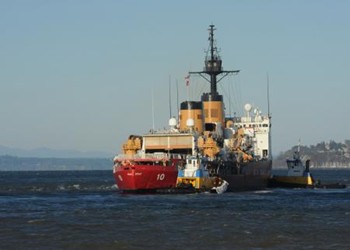
Two tugboats escort Coast Guard Cutter Polar Star, a 399-foot Polar Class Icebreaker homeported in Seattle, through Elliott Bay after the cutter got underway from Coast Guard Base Seattle, Dec. 3, 2013. CGC Polar Star’s crew departed for Antarctica in support of Operation Deep Freeze for the first time since 2006, following a three-year overhaul to the cutter and test period. (U.S. Coast Guard photo by Petty Officer 3rd Class Katelyn Tyson)
Coast Guard Cutter Polar Star departed Coast Guard Base Seattle for Antarctica, Tuesday, in support of Operation Deep Freeze for the first time since 2006 with the task of resupplying the National Science Foundation Scientific Research Station in McMurdo.
For more than 50 years, Coast Guard icebreaker crews have deployed to Antarctica in support of Operation Deep Freeze. They will assist by creating a navigable shipping lane through the layers of ice in McMurdo Sound. Approximately eight million gallons of U.S. fuel will be sent to McMurdo residents through the channel and be delivered to Winter Quarters Bay. This fuel allows the Station to remain manned and ready during the freezing winter months.
This past summer, CGC Polar Star conducted sea trials in the Arctic to test all of the ship’s equipment and train the crew prior to embarking to Antarctica this winter. During the summer trip, CGC Polar Star spent weeks in the Beaufort Sea north of Barrow, Alaska, testing propulsion machinery, conducting emergency drills, and qualifying crewmembers in individual watchstations.
In preparation for CGC Polar Star’s Deep Freeze Deployment, the crew overhauled many pieces of equipment from the bridge to the engine room and successfully completed a number of assessments to achieve their fully reactivated status.
Polar Star is a 399-foot Polar Class Icebreaker with a 140-person crew, homeported in Seattle. The cutter is recently out of a three-year, $90 million overhaul, which is part of the Coast Guard’s plan to reactivate the heavy icebreaker.
uscgnews.com
 Family members and friends of crewmembers assigned to Coast Guard Cutter Polar Star, a 399-foot Polar Class Icebreaker homeported in Seattle, wave from the pier as they watch the cutter get underway from Coast Guard Base Seattle, Dec. 3, 2013. The cutter’s crew departed for Antartica to resupply the National Science Foundation Scientific Research Station in McMurdo in support of Operation Deep Freeze. (U.S. Coast Guard photo by Petty Officer 3rd Class Katleyn Tyson)

Share this:

Today in U.S. Naval History: December 4
MarineLink.com
Wednesday, December 04, 2013, 11:40 AM

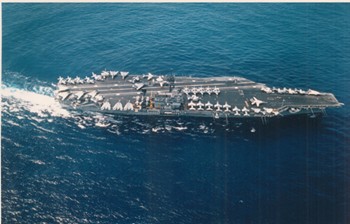
USS John F. Kennedy (CV-67). (USN Photo DN-ST-89-01287 by Photographer’s Mate 2d Class William Lipski)
Today in U.S. Naval History – December 4
1918 – President Woodrow Wilson sails in USS George Washington for Paris Peace Conference.
1943 – Aircraft from USS Lexington (CV-16) and USS Independence (CVL-22) attack Kwajalein Atoll, sinking four Japanese ships and damaging five others, while only three U.S. ships suffered damage.
1944 – USS Flasher (SS-249) sinks Japanese destroyer Kishinami and damages a merchant ship in South China Sea. Flasher is only U.S. submarine to sink over 100,000 tons of enemy shipping in World War II.
1965 – Launch of Gemini seven piloted by CDR James A. Lovell, USN. This flight consisted of 206 orbits at an altitude of 327 km and lasted 13 days and 18 hours. Recovery by HS-11 helicopters from USS Wasp (CVS-18)
1983 – Aircraft from USS John F. Kennedy (CV-67) and USS Independence (CV-62) launch strike against anti-aircraft positions in Lebanon that fired on U.S. aircraft. Two U.S. Navy planes shot down.
For more information about naval history, visit the Naval History and Heritage Command website at history.navy.mil.
Share this:

Damen Shiprepair Brest Earns ISO9001:2008 Certificate
MarineLink.com
Wednesday, December 04, 2013, 11:52 AM

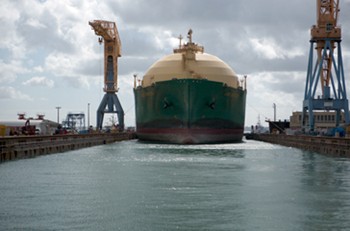
Photo: Damen
Damen Shiprepair Brest (France) received certification from Lloyd’s Register Quality Assurance (LRQA) for aligning its quality and safety management systems with internationally recognized standards.
A certificate of approval for the ISO 9001:2008, management standards was presented by LRQA France at the shipyard premises on 26 November 2013.
Damen Brest’sManaging Director Jos Goris commented, “We are proud to be awarded with the certificate, in particular since we started this process 11 months ago and only a couple of months after the shiprepair activities started in second quarter of 2012. Damen Shiprepair Brest passed the five-day audit without any nonconformity.”
Mr. Goris continued, “By adhering to these globally-recognized best practices, we are positioning Damen Shiprepair Brest as a professional and well organized ship repair facility with a high management focus on Safety, Quality, Reliability and Transparency. We are convinced that our valued customers will note the difference.”
“Our next step will be to become ISO14001 certified, but we will first give our staff some ‘recovery’ time from the audit for ISO9001:2008. We have already started implementing several environmental procedures and it is our aim to further improve our environmental footprint in the years to come,” Mr. Goris added.
damen.com
 Photo: Damen


Share this:

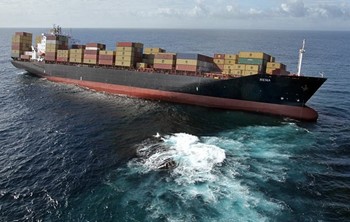
Rena Grounding Response Reviewed
MarineLink.com
Wednesday, December 04, 2013, 3:05 PM

Picture: New Zealand Herald, Allan Gibson/AP
Maritime New Zealand (MNZ) welcomes the release of the independent review of its response to the grounding of the Rena, and the announcement of $2 million of government funding to help improve New Zealand’s maritime response capability.
The report, by independent reviewer Simon Murdoch, was released today by Transport Minister Gerry Brownlee.
MNZ Director Keith Manch said the organization was already implementing a number of the review recommendations and the funding package would help MNZ develop a wider strategic and operational response to maritime incidents.
In the review report, Mr. Murdoch made it clear the Rena grounding was unprecedented in its complexity but the response, while flawed in some aspects, had ultimately been effective.
After Rena hit the Astrolabe Reef on 5 October 2011, hundreds of oil spill responders and 8,000 volunteers removed around 1,000 metric tons of oily waste from the coastline, recovered more than 4,500 metric tons of containers and debris and rescued hundreds of oiled birds. Beaches closed as a result of oil were re-opened from 16 November 2011.
“The reviewer finds the response team overcame initial hurdles to set up a strong and effective team that worked closely with the local community. The response minimized the risks to wildlife and achieved a high quality, world class clean-up,” Mr. Manch said. “The generally positive results of the Rena Recovery Plan’s scientific monitoring program support this finding.”
Mr Manch said the response team faced a complex scenario involving not only oil recovery, but non-oil pollution from containers and resulting debris, as well as overseeing a difficult salvage operation.
“I’m very proud of the professional and sustained effort by people across MNZ but we certainly did not act alone. The success of the response was only possible due to the collaborative efforts of the Bay of Plenty Regional Council, iwi, community groups, local government and other agencies such as the Department of Conservation, the Defense Force, and Massey University’s Wildlife Health Center.”
The review states: “As is often the case, imperfections in systems, plans and structures, which are to be expected in any crisis, can be overcome by a workforce that is motivated and well managed.” (8.6)
“The review identifies a range of areas for improvement including: being better prepared (strategically and operationally) across government and with response partners; having greater capability and training; improved administration; revising the structure of the incident command center (ICC); and better engagement with communities and iwi.”
Mr. Manch said a work program was already underway to build on the lessons identified in the review. MNZ has:
- worked closely with the Ministry of Transport, Department of Prime Minister and Cabinet, and the Environmental Protection Agency to improve inter-agency information-sharing and reporting on maritime response activity.
- undertaken a comprehensive review of the National Response Team (NRT) – a group of trained oil spill responders from around the country who form the core response team for a Tier 3 oil spill incident. The team will have greater resources to support oil spill response and the national oiled wildlife response.
- appointed an exercise leader and additional technical support staff at MNZ’s Maritime Pollution Response Service (MPRS). A logistics manager has also been seconded to MPRS to improve national procurement and supply arrangements.
- reviewed its international support arrangements for oil spill response – both government and specialist commercial support. This includes the Australian Maritime Safety Authority (AMSA) and salvage experts London Offshore Consulting.
- developed additional specialist support arrangements in areas such as well control and hazardous and noxious substances
- initiated discussions with the Department of Conservation aimed at the development of memorandum of understanding to develop a wider response policy framework to address non-oil pollution and natural resource protection in its marine jurisdiction and coastline.
- reviewed the wildlife response contract to ensure better integration of this area of the response into the NRT.
- undertaken training for MNZ staff on the International Oil Pollution Compensation Fund and International Tanker Owners Pollution Federation to improve understanding of how financial claims for oil pollution incidents should be compiled.
- MNZ is currently reviewing the national Oil Spill Response Strategy.
- MNZ is also reviewing its purchasing system to improve financial management during the peak of a response.
maritimenz.govt.nz

