|
Naval Today >> The industry’s seaborne news provider by Naval Today / 3h // keep unread // hide // preview
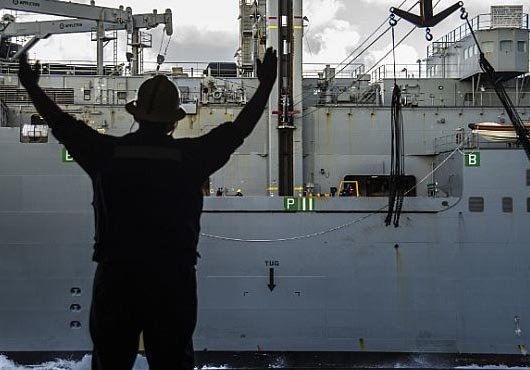
The U.S. Navy’s forward-deployed aircraft carrier USS George Washington (CVN 73) completed its largest replenishment-at-sea (RAS) for the 2013 patrol with Military Sealift Command dry cargo and ammunition USNS Charles Drew (T-AKE 10), Nov. 30.While RAS’s are nothing new to the Sailors aboard George Washington, the ship received nearly 700 pallets of supplies at once, three times the amount of a standard RAS. This produced a unique and rare challenge for the Sailors of the ship’s supply department.
George Washington conducts approximately three to four RASs over the course of a month while on patrol under normal operating conditions. Due to certain circumstances, the ship was forced to skip some of them.
In order to move the supplies to where they belong, each pallet had to be air lifted from Charles Drew’s flight deck to the drop zone on the fantail of George Washington, taken from the drop zone to the hangar bay via aircraft elevator where they were processed and sorted to be sent to various storerooms.
Safety plays a huge role in large ship evolutions like replenishments-at-sea. In order to finish the mission without incident, like any other mission, every Sailor must keep their head on a swivel and maintain good safety practices.
George Washington and its embarked air wing, Carrier Air Wing (CVW) 5, provide a combat-ready force that protects and defends the collective maritime interest of the U.S. and its allies and partners in the Indo-Asia-Pacific region. Follow Naval Today via:           
+TAG
|


HMS Illustrious’ Busy Bees Render Relief to Philippines
|
Naval Today >> The industry’s seaborne news provider by Naval Today / 2h // keep unread // hide // preview
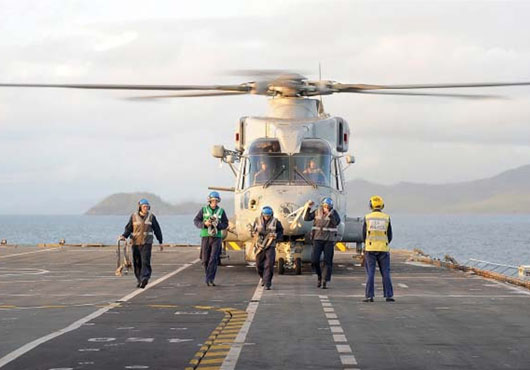
Since arriving in the Philippines, HMS Illustrious and her ‘floating warehouse’ of emergency supplies have been a hub of activity.The Royal Navy’s amphibious aircraft carrier arrived in the Philippines on 25 November after a short stop in Singapore to load up 500 tonnes of humanitarian aid under the direction of the UK Department for International Development (DFID). Teams of personnel have been working 24-hours-a-day in her hangar to sort and pack the much needed supplies, ready for distribution ashore, and the flight deck has been operating constantly since the 23,000-tonne ship arrived. HMS Illustrious has delivered food to more than 10,000 people during her first week helping people in the Philippines hit by Typhoon Haiyan. The carrier’s helicopters have collectively clocked up one and a half weeks in air ferrying tonnes of supplies around, including makeshift shelters, tools and fresh water.
Since the start of Operation Patwin, the UK’s contribution to the multinational humanitarian aid effort, 356 pallets of supplies have been distributed ashore. This equates to roughly 130 tonnes of stores, including 2,048 family food packs (each enough to feed a family of 5 for 1 week), 5,400 tarpaulins, 46 debris clearance packs (shovels, wheelbarrows, hammers, saws, tarpaulins, rice bags and assorted tools), and 1,500 litres of water to those islands which do not have a fresh water supply. Royal Navy Sea King and Merlin and British Army Lynx helicopters have been streaming to the islands around the coast of Panay every few minutes to deliver the supplies. Together, they have completed 252 flying hours and 227 vertical replenishments (where the aircraft hovers over the flight deck to collect an underslung load without landing). Speaking on 2 December, Commander Nick Walker said:
Alongside food aid and equipment distribution on numerous islands, there have been opportunities for soldiers, sailors and marines to get their hands dirty. Teams have been sent ashore on 6 islands to assist with such things as repairing generators, buildings and fishing boats and debris clearance.
Filipinos have been quick to show their gratitude for the assistance – from islanders crowding around the sailors delivering aid to messages of thanks hung from buildings (and even tree trunks) or spelled out on beaches (using old clothes). And from children on the island of Sicogon, a thank-you letter “to the members of the Royal Navy”.
HMS Illustrious will continue to visit further island clusters around the central Philippine island of Panay to assess the needs of the local communities and provide vital assistance. Follow Naval Today via:
+TAG
|


Share this:

UK: Royal Navy Reservists Conduct Tests
|
Naval Today >> The industry’s seaborne news provider by Naval Today / 2h // keep unread // hide // preview
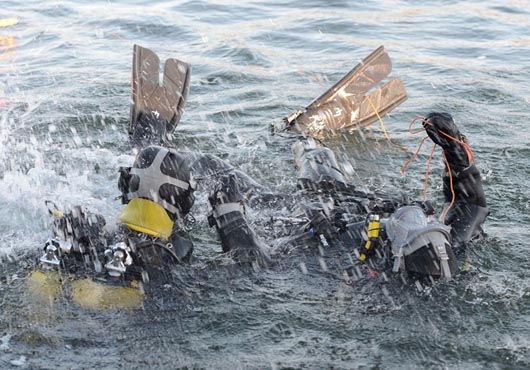
A biting wind whistled across Portsmouth Harbour as six Royal Naval Reservists plunged into the dark waters of the diving training lake at the Navy’s Horsea Island training site, swimming across the lake, completing a timed set of circuits and leaping several times from the highest platform (over 30 feet) into the water, clutching their fins to their chests.The reservists were conducting pre-joining aptitude and acquaint tests on a wintry Saturday morning in late November. These determined men have one collective ambition: to join the Royal Naval Reserve Diving Branch, a specialist cadre of the Maritime Reserves that supports the Fleet Diving Squadron of the Royal Navy. The six reservists joined a diving training weekend alongside qualified Naval Reservist divers drawn from RNR units across the country from as far away as HMS Scotia in Rosyth and HMS Vivid in Plymouth. Commander of the Maritime Reserves, Commodore Andrew Jameson and Command Warrant Officer for the Maritime Reserves, WO Annette Penfold visited the Horsea Island site to observe activity and meet the divers. They received a presentation on the RNR Diving Branch from Lt Nick Foster, with Branch Manager Lt Cdr John Herriman answering detailed training and policy questions. The Commodore was briefed on the Diving Branch’s role to deliver a Homeland Defence underwater search capability in the UK, providing underwater force protection and supporting harbour searches in strategic UK ports. The Diving Branch also generates reservist diving teams to support the UK’s Explosive Ordnance Reconnaissance operations, backfilling the Fleet Diving Squadron’s teams when personnel are deployed overseas. More recently, the RNR Diving branch has been tasked to generate manpower to support the NATO Submarine Rescue System. The two Senior HQ Officers spent the morning observing the course and joined the would-be divers afterwards for lunch, tucking into bag meals inside a cosy heated cabin to escape the lakeside chill. They learned more about the ambitions of the reservists and the challenges they face juggling civilian careers with the high levels of commitment required to qualify for the Diving branch. Amongst the six applicants is James Parker, a 34-year-old carpenter from Redditch, near Birmingham. James, a keen scuba diver, already holds a PADI qualification and the mandatory 1000 minutes dived underwater. Currently serving as an infantryman in the Army Reserve’s Mercian Regiment, he explained:
Several of the more experienced divers acted as mentors at the weekend, supervising the new applicants through the demanding fitness and aptitude tests, providing presentations and describing their experiences and various tasks undertaken. The qualified RNR divers attending the training weekend also need to maintain their own skills and undertake specific courses to continue their professional development. Training undertaken includes learning how to operate the recompression chambers, advanced diving First Aid courses, driving inflatable boats, transporting hazardous goods and the maintenance of diving equipment. On average a new candidate can expect to achieve full qualification as an RNR Diver after two to three years. Lt Foster explained:
AB Tony Cassidy from HMS Eaglet can vouch for the level of integration he saw between Reservist and regular RN divers during his three-month mobilisation during the 2012 Olympics. Tony, an offshore steward working on the North Sea oil rigs voluntarily mobilised to Operation Olympics, providing military support to London 2012. He worked alongside a group of RN divers inspecting the Port of London and protecting underwater security in the River Thames and adjacent Olympic arenas while also paying particular attention to the force protection safety zones around the warships in the capital, providing accommodation to the troops providing security at the Olympics. The latest Naval task to be opened up to RNR divers will provide direct support to the NATO Submarine Rescue System (NSRS). The RNR aims to train up to 36 reservists over the next five years to meet the operational requirement. A pool of 12 NSRS trained divers will then be at 24 hours standby notice to move to deploy to assist with the recovery and rescue of personnel from a submarine in distressed circumstances. The first reservist to undertake the two-week additional NSRS qualification is former submariner, now RNR diver, Chief Petty Officer Chris Dello. Chris (35) from Poole, works as an engineer surveyor for Independent Safety Evaluation (ISE) but balances his civilian career with a high readiness commitment to support NATO’s submarine rescue system. Joining the Naval Reserve three years ago at HMS King Alfred after 12 years in the RN, one of his responsibilities would be to operate the Transfer Under Pressure (TUP) element of the rescue phase, bringing submariners who have been exposed to a drop in pressure underwater back to the surface which would potentially take up to a few days in the pressurised system depending on the depth and circumstances of the incident. AB Grant Thornes (24) is one of the young divers undergoing continuation training. Joining the Reserves in the Leeds-based Ceres unit nearly five years ago he is originally from Bradford but moved to Southsea to undertake a two-year paramedic course at Portsmouth University. Grant has already completed a number of the additional branch qualifications required and has taken part in the physically demanding Field Gun Competition, representing the Royal Navy Reserves over the past four years as both the sprint and pin number on the team. Grant said:
AB Natasha Senn (27) from HMS King Alfred is currently the only female diver in the RNR and recently became the first female reservist to qualify on her Explosive Ordnance course. A lab scientist at DSTL in her day job, Natasha also has a young family and manages to juggle all her responsibilities to pursue her passion for a fit and active lifestyle. As the weekend drew to a close Lt Cdr John Herriman said:
The Diving Branch is open to anyone, male or female, who has previous military service and holds a Royal Navy or Army diving qualification. Candidates should be UK citizens with at least five years residency and be between the ages of 17-40 although ex-military candidates may join beyond the age of 40. It is also open to those who have no military diving background but who possess a recognised civilian diving qualification. This can be either commercial (HSE) or recreational (BSAC/PADI.) The minimum requirement is for 1000 minutes spent under water, these must be recorded in a diving log book. The branch recruits both commissioned officers and ratings. Follow Naval Today via:
+TAG
|

Share this:

USA: GDBIW Lands USD 73.9 Million DDG 51, FFG7 Contract

|
Naval Today >> The industry’s seaborne news provider by Naval Today / 1h // keep unread // hide // preview
General Dynamics Bath Iron Works (GDBIW) has received a USD 73.9 million worth DDG 51 and FFG 7 contract.Within the contract, GDBIW will provide expert design, planning, and material support services for both maintenance and modernization of the said class of ships. Design of USS Arleigh Burke (DDG 51) class ships includes what is now better known as stealth technology, which improves the ship’s ability to evade anti-ship missiles. The vessels also integrate a slightly downgraded version of the Aegis combat system, allowing the launching, tracking, and evading missiles simultaneously. FFG-7 class warships were designed in the United States in the mid-1970s as general-purpose escort vessels inexpensive enough to be bought in large quantities to replace the World War II-era destroyers and 1960s-era Knox class frigates. Former U.S. Navy warships of this class have been sold or donated to the navies of Bahrain, Egypt, Poland, Pakistan, and Turkey. GDBIW is going to perform the work in Bath, Maine, with expected completion by December 2016. Follow Naval Today via:
+TAG
|

Share this:

Royal Australian Navy Photo Archive
|
Home | Think Defence by Think Defence / 31d // keep unread // hide // preview
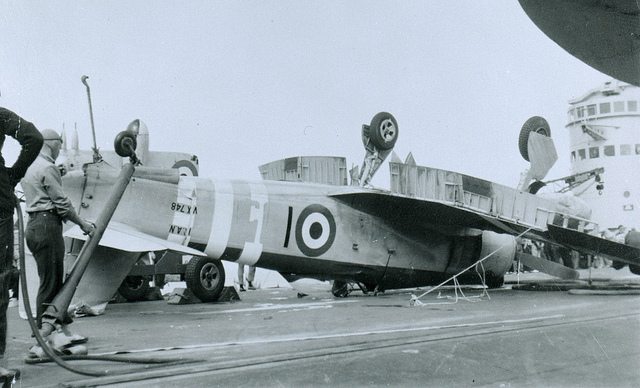
The Flickr photostream from Horatio J. Kookaburra is always worth a visit, some great shots, click to visit
The post Royal Australian Navy Photo Archive appeared first on Think Defence. |


