
|
Naval Today >> The industry’s seaborne news provider by Naval Today / 11h // keep unread // hide // preview
Kawasaki Heavy Industries, Ltd. held a ceremony marking the launch of the submarine Kokuryu, which was built for the Japan Ministry of Defense (MOD) at its Kobe Works’ first dock. The ceremony was attended by a delegation of top JDA officials.The submarine is the 6th Soryu class submarine built by Kawasaki, and the 26th built at this shipyard after World War II.
It provides superior submerged operations and propulsion performance, and uses high tensile steel for its hull. It also has Stirling engines for increased underwater endurance, a variety of automated systems, improved surveillance capabilities using high-performance sonar, increased stealth capabilities and enhanced safety measures. Follow Naval Today via:
          
+TAG
|
|||||||||||||||||||||||||||||||


Shell Floats Hull for World’s Largest Floating Facility
MarineLink.com
Tuesday, December 03, 2013, 9:12 AM

Photo: Shell
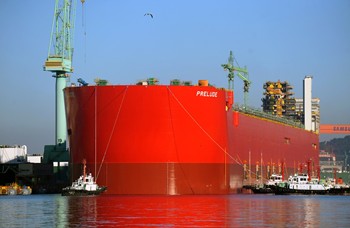
The 488-meter-long-hull of Shell’s Prelude floating liquefied natural gas (FLNG) facility has been floated out of the dry dock at the Samsung Heavy Industries (SHI) yard in Geoje, South Korea, where the facility is currently under construction. Prelude will unlock new energy resources offshore and produce approximately 3.6 million metric tons of liquefied natural gas (LNG) per annum (mtpa) to meet growing demand, 1.3 mtpa of condensate and 0.4 mtpa of LPG. and to remain on location for approximately 25 years.
Once complete, Prelude FLNG will be the largest floating facility ever built, longer than four soccer fields laid end to end and longer than the Empire State Building is tall. The FLNG facility will weigh more than 600,000 metric tons fully loaded, displacing the same amount of water as six of the world’s largest aircraft carriers. Its LNG storage tanks have a capacity equivalent to approximately 175 Olympic swimming pools.
“Making FLNG a reality is no simple feat,” said Matthias Bichsel, Shell Projects & Technology Director. “A project of this complexity – both in size and ingenuity – harnesses the best of engineering, design, manufacturing and supply chain expertise from around the world. Getting to this stage of construction, given that we only cut the first steel a year ago, is down to the expert team we have ensuring that the project’s critical dimensions of safety, quality, cost and schedule are delivered.”
FLNG will allow Shell to produce natural gas at sea, turn it into liquefied natural gas and then transfer it directly to the ships that will transport it to customers. It will enable the development of gas resources ranging from clusters of smaller more remote fields to potentially larger fields via multiple facilities where, for a range of reasons, an onshore development is not viable. This can mean faster, cheaper, more flexible development and deployment strategies for resources that were previously uneconomic, or constrained by technical or other risks.
Prelude FLNG is the first deployment of Shell’s FLNG technology and will operate in a remote basin around 475 kilometers north-east of Broome, Western Australia for around 25 years. The facility will remain onsite during all weather events, having been designed to withstand a category 5 cyclone.
Shell is the operator of Prelude FLNG in joint venture with INPEX (17.5%), KOGAS (10%) and OPIC (5%), working with long-term strategic partners Technip and Samsung Heavy Industries (the Technip Samsung Consortium).
shell.com
 Photo: Shell

Share this:

Eastern Delivers PSV to Brazil’s Bravante Group
MarineLink.com
Tuesday, December 03, 2013, 10:15 AM

Bravante V (Photo: Eastern Shipbuilding)
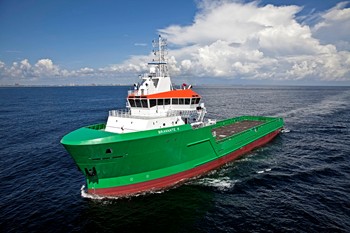
Eastern Shipbuilding Group, Inc. announced the delivery of the M/V Bravante V (Hull 155) on Friday November 29, 2013, to Boldini S.A., Bravante Group of Brazil.
The Bravante V is the first STX SV290 design of five vessels in a series which are all ABS, SOLAS, DPS-2, AC Diesel-Electric powered, twin Z-drive propelled PSV’s measuring 284’(86.5m) x 60’(18.3m) x 24’-6”(7.5m). These high-tech vessels feature four Cummins QSK-60DM 16-cylinder turbo-charged IMO Tier II diesel generator engines each rated at 1825 kW at 1,800 rpm. Cummins also furnished the four Marathon Model 744 690VAC main generators. Main propulsion power is provided by two 690VAC electric motors driving two Schottel Combi-Drives SCD 2020 Single Fixed Pitch Propellers with Nozzles rated at 2,500 kW at 750 rpm each for a total of 6,700 Hp. Schottel also provides two STT 4 Fixed Pitch Reversing Tunnel Thrusters rated at 1,180 kW at 1,170 rpm, each with direct coupled Hyundai 690VAC electric motors. GE Energy provides the complete system integrated diesel electric package, including the thruster drives, motors, control systems, DP system, switchboards, motor control centers, automation and navigation/ communication electronics. These vessels are capable of a maximum speed of 14 knots with a cruising speed of 12 knots. The fully integrated bridge is arranged for increased visibility and features the latest technology in navigation, communication equipment.
The Bravante V is the first of five in a series of Platform Supply Vessels under contract, each with below-deck segregation capacities:
- Total Fuel Oil Capacity: 442,675 USG (1,600m³)
- Fuel Oil Day-tanks: 62,608USG (237m³)
- Drill Water/Ballast Capacity: 513,550 USG (1,944 m³)
- Potable Water Capacity: 26,575 USG (100.6 m³)
- Drill/Brine Water Capacity: 5,030 Barrels (800m³)
- Fuel/Liquid Mud Capacity: 5,030 Barrels (800m³)
- Dry-bulk Mud: 8,631 Cubic Feet (244m³)
- Clear Deck Area: 9,494 Square Feet (882m²)
All five vessels under contract are Marshal Island Flag, IMO/SOLAS, ABS Classed A1, Offshore Support Vessel Ocean Service, Loadline, AMS, ACCU, Circle E, with additional ABS Class notations UWILD, ENVIRO, DPS-2.
STX Canada Marine and Eastern Shipbuilding provided the design for these vessels from the very successful and proven Eastern Shipbuilding Tiger Shark Class Series. Eight other Offshore Supply Vessels in this series have been delivered to Eastern’s clients and have already proven themselves in worldwide operations.
Eastern Shipbuilding Group is currently under contract constructing a total of sixteen vessels of similar size and complexity for customers here in the United States and in Brazil. These contracts will maintain Eastern’s reputation as the largest OSV/PSV and MPSV new construction shipyard in North America.
easternshipbuilding.com
 Bravante V (Photo: Eastern Shipbuilding)

Share this:

Australia’s Largest Research Vessel Ready for Launch

Posted by Eric Haun
Tuesday, December 03, 2013, 10:59 AM

Australia’s new research vessel, Investigator
At the end of 2013, the team of Sembawang Shipyard of Singapore and Teekay Shipping Australia will hand over the new scientific Research Vessel Investigator to her owners, the Commonwealth Scientific and Industrial Research Organization (CSIRO), an agency of the Federal Government of Australia.
The Investigator will be among the most capable and quietest non-naval research vessels in the world. It will serve Australia in diverse scientific operations ranging over an area from the equator to the ice shelf of Antarctica and spanning almost 1/3rd of the circumference of the globe. An area this large is hugely diverse and the types of research to be undertaken are numerous and demanding, resulting in the need for a very flexible, capable and seaworthy research vessel.
The “design and build” contract for construction of this ship was awarded to a team led by Teekay Shipping Australia and Sembawang Shipyard of Singapore. The design was developed by RALion, a joint venture between Vancouver BC Naval Architects, Robert Allan Ltd, Alion Science and Technology of Alexandria, Virginia and Alion Canada of Ottawa. The contract was awarded to this international team in January 2011. An extensive program of model testing and design work was completed by November of that year. The vessel was launched on July 21st, 2013 and then officially named Investigator at a ceremony in Singapore on September 5th.It is due to be completed and turned over to the Owners at the end of 2013.
Investigator has been designed to handle the heat and humidity of the tropics and the cold and ice of Antarctica while working safely and effectively in the broad expanse of the Great Southern Ocean separating these extremes. This ice capable vessel has also been designed to meet the underwater radiated noise requirements of the DNV “Silent R” notation up to 11 knots – a capability that enables her to undertake the most sensitive types of environmental research.
Investigator is fitted out with a full range of scientific laboratories, science and fishing winches, coring equipment, air and water sampling devices, and acoustic systems. It is capable of general-purpose oceanographic survey operations in coastal and deep ocean areas, including the physical, chemical and biological oceanography, multi-discipline environmental investigations, ocean engineering and marine acoustics, coastal hydrographic survey, marine geology and geophysics, bathymetric surveys and fisheries research.
In support of these missions, the ship is extensively equipped to perform all the following tasks:
- Acoustic habitat mapping
- Acoustic surveys in support of bathymetric, geomorphological and biological research using a combination of hull-mounted, drop keel mounted, and towed transducers
- Acoustic surveys of marine species
- Acquiring geological samples of the ocean bottom in depths of up to 5000 m
- Acquisition of benthic samples of the ocean bottom at depths up to 6500 m
- Acquisition of up to 20-30 m core samples of the ocean bottom at depths up to 7000 m
- Bottom trawling to depths of up to 4000m
- Calibration of ship mounted transducers
- Conduct horizontal or oblique plankton tows over the stern or over the side of the Vessel
- Conduct oceanographic sampling with rosettes of up to 36 bottles and CTD instrument packages to >6500 m depth while continuously sounding
- Freeze and cold store samples for further analysis at shore based facilities
- Launch / tow / retrieve a broad variety of active and passive sensors and sensor platforms including magnetometers, hydrocarbon sniffers, sonar tow fish, AUVs and UUVs
- Launch/tow/retrieve a variety of egg, larval, juvenile and adult fish sampling systems
- Marine mammal and seabird enumeration, identification, tracking, and bio assessment
- Mid-water and surface trawling
To accomplish the scientific missions above, the Investigator is fitted with a gondola and two retractable drop keels to house the extensive scientific sonar and transducer suites, supplied by Kongsberg. The vessel is fitted with a stern ramp to support fisheries research activities.
The Investigator is classed by Lloyds Register of Shipping with the following notation:
+100A1, +LMC, UMS Ice 1C IWS, EP, Research Vessel, DP (AM) and DNV SILENT-R.
The principal design characteristics of this ship are as follows:
- Length Overall: 93.9 meters
- Beam: 18.5 meters
- Depth to Main Deck: 9.45 meters
- Draft: 5.7 meters
- Draft, Navigational: 6.9 meters (to bottom of gondola)
- Complement: 60 (including scientists)
- Vessel Speed: 15 knots, fully loaded in Sea State 2
- Range: 10,800 nautical miles
- Endurance: 60 days
The vessel is twin screw, powered by an integrated diesel – electric propulsion and ship service plant provided by L3 Marine Systems. Three Mak 9M25C diesel generators provide a total electrical output of 9 MW at 690V. To meet the noise requirements of DNV Silent R notation, all three diesel generators are double resiliently mounted on araft system engineered by RALion and supplied by Mak. The L3/Indar 690V AC 2600 kW propulsion motors feature a resiliently mounted rotor and other design features to meet the noise requirements. These propulsion motors are believed to represent the first use of AC motors of this size range in a research vessel to meet DNV Silent-R requirements. Wartsila provided the 3.5m diameter 5-bladed propellers, which are specially designed to be cavitation free at 11 knots, and the complete shaft-line from motors to propeller. The ship is also equipped with an azimuthing, retractable bow thruster, Thrustmaster model TH1500MLR, rated at 1200 kW and with Becker Flap type high lift rudders, all creating a vessel with much enhanced maneuverability at low speeds.
- First Platform Deck: scientist’s accommodation forward; stores and transceiver room midships, and control room, switchboard room, winch room and container hold aft
- Main Deck: contains all the science labs, CTD lab offices and workshops and is the primary working deck
- Forecastle Deck: crew accommodation, galley, mess, lounge spaces and galley stores, with the upper level CTD lab and CTD winch spaces aft and enclosed anchor and mooring space forward
- 02 Deck Level: senior crew, offices, hospital, chemistry lab, and boat deck
- 03 and 04 Decks: Senior Officers and Sr. Scientist accommodations and offices
- Wheelhouse: the large and extensively equipped bridge is located above a full height plenum on taining bridge equipment and HVAC system
The complete suite of fisheries, scientific, and ship’s deck equipment was supplied by Rapp-Hydema, including an array of coring, trawling, towing, general purpose, CTD deployment, drum, and anchor/capstan electric winches. Triplex AS, a Rapp-Hydema subsidiary, supplied the coring boom, pipe handler, over stern A-frame, and CTD Overhead crane. The aft deck is serviced by a Bergen DKF300 Main Crane, with a capacity of 25 metric toes at 12m, or 5 metric tons at 20m. In addition there are also a Bergen DKF40 utility crane and a Bergen DKF70 stores crane fitted.
Roll stabilization on the ship is provided by a U-Tube tank system designed by HOPPE.
Robert Allan Ltd. and Alion Science and Technology are very proud to have been selected to design the Investigator, and the entire teaming arrangement with Teekay and Sembawang has proven extremely successful. This remarkable vessel will be the new benchmark for research vessels worldwide. The vessel enters service, fully commissioned, less than three years after award of the design and construction contract; a remarkable feat given the size and complexity of this ship.
ral.ca

Share this:

Ten thousand thank-yous for Illustrious after first week on typhoon mission

3 December 2013
HMS Illustrious has delivered food to more than 10,000 people during her first week helping people in the Philippines hit by Typhoon Haiyan.
The carrier’s helicopters have collectively clocked up one and a half weeks in air ferrying tonnes of supplies around, including makeshift shelters, tools and fresh water.

Pictures: PO(Phot) Ray Jones and LA(Phot) Nicky Wilson, HMS Illustrious
MORE than 10,000 people have been given food for seven days – just one headline statistic from the first week’s efforts in the Philippines by the men and women of HMS Illustrious.
During seven intense days of flying by the aircraft carrier’s Royal Navy and Army Air Corps helicopters, and all-out efforts on the ground and on the ship to sort out aid and deliver it, 130 tonnes of food, tools and makeshift shelters have been landed in half a dozen remote islands whose communities were badly hit by Typhoon Haiyan.
The carrier’s flight deck has been operating constantly since she arrived in the Philippines on November 25 following a 6,000-mile journey from the Horn of Africa where the ship had been chasing down pirates.
After briefly stocking up with 500 tonnes of supplies of UK aid loaded in Singapore, turning the man o’war into a ‘floating warehouse’ of emergency supplies, the Portsmouth-based helicopter carrier took over from HMS Daring, which spent ten days around the islands of the Visayan Sea.

Filipinos have been quick to show their gratitude for the assistance – from islanders crowding around the sailors delivering aid to messages of thanks hung from buildings (and even tree trunks) or spelled out on beaches (using old clothes).
And from children on the island of Sicogon, a thank-you letter “to the members of the Royal Navy”.
May you continue to help and served [sic] as an inspiration to all people, especially those who are less fortunate, not only in our country but also those who are in need from the whole world.
GOD BLESS YOU ALL!!
In her first week on station in the region as part of Operation Patwin, the UK military’s response to the typhoon, HMS Illustrious has delivered 356 pallets of supplies (roughly 130 tonnes of stores) including:
- 2,048 family food packs (each enough to feed a family of five for one week);
- 5,400 pieces of tarpaulin;
- 46 debris clearance packs (shovels, wheelbarrows, hammers, saws, tarpaulins, rice bags and assorted tools)
- 1,500 litres of water to those islands where they do not have a fresh water supply.
It’s not just the size of the ship and the amount of aid she can carry which are important, but the Fleet Air Arm Merlin and Sea King and Army Air Corps Lynx helicopters which have really made a difference.

Combined they have flown 252 hours in Illustrious’ first week in the Philippines, performing 227 sorties with loads slung beneath them to deliver aid in large quantities to inaccessible areas.
“After five days of intensive air operations, December 1 was the most active day so far. Five helicopters transported 40 tonnes of stores in 61 under-slung loads, with 50 sorties taking freight and landing our teams and DfID officials ashore,” said Cdr Nick Walker, Commander Air – in charge of all flying operations about Illustrious.
”I don’t think there has been a busier day on the Flight Deck since Illustrious converted to a helicopter carrier in 2010.”
The 800-plus sailors, soldiers – both Army Air Corps and Royal Engineers – and Royal Marines of Juliet Company 42 Commando have around 11 hours of daylight to do the majority of the work on the ground.

But the work doesn’t stop when the sun goes down. In Lusty’s cavernous hangar, teams of personnel have been working around the clock to sort and pack the much needed supplies ready for the daylight hours to be distributed ashore.
“Although the majority of the flying occurs in daylight hours, supporting the air effort with aircraft maintenance, deck and load preparations and planning and briefing is a 24-hour operation,” said Cdr Walker.
“I am immensely proud of all those involved and what they have enabled the Air Group to achieve for the people of the Philippines.”
Alongside food aid and equipment distribution on numerous islands, there have been opportunities for soldiers, sailors and Royal Marines to get stuck in with repair projects: fixing generators, buildings, fishing boats, plus clearing debris on six islands to allow the local populace to get back to providing for themselves.
On the islands of Calagnaan, Binaluangan and Gigante, teams of engineers repaired the school roofs, providing shelter from the sun and rain for the children, and allowing lessons to return to normal.

Gigante was also provided with two generators; one of which is up and running providing power to the school. On the islands of Sicagon and Binaluangan, medical teams from International Emergency Trauma Register (UK-Med) set up a clinic for islanders whose nearest hospital is several hours away by boat.
Lt Cdr Andy Reeves led the team repairing the school roof of Bito-on, Calagnaan Island.
“It’s a huge honour to be involved in this kind of operation,” he said. My team and I have found it incredibly rewarding to be able to make a difference on the ground to the people of the Philippines who have been through so much in the last few weeks.”
Illustrious is remaining in the Philippines as she continues her relief work, focusing her efforts on the island clusters around the central isle of Panay to assess what is needed and continue providing vital assistance to local communities.
Navy NewsDigital Edition


