Nigerian Navy plans further acquisitions in 2014

Written by Guy Martin, Monday, 02 December 2013

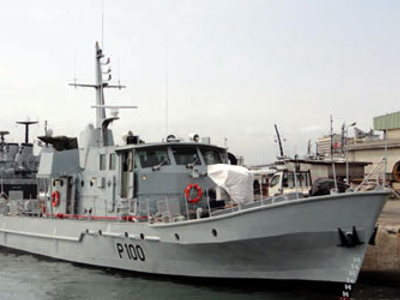
The first Seaward Defence Boat of the Nigerian Navy NNS Andoni.The Nigerian Navy will take delivery of a number of new vessels next year as it attempts to reduce maritime crime, oil theft and attacks on ships, according to its recently released Strategic Guidance document.

Vice Admiral Dele J Ezeoba, Chief of Naval Staff, said that on assuming office in October 2012, he was committed to repositioning the Nigerian Navy, improving capability for internal security and policing the Gulf of Guinea. As a result, a first Chief of Naval Staff Strategic Guidance document (CNS SG-01) was issued in October last year.

According to Ezeoba, 90% of SG-01’s objectives have been completed. Significant progress has been made on fleet reactivation and recapitalisation, with the availability of operational vessels increasing from 35% to 70% within a year, according to SG-02, released late last month.

Over the last year the Nigerian Navy took delivery of three OCEA patrol boats, three Manta Fast Patrol Boats and two Shaldag patrol craft. Construction is ongoing on two Chinese offshore patrol vessels, one of which will be built in China and the other to be completed at the Naval Shipyard in Nigeria. Nigeria’s naval dockyard is also building a 38 metre Seaward Defence Boat. The Navy is also refitting the NNS Ekun fast attack craft, NNS Ohue and NNS Barama minesweepers and will soon refit the NNS Yola and NNS Brass patrol craft. In addition, three inshore patrol craft will be reactivated.

On the operational side, the Nigerian Navy continued with patrols and reactivated a number of Regional Maritime Awareness Capability Centres and is setting up new sites to improve its maritime domain awareness. Operational successes listed for the previous year up to October 2013 included the apprehension of 33 vessels and 2 278 suspects over oil theft, the destruction of 2 417 illegal oil refineries, 137 barges and 2 032 boats, according to SG-02.

While Ezeoba said that the Navy can be proud of its achievements over the last year, there is room for improvement, hence the creation of SG-02. The Navy wants to clamp down on problems like oil theft, illegal oil bunkering, piracy, robbery at sea and attacks on ships. Ezeoba stated that solving these problems is necessary for Nigeria’s economic prosperity, as it relies heavily on its offshore and onshore oil reserves.

Strategic Guidance 02 expands on the previous document’s objectives, notably improving Navy capacity and domestic and regional security. Short term goals to be accomplished in the next six months include acquiring five K13 inshore patrol vessels, ensuring operational availability of at least four Navy helicopters, establishing a Fishery Protection Patrol Squadron in collaboration with the agriculture ministry, Nimasa and other stakeholders, and improving Navy logistics and training.

Medium term goals (over the next 12 months) include the acquisition of the ex-US Coast Guard cutter USCGC Gallatin, the completion and commissioning of the first Chinese-built OPV and domestic assembly of the second Chinese OPV, commissioning of the second domestic Seaward Defence Boat, completion of the refit of NNS Brass and NNS Yola and the refit of the frigate NNS Aradu, the fast attack craft NNS Siri, Ayam and Damisa. The refit of the fast patrol boat NNS Ekpe, Ekun and minesweepers NNS Ohue and NNS Barama are also expected to be completed in this period.

“All hands must be on deck to ensure the attainment of the objectives set out in this Strategic Guidance 02 in fulfilment of the desired end state of defending and protecting Nigeria’s territorial integrity whilst contributing to the economic prosperity and national development of Nigeria,” Ezeoba concluded.

US Sends Submarine-hunting Jets to Japan

News / USA

FILE - A P-8A Poseidon surveillance plane conducts flyovers above the Enterprise Carrier Strike Group in this handout photo courtesy of the U.S. Navy, Feb. 3, 2012.

FILE – A P-8A Poseidon surveillance plane conducts flyovers above the Enterprise Carrier Strike Group in this handout photo courtesy of the U.S. Navy, Feb. 3, 2012.
TEXT SIZE
Reuters

December 02, 2013

TOKYO — The U.S. Navy’s first two advanced P-8A Poseidon patrol aircraft have arrived in Japan, U.S. military officials said on Monday, helping to upgrade America’s ability to hunt submarines and other vessels in seas close to China as tension in the region mounts.

The initial deployment – another four of the aircraft are due to arrive in the coming days – was planned before China last month established an air defense identification zone covering islands controlled by Japan and claimed by Beijing.

The Pentagon says it is routinely flying operations in the region, including in China’s newly declared air defense zone, without informing Beijing ahead of time.

One U.S. defense official, speaking on condition of anonymity, told Reuters these routine operations include surveillance flights.

The deployment of the P-8As came before U.S. Vice President Joe Biden left for Asia this week, where he is seeking to strike a balance between calming military tensions with China and supporting Japan as it wrangles with Beijing over the islands.

The P-8As, built by Boeing Co. based on its 737 passenger plane, were been built to replace the aging propeller-powered Lockheed Martin P-3 Orion patrol aircraft, which have been in service for 50 years.

Equipped with the latest radar equipment and armed with torpedoes and anti-ship missiles, the P-8A is able to fly further and stay out on a mission longer than the P-3.

“The P-8A is the most advanced long-range anti-submarine and anti-surface warfare aircraft in the world,” the Pentagon said.

Lieutenant Colonel Jeffrey Pool, a Pentagon spokesman, said the first two P-8As arrived in Japan on Sunday. The other four were expected to arrive there later this week, a Navy spokeswoman said.

One U.S. official, speaking on condition of anonymity, acknowledged the deployment came at a moment of regional tensions. The official said the timing was a coincidence, but one that would bolster the U.S. military’s efforts to monitor the maritime environment in the region.

That includes the area around the disputed islands, known to the Japanese as the Senkakus and to the Chinese as the Daioyu, the official said.

Washington takes no position on the sovereignty of the islands. However, it recognizes Tokyo’s administrative control and says the U.S.-Japan security pact applies to them, a stance that could drag the United States into a military conflict it would prefer to avoid.


1st of 3 Norfolk-based Navy ships heading to Fla.

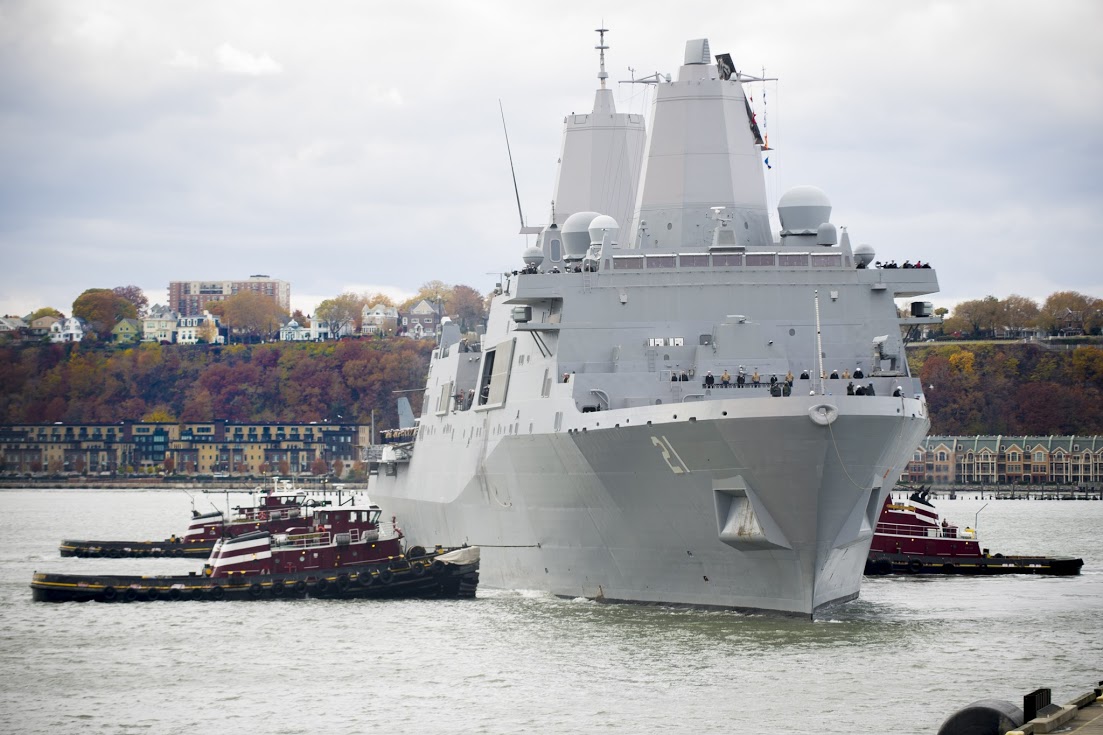
NORFOLK, Va. (AP) — The first of three Virginia-based Navy ships is heading to a new homeport in Florida this week.

The amphibious transport dock USS New York will leave Norfolk Naval Station on Wednesday and move to Mayport Naval Station in Jacksonville, Fla.

The Virginian-Pilot reports (http://bit.ly/1gijAPd ) that the amphibious assault ship USS Iwo Jima and the dock landing ship USS Fort McHenry will move to Mayport in 2014.

The Iwo Jima is undergoing work at a Norfolk shipyard. The Fort McHenry currently is based at Joint Expeditionary Base Little Creek.

The New York has a crew of about 350 sailors.

The Fort McHenry has about 400 sailors


The Iwo Jima has about 1,100 sailors.

USS Nitze Embarks on Seven-Month Deployment

Naval Today >> The industry’s seaborne news provider by Naval Today  /  8h  //  keep unread  //  hide

USS Nitze Embarks on Seven-Month Deployment
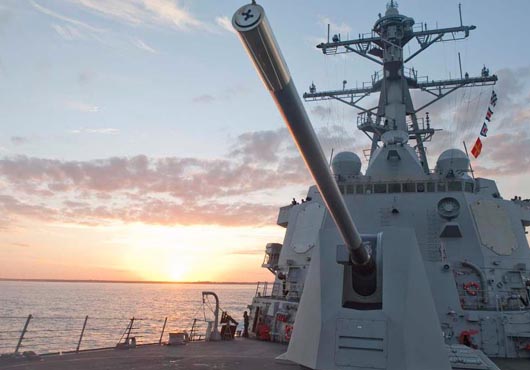
The Arleigh Burke class guided-missile destroyer, USS Nitze (DDG 94), departed Nov. 29 on a seven-month deployment to the 6th Fleet area of operations.

The ship will conduct maritime security operations and theater security cooperation efforts in and around the waters of Europe and Africa.

“The U.S. Navy has routinely deployed throughout Europe and Africa to promote peace, regional cooperation and security. Nitze will continue to do its part to help ensure this is maintained,” said Cmdr. John Bub, commanding officer.

This is the ship’s fourth deployment since her 2005 commissioning. Nitze deployed with the Enterprise Carrier Strike Group to the Mediterranean and Arabian Seas in last March and returned Nov. 4, 2012.

The ship is capable of firing surface-to-air missiles and Tomahawk cruise missiles from forward and aft vertical launching systems and is configured with port and starboard torpedo tubes, one five-inch gun; and advanced electronic warfare systems. Nitze will deploy with more than 220 Sailors and civilians.

DDG 94′s name honors Paul H. Nitze, whose career included serving as the 57th Secretary of the Navy from 1963 to 1967. He also served as Deputy Secretary of Defense, was a member of the U.S. delegation to the Strategic Arms Limitation Talks (SALT) and Assistant Secretary of Defense for International Affairs. In 1984, Nitze was named special advisor to the President and Secretary of State on Arms Control. President Reagan awarded him the Presidential Medal of Freedom in 1985 for his contributions to the freedom and security of the United States.
Press Release, December 02, 2013; Image: US Navy

Follow Naval Today via:

Facebook

Twitter

RSS

Email

Linkedin

Visit Website

Share on Google PlusTwitterFacebookLinkedInBufferFacebookCustom Sharing Tool
Evernote

+TAG

YOUR US Navy Operating Forward – Pacific Ocean, Philippine Sea, Gulf of Oman, Mediterranean Sea

Right now your Navy is 100 percent on watch around the globe helping to preserve the American way of life. Whether it be operating and training off the coast of California or forward deployed to the Mediterranean Sea, the flexibility and presence provided by our U.S. naval forces provides national leaders with great options for protecting and maintaining our national security and interests around the world. The imagery below highlights the Navy’s ability to provide those options by operating forward.

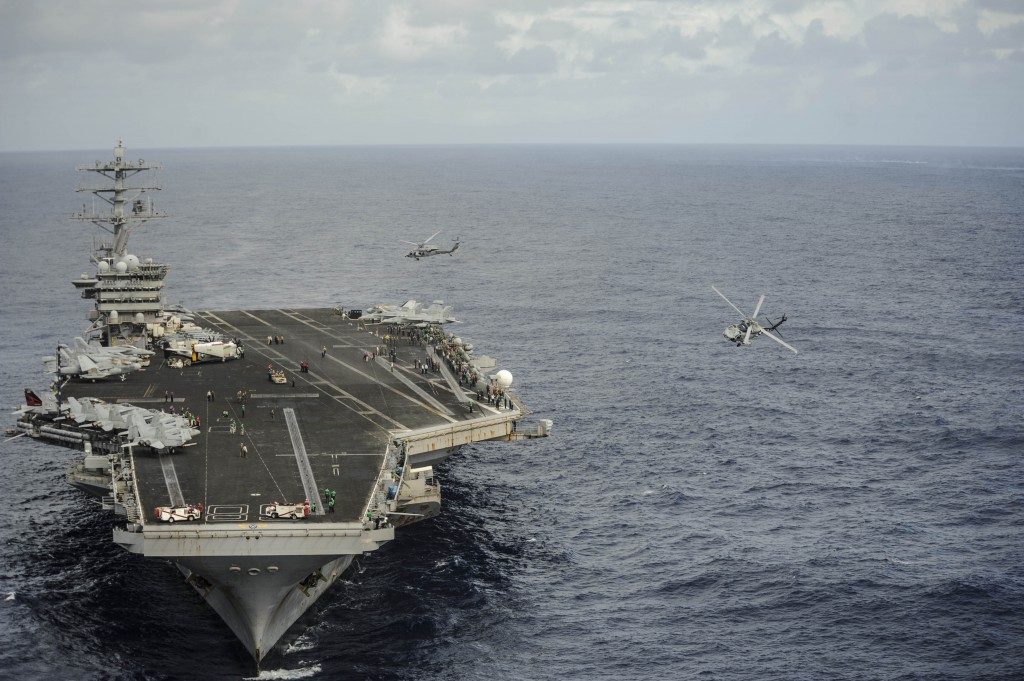
An MH-60R Sea Hawk helicopter, right, and an MH-60S Sea Hawk helicopter, participate in a fly-by performance past the aircraft carrier USS Nimitz (CVN 68) in the Pacific Ocean.An MH-60R Sea Hawk helicopter, right, and an MH-60S Sea Hawk helicopter, participate in a fly-by performance past the aircraft carrier USS Nimitz (CVN 68) in the Pacific Ocean.

Lt. Caleb McDonald, a shooter assigned to the aircraft carrier USS George Washington (CVN 73), launches an F/A-18E Super Hornet during the Carrier Air Wing (CVW) 5 fly-off in the Philippine Sea.Lt. Caleb McDonald, a shooter assigned to the aircraft carrier USS George Washington (CVN 73), launches an F/A-18E Super Hornet during the Carrier Air Wing (CVW) 5 fly-off in the Philippine Sea.

Sailors fight a simulated fire during a general quarters drill in the hangar bay of the aircraft carrier USS Harry S. Truman (CVN 75) in the Gulf of Oman.Sailors fight a simulated fire during a general quarters drill in the hangar bay of the aircraft carrier USS Harry S. Truman (CVN 75) in the Gulf of Oman.

The littoral combat ship USS Freedom (LCS 1) conducts a passing exercise with the Bangladesh navy frigate BNS Somudro Joy (F-28) in the Pacific Ocean. The littoral combat ship USS Freedom (LCS 1) conducts a passing exercise with the Bangladesh navy frigate BNS Somudro Joy (F-28) in the Pacific Ocean.

A helicopter with the Japan Maritime Self-Defense Force lifts off from the aircraft carrier USS George Washington (CVN 73) during Annual Exercise (AE) 13 in the Philippine Sea.A helicopter with the Japan Maritime Self-Defense Force lifts off from the aircraft carrier USS George Washington (CVN 73) during Annual Exercise (AE) 13 in the Philippine Sea.

Seaman Recruit Thomas Hyatt, right, deploys a Mk-58 smoke marker while Boatswain's Mate 2nd Class Errol Brown observes during a man overboard drill aboard the guided-missile cruiser USS Monterey (CG 61) in the Mediterranean Sea. Seaman Recruit Thomas Hyatt, right, deploys a Mk-58 smoke marker while Boatswain’s Mate 2nd Class Errol Brown observes during a man overboard drill aboard the guided-missile cruiser USS Monterey (CG 61) in the Mediterranean Sea.

An F/A-18C Hornet launches from the aircraft carrier USS Harry S. Truman (CVN 75) to support coalition forces in Afghanistan.An F/A-18C Hornet launches from the aircraft carrier USS Harry S. Truman (CVN 75) to support coalition forces in Afghanistan.


Visit Website

Share on Google PlusTwitterFacebookLinkedInBufferFacebookCustom Sharing Tool
Evernote

+TAG

JCs Royal New Zealand Navy Ships and New Zealand Defence, Also other World Defence Updates

Ships and Defence News Past and Present

Skip to content ↓