HMAS Melbourne gets timely reminder of piracy dangersHMAS Melbourne near MV Albedo,…

HMAS Melbourne gets timely reminder of piracy dangers

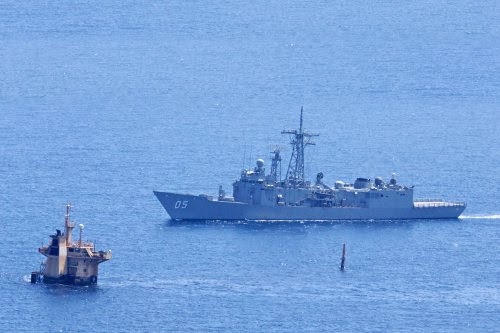
HMAS Melbourne near MV Albedo, a sunken merchant vessel, off the coast of Somalia.
Fresh from their successful interdiction of suspected Somali pirates in October, the crew of the Royal Australian Navy frigate HMAS Melbourne has experienced a sombre reminder of the consequences of piracy when the ship came across the wreckage of the merchant vessel MV Albedo, almost three years to the day since its violent capture and subsequent sinking. 

http://news.navy.gov.au/en/Nov2013/Operations/658

Posted: 11/28/2013

By: Paul Armstrong
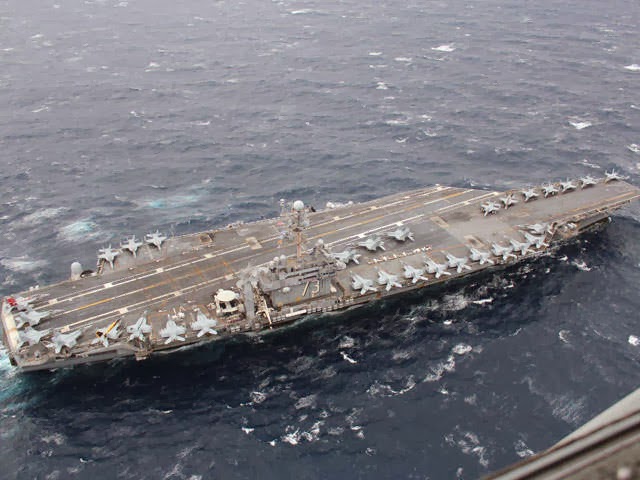
USS GEORGE WASHINGTON, East China Sea (CNN) — The deafening roar of state-of-the-art warplanes being catapulted into the air from its huge flight deck signaled that the USS George Washington was back in combat mode after its recent detour to the Philippines to take part in the aid effort in the wake of Super Typhoon Haiyan.
Barely a week on and the 90,000-ton Nimitz-class aircraft carrier is now patrolling waters off the island of Okinawa as part a huge naval exercise — AnnualEx 2013 — involving dozens of warships, submarines and aircraft from the U.S. Navy's 7th fleet and the Japan Maritime Self-Defense Force (JMSDF).
The aim? To provide a stern test of their ability to effectively and mutually respond to the defense of Japan or to a regional crisis or contingency situation in the Indo-Asia-Pacific region, according to the U.S. Navy.
But this year's war games have taken on an added dimension given the high-pressure atmosphere in the region at present — they take place in the shadow of a controversial new Air Defense Identification Zone announced by the Chinese last weekend.
This zone, which incorporates among other areas an East China Sea island chain at the center of an acrimonious tug of war between Tokyo and Beijing, requires that all military aircraft in the area must report their flight plans to China, maintain two-way radio and clearly mark their nationalities on the aircraft. China has warned it will take "defensive measures" if their orders are ignored.
The commander of the U.S. 7th fleet, Vice Admiral Robert L. Thomas, appeared relaxed about the situation while addressing a group of reporters aboard the USS George Washington. He said while China's air defense zone did not appear to be "well thought out" given the overlap with both Japanese and South Korean territorial claims, he did not think U.S. military activity in the region would be negatively affected.
"We are going to continue with our operations in international airspace as we always have," he said. "It's about international norms, standards, rules and laws. When anybody makes an extreme claim it is really an imperative that the international community can continue to operate in accordance with international law and not be distracted.
"So for us it's 'steady as you go.' Our operations in the East China Sea will continue as they always have."
Japan, which administers the largely uninhabited island chain — known as Diaoyu by China and Senkaku by the Japanese — has described China's move as "a profoundly dangerous act that may cause unintended consequences in the area," while U.S. Secretary of State John Kerry said "this unilateral action constitutes an attempt to change the status quo in the East China Sea. Escalatory action will only increase tensions in the region and create risks of an incident."
READ: Why China's new air zone incensed Japan, U.S.
China has rebuffed any criticism by stating that its action is not directed at any one in particular, and that other countries — including Japan — have established similar control zones in the past.
In recent months, both sides have been involved in a dangerous game of "cat and mouse," prompting fears that any miscalculation could set the two Asian powers on a collision course — with the United States likely to be dragged into such a conflict to defend its Japanese ally. Tokyo says it has twice scrambled fighter jets this month after Chinese aircraft appeared on course to enter its airspace. For its part, China lodged a complaint after it said a Japanese warship recently entered waters where the People's Liberation Army (PLA) Navy was holding live-fire drills, noting "the provocative move may have led to unexpected emergencies."
Meanwhile, China's first aircraft carrier, the "Liaoning," set sail this week from its home port of Qingdao in eastern China. According to the PLA Navy's website, it will head for the South China Sea to "conduct scientific experiments and military training." This course would take it through the East China Sea accompanied by four other warships.
Yet with so many potential flashpoints in the region, Thomas is optimistic that conflict will be avoided. He pointed to the professionalism shown by the armed forces on all sides in the region as the basis for this confidence.
"The South Koreans have shown great restraint with regard to North Korea and those severe provocations, while the Japanese Self Defense Force has also been very measured," he said. Significantly, he pointed to China's development of a "world class" navy, with a level of professionalism that matches its improving infrastructure.
"The more confident they become in their own capabilities, then this will actually 'depressurize' the situation," he said. He added that the People's Liberation Army Navy was no longer an unpredictable, conscription-based force training only at certain times of the year.
He said the PLA Navy was now showing signs of being able to operate far beyond its own waters, carrying out

Read more: http://www.wptv.com/dpp/news/world/chinas-presence-looms-amid-massive-us-japanese-annualex-war-games#ixzz2m5toYM9K
Posted: 11/28/2013

By: Paul Armstrong
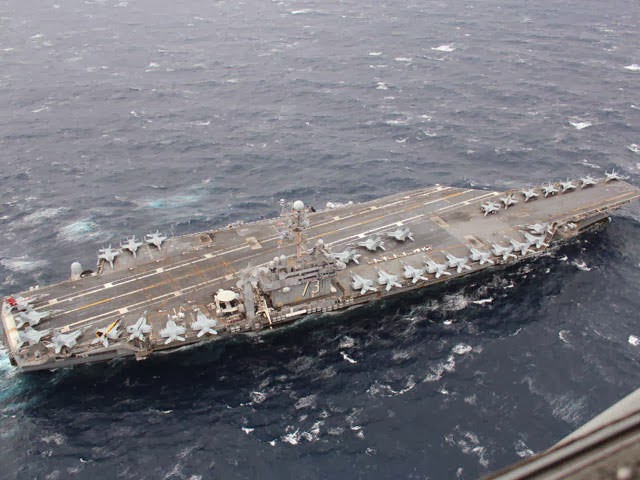
USS GEORGE WASHINGTON, East China Sea (CNN) — The deafening roar of state-of-the-art warplanes being catapulted into the air from its huge flight deck signaled that the USS George Washington was back in combat mode after its recent detour to the Philippines to take part in the aid effort in the wake of Super Typhoon Haiyan.
Barely a week on and the 90,000-ton Nimitz-class aircraft carrier is now patrolling waters off the island of Okinawa as part a huge naval exercise — AnnualEx 2013 — involving dozens of warships, submarines and aircraft from the U.S. Navy's 7th fleet and the Japan Maritime Self-Defense Force (JMSDF).
The aim? To provide a stern test of their ability to effectively and mutually respond to the defense of Japan or to a regional crisis or contingency situation in the Indo-Asia-Pacific region, according to the U.S. Navy.
But this year's war games have taken on an added dimension given the high-pressure atmosphere in the region at present — they take place in the shadow of a controversial new Air Defense Identification Zone announced by the Chinese last weekend.
This zone, which incorporates among other areas an East China Sea island chain at the center of an acrimonious tug of war between Tokyo and Beijing, requires that all military aircraft in the area must report their flight plans to China, maintain two-way radio and clearly mark their nationalities on the aircraft. China has warned it will take "defensive measures" if their orders are ignored.
The commander of the U.S. 7th fleet, Vice Admiral Robert L. Thomas, appeared relaxed about the situation while addressing a group of reporters aboard the USS George Washington. He said while China's air defense zone did not appear to be "well thought out" given the overlap with both Japanese and South Korean territorial claims, he did not think U.S. military activity in the region would be negatively affected.
"We are going to continue with our operations in international airspace as we always have," he said. "It's about international norms, standards, rules and laws. When anybody makes an extreme claim it is really an imperative that the international community can continue to operate in accordance with international law and not be distracted.
"So for us it's 'steady as you go.' Our operations in the East China Sea will continue as they always have."
Japan, which administers the largely uninhabited island chain — known as Diaoyu by China and Senkaku by the Japanese — has described China's move as "a profoundly dangerous act that may cause unintended consequences in the area," while U.S. Secretary of State John Kerry said "this unilateral action constitutes an attempt to change the status quo in the East China Sea. Escalatory action will only increase tensions in the region and create risks of an incident."
READ: Why China's new air zone incensed Japan, U.S.
China has rebuffed any criticism by stating that its action is not directed at any one in particular, and that other countries — including Japan — have established similar control zones in the past.
In recent months, both sides have been involved in a dangerous game of "cat and mouse," prompting fears that any miscalculation could set the two Asian powers on a collision course — with the United States likely to be dragged into such a conflict to defend its Japanese ally. Tokyo says it has twice scrambled fighter jets this month after Chinese aircraft appeared on course to enter its airspace. For its part, China lodged a complaint after it said a Japanese warship recently entered waters where the People's Liberation Army (PLA) Navy was holding live-fire drills, noting "the provocative move may have led to unexpected emergencies."
Meanwhile, China's first aircraft carrier, the "Liaoning," set sail this week from its home port of Qingdao in eastern China. According to the PLA Navy's website, it will head for the South China Sea to "conduct scientific experiments and military training." This course would take it through the East China Sea accompanied by four other warships.
Yet with so many potential flashpoints in the region, Thomas is optimistic that conflict will be avoided. He pointed to the professionalism shown by the armed forces on all sides in the region as the basis for this confidence.
"The South Koreans have shown great restraint with regard to North Korea and those severe provocations, while the Japanese Self Defense Force has also been very measured," he said. Significantly, he pointed to China's development of a "world class" navy, with a level of professionalism that matches its improving infrastructure.
"The more confident they become in their own capabilities, then this will actually 'depressurize' the situation," he said. He added that the People's Liberation Army Navy was no longer an unpredictable, conscription-based force training only at certain times of the year.
He said the PLA Navy was now showing signs of being able to operate far beyond its own waters, carrying out

Read more: http://www.wptv.com/dpp/news/world/chinas-presence-looms-amid-massive-us-japanese-annualex-war-games#ixzz2m5toYM9K

Cutting edge technology made at the Devonport Naval Base has been sold to the US…

Cutting edge technology made at the Devonport Naval Base has been sold to the US Navy.

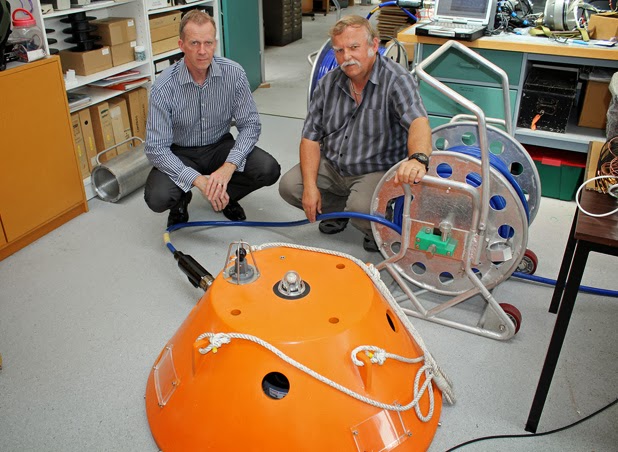
MILITARY MINDS: DTA director Brian Young, left, with trials officer Garry Armstrong who has been developing the diver training system in a workshop at the Devonport Naval Base.

The Defence Technology Agency, the science and technology arm of the New Zealand Defence Force, employs 80 civilian staff to cater to the needs of the army, navy and air force.

A move to commercialise intellectual property generated by the DTA, that began in November last year, has already borne fruit.

The US Navy bought six diver training systems and further inquiries have been made into new avionics technology.

The diver training systems, also known as METRES (Maritime EOD Training, Ranging and Evaluation Systems), are made up of a replica mine that sits on the seabed and reacts when divers approach it.

Sound, pressure and magnetic sensors trigger different reactions to mimic an exploding mine. If a diver does not approach it correctly The Last Post begins playing from the METRES' underwater speaker.

DTA director Brian Young says a 45-year alliance between international military forces, including the US, provides shared access to the minds of thousands of top defence scientists.

He says the US Navy's acquisition of the diver training systems is proof that New Zealand can produce world leading technology.

"Huge organisations like the US Department of Defense are working all the time to source the very best technologies available and in this case they have found that in what we have to offer."

While the sale has generated significant revenue, Dr Young says it is just a "byproduct of our main purpose, to ensure the safety of the New Zealand Defence Force".

The DTA base houses offices, labs, workshops and IT suites within a secure compound in Devonport.

As part of the commercialisation process DTA staff are developing avionics technology that can also be used in a non-military capacity, such as surveying crops, electricity lines and mine sites from within a small remote controlled aeroplane.

Upgrades are also taking place across the entire fleet of Anzac class frigates. Small scale models of the ships' bridge and operations rooms have been produced using 3D printing to help with the redesign.

Ad Feedback

– © Fairfax NZ News

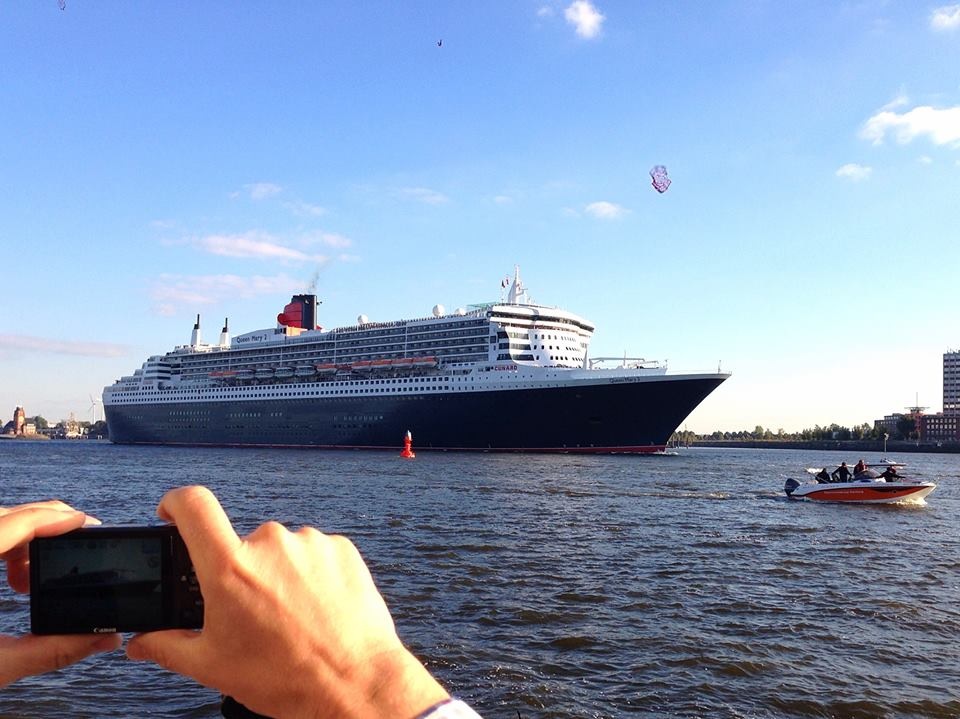
Queen Mary 2 yesterday in Hamburg at Teufelsbrück on her way towards Denmark!

Reshared post from +Sebastian Winkelmann

Queen Mary 2 yesterday in Hamburg at Teufelsbrück on her way towards Denmark!

JCs Royal New Zealand Navy Ships and New Zealand Defence, Also other World Defence Updates

Ships and Defence News Past and Present

Skip to content ↓