Singapore: RSS Endurance Sparks Public Interest at Vivocity

RSS Endurance

Naval Today >> The industry’s seaborne news provider by Naval Today  /  3h  //  keep unread  //  hide

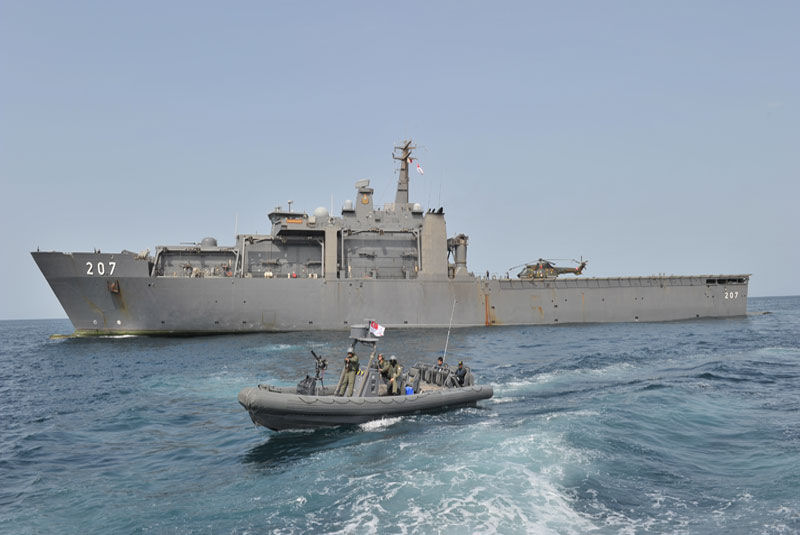
RSS Endurance Calls at Vivocity

The Republic of Singapore Navy’s (RSN) Endurance-class Landing Ship Tank, RSS Endurance, embarked with a Super Puma helicopter, was docked at VivoCity Promenade from 14 to 17 November 2013.

The event, Navy@Vivo, was launched by the Chief of Navy Rear-Admiral Ng Chee Peng. The public had a chance to visit RSS Endurance, which has been deployed for various Singapore Armed Forces overseas deployments. Some visitors also got the opportunity to ride onboard the RSN’s Fast Craft Utility.

   “My crew and I are looking forward to welcoming visitors to our ship and share with them our experiences during operations and exercises, both in Singapore and overseas,” said Commanding Officer of RSS Endurance, Lieutenant Colonel (LTC) Jason Yee.

Apart from the exhibitions and video screenings of the various missions and operations that the ship had undertaken, the public was also  able to witness the conduct of a ceremonial sunset – a long-standing naval tradition – at 6.45pm daily during Navy@Vivo. In addition, an exhibition within VivoCity illustrated how the RSN conducts its missions.
Press Release, November 28, 2013; Image: Singapore Navy

Follow Naval Today via:

Facebook

Twitter

RSS

Email

Linkedin

Visit Website

Share on Google PlusTwitterFacebookLinkedInBufferFacebookCustom Sharing Tool
Evernote

+TAG


US Coast Guard Helicopter Crew Hit by Laser Pointer Again

Naval Today >> The industry’s seaborne news provider by Naval Today  /  3h  //  keep unread  //  hide

US Coast Guard Helicopter Crew Hit by Laser Pointer Again

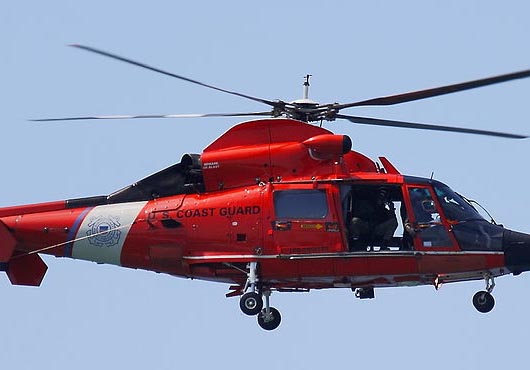
A Coast Guard helicopter crew was targeted by an individual with a laser pointer while flying in the vicinity of Waimanalo Bay on Oahu, Saturday.

The lased MH-65 Dolphin helicopter crew was conducting a search in response to an uncorrelated distress call when the incident occurred. Four crewmembers observed the laser sweeping the aircraft and one of the pilots was directly struck.

This is the fifth lasing incident within the last year at Coast Guard Air Station Barbers Point.

The Coast Guard is working with the Federal Aviation Administration and the Honolulu Police Department to investigate the incident.

“We were searching off Waimanalo following a received mayday call when we were hit by a green laser,” said Lt. Cmdr. Roger Barr, an MH-65 Dolphin helicopter pilot at Air Station Barbers Point. “We protected our eyes quickly enough to avoid being blinded, reported the incident, and were able to continue the mission. This was the air station’s first East Oahu lasing incident in recent years. The frequency of incidents locally and nationally is increasing at a dangerous rate and the public needs to know that when we are hit by a laser, we are no longer effective at finding that lost family member or friend.”

Laser pointers can cause glare, afterimage, flash blindness or temporary loss of night vision, all causing a great danger to the crew. If any aircrew member’s vision is compromised during a flight, Coast Guard flight rules dictate that the aircraft must abort their mission. If an aircrew member is lased it severely compromises their ability to fly the aircraft and complete the mission safely. In order to ensure their health, aircrew members are taken off flight duty until cleared by a flight surgeon before flying again. This hinders the Coast Guard’s ability to respond to people in distress, training, and homeland security missions.

It is a federal crime, as well as violation of most states’ laws to aim a laser pointer at an aircraft. If an individual is caught purposefully lasing an aircraft, punishment ranges from being arrested or having to pay a civil penalty of $11,000 for a single offense, to more than $30,000 if the individual has multiple offenses. People witnessing this crime are strongly encouraged to immediately call 911 to report the incident. The FAA tracks laser incidents by city, state and nationality and initiated about 95 civil penalty cases in 2011 nationwide.
Press Release, November 28, 2013; Image: Navy

Follow Naval Today via:

Facebook

Twitter

RSS

Email

Linkedin
Visit Website

Share on Google PlusTwitterFacebookLinkedInBufferFacebookCustom Sharing Tool
Evernote

+TAG

Australia: CEA Technologies Tasked with CEAFAR Radar Development

Naval Today >> The industry’s seaborne news provider by Naval Today  /  2h  //  keep unread  //  hide

CEA Technologies Tasked with CEAFAR Radar Development

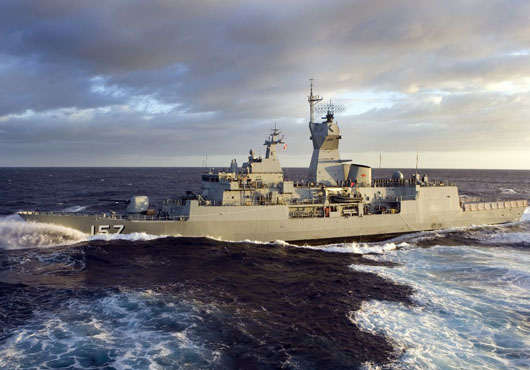
A Standing Offer contract has been awarded to Canberra based company CEA Technologies, to develop high powered Phased Array Radar technology, Australian Minister for Defence Senator David Johnston today announced.

The contract relates to development of systems based on the CEAFAR radar that would support a number of future Defence acquisitions.

 “The CEAFAR radar is currently being fitted to the ANZAC Class Frigates as part of a major upgrade,” Senator Johnston said.

The radar has proven to be a significant enhancement to self and local area defence against modern anti-ship missiles and has performed successfully in recent trials.

 “This radar is a world-leading capability for a system of its weight and size and importantly, is considerably more cost-effective than comparable systems,” Senator Johnston said.

“The development of high power phased array radar based on the CEAFAR system builds on the substantial investment in domestic radar-related research and development.”

Senator Johnston said the CEAFAR radar is a focus of the phased array radar element of the High Frequency and Phased Array Radar Priority Industry Capability (PIC).

 “The High Frequency and Phased Array Radar (PIC) defines world leading radar capabilities that are locally developed in Australia, providing effective capabilities in their respective operational environments, while the intellectual property stays here.”

CEA Technologies is an internationally recognised radar and communication systems supplier established by two former officers from the Royal Australian Navy in 1983.
Press Release, November 28, 2013; Image:CEA Technologies

Follow Naval Today via:

Facebook

Twitter

RSS

Email

Linkedin

Visit Website

Share on Google PlusTwitterFacebookLinkedInBufferFacebookCustom Sharing Tool
Evernote

+TAG

New Canadian Coast Guard Hovercraft Arrives

MarineLink.com

Wednesday, November 27, 2013
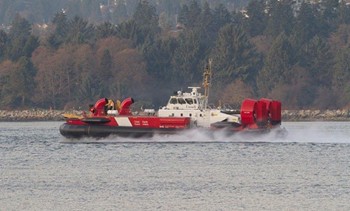
File CCGS Moytel: Photo courtesy of Canada Govt.
CCGS Moytel: Photo courtesy of Canada Govt.

Canadian Government ministers have announced the arrival in Canada of the new hovercraft to be stationed at Sea Island in Richmond, British Columbia – the ‘CCGS Moytel’.

The new hovercraft will be named the CCGS Moytel. Moytel is a Halq’emélem word meaning “to help each other.” Canadian Coast Guard vessels are given names that promote Canadian sovereignty, culture, geography and history.

As a replacement for the CCGS Penac, the new Moytel will be a heavy-duty, more versatile amphibious vehicle capable of patrolling inland waters. A larger more powerful vessel than theCCGS Penac, it has a greater range of capabilities and features including a bow ramp that will enable it to transport supplies such as rescue equipment and vehicles.

“Our investment in the CCGS Moytel, a world-class modern hovercraft, is another example of our Government’s commitment to ensure the safety of fishermen, recreational boaters, and sailors in and around Vancouver Harbour,” said Minister Wong. “The name of the new vessel is in Halq’eméylem, in recognition of our First Nations’ contribution to the province’s history, culture and economy.”

Sea Island is the home to Vancouver International Airport (YVR) and a large conservation project to offset the environmental impact the airport causes; including a wildlife preserve and public beaches.

SNMG2 Crews Conduct Boarding Exercise on French Oiler

Naval Today >> The industry’s seaborne news provider by Naval Today  /  1h  //  keep unread  //  hide

SNMG2 Crews Conduct Boarding Exercise on French Oiler

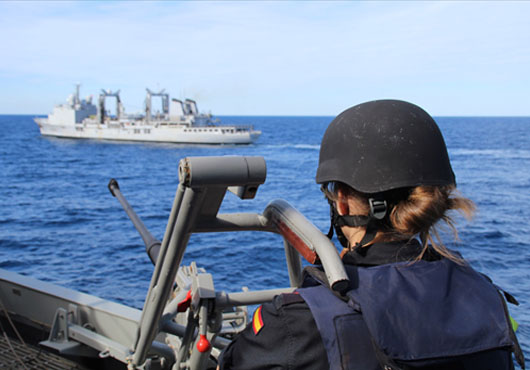
On Saturday, 23 November 2013, Standing NATO Maritime Group TWO (SNMG2) performed an opposed boarding exercise on the French oiler FS VAR, the culmination of four months of intense combined training that demonstrated the interoperability of the Group’s three ships.

The Group’s flagship ESPS ALVARO DE BAZAN and the German FGS SACHSEN and Turkish TCG SALIHREIS acted as a single unit during a coordinated boarding exercise on the oiler, demonstrating the skills necessary to face the challenges prevalent in the Mediterranean during maritime security operations.

The three ships reacted sharply and quickly to the scenario, safely reaching the necessary close position to conduct the visit and seizure of a vessel suspicious of conducting illegal activities. The scenario was designed to follow a typical application of the United Nations Convention on the Law of the Sea.

SNMG2 Crews Conduct Boarding Exercise on French Oiler 1

While small boats were approaching the suspect vessel, a helicopter and snipers kept a watchful eye for threats to the boarding team. In less than 45 minutes, the suspect merchant vessel was secured.

“I am very satisfied that this team of three ships has become able to operate as a single unit,” said Commander SNMG2 Rear Admiral Eugenio Diaz del Rio.

SNMG2 is wrapping up six months’ support to NATO’s counter-terrorism Operation ACTIVE ENDEAVOUR in the Mediterranean, and will soon take command of NATO’s counter-piracy Operation OCEAN SHIELD in the Indian Ocean.
Press Release, November 28, 2013; Image: NATO ACO

Follow Naval Today via:

Facebook

Twitter

RSS

Email

Linkedin

Visit Website

Share on Google PlusTwitterFacebookLinkedInBufferFacebookCustom Sharing Tool
Evernote

+TAG

JCs Royal New Zealand Navy Ships and New Zealand Defence, Also other World Defence Updates

Ships and Defence News Past and Present

Skip to content ↓