Timing The Opening Of A New Maritime Crossroad: The Arctic

Another post on John’s Naval, Marine and other Service news

.

By Rear Adm. Jon White
Oceanographer & Navigator of the Navy, Director Task Force Climate Change

The loss of seasonal sea ice in the Arctic will have ramifications for the U.S. Navy in terms of future missions, force structure, training and investments. To get a better handle on planning for future Arctic missions, Chief of Naval Operations (CNO) Adm. Jonathan Greenert asked me to provide an unambiguous assessment of how ice coverage will change in the Arctic and how human activity in the Arctic will change in response to decreased ice coverage and other factors.
To understand this challenge, let me give you a little background. Thirty years ago, 35% of Arctic sea ice was two to four meters thick and did not significantly diminish during the summer melt season. This thick, hard multi-year ice restricted access to the Arctic Ocean, and made the region less than attractive to commercial interests, or surface security forces for that matter. Submarines were able to sail under the ice, and were the only naval vessels that routinely went to the high latitudes.

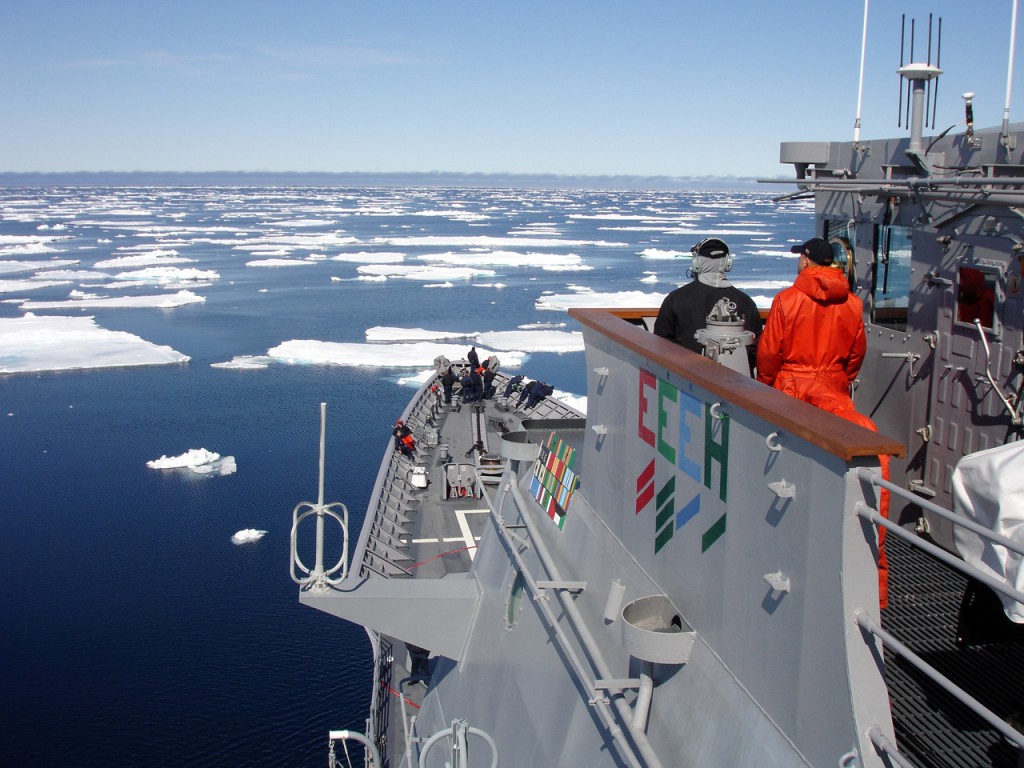
Ship's Serviceman Seaman Recruit Jamal Powell, left, and Seaman Recruit Stephen Harmon stand forward lookout watch aboard guided-missile cruiser USS Normandy (CG 60) as the ship navigates an ice field north of Iceland.Ship’s Serviceman Seaman Recruit Jamal Powell, left, and Seaman Recruit Stephen Harmon stand forward lookout watch aboard guided-missile cruiser USS Normandy (CG 60) as the ship navigates an ice field north of Iceland.

Today, much of the perennial ice is gone and the Arctic Ocean is covered with younger first-year ice that is thinner and more vulnerable to melt during the Arctic summer. This young ice is also easier to break, making the region even more accessible for ships with ice-strengthened hulls. First-year sea ice begins to melt in the Arctic in late March, with a minimum sea ice extent achieved annually in September. Sea ice then begins to accrue until it reaches a maximum in mid-March and the cycle repeats.
In September 2012, a record minimum was observed in which sea ice covered less than four million square kilometers of the total 14.1 million square kilometers that comprise the Arctic Ocean. While the September 2013 sea ice extent minimum was higher than 2012 at 5.3 million square kilometers, it was still significantly less than the thirty year observed mean of 6.27 million square kilometers and was the sixth lowest on record.
In response to the CNO’s tasking, we assembled an interagency team of Arctic experts from various Navy offices, the National Oceanic and Atmospheric Administration, theNational Ice Center, the U.S. Coast Guard, and academia. As a final review of the team’s conclusions, a panel of national experts from the Naval Studies Board, a component of the National Research Council of the National Academies, validated the methodology and supported the team’s assessment.
The team reviewed the scientific literature on current Arctic sea-ice projections and agreed to use three scientific approaches described in an article published in the journal Geophysical Research Letters. (Overland, J. and M. Wang (2013), “When will the summer Arctic be nearly sea ice free?” (Geophys. Res. Lett., 40, 20972101, doi:10.1002/grl.50316).
To capture the intent of this assessment, we characterized sea ice in terms of its areal coverage and consequent impact on the availability of four sea passages associated with the Arctic. We also use the World Meteorological Organization’s metric “open water,” which is defined as up to 10% of sea ice concentration with no ice of land origin (e.g., icebergs). These waters are navigable by any open ocean vessel capable of operating in northern latitudes without ice breaker escort. Additionally, when considering “shoulder seasons,” period of time prior to and after open water periods, the team adopted sea ice concentration between 10%-40% of sea ice as its benchmark. This 40% figure corresponds with current depictions of the Marginal Ice Zone, available through sources such as the National/Naval Ice Center. Vessels operating during shoulder seasons will require at least minimal ice-hardening and will require icebreaker escort.

Los Angeles-class fast attack submarine USS Alexandria (SSN 757) is submerged after surfacing through two feet of drifting ice about 180 nautical miles off the north coast of Alaska.Los Angeles-class fast attack submarine USS Alexandria (SSN 757) is submerged after surfacing through two feet of drifting ice about 180 nautical miles off the north coast of Alaska.

For the near-term, defined as present to 2020, current trends are expected to continue, with major waterways becoming increasingly open. By 2020, the Bering Strait (BS) is expected to see open water conditions approximately 160 days per year, with another 35 to 45 days of shoulder season. The Northern Sea Route (NSR) will experience around 30 days of open water conditions, also with up to 45 days of shoulder season conditions. Analysis suggests that the reliable navigability of other routes is limited in this timeframe.
The mid-term period, from 2020 to 2030, will see increasing levels of ice melt and increasingly open Arctic waters. By 2025, we predict that the BS will see up to 175 days of open water (with 50-60 days of shoulder season.)  These figures increase to 190 days of open water (and up to 70 days of shoulder season) by 2030. For the NSR, we predict up to 45 days of open water (with 50-60 days of shoulder season) by 2025, increasing to 50-60 days of open water by 2030 (with up to 35 days of shoulder season conditions). This period will begin to see greater accessibility of the Trans-Polar Route (TPR), which is forecast to be open for up to 45 days annually, with 60-70 days of shoulder season. Reliable navigability of the Northwest Passage (NWP) remains limited in this timeframe. The limited depth and narrow passages within the NWP make it an extremely challenging transit route, even during total open water conditions.
In the far-term, beyond 2030, environmental conditions are expected to support even greater and more reliable maritime presence in the region. Major waterways are predicted to be consistently open for longer periods, with a significant increase in traffic over the summer months. The NSR and TPR should be navigable 130 days per year, with open water passage up to 75 days per year. By 2030, the NWP is still expected to be open for only brief periods.
This assessment establishes the timeframe in which the Navy will prepare for expected increased activity in the Arctic region, and informs the update to the Navy’s Arctic Roadmap, a strategic approach to Navy’s future engagement in this growing ocean which supports maritime strategic crossroads.

Visit Website

Share on Google PlusTwitterFacebookLinkedInBufferFacebookCustom Sharing Tool
Evernote 

+TAG
.

via Blogger http://www.h16613.com/2013/11/timing-opening-of-new-maritime.html

Timing The Opening Of A New Maritime Crossroad: The Arctic

Another post on John’s Naval, Marine and other Service news

.

By Rear Adm. Jon White
Oceanographer & Navigator of the Navy, Director Task Force Climate Change

The loss of seasonal sea ice in the Arctic will have ramifications for the U.S. Navy in terms of future missions, force structure, training and investments. To get a better handle on planning for future Arctic missions, Chief of Naval Operations (CNO) Adm. Jonathan Greenert asked me to provide an unambiguous assessment of how ice coverage will change in the Arctic and how human activity in the Arctic will change in response to decreased ice coverage and other factors.
To understand this challenge, let me give you a little background. Thirty years ago, 35% of Arctic sea ice was two to four meters thick and did not significantly diminish during the summer melt season. This thick, hard multi-year ice restricted access to the Arctic Ocean, and made the region less than attractive to commercial interests, or surface security forces for that matter. Submarines were able to sail under the ice, and were the only naval vessels that routinely went to the high latitudes.

Ship's Serviceman Seaman Recruit Jamal Powell, left, and Seaman Recruit Stephen Harmon stand forward lookout watch aboard guided-missile cruiser USS Normandy (CG 60) as the ship navigates an ice field north of Iceland.Ship’s Serviceman Seaman Recruit Jamal Powell, left, and Seaman Recruit Stephen Harmon stand forward lookout watch aboard guided-missile cruiser USS Normandy (CG 60) as the ship navigates an ice field north of Iceland.

Today, much of the perennial ice is gone and the Arctic Ocean is covered with younger first-year ice that is thinner and more vulnerable to melt during the Arctic summer. This young ice is also easier to break, making the region even more accessible for ships with ice-strengthened hulls. First-year sea ice begins to melt in the Arctic in late March, with a minimum sea ice extent achieved annually in September. Sea ice then begins to accrue until it reaches a maximum in mid-March and the cycle repeats.
In September 2012, a record minimum was observed in which sea ice covered less than four million square kilometers of the total 14.1 million square kilometers that comprise the Arctic Ocean. While the September 2013 sea ice extent minimum was higher than 2012 at 5.3 million square kilometers, it was still significantly less than the thirty year observed mean of 6.27 million square kilometers and was the sixth lowest on record.
In response to the CNO’s tasking, we assembled an interagency team of Arctic experts from various Navy offices, the National Oceanic and Atmospheric Administration, theNational Ice Center, the U.S. Coast Guard, and academia. As a final review of the team’s conclusions, a panel of national experts from the Naval Studies Board, a component of the National Research Council of the National Academies, validated the methodology and supported the team’s assessment.
The team reviewed the scientific literature on current Arctic sea-ice projections and agreed to use three scientific approaches described in an article published in the journal Geophysical Research Letters. (Overland, J. and M. Wang (2013), “When will the summer Arctic be nearly sea ice free?” (Geophys. Res. Lett., 40, 20972101, doi:10.1002/grl.50316).
To capture the intent of this assessment, we characterized sea ice in terms of its areal coverage and consequent impact on the availability of four sea passages associated with the Arctic. We also use the World Meteorological Organization’s metric “open water,” which is defined as up to 10% of sea ice concentration with no ice of land origin (e.g., icebergs). These waters are navigable by any open ocean vessel capable of operating in northern latitudes without ice breaker escort. Additionally, when considering “shoulder seasons,” period of time prior to and after open water periods, the team adopted sea ice concentration between 10%-40% of sea ice as its benchmark. This 40% figure corresponds with current depictions of the Marginal Ice Zone, available through sources such as the National/Naval Ice Center. Vessels operating during shoulder seasons will require at least minimal ice-hardening and will require icebreaker escort.

Los Angeles-class fast attack submarine USS Alexandria (SSN 757) is submerged after surfacing through two feet of drifting ice about 180 nautical miles off the north coast of Alaska.Los Angeles-class fast attack submarine USS Alexandria (SSN 757) is submerged after surfacing through two feet of drifting ice about 180 nautical miles off the north coast of Alaska.

For the near-term, defined as present to 2020, current trends are expected to continue, with major waterways becoming increasingly open. By 2020, the Bering Strait (BS) is expected to see open water conditions approximately 160 days per year, with another 35 to 45 days of shoulder season. The Northern Sea Route (NSR) will experience around 30 days of open water conditions, also with up to 45 days of shoulder season conditions. Analysis suggests that the reliable navigability of other routes is limited in this timeframe.
The mid-term period, from 2020 to 2030, will see increasing levels of ice melt and increasingly open Arctic waters. By 2025, we predict that the BS will see up to 175 days of open water (with 50-60 days of shoulder season.)  These figures increase to 190 days of open water (and up to 70 days of shoulder season) by 2030. For the NSR, we predict up to 45 days of open water (with 50-60 days of shoulder season) by 2025, increasing to 50-60 days of open water by 2030 (with up to 35 days of shoulder season conditions). This period will begin to see greater accessibility of the Trans-Polar Route (TPR), which is forecast to be open for up to 45 days annually, with 60-70 days of shoulder season. Reliable navigability of the Northwest Passage (NWP) remains limited in this timeframe. The limited depth and narrow passages within the NWP make it an extremely challenging transit route, even during total open water conditions.
In the far-term, beyond 2030, environmental conditions are expected to support even greater and more reliable maritime presence in the region. Major waterways are predicted to be consistently open for longer periods, with a significant increase in traffic over the summer months. The NSR and TPR should be navigable 130 days per year, with open water passage up to 75 days per year. By 2030, the NWP is still expected to be open for only brief periods.
This assessment establishes the timeframe in which the Navy will prepare for expected increased activity in the Arctic region, and informs the update to the Navy’s Arctic Roadmap, a strategic approach to Navy’s future engagement in this growing ocean which supports maritime strategic crossroads.

Visit Website

Share on Google PlusTwitterFacebookLinkedInBufferFacebookCustom Sharing Tool
Evernote 

+TAG
.

via Blogger http://www.h16613.com/2013/11/timing-opening-of-new-maritime.html

Crowley to Build Revolutionary LNG-Powered ConRo Ships for U.S. – Puerto Rico Trade

Another post on John’s Naval, Marine and other Service news

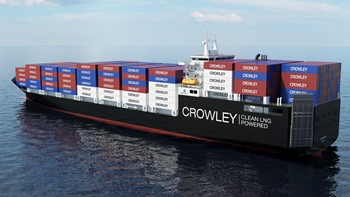
File Crowley depiction: larger, faster and environmentally-friendly liquefied natural gas (LNG)-powered, combination container – Roll-On/Roll-Off (ConRo) ships.
marinelink.com
Monday, November 25, 2013, 3:28 PM
Crowley depiction: larger, faster and environmentally-friendly liquefied natural gas (LNG)-powered, combination container – Roll-On/Roll-Off (ConRo) ships.
Commitment Class Jones-Act Ships to Offer Lower Emissions; Increased Speed, Reliability and Capacity, and Optimized Vehicle Shipping Decks.
The next chapter in Crowley’s storied history of shipping and logistics services between the United States mainland and Puerto Rico will be written with larger, faster and environmentally-friendly liquefied natural gas (LNG)-powered, combination container – Roll-On/Roll-Off (ConRo) ships.
Crowley today announced that it has signed a contract with VT Halter Marine Inc., of Pascagoula, Miss., to build two of the world’s first LNG-powered ConRo ships, which are designed to travel at speeds up to 22 knots and carry containers ranging in size from 20-foot standard to 53-foot-long, 102-inch-wide, high-capacity units, along with hundreds of vehicles in enclosed, weather-tight car decking.
The Commitment Class, Jones Act ships, scheduled for delivery in second and fourth quarter 2017, will replace Crowley’s towed triple-deck barge fleet, which has served the trade continuously and with distinction since the early 1970s. These new ships, which will be named El Coquí (ko-kee) and Taíno (tahy-noh), will offer customers fast ocean transit times, while accommodating the company’s diverse equipment selection and cargo handling flexibility – benefits customers have enjoyed for nearly 60 years.  
El Coquí is the common name for several species of small frogs that are native to Puerto Rico, and Taíno were native Puerto Ricans who lived off the land and who had great appreciation and respect for their environment. Adopting these ship names is an acknowledgement of the subjects’ enduring importance within Puerto Rico’s diverse ecology and heritage as well as symbols of Crowley’s commitment to help protect the environment. Powered by LNG, the Crowley ships will set a new standard for environmentally responsible shipping.
LNG is a stable gas that is neither toxic nor corrosive and is lighter than air. It is the cleanest fossil fuel available, netting a 100-percent reduction in sulphur oxide (SOx) and particulate matter (PM), and a 92-percent reduction in nitrogen oxide (NOx). LNG also has the ability to significantly reduce carbon dioxide (CO2), a contributor to greenhouse gas emissions, as compared with conventional fossil fuels. “Our investment in these new ships – the first of their kind in the world – is significant on so many fronts,” said Tom Crowley, company chairman and CEO. “We named them the Commitment Class of ships because they represent our commitment to our customers and the people of Puerto Rico whom we will continue to serve for years to come with the superior service they expect from Crowley.”
“Second, it reflects Crowley’s commitment to EcoStewardship© in that we are developing and using best-available technology that allows for improved emissions, advanced ballast water management and alternative fuel selection,” he said. “And lastly, our actions are clear evidence of our commitment to the U.S. maritime industry and the Jones Act. American built, crewed and owned ensures U.S. shipbuilding capabilities, skilled U.S. merchant seamen, and available domestic vessel tonnage, all of which are of vital importance to our national defense.”    
The vessel design has been brought to life by Warstila Ship Design in conjunction with Crowley subsidiary Jensen Maritime, a leading Seattle-based naval architecture and marine engineering firm. The new double-hulled ConRo ships have been designed to maximize the carriage of 102-inch-wide containers, which offer the most cubic cargo capacity in the trade. The ships will be 219.5 meters long, 32.3 meters wide (beam), have a deep draft of 10 meters, and an approximate deadweight capacity of 26,500 metric tonnes. Cargo capacity will be approximately 2,400 TEUs (20-foot-equivalent-units), with additional space for nearly 400 vehicles. The main propulsion and auxiliary engines will be fueled with LNG.
Jensen will also provide construction management and supervision in the shipyard throughout the building phase. “When we sat down with Jensen and Wartsila to design these ships, we started with a clean slate to address and incorporate the specific needs of the Puerto Rico market,” said John Hourihan, senior vice president and general manager, Puerto Rico and Caribbean services. “We are very excited to add faster transit times to our existing service offerings while maintaining our ability to handle 53-foot and refrigerated equipment that so many of our customers have come to rely on.”
 
“We also understand what our car customers want, so we are pleased that these vessels will be the only ones in the trade to offer vehicle transportation in completely-enclosed, ventilated, weather-tight decks,” he said. “Coupled with the LNG fuel, customers can take satisfaction in that they are getting faster, more reliable service, while reducing the amount of CO2 emissions attributable to each container by approximately 38 percent.  This design is a win-win for the customer and for the environment.”
“Safety and environmental protection were also at the forefront of our design process,” said Johan Sperling, Jensen vice present. “For example, one of the superior safety systems we engineered included a feature that places all fuel tanks behind double-wall voids with no exposure to the environment.”

Additionally, Sperling said the ships will meet or exceed all regulatory requirements and have the CLEAN notation, which requires limitation of operational emissions and discharges, as well as the Green Passport, both issued by classification society Det Norske Veritas (DNV).

Designing, building and operating LNG powered vessels is very much in line with Crowley’s overall EcoStewardship positioning and growth strategy. The company formed an LNG services group earlier this year to bring together the company’s extensive resources to provide LNG vessel design and construction management; transportation; product sales and distribution, and full-scale, project management solutions.
 

  • Photo: Crowley
    Photo: Crowley
.

via Blogger http://www.h16613.com/2013/11/crowley-to-build-revolutionary-lng.html

Crowley to Build Revolutionary LNG-Powered ConRo Ships for U.S. – Puerto Rico Trade

Another post on John’s Naval, Marine and other Service news

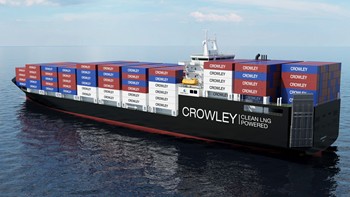
File Crowley depiction: larger, faster and environmentally-friendly liquefied natural gas (LNG)-powered, combination container – Roll-On/Roll-Off (ConRo) ships.
marinelink.com
Monday, November 25, 2013, 3:28 PM
Crowley depiction: larger, faster and environmentally-friendly liquefied natural gas (LNG)-powered, combination container – Roll-On/Roll-Off (ConRo) ships.
Commitment Class Jones-Act Ships to Offer Lower Emissions; Increased Speed, Reliability and Capacity, and Optimized Vehicle Shipping Decks.
The next chapter in Crowley’s storied history of shipping and logistics services between the United States mainland and Puerto Rico will be written with larger, faster and environmentally-friendly liquefied natural gas (LNG)-powered, combination container – Roll-On/Roll-Off (ConRo) ships.
Crowley today announced that it has signed a contract with VT Halter Marine Inc., of Pascagoula, Miss., to build two of the world’s first LNG-powered ConRo ships, which are designed to travel at speeds up to 22 knots and carry containers ranging in size from 20-foot standard to 53-foot-long, 102-inch-wide, high-capacity units, along with hundreds of vehicles in enclosed, weather-tight car decking.
The Commitment Class, Jones Act ships, scheduled for delivery in second and fourth quarter 2017, will replace Crowley’s towed triple-deck barge fleet, which has served the trade continuously and with distinction since the early 1970s. These new ships, which will be named El Coquí (ko-kee) and Taíno (tahy-noh), will offer customers fast ocean transit times, while accommodating the company’s diverse equipment selection and cargo handling flexibility – benefits customers have enjoyed for nearly 60 years.  
El Coquí is the common name for several species of small frogs that are native to Puerto Rico, and Taíno were native Puerto Ricans who lived off the land and who had great appreciation and respect for their environment. Adopting these ship names is an acknowledgement of the subjects’ enduring importance within Puerto Rico’s diverse ecology and heritage as well as symbols of Crowley’s commitment to help protect the environment. Powered by LNG, the Crowley ships will set a new standard for environmentally responsible shipping.
LNG is a stable gas that is neither toxic nor corrosive and is lighter than air. It is the cleanest fossil fuel available, netting a 100-percent reduction in sulphur oxide (SOx) and particulate matter (PM), and a 92-percent reduction in nitrogen oxide (NOx). LNG also has the ability to significantly reduce carbon dioxide (CO2), a contributor to greenhouse gas emissions, as compared with conventional fossil fuels. “Our investment in these new ships – the first of their kind in the world – is significant on so many fronts,” said Tom Crowley, company chairman and CEO. “We named them the Commitment Class of ships because they represent our commitment to our customers and the people of Puerto Rico whom we will continue to serve for years to come with the superior service they expect from Crowley.”
“Second, it reflects Crowley’s commitment to EcoStewardship© in that we are developing and using best-available technology that allows for improved emissions, advanced ballast water management and alternative fuel selection,” he said. “And lastly, our actions are clear evidence of our commitment to the U.S. maritime industry and the Jones Act. American built, crewed and owned ensures U.S. shipbuilding capabilities, skilled U.S. merchant seamen, and available domestic vessel tonnage, all of which are of vital importance to our national defense.”    
The vessel design has been brought to life by Warstila Ship Design in conjunction with Crowley subsidiary Jensen Maritime, a leading Seattle-based naval architecture and marine engineering firm. The new double-hulled ConRo ships have been designed to maximize the carriage of 102-inch-wide containers, which offer the most cubic cargo capacity in the trade. The ships will be 219.5 meters long, 32.3 meters wide (beam), have a deep draft of 10 meters, and an approximate deadweight capacity of 26,500 metric tonnes. Cargo capacity will be approximately 2,400 TEUs (20-foot-equivalent-units), with additional space for nearly 400 vehicles. The main propulsion and auxiliary engines will be fueled with LNG.
Jensen will also provide construction management and supervision in the shipyard throughout the building phase. “When we sat down with Jensen and Wartsila to design these ships, we started with a clean slate to address and incorporate the specific needs of the Puerto Rico market,” said John Hourihan, senior vice president and general manager, Puerto Rico and Caribbean services. “We are very excited to add faster transit times to our existing service offerings while maintaining our ability to handle 53-foot and refrigerated equipment that so many of our customers have come to rely on.”
 
“We also understand what our car customers want, so we are pleased that these vessels will be the only ones in the trade to offer vehicle transportation in completely-enclosed, ventilated, weather-tight decks,” he said. “Coupled with the LNG fuel, customers can take satisfaction in that they are getting faster, more reliable service, while reducing the amount of CO2 emissions attributable to each container by approximately 38 percent.  This design is a win-win for the customer and for the environment.”
“Safety and environmental protection were also at the forefront of our design process,” said Johan Sperling, Jensen vice present. “For example, one of the superior safety systems we engineered included a feature that places all fuel tanks behind double-wall voids with no exposure to the environment.”

Additionally, Sperling said the ships will meet or exceed all regulatory requirements and have the CLEAN notation, which requires limitation of operational emissions and discharges, as well as the Green Passport, both issued by classification society Det Norske Veritas (DNV).

Designing, building and operating LNG powered vessels is very much in line with Crowley’s overall EcoStewardship positioning and growth strategy. The company formed an LNG services group earlier this year to bring together the company’s extensive resources to provide LNG vessel design and construction management; transportation; product sales and distribution, and full-scale, project management solutions.


  • Photo: Crowley
    Photo: Crowley
.

via Blogger http://www.h16613.com/2013/11/crowley-to-build-revolutionary-lng.html

HMS Illustrious Head for Philippines

Another post on John’s Naval, Marine and other Service news

.

HMS Illustrious Head for Philippines

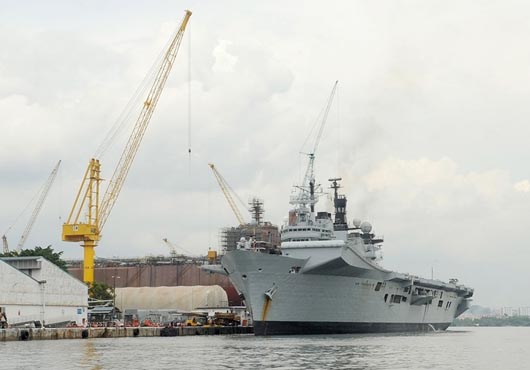
HMS Illustrious departed Singapore en route to the Philippines on Friday, November 22. During 48 hours alongside Sembawang naval shipyard in Singapore, over 500 tons of disaster relief aid was loaded into the hangar by the men and women serving in HMS Illustrious, a team from the Department for International Development (DFID), and the embarked forces including J Company 42 Commando Royal Marines and the carrier air group.


During the time alongside in Singapore, additional medical teams embarked along with personnel from 24 Commando Royal Engineers, as well as a humanitarian expert and a logistics adviser from DFID.
The Portsmouth based amphibious helicopter carrier was released by DfID, the government department leading the aid effort, to sail at 1330 local.
“Lusty” will make best speed to the Philippines to join the international humanitarian effort following the devastation caused by Typhoon Haiyan.
Commander Phil Hally, who was responsible for the complex task of planning the onload of aid, said:

“We have managed to fit in everything DfID asked us to carry.
“The young men and women onboard have worked tremendously hard and we are very proud of what they have achieved in a very short time. This is something we will all remember.
“We now have a very short period of passage to the Philippines before the really hard work begins.”
“Lusty” is due to arrive in the Philippines around 25th November to relieve HMS Daring as part the UK’s contribution to the aid effort.

Press Release, November 25, 2013; Image: Royal Navy
Follow Naval Today via:
Facebook
Twitter
RSS
Email
Linkedin

Visit Website

Share on Google PlusTwitterFacebookLinkedInBufferFacebookCustom Sharing Tool
Evernote 

+TAG
.

via Blogger http://www.h16613.com/2013/11/hms-illustrious-head-for-philippines.html

JCs Royal New Zealand Navy Ships and New Zealand Defence, Also other World Defence Updates

Ships and Defence News Past and Present

Skip to content ↓