
|
Culdrose Merlin Heads for Philippines
Naval Today >> The industry’s seaborne news provider by Naval Today / 25min // keep unread // skip // preview
A Royal Naval Air Station Culdrose based Merlin Mk 1 flight is en route to the Philippines.The seventeen strong team, currently embarked in Portsmouth based amphibious helicopter carrier HMS Illustrious, were in the latter stages of the UK Response Force Task Group’s Cougar 13 autumn deployment when re-tasked to join in disaster relief operations. The Merlin flight of 829 Naval Air Squadron has been deployed from home since June. The ship and flight were in the midst of counter-piracy operations when the Prime Minister ordered HMS Illustrious and her embarked aircraft to head east to assist in the delivery of humanitarian aid. The Merlin Mk 1 is the only RNAS Culdrose based aircraft presently embarked in HMS Illustrious or ‘Lusty’ as she is affectionately known by her crew. The flight, made up of twelve technicians, four aircrew and one aircraft controller, had expected to be home in time for Christmas. They will now be returning to RNAS Culdrose in Cornwall in the New Year. Lieutenant Matt ‘Sooty’ Sutcliffe Royal Navy is the flight’s senior pilot.
The Merlin Mk 1 is an all weather, day or night helicopter that is capable of conducting a range of roles which are well suited to the delivery of humanitarian aid including search and rescue, lift of over 2000 kgs of aid supplies, winching of personnel including stretchers from inaccessible areas or carrying people. The helicopter is expected to be widely employed around the many islands in the Philippines affected by Typhoon Haiyan. Whilst en route to the Philippines, the team will be spending time sharpen their skills to ensure they are at the top of their game by the time they reach the affected area. Follow Naval Today via: |


USA: ACC’s T-SAS System Shows Off Its Mine-Hunting Capabilities
|
USA: ACC’s T-SAS System Shows Off Its Mine-Hunting Capabilities
Naval Today >> The industry’s seaborne news provider by Naval Today / 2h // keep unread // skip // preview
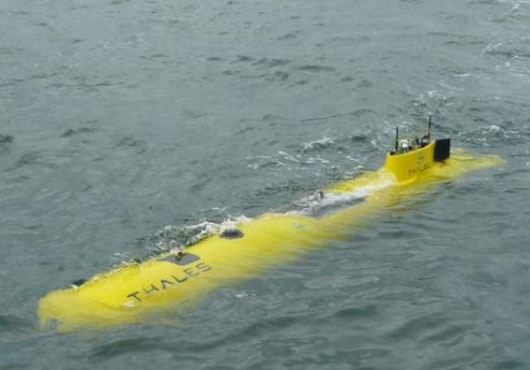
Advanced Acoustic Concepts (AAC), a joint venture between DRS Technologies and Thales, successfully demonstrated advanced mine-hunting capabilities with the US Navy during the 2013 Fleet Experimentation (FLEX) Unmanned Systems (UxS) Campaign.By towing the unmanned high resolution synthetic aperture sonar (T-SAS), the system detected all exercise mines with increased area clearance rates. According to the Space and Naval Warfare Systems Command (SPAWAR), the FY13 FLEX UxS Campaign Plan was developed to identify potential solutions to the fleet’s highest priority operational needs. Specifically, the Naval Warfare Development Center (NWDC), in coordination with the Navy Mine and Antisubmarine Warfare Command (NMAWC), solicited industry participation to demonstrate highly mature mine warfare capabilities that either improve large geographic area search or automate detection and classification of undersea mines and maritime IEDs. During the FLEX at-sea demonstration off the coast of Camp Pendleton, CA, the T-SAS system augmented system operators by providing Automatic Target Recognition (ATR) sonar processing, enabling real-time (in-stride) detection and classification of exercise mines while eliminating the requirement to conduct post-mission analysis (PMA). The high-resolution SAS sensor combined with ATR processing provides fleet operators with improved probability of correct classification and dramatically reduced false alarms. Moreover, by eliminating the substantial PMA time commitment required by traditional mine hunting systems, the T-SAS provides the US Navy with a game-changing capability to increase area clearance rates and reduce the overall mine warfare detect-to-engage timeline. The FLEX demonstration offered the opportunity to operate in a high-clutter tactical mine warfare environment. Over three days, 1,100 contacts were processed in real-time with a final tally of 44 MILCOs (Mine-Like Contacts) and very low false alarm rates. T-SAS, a mature and highly reliable system, was operational throughout the entire demonstration with more than 60 hours of in-water operations. The AAC T-SAS system is an upgraded version of the TSM 2054 Side Scan Sonar, which is towed from both manned and unmanned vessels and has been in service with the Danish Navy since the late 1990s. The T-SAS is currently in service in the French Navy and in an Asian country. Its automated active control tow body (stabilization and automatic bottom following) is highly stable and produces extremely high quality Synthetic Aperture Sonar (SAS) images even in high sea state conditions with the highest resolution in service in the world. The system was recently qualified for operation with an unmanned surface vehicle (USV) as part of the French ESPADON program, the towed body being automatically deployed/recovered with a LARS (Launch and Automatic Recover System patented) up to high sea state. Additionally, the T-SAS is currently in production with a LARS to be installed on a USV for an Asian country. Follow Naval Today via: |

Share this:

USS Olympia Changes Command

|
USS Olympia Changes Command
Naval Today >> The industry’s seaborne news provider by Naval Today / 2h // keep unread // skip // preview
The command of a warship was passed down at a time-honored ceremony that was held for the Los Angeles-class attack submarine USS Olympia (SSN 717) aboard the Battleship Missouri Memorial, Nov. 20.Cmdr. Michael Boone, commanding officer of Olympia, was relieved by Cmdr. Thomas Shugart. The ceremony’s guest speaker, Commander Submarine Squadron 7, Capt. Rick Stoner praised Boone for his exceptional performance while in command of Olympia.
Boone said he is proud of having had the opportunity to be in command of Olympia and working with a fantastic team of Sailors.
During the ceremony, Boone was awarded the Meritorious Service Medal.
Olympia is the United States Navy’s 104th nuclear-powered submarine and the 95th of the attack submarine fleet. She is the 29th of the Los Angeles-class nuclear powered fast attack submarine to be delivered to the Navy. Follow Naval Today via: |

Share this:

Washington State Ferries a Step Closer to LNG Propulsion
Washington State Ferries a Step Closer to LNG Propulsion
MarineLink.com
Thursday, November 21, 2013

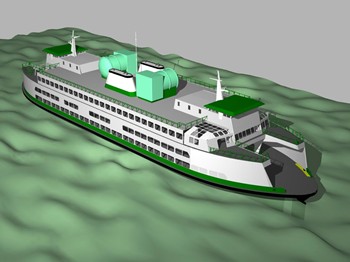
LNG Bunker tanks on upper deck: Rendering courtesy of WSF
Washington State Ferries say they are another step closer to significantly reducing fuel costs and transportation emissions by switching a class of vessels from diesel fuel to liquefied natural gas.
After more than three years of study, WSF has a plan to safely convert six Issaquah Class vessels to run on cleaner-burning LNG. The proposal has been officially submitted to the U.S. Coast Guard in a formal letter of intent (LOI) and waterways suitability assessment (WSA). The submission of the LOI and WSA marks the official starting point of the Coast Guard’s review process. WSF expects the Coast Guard to issue a finding regarding the LNG conversion proposal in 2014.
“Fuel is WSF’s fastest growing operating expense,” said David Moseley, assistant secretary for the Washington State Department of Transportation, Ferries Division. “Replacing diesel with LNG on the Issaquah Class ferries could result in very substantial savings on fuel over the remaining 30 years of their service life. This will also mean a cleaner, more efficient future for our fleet by significantly decreasing emissions.”
The average Issaquah Class vessel carries up to 124 cars and 1,200 passengers, serving on some of the state’s busiest ferry routes. Converting the fuel systems from ultra-low sulfur diesel to LNG would significantly reduce emissions according to WSDOT’s Air Emissions Model, including:
• 89 percent reduction in particulate matter
• 61 percent reduction in nitrous oxide
• 28 percent reduction in carbon dioxide
• 59 percent reduction in sulfur dioxide
For the proposed LNG conversions, WSF would install main propulsion engines to use natural gas and retrofit LNG fuel tanks on the top decks of the six vessels. The proposal calls for a phased approach for conversions to avoid schedule changes or delays. Once vessels are converted and back in service, they would begin a routine overnight, out-of-service refueling process similar to current diesel refueling.
Share this:

Yo Ho Ho! Christmas Trees Loaded Aboard Cutter ‘Mackinaw’
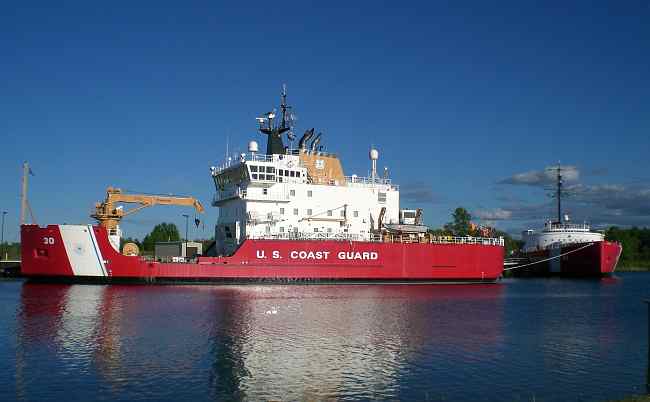
 New and old Mackinaws at the Millard D. Olds Memorial Mooring in Cheboygan, Michigan – June 11, 2006[/caption]
Yo Ho Ho! Christmas Trees Loaded Aboard Cutter ‘Mackinaw’
MarineLink.com
Thursday, November 21, 2013

Christmas tree loading: Photo credit USCG
Coast Guard Cutter Mackinaw has taken on board more than 1,300 Christmas trees in preparation for the annual transit to Chicago where the trees will be given to nonprofit organizations, pre-determined by the Chicago maritime community, and then to needy families.
The Mackinaw, which has served as the Christmas Ship since 2000, reenacting a tradition dating back to the late 1890s, makes the annual trip in conjunction with annual fall buoy retrieval operations.
The journey and ceremony honors the traditions of the Rouse Simmons, the original Christmas Ship, which sank between Kewaunee and Two Rivers, Wis. on Nov. 23, 1912 in a storm during its annual transit from northern Wisconsin to Chicago.
During the transit to Chicago, the crew of the Mackinaw will conduct a wreath laying ceremony near the wreck of the Rouse Simmons to honor the ship and its crew.
“The crew and I are looking forward in participating in this year’s event. We feel it’s an extremely worthwhile cause.” commented Cmdr. Michael Davanzo, the ship’s commanding officer.

