
New post (Turkey: Over Twenty Naval Vessels Team Up amid Dogu Akdeniz 2013) has been published and can be read on http://www.h16613.com/
Ships and Defence News Past and Present

|
Tanzanian Navy Trains with Meteoro
Naval Today >> The industry’s seaborne news provider by Naval Today / 12min // keep unread // skip // preview
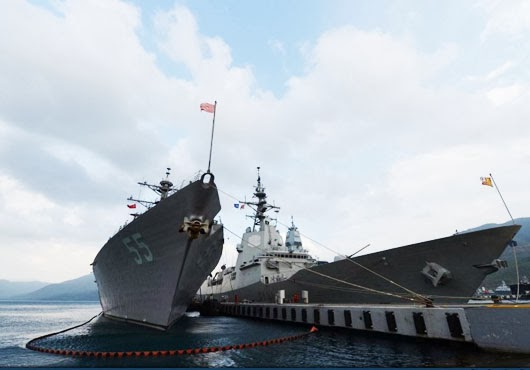
Spanish maritime action ship ‘Meteoro’ is participating in operation ‘Atalanta’ as of last August and has recently carried out a series of Maritime Interdiction Operations (MIO) with personnel from the Tanzanian Navy as part of the collaboration endeavor of EUNAVFOR with local navies.The participants attended two briefings. The first one was delivered by the ship’s Commanding Officer, Lt.-Cdr Juan Carlos Pérez and dealt with the Spanish Navy’s (and other European navies) contribution to operation ‘Atalanta’; the second briefing was about general aspects and security regulations of MIO exercises. The first stage of the exercise consisted in challenging a (simulated) merchant ship with a subsequent VBSS (visit, board, search seizure) operation. During the execution of the exercise, personnel from the Tanzanian Navy were also part of the VBSS team. This collaboration drills enhance the mutual understanding between EUNAVFOR and regional naval forces. Combined trainings contribute to operation in a coordinated way and encourage maritime security in the area.
Once the exercise was over, the ‘Meteoro’ received a visit of the Spanish Ambassador in Tanzania, Luis Manuel Cuesta, who was welcomed by the ship’s commander. After greeting the officers and non-commissioned officers he was shown around the offshore patrol boat and briefed on her capabilities and the activities carried out to date. Press Release, November 21, 2013; Image: Spanish Navy |
|
Turkey: Over Twenty Naval Vessels Team Up amid Dogu Akdeniz 2013
Naval Today >> The industry’s seaborne news provider by Naval Today / 12min // keep unread // skip // preview
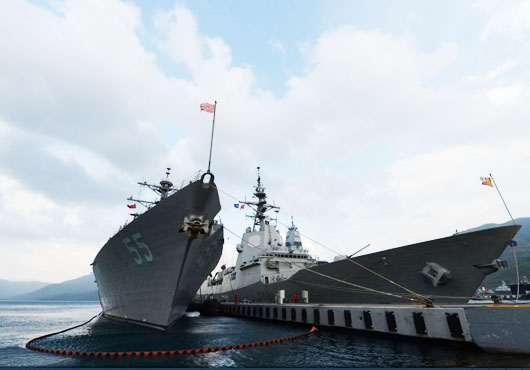
More than twenty destroyers, corvettes, frigates, submarines and patrol vessels from four different NATO nations have taken part in the Turkish exercise ‘Dogu Akdeniz 2013’ in the Eastern Mediterranean.The exercise contemplated an asymmetric threat scenario where the participating units trained in both, conventional and maritime security operations. Other training activities included counter-piracy operations, maritime embargo, non-combatant evacuations and search and rescue (SAR). The three SNMG-2 ships under the command of Spanish RA Eugenio Díaz del Río –the Spanish frigate ‘Álvaro de Bazán’, German frigate ‘Sachsen’ and the Turkish frigate ‘Salihreis’– had the chance to enhance their training for the forthcoming deployment in Somali waters to fight piracy in the Indian Ocean. The Standing NATO Maritime Group 2 is a naval task group ready to carry out all sorts of missions, from participation in exercises to crisis response missions. Press Release, November 21, 2013; Image: Spanish Navy |

|
Navy, NATO Leaders Address Maritime Security Challenges
Naval Today >> The industry’s seaborne news provider by Naval Today / 22min // keep unread // skip // preview
For two days, 20 Heads of Navy, 54 international delegations and 127 distinguished guests; including General Philip Breedlove USA AF, the Supreme Allied Commander Europe, will gather under the auspices of NATO’s Allied Maritime Command, to discuss the opportunities and challenges facing the maritime community in the security arena.Namely, on Wednesday, 20 November 2013, a major conference began in central London to address significant challenges to the future of global security and in particular maritime security.
For two days, the participants to SEA SENSE 13 will be briefed on a number of key issues ranging from current environmental and economic trends impacting on the maritime domain to the role that NATO, its Maritime Command (MARCOM), and Partners should have in dealing with future maritime security challenges. Many of these presentations will be delivered by representatives from the wider interest community of International Organisations; including, academia, think-tanks and other non-defence Governmental Organisations who have a stake in the future of global maritime environment. During the second part of the conference, Heads of Navy and other Heads of Delegations will focus on topics critical to the fleets of the Alliance and determine how to better connect national naval capabilities to the NATO Command Structure. Fleet Commanders will also discuss the importance of combining exercises, of contributing to NATO’s regional awareness and also consider the role and future of the Alliance’s Standing Naval Forces.
Press Release, November 21, 2013; Image: NATO |
|
US Navy’s ‘Mine-Hunter’ AUV Breaks Endurance Record
Naval Today >> The industry’s seaborne news provider by Naval Today / 22min // keep unread // skip // preview
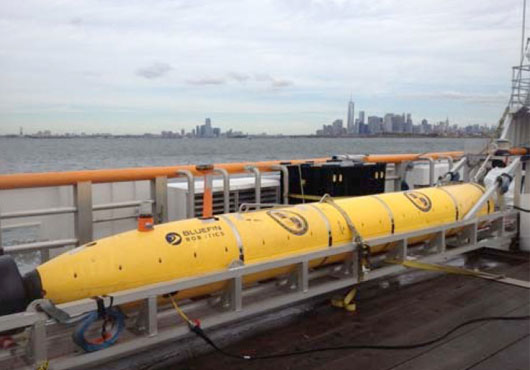
The U.S. Naval Research Laboratory’s (NRL) Acoustics Division, with Bluefin Robotics, executed a record setting 507 kilometer (315 mile), long-endurance autonomy research mission using its heavyweight-class mine countermeasures autonomous underwater vehicle (AUV), Reliant.NRL’s Reliant AUV, when equipped with a low frequency broadband (LFBB) sonar system, is perhaps best known as the prototype for the new U.S. Navy Knifefish mine-hunter. Navigating from the waters of Boston Harbor, the 20 foot long, 1,350 pound, ‘heavyweight’ AUV traveled south past Cape Cod, headed west through Nantucket Sound between Martha’s Vineyard and the mainland, and then continued south of Long Island to the approaches to New York City. The fully autonomous endurance mission was designed to push the boundaries of traditional AUVs with the objective to uncover the challenges and requirements for significantly extending AUV endurance for new applications. To optimize for endurance and range, the vehicle traveled at a depth of 10 meters and an average speed of 2.5 knots through busy waterways and strong currents. The vehicle surfaced at 20-kilometer intervals to report position via Iridium satellite and made Upper New York Bay with a 10 percent energy reserve crediting a new high capacity energy section.
Reliant uses a modular vehicle design that was recently configured with a 40 kilowatt-hour (kWh) energy section that enabled the 109-hour journey. The AUV is navigated using a fiber-optic gyro based inertial navigation system (INS) integrated with GPS, and a Doppler velocity log (DVL) providing precise underwater navigation for long endurance missions. This exercise is the first of several planned missions that will incrementally increase autonomy complexity and endurance over the life of NRL’s research program and in overall AUV-based technology for the Navy. Houston and his team are developing AUV based technologies that include extension of the Knifefish technology (as part of the Office of Naval Research Future Naval Capabilities program), increasing ranges for mine countermeasure (MCM) operations, and advancing autonomy for AUVs. Houston’s team is also applying this new technology to shallow water Anti-Submarine Warfare (ASW). This more recent development provides the Navy with the technical foundation for high performance detection and classification of difficult ASW targets using active sonar on AUVs in challenging environments. The purpose of the system is to address the Navy’s need to reliably detect and identify undersea volume and bottom mines in high-clutter environments with low false alarm rates. The Knifefish system is a part of the Littoral Combat Ship (LCS) mine countermeasure (MCM) mission package targeted to reduce risks to personnel by operating in potential minefield regions as an off-board sensor, allowing host ships to remain at safe distances outside minefield boundaries. Press Release, November 21, 2013; Image:NRL |
Ships and Defence News Past and Present


