Aircraft Carrier Gerald R. Ford Takes First Voyage

USS Gerald Ford and its first journey at sea -  going on to to finish fitting out USS Gerald Ford and its first journey at sea – going on to to finish fitting out[/caption]

MarineLink.com
Tuesday, November 19, 2013, 12:44 PM
File The aircraft carrier Gerald R. Ford (CVN 78) was moved Sunday to Newport News Shipbuilding
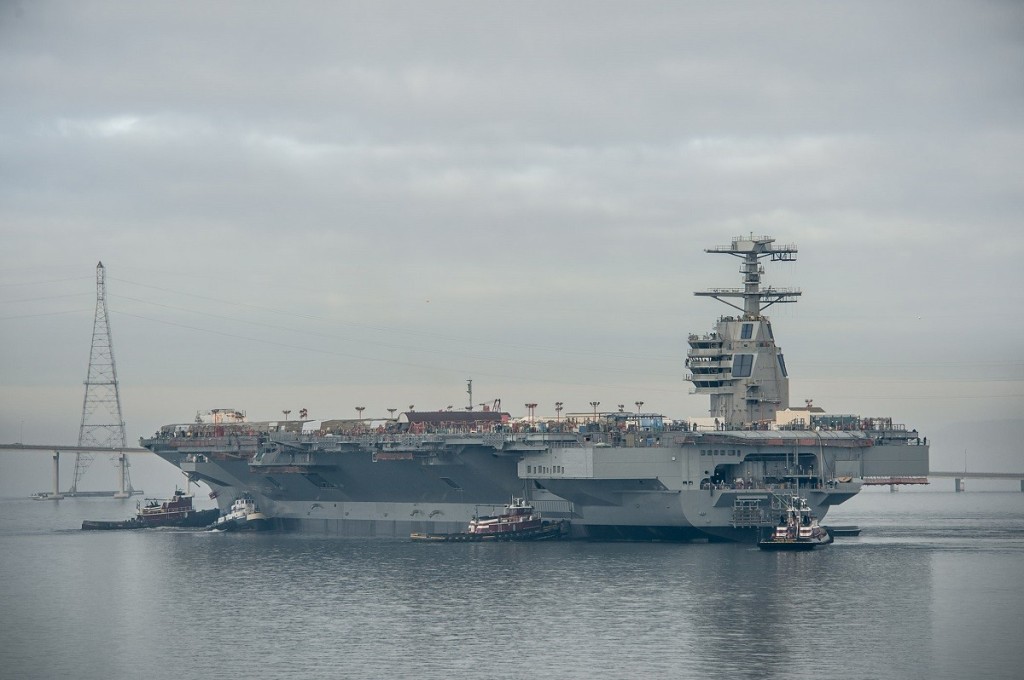
The aircraft carrier Gerald R. Ford (CVN 78) was moved Sunday to Newport News Shipbuilding’s Pier 3, where it will undergo additional outfitting and testing for the next 28 months. Photo by Chris Oxley

Huntington Ingalls Industries’ (HII) Newport News Shipbuilding (NNS) division launched Gerald R. Ford (CVN 78) into the James River for the first time on Sunday. The first-of-class aircraft carrier was moved to the shipyard’s Pier 3, where it will undergo additional outfitting and testing for the next 28 months.

Gerald R. Ford has been under construction in Dry Dock 12 since November 2009 and was moved about one mile south to the shipyard’s Pier 3 with the assistance of six tugboats. The ship will be moored at Pier 3 to complete outfitting and testing. Habitability spaces, such as berthing and mess areas, will be completed, and distributive, mechanical and combat systems, such as catapults and radar arrays, will be tested. The ship is scheduled for delivery to the U.S. Navy in 2016.

“The ship’s launch is always significant for her shipbuilders,” said NNS Rolf Bartschi, NNS’ vice president of CVN 78 carrier construction, “but I think it’s an extra special experience this time because of Ford’s unique qualities as the first ship of the class, and thanks to the close relationship shipbuilders have developed with CVN 78′s sponsor, Susan Ford Bales. This milestone provides an opportunity for the shipbuilding team to reflect on all of the hard work that has been accomplished to ready the ship for launch, and I could not be more proud of our shipbuilding team.”

huntingtoningalls.com

FEMCO Contracts Havyard for Ice Breaker Newbuild

MarineLink.com

Tuesday, November 19, 2013, 4:58 PM
File Photo: Havyard
Photo: Havyard

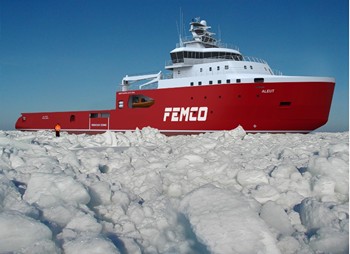
Havyard has been commissioned to design and build an ice breaker vessel for Russian shipping company FEMCO, to be designed by Havyard Design & Solutions in Fosnavaag, Norway and is going to be constructed at Havyard Ship Technology`s shipyard in Leirvik in Sogn, Norway. The vessel will become newbuild no.122 and is due to be delivered in September 2015. The Russian shipping company has also secured an option for the construction of one further Havyard 843 Ice.

Havyard has experience in constructing icebreakers for Russian shipowners. In 2006, Havyard delivered two icebreaking offshore vessels for the Russian shipping company Sevmorneftegaz (currently Gazprom Neft Shelf).

Executive Vice President Sales Tor Leif Mongstad of Havyard Group, said, “Havyard has previously constructed seven icebreaking offshore vessels and this is a third of all the icebreakers that DnV has classified of this type worldwide … Five vessels constructed by Havyard are currently sailing under a Russian flag, included 2 AHTSs of a Havyard 842 design and the ice breaker Vidar Viking.”

Havyard 843 Ice is a new design from the Herøy-based design company Havyard Design & Solutions. The vessel is going to have DnV ice class Icebreaker Ice 10 and Winterized Cold (-30 °C). Amongst other things, the vessel can break ice that`s more than 1 metre thick and has systems for avoiding icing of the vessel. The vessel is otherwise designed to carry out anchor handling, towing and standby operations for oil protection and rescue services.

“We also have great expectations towards the market that is opening up with major activity in Russian territories in the north and we believe this contract will make Havyard even more attractive for the Russian interests who are looking for this type of tonnage,” Mongstad continues. “With the new Havyard 843 Ice design, we have positioned ourselves well in order to compete for contracts that the market will offer in the future. We also have other icebreaking designs in our portfolio and we have the ability to quickly adapt our designs for whatever needs the customer may have.”

“We are well equipped to compete in this market, and we think there may be similar contracts ahead,” Mongstad concluded.

With this contract, Havyard Group has eight newbuilds and a major conversion on order at the Leirvik shipyard in Sogn, Norway, with an order reserve in the business area of shipbuilding of just under NOK 3 billion. Like the other vessels being constructed at the shipyard, Havyard Design & Solutions deliver both design and detail engineering for the production of the vessel. In addition, Havyard Power & Systems based in Aalesund, will deliver electro engineering, automation- and alarm systems and Havyard Concept Bridge. Norwegian Electric Systems, where Havyard owns 40% of the shares, will deliver electrical motors, generators and switchboards. The contract will also lead to extended effects within the maritime cluster in Western Norway, in the shape of equipment deliveries and services to the shipyard during construction of the vessel.

Main data
Length: 86 m
Breadth: 19.5 m
Depth: 7.75 m
Speed: 16 knots
Bollard pull: 185 metric tons
Accommodation: 34 persons

havyard.com
  • EVP Sales Tor Leif Mongstad of Havyard Group has great expectations for the market of icebreaking offshore vessels in northern Russia.EVP Sales Tor Leif Mongstad of Havyard Group has great expectations for the market of icebreaking offshore vessels in northern Russia.

An Australian Customs patrol boat has sunk an asylum boat after towing it from Christmas Island

Customs

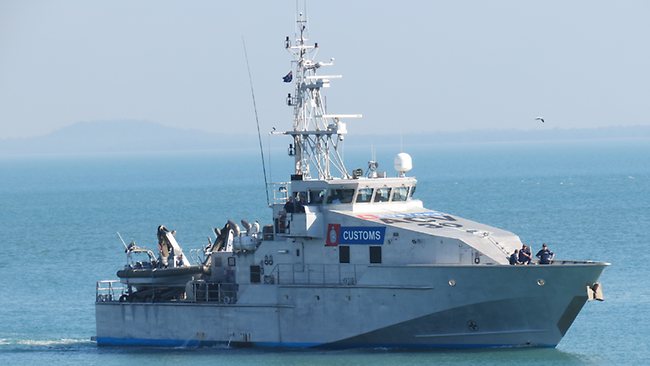
An Australian Customs patrol vessel similar to that involved in the incident of Christmas Island.Source: Supplied

A CUSTOMS border protection vessel was forced to rescue 40 asylum seekers after it tore off the bow of their rickety timber boat about 20km from Christmas Island.

The people were transferred from their boat by the Customs crew late on Friday, but were not delivered to the island until Sunday afternoon.

According to sources the suspected illegal vessel was detected by radar about 30km from the island on Friday afternoon and the passengers and crew were issued with a verbal warning about their final destination being Manus Island or Nauru and not Australia.

When they refused to turn around the Customs crew boarded the boat at about 6pm when it was just 20km from the island.

The Customs transit attachment took command of the vessel and turned it back towards Indonesian waters.

About three hours later the engine stopped and could not be restarted so a tow rope was attached.

By midnight the rickety timber boat had suffered terminal damage and began sinking so the asylum seekers were transferred to the Customs vessel.

The decision to move them to Christmas Island was not taken until about midnight on Saturday and they arrived at the island at lunch time on Sunday.

Various government officials, including Immigration Minister Scott Morrison and the commander of the joint agency task force Lieutenant General Angus Campbell, refused to shed any light on the drama or why it took 36 hours to transfer the people to Christmas Island.

Mr Morrison batted away several questions on the matter in Parliament and General Campbell said he would continue to provide only scant information to the public about “on water matters’’ to avoid feeding the people smugglers, but he did reveal that 13 boats carrying 707 people had arrived since the operation began.

He also told Senators that he would only provide information at his weekly Friday update.

Labor Senator Kim Carr reminded the general of his responsibility to answer questions under Senate Standing orders.

“It is not appropriate to be giving incidental advice of arrivals,” General Campbell said.

“I can assure the committee … where a serious [loss of life] incident arises they are reported at the time.”

The government’s secrecy over the asylum seeker issue has reached the point where Defence personnel in Darwin were ordered by their commander Air Commodore Ken Watson to avoid sending any emails on border protection matters.

Immigration Minister Scott Morrison refused to confirm or deny the sinking and he ordered all departmental officials not to answer any questions about the matter.

Meanwhile the cost of detaining asylum seekers in Australia’s Nauru and Manus Island detention centres is set to blow out beyond almost $1 billion in this financial year.

The federal government will have to find extra cash in the midyear budget review to keep the offshore detention centres running on Nauru and Manus Island, a Senate committee has heard.

Immigration Department secretary Martin Bowles told the estimates hearing the current budget allocation of $900 million would not last until the end of 2013/14.

“We are looking at needing more money,” he told the Senate.


CHRISTMAS ISLAND


Ads By Google

China Stages Night Landing Drill Near N.Korea

China staged a live-firing landing exercise with about 5,000 Army, Navy, and Air Force troops in Bohai Bay near North Korea on Sunday night, the official Chinanews website reported Monday. 

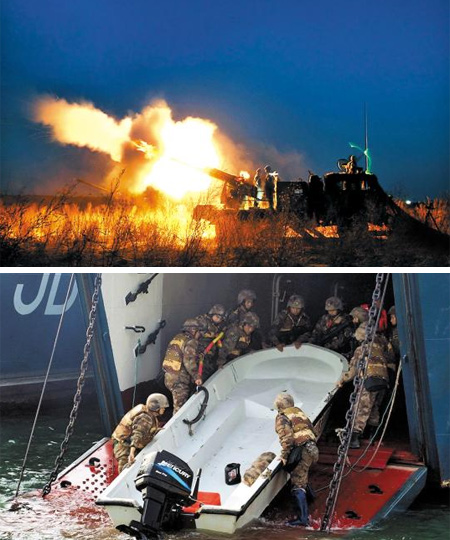
Photos showed tanks from a landing ship running on the beach, self-propelled guns firing shells, soldiers loading a landing boat and flares exploding above a fleet of ships.

The website said the exercise focused on reconnaissance, warning, maritime transport, firepower, and landing.

Chinese soldiers fire shells during a night landing drill in Bohai Bay on Sunday (top); Chinese soldiers load a landing boat onto a warship during a night landing drill in Bohai Bay on Sunday. /Chinanews.comChinese soldiers fire shells during a night landing drill in Bohai Bay on Sunday (top); Chinese soldiers load a landing boat onto a warship during a night landing drill in Bohai Bay on Sunday. /Chinanews.com
The live shell firing exercise continues until Wednesday, the website added, and ships are banned from the area for the duration.

It is rare for China to stage a military exercise under North Korea’s nose and make it public immediately. A diplomatic source in Beijing speculated that the drill aims to prepare for any serious instability in the North.

Others guess that it was a show of force aimed chiefly at Japan in the conflict over the Diaoyu or Senkaku Islands in the East China Sea.

englishnews@chosun.com / Nov. 19, 2013 09:45 KST

Related Articles

This is what a high speed turn in a US Navy destroyer looks like

This is what a high speed turn in a US Navy destroyer looks likeSEXPAND

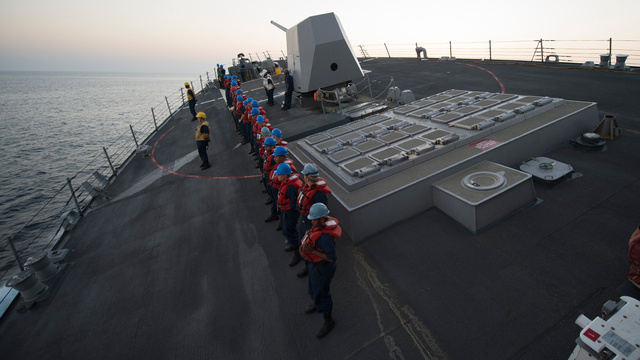
I love this photo by U.S. Navy photo by Mass Communication Specialist 3rd Class Shane A. Jackson: sailors standing aboard the guided-missile destroyer USS Bulkeley during a turn at full speed. It’s crazy to think that a 509-foot-long beast that displaces 9,200 tons can make such high-speed maneuvers.

For reference:

This is what a high speed turn in a US Navy destroyer looks like

And here’s a video:

JCs Royal New Zealand Navy Ships and New Zealand Defence, Also other World Defence Updates

Ships and Defence News Past and Present

Skip to content ↓