
|
UK: Babcock to Equip Type 23 Frigates with CESM
Naval Today >> The industry’s seaborne news provider by Naval Today / 3h // keep unread // trash // preview
Under a contract assigned by the UK Ministry of Defence (MoD), Babcock will deliver an off-the-shelf communications electronic support measures (CESM) system providing an enhanced electronic surveillance capability for the Royal Navy’s (RN) Type 23 frigates. The seven year contract to deliver the Type 23 CESM system is effective from November.Babcock, teamed with principal subcontractor Argon ST, will deliver a system at the required high Technology Readiness Level (TRL), requiring no development work, to enable rapid replacement of the existing obsolete system on the Type 23s with very low risk delivery, meeting the MoD’s capability requirement at optimum value for money. Babcock’s Type 23 CESM system, Hammerhead, offers a low risk, mature solution tailored to Type 23 requirements and provides surveillance capability, supporting both tactical indicators and warnings and other tasked requirements, using technology proven on naval platforms. It offers exceptional installed performance, while the commonality with other Lighthouse CESM systems currently in use provides the opportunity for common spares, training, and operator flexibility. These features combined with a modular design block approach enable Babcock to provide flexibility in system configuration, enabling the MoD to meet current requirements within budget and to future-proof the capability with the potential for enhancement or life extension using future funding if available to meet changes in operational requirements. Further, Babcock’s unparalleled knowledge of the platform and leadership role within the Type 23 Class Output Management team ensures low risk platform integration delivered by a known and experienced team, and assured installed performance.
Press Release, November 19, 2013; Image: Royal Navy |


Typhoon Haiyan – UK Response Update

|
Typhoon Haiyan – UK Response Update
Home | Think Defence by Think Defence / 3h // keep unread // trash // preview
An update post on the UK’s response to Typhoon Haiyan
      
 Royal Air ForceThe first RAF C-17 delivered vital UK aid to Cebu in the Philippines earlier today. At the airport in Cebu to greet the RAF crew and emergency personnel on behalf of the President was General Roy Deveraturda, the region’s senior military commander, who thanked the RAF and the British people for their contribution to the disaster relief operation.
The post Typhoon Haiyan – UK Response Updateappeared first on Think Defence.           
+TAG
|


Share this:

USCG Apprehends Suspected Smugglers

|
USCG Apprehends Suspected Smugglers
Naval Today >> The industry’s seaborne news provider by Naval Today / 2h // keep unread // trash // preview
U.S. Coast Guard crews intercepted five people suspected of working as refuelers for smuggling vessels approximately 100 miles south of San Diego, Sunday morning.At approximately 3:20 a.m., the crew of Coast Guard Cutter Midgett detected the panga. After a brief chase ending in the use of disabling fire on the vessel’s engine, the suspects were detained and brought to San Diego. The smuggling vessel was seized and the crew were turned over to U.S. Border Patrol. Refueling at sea is a tactic smugglers have adopted to allow them to carry illicit cargo further out to sea and north along the California coast. |

Share this:

Vigorous Comes Back from Patroling the Caribbean Sea

|
Vigorous Comes Back from Patroling the Caribbean Sea
Naval Today >> The industry’s seaborne news provider by Naval Today / 2h // keep unread // trash // preview
The crew of the Cape May-based Coast Guard Cutter Vigorous returned on Sunday from a 48-day patrol. The Vigorous crew departed Oct. 1 for a counter-drug and counter-human trafficking patrol throughout the Caribbean Sea. During the patrol, Vigorous crewmembers offloaded $40 million worth of cocaine at Port Everglades, Fla.On Nov. 12, the Vigorous crew intercepted an overloaded Haitian sailing vessel off the North coast of Haiti containing 68 migrants. The migrants were transferred to Vigorous carefully using the cutter’s small rescue boats. They were then medically cared for, and supplied with food and water before being repatriated to Haiti. The Vigorous also served as a migrant holding platform, providing shelter and care for 84 Cuban migrants. The Vigorous crew also assisted in the rescue of a severely dehydrated Canadian sailor along with a helicopter crew from Coast Guard Air Station Borinquen, Puerto Rico. The Vigorous crew worked with the air station crew to provide the 61-year-old man with necessary medical care. Medium endurance cutters like the 210-foot Vigorous are built for multi-week offshore patrols, including operations requiring enhanced communications, and helicopter and pursuit boat operations, which provide a key capability for homeland security missions at sea. |

Share this:

China’s Ballistic-Missile Submarines: How Dangerous?
Share on emailShare on twitterShare on facebookShare on digg|More Sharing ServicesMore
|November 18, 2013
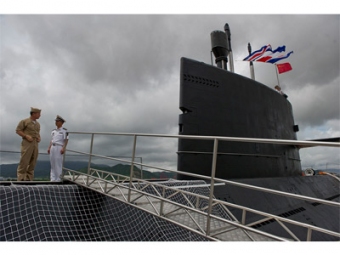
 On October 27, China’s state-run Xinhua news agency released a slideshow showing what the Chinese People’s Liberation Army Navy (PLAN) touted as the country’s first nuclear ballistic-missile submarine (SSBN). Though the “unveiling” of China’s Type 092 Xia-class SSBN comes as no surprise, Beijing’s open display of the submarine, coupled with technical improvements to the Chinese JL-2 submarine-launched ballistic missile (SLBM), raises the question of whether China is approaching a credible sea-based nuclear deterrent.
Although the Xia-class SSBN received much fanfare in both Chinese andWestern sources alike, the PLAN envisions the Type 094 Jin-class submarine as playing the primary role in China’s sea-based nuclear-deterrence strategy. Even Xinhua has admitted that the Xia-class SSBN does not comprise a viable nuclear second-strike force. According to the U.S. Office of Naval Intelligence, China maintains three operational Jin-class SSBNs and is currently constructing two more, all five of which will be outfitted with twelve JL-2 SLBMs. According to U.S. defense officials, the Jin-class SSBN is expected to begin sea patrols as early as 2014.
For China to acquire a credible survivable sea-based nuclear deterrent, the country must overcome two technical challenges that the country has been unable to surmount since first launching an SLBM from a submarine in 1988. China must build a submarine stealthy enough to avoid U.S. antisubmarine warfare (ASW) assets and design a JL-2 SLBM capable of penetrating US ballistic missile defense (BMD) with high probability.
Both the Xia-class and Jin-class SSBNs are not quiet enough to avoid detection by U.S. ASW assets. The Jin-class SSBN design if fundamentally flawed in that the large missile compartment at the rear of the vessel and the flood openings below the missile hatches create a detectable sonar signature. A 2009 U.S. Office of Naval Intelligence report comparing the low-frequency noise level for China’s SSBN force to that of Russian 1970s-era SSBNs found that out of the twelve submarines profiled, the Xia-class SSBN was the most detectable and the Jin-class SSBN the fourth-most detectable. China’s JL-2 SLBM has repeatedly failed launch tests and it is still unclear whether the PLAN successfully tested the SLBM on August 16, as it claimed.
Even if China acquires the technical capacity necessary for a survivable sea-based nuclear deterrent, the highly centralized PLA has no operational experience in maintaining deterrence patrols on the open seas. China has traditionally relied exclusively on its land-based intercontinental ballistic missiles (ICBMs) for deterrence and thus has never confronted the existential question of whether to predelegate SLBM launch authority to submarine commanders in case of crisis.
MORE BY
Topics:
Regions:
- Show full page
- Login or register to post comments

