RFA Lyme Bay Keeps Operational Capability

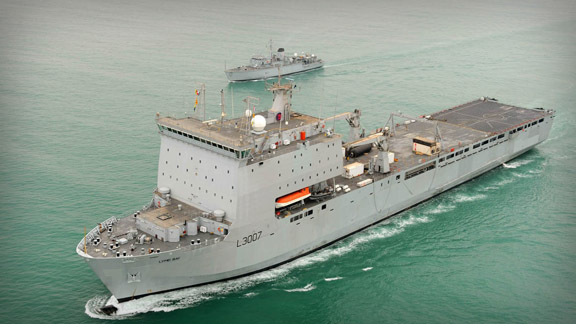
RFA Lyme Bay

RFA Lyme Bay Keeps Operational Capability

Naval Today >> The industry’s seaborne news provider by Naval Today  /  9h  //  keep unread  //  trash  // preview

RFA Lyme Bay Keeps Operational Capability

Onboard RFA Lyme Bay, which is part of European Union Naval Force (EU NAVFOR) Somalia Operation Atalanta, the Boarding teams from the Fleet Contingency Troop and K Company 43 Commando Royal Marines have taken advantage of the Lynx MK 8 that embarked from RFA Fort Austin to practice fast roping techniques.

Each stick of the boarding team conducted 3 separate fast roping exercises, each from different heights and to a different location on Lyme Bay: from the flight deck up to the forecastle. This training is part of the effort to maintain the skills of the boarding team and their operational capability.

Fast roping can be useful and necessary to board a vessel in a different way than using normal boats. They also conducted a small arms shoot across the flight deck of Lyme Bay in order to maintain their military skills.

RFA Lyme Bay joined EU NAVFOR Somalia Operation Atalanta on October 16 and will be part of the mission until half November.
Press Release, November 11, 2013; Image: EUNAVFOR

Ukrainian Navy Hetman Sahaidachnyi (U130) frigate within the Multinational Ship Component under the Ocean Shield operation proceeded to the third patrolling phase in the Gulf of Aden.

Hetman Sahaidachnyi Keeps Up the Good Work under Ocean Shield

Naval Today >> The industry’s seaborne news provider by Naval Today  /  9h  //  keep unread  //  trash  // preview

Hetman Sahaidachnyi

On November 10, the Ukrainian Navy Hetman Sahaidachnyi (U130) frigate within the Multinational Ship Component under the Ocean Shield operation proceeded to the third patrolling phase in the Gulf of Aden.

During the second patrolling phase, from October 29 through November 7, the personnel of the national contingent ensured the navigation security in the defined areas of the Gulf of Aden and completed intensive training of the ship crew and special team, as well as monitored the maritime transport.

According to the Ukrainian Ministry of Defence (MOD), the ship’s crew members are pleased with combat flagman service and they stress that this job is heavy but very honorable as they accomplish the state mission.
In the Djibouti port, the crew executed the ship logistics support. Hetman Sahaidachnyi will participate in counter-piracy operation until January 2014.
Press Release, November 11, 2013; Image: Ukrainian MoD

X-47B Integrates with USS Theodore Roosevelt

X-47B Integrates with USS Theodore Roosevelt

Naval Today >> The industry’s seaborne news provider by Naval Today  /  8h  //  keep unread  //  trash  // preview

X-47B Integrates with USS Theodore Roosevelt

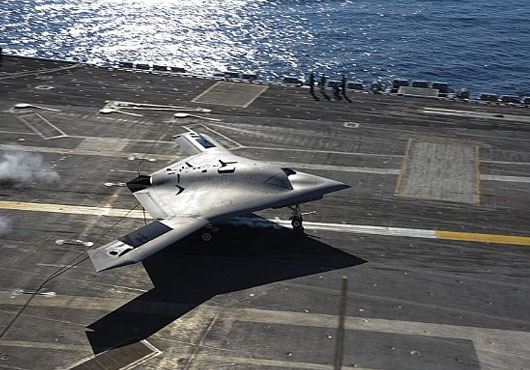
The X-47B Unmanned Combat Air System Demonstrator (UCAS-D) conducted flight operations aboard the aircraft carrier USS Theodore Roosevelt (CVN 71), Nov. 10.

The event, the most-recent in a series of carrier-based tests, demonstrated the integration of the latest in naval aviation technology with the most advanced and capable carrier.

This weekend’s tests demonstrated the X-47B’s ability to integrate with the carrier environment. The aircraft performed precise touch and go maneuvers on the ship to generate data that characterizes the environment in close proximity of the carrier flight deck. In addition, the aircraft took part in flight deck handling drills, completed arrested landings and catapult launches. Mission operators monitored the aircraft’s autonomous flight from a portable command and control unit from Theodore Roosevelt’s flight deck during each of its 45-minute flights.

“It is a tremendous opportunity for the ‘Big Stick’ to be a part of the development and testing of the future of Naval Aviation,” said Capt. Daniel Grieco, Theodore Roosevelt’s commanding officer. The UCAS is an impressive system that gives us all a glimpse into the support and strike capabilities we can expect to join the fleet in the years to come. The tactical and support possibilities for such platforms are endless, and I know the crew of TR are proud to be able to be a part of that development.”

A major objective for the UCAS-D program is to demonstrate a digitized carrier controlled environment to allow for robust communications between the aircraft and all carrier personnel involved with launching, recovering and controlling the aircraft. A digitized carrier environment will ultimately increase flexibility and improve safety.

“This weekend’s resumption of carrier-based flights for the X-47 continues our efforts to mature critical unmanned enabling technologies and reduce the technical risk for the follow-on Unmanned Carrier Launched Airborne Surveillance and Strike (UCLASS) system,” said Capt. Beau Duarte, the Program Manager for Unmanned Carrier Aviation.

Current and future test events will continue to mature unmanned technologies and refine concept of operations to further inform unmanned carrier requirements. These program successes represent significant advancements in naval aviation technology and provide a glimpse into the future integration of manned and unmanned aircraft aboard the carrier fleet.

 ”Today, we took another significant step toward integration of unmanned capabilities into our carrier airwings and aircraft carrier environments,” said Rear Adm. Mat Winter. “The Navy remains steadfast in its commitment to maturing today’s technologies which have established a realistic path to tomorrow’s affordable, flexible unmanned carrier aviation capabilities for our warfighters.”

Carrier-based tests of the X-47B began in December 2012 with flight deck operations aboard USS Harry S. Truman (CVN 75). Carrier testing resumed in May 2013 aboard USS George H.W. Bush (CVN 77), where the X-47B completed its first carrier-based catapult launch, followed by its first carrier-based arrested landing in July.
Press Release, November 11, 2013; Image: US Navy

British, Omani Sailors Switch Ships for the Day

British, Omani Sailors Switch Ships for the Day

Naval Today >> The industry’s seaborne news provider by Naval Today  /  8h  //  keep unread  //  trash  // preview

British, Omani Sailors Switch Ships for the Day

HMS Illustrious, part of the Response Force Task Group deployed on Cougar 13, has participated in Exercise Omani Cougar. During the six day exercise around 20 sailors were given the opportunity to switch ships for the day to experience how their Omani counterpart’s ships operate and get a chance to engage with sailors, to share experiences and knowledge.

The Royal Navy of Oman (RNO) primarily operates coastal craft that are small by comparison with 22,000 tons that HMS Illustrious displaces.

HMS Illustrious hosted nine personnel from RNOV Al Sharqiyah, a Dhofar Class Fast Attack Craft.

The ship has a complement of 43 sailors compared with the 1200 that can live and work on board HMS Illustrious.

British, Omani Sailors Switch Ships for the Day 1

The visit began with tour of the Marine Engineering department, and the Royal Navy of Oman sailors seemed particularly impressed by the ship’s Rolls Royce gas turbine engines and the ship’s ability to produce daily 400 tons of water.

Three sailors from HMS Illustrious were able to enjoy the view from the upper deck of the Royal Naval Omani Vessel Al Najah.

Lt Cdr Bleasdale said:

 “It was really interesting to understand and witness how the Omanis operate and the parity that the joint training for the officers at BRNC Dartmouth brings to the exercise.

“It was also refreshing to experience a different type of breakfast, with chickpea in masala sauce on the menu!”

The Cougar 13 deployment also includes operations in the Mediterranean, Red Sea, the Gulf, and Horn of Africa. It involves exercising with partner nations, and demonstrates the UK Armed Forces’ capacity to project an effective maritime component anywhere in the world.
Press Release, November 11, 2013; Image: Royal Navy

Follow Naval Today via:

Matson Orders Engines for New Containerships

By Eric Haun

Monday, November 11, 2013, 10:12 AM
File Artist
Artist’s depiction of 3,600 TEU containerships

Matson Navigation Company, Inc., a U.S. carrier in the Pacific Ocean, announced an order today for two MAN B&W, 7S90ME-GI dual fuel engines with liquefied natural gas (LNG) capability to be installed aboard two new “Aloha Class” 3,600 TEU containerships ordered last week from with Aker Philadelphia Shipyard Inc. (APSI). The deal includes an option for three further vessels.

The dual fuel engines, each developing 42,700 kW, are reportedly the largest ever ordered in terms of power output. The ME-GI engines and pertaining systems will be manufactured by MAN Diesel Turbo’s licensee, Hyundai and will be able to use HFO, MDO or LNG as fuel. According to the engines’ manufacturer, the 7S90ME-GI uses the Diesel cycle to maintain high efficiency, with no need for any derating. The company also states that the engines by virtue of its diesel operating principle will have negligible methane slip and no need for restrictive load ramps or other knock-preventing measures.

APSI delivered four newbuild Jones Act containerships for Matson from 2003-2006. Expected for delivery in the third and fourth quarters of 2018, the newest orders will add to Matson’s current 18-vessel fleet of containerships, combination container and roll-on/roll-off ships and custom-designed barges, were ordered at a reported aggregate price of $418 million. The 850-foot long vessels will be the largest Jones Act containerships ever constructed and are designed to operate at speeds in excess of 23 knots, and will still be able to navigate some of Hawaii’s smaller ports.

Matt Cox, Matson’s president and CEO, said the Aloha Class containerships are built specifically for Hawaii’s freight demands: “The new ships are designed to accommodate the diversified mix of cargo needed to support the state’s economy and will boost our capacity for moving 45-foot containers and refrigerated cargo. The ships will also carry construction materials more effectively. Most importantly, this considerable investment underscores Matson’s long-term commitment to providing Hawaii with a strong, reliable lifeline to and from the U.S. Mainland.”

Aimed at reducing fuel consumption and emissions, Matson the new vessels will also feature a variety of environmentally-focused technologies in addition to its efficient engines, including a fuel efficient hull design, dual fuel engines, environmentally safe double hull fuel tanks and fresh water ballast systems.

The first of the two new ships will be named after the late Senator Daniel K. Inouye, who was a longstanding supporter of the U.S. maritime industry and its role in supporting Hawaii’s economy.
JCs Royal New Zealand Navy Ships and New Zealand Defence, Also other World Defence Updates

Ships and Defence News Past and Present

Skip to content ↓