Stephen Hume: Canada’s first casualties of the First World War – Four young Canadians: Last-minute additions to a Royal Navy cruiser, they died in a mismatched battle in the Pacific

Stephen Hume: Canada’s first casualties of the First World War

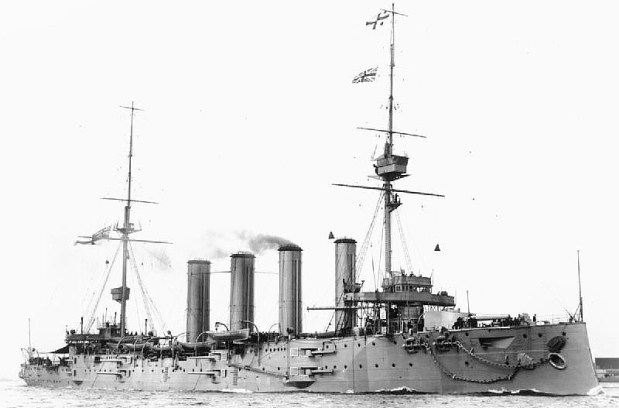
HMS Good Hope, Rear Admiral Sir Christopher Cradock’s flagship, was destroyed by Admiral Graf Maximilian von Spee’s squadron before it could fire a shot.

Who was Canada’s first casualty in the First World War?

It’s hard to say since Canada, as a dominion of the British Empire, automatically went to war on Aug. 4, 1914, when Britain entered it against Germany in support of its Russian and French allies.

Although the Canadian Expeditionary Force didn’t land in France until early 1915 — the Canadian Army consisted of barely 3,000 men when war was declared — some Canadians who were already overseas almost certainly joined British units that went into action right away.

British regiments were fighting in the battle of Alsace as soon as Aug. 7 that year and there were 7,000 casualties. By early October, the fighting on the Marne, at Mons and Ypres had already claimed more than half a million casualties on both sides and there were probably Canadians among them although you’d have to sift through British army records to find them.

The first recorded Canadian casualties at I’ve been able to find, though, were four lads from the newly minted Royal Canadian Navy — it was only established in 1910 — who were killed in a disastrous sea battle in the Pacific that’s largely overshadowed by the monstrous carnage that seized Europe.

Malcolm Cann, 18, John Hatheway, 19, William Palmer, 20, and Arthur Silver, 20, were four midshipmen who had been in the first class of the newly founded Royal Navy Colleges of Canada in Halifax.

When war broke out, Rear Admiral Sir Christopher Cradock, commanding the Royal Navy’s North American and West Indies station, was visiting Halifax.

When Germany’s East Asia squadron of five powerful cruisers commanded by Admiral Graf Maximilian von Spee threatened British commerce in the eastern Pacific — there was a panic in Vancouver over the German marine menace and Japan sent a battleship to defend the Strait of Juan de Fuca from the Germans — Cradock was ordered find and engage the German fleet.

He transferred his flag to the armoured cruiser HMS Good Hope and, being short four junior officers, asked that Silver, the chief cadet captain, and Palmer, who was the top of his class and senior midshipman, join his gun crew. Cann and Hatheway were drawn by lots.

Cradock’s squadron consisted of his new flagship, built in 1901; HMS Monmouth, a smaller cruiser built the same year; the light cruiser HMS Glasgow; and the lightly armed merchant ship Otranto. A much larger but obsolete battleship, HMS Canopus, was assigned but was so old and slow that it couldn’t keep up when Cradock dashed for the South Pacific.

Von Spee’s squadron included the cruisers Scharnhorst, Gneisenau, Leipzig, Dresden and Nurnberg, which had greater speed, armament and range than Cradock’s ships.

The squadrons met late on the afternoon of Nov. 1, 1914, about 80 kilometres off the coast of Chile which was neutral, had a large German immigrant population and coal with which von Spee planned to refuel.

The British squadron found itself silhouetted by the setting sun and the German ships opened fire at long range. Before his crew could even return fire, Cradock’s flagship exploded and sank with all hands, including the four Canadian midshipmen and the admiral who had chosen them. HMS Monmouth was sunk two hours later. There were 1,600 sailors killed. It was the worst British naval defeat in a century.

But HMS Glasgow and the Otranto escaped.

But when von Spee rounded Cape Horn to evade a large joint Australian and Japanese task force, the Royal Navy was waiting at the Falkland Islands with a powerful squadron, including two modern battle cruisers. On December 8, the four German ships were pursued and sunk. Von Spee and two of his sons were killed and 1,800 German sailors perished.

One of the Royal Navy ships most heavily damaged, the cruiser HMS Kent, limped around Cape Horn and had its battle damage repaired at Esquimalt.

The names of the four young midshipmen who were among the very first Canadians to die in battle in the First World War whose names we know are commemorated on the Halifax Memorial.

© Copyright (c) The Vancouver Sun

Read more:http://www.vancouversun.com/news/Stephen+Hume+Canada+first+casualties+First+World/9144648/story.html#ixzz2kLPWmNjk

The importance of the renewable fuel standard

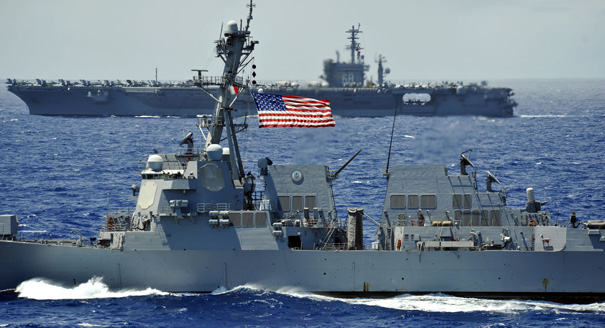
The guided-missile destroyer USS Chung-Hoon and the aircraft carrier USS Nimitz are underway during the Great Green Fleet demonstration portion of the Rim of the Pacific 2012 exercise. | AP Photo

At RIMPAC 2012, Navy ships used a 50 percent renewable fuel blend, the author writes. | AP Photo

Close

By SEN. MAZIE HIRONO | 11/10/13 9:04 PM EST

In the summer of 2012, Hawaii and the surrounding Pacific Ocean played host to the 23rd biannual Rim of the Pacific naval exercise. Last year’s RIMPAC was the world’s largest and most comprehensive maritime exercise, with more than 22 countries participating from across the Asia-Pacific region.

While RIMPAC 2012 was notable for its size and scope, it was also notable for something else — it was the first time the U.S. Navy operated ships and other platforms with a blend consisting of 50 percent renewable fuel.

Continue Reading

Dubbed the Great Green Fleet demonstration, the Navy’s exercise proved that biofuels are a viable alternative to fossil fuels. In fact, the Navy even refueled a Royal Australian Navy helicopter that had been using conventional fuels with biofuel aboard the USS Nimitz. The helicopter performed perfectly after the refueling, and on July 19, the United States and Australia signed an agreement to work together to advance the use of biofuels.

For the Navy, developing alternatives to fossil fuels isn’t just about fighting climate change — though that’s an important side benefit. Biofuels will also play a much more practical role in the Navy’s fuel mix, boosting our energy security and supporting the U.S. economy.

The economic case for biofuels is especially compelling. From fiscal year 2005 through fiscal year 2012, the U.S. military reduced its annual oil consumption from 122 million barrels to 107.6 million barrels — a 12 percent decrease. Over that same time period, however, the military’s spending on fuel rose from $7.4 billion to $16.8 billion — a 130 percent increase.

These are unsustainable costs that eat up funds that could be put toward training, equipping and otherwise supporting our troops. It is clear that our national security and economic growth are tied to affordable, abundant energy sources. That is why calls to repeal the federal Renewable Fuel Standard are the wrong way to go. The RFS not only lowers the cost of fuel but also reduces the resources spent both protecting our trade routes and the costs to transport the fuel itself. It saves American consumers money.

In place since 2007, the RFS has spurred a growing renewable fuel industry in the United States and is providing a framework to drive investment and innovation in the next generation of oil alternatives. This flexible policy is giving long-term investors confidence that there will be a market for the fuels they are working to develop.

Increasing the renewable fuel market share in a sector monopolized by oil will also drive economic growth in nearly every state. Hawaii is working to lead the way in this regard. We rely on oil for 90 percent of our primary energy — from fueling our cars, trucks and aircraft to keeping the lights on in our homes, schools and businesses.

We pay billions of dollars per year to purchase oil, and 96 percent of that money leaves our state. For every dollar that leaves our islands, Hawaii’s economic activity is reduced by $2.75. As a result, our state has set one of the nation’s most ambitious goals for reducing fossil-fuel use: 70 percent by 2030. Meeting this goal is both a challenge and an opportunity, and Hawaiian companies are leading the way.

Clearly, there is a growing market for affordable, abundant and sustainable energy. Industry is working to meet the needs of this market, and in the process is creating jobs, technologies and industries in states across the country.

Now is not the time to eliminate policies that are helping these entrepreneurs grow to meet the energy needs of our military and our families. Instead, we should continue to support the RFS, boost the efforts of the military and increase federal investment in research, development and deployment of clean energy.

The United States is in a position to be the world’s clean energy leader. Diversifying our energy sources will create jobs, improve our national security and lay the foundation for a strong, sustainable economy in the future.

Mazie Hirono is the junior U.S. senator from Hawaii.

Read more: http://www.politico.com/story/2013/11/mazie-hirono-renewable-fuel-standard-99633.html#ixzz2kLNvIA2r

Historians attempt to find WWI’s first bullet deep in Australian waters


After the Pfalz was captured, it was refitted as a troop ship for the Royal Australian Navy under the name of HMT Boorara. (Allan Green / National Library of Australia)
ABCAfter the Pfalz was captured, it was refitted as a troop ship for the Royal Australian Navy under the name of HMT Boorara. (Allan Green / National Library of Australia)

The seemingly impossible task of finding the very first shot fired by Allied troops in World War I has begun, and the key to the mystery may be at the bottom of Port Phillip Bay in Melbourne.

As the nation marks Remembrance Day, historians say Australian gunners were the ones who fired the first shell at a German ship.

One hundred years on, the Anzac Centenary Commission is hoping it can salvage the six-inch explosive from the ocean floor.

Around noon on August 5, 1914, a gun crew stationed at Fort Nepean on the Mornington Peninsula fired across the bow of German cargo steamer SS Pfalz.

Local historian Keith Quitten says it was not as simple as point and shoot.

At the time, the Commonwealth government was based in Melbourne and such action had to be approved there.

“The commander at Fort Queenscliff was told there was a declaration of war,” Mr Quitten said.

“The attorney-general got his lawyers to look up the legal details of how the shot was to be fired and informed the fort that it should be fired across the bow of the ship,” he said.

“It was reputed they could cut the tow rope between the towing ship and the target with the first single shot fired from each of their six-inch guns.”

Long-lost clues discovered in cardboard box

The press at the time got most of its information from the pilot of the German ship, who made most of it up.

That all changed last year with the discovery of a cardboard box full of military documents.

The shot had to be fired from the gun in the bay before the enemy ship got too close to Swan Island, which had a naval mine depot.

“However, if the shell missed the ship and landed there, there was a chance there could be an explosion in the mine depot itself, or a little further on that it could hit the township of Queenscliff.”

But the crew did not get any instructions and the commander decided on his own volition to fire the gun.

The ship was halted and detained, making this not just the first event of World War I, but the first capture of a German asset.

It will be a mammoth task: Baillieu

Armed with a better idea of where to look, a recovery mission has been suggested as part of the Anzac centenary commemorations.

Former Victorian premier Ted Baillieu is heading up the Victorian Anzac Centenary Committee.

“The fact that the very first shot was fired in Victoria from Point Nepean, I think, underscores the depth of commitment Victorians made,” Mr Baillieu said.

He added that finding a 100-year-old artillery shell at the bottom of a bay “will be a mammoth task”.

“Of course it would be an extraordinary thing to locate and recover the shell. I don’t think there is any doubt about that,” he said.

“It would have to be intact. But it is not beyond the realm of possibility if the shell didn’t explode and there is still a little bit of doubt about that.”

Having spoken with specialist divers and historians, Mr Baillieu says any search would have to happen in the summer months.

Everyone agrees that finding a six-inch shell at the bottom of a sea bed is a long shot, but the temptation to give it a go is too great.

“It’s an unlikely prospect but it is nevertheless and tantalising one,” Mr Baillieu said.

“And were we to locate and recover the very first shell fired by the British empire in World War I, then I think that would be an international event,” he said.

‘Yolanda’ kicks out Chinese from Ayungin Reef, Philippine Marines on grounded ship safe

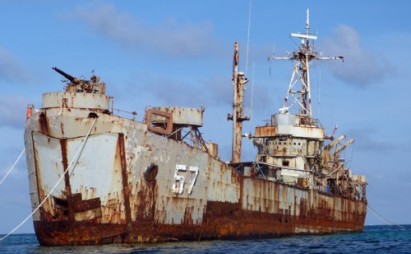
BRP Sierra Madre

InterAksyon.com
The online news portal of TV5

MANILA – Super typhoon Yolanda has sent home Chinese maritime and Navy vessels at the Ayungin Reef in Palawan, while the half a dozen Philippine Marines on board a rusting and grounded World War II-era ship are safe, a source told InterAksyon.com.

This effectively ends the standoff between the two countries some 100 nautical miles from the island of Palawan.

Ayungin is part of the Kalayaan Island Group (KIG) in the West Philippine Sea (WPS). China claims the reef is part of its territory, more than a thousand nautical miles from its nearest 200-nautical-mile exclusive economic zone (EEZ).

“They’re safe,” said a senior officer of the Philippine Marines guarding the reef on board the shipwreck BRP Sierra Madre (Landing Ship Tank 57). The Philippine Marine official requested that he not be named because he is not authorized to give any statement regarding operational activities in the West Philippine Sea.

Hindi naman sila naanod (They were not washed away),” the source added.

The source said the Chinese Navy ship, maritime ships, and fishing vessels left Ayungin two or three days before Yolanda struck the country.

“As of now, we’ve no report that the Chinese ships have returned to Ayungin. Dahil siguro may paparating na naman na isa pang bagyo (Maybe because another storm is approaching the country),” he said.

In June this year, Chinese vessels entered Ayungin and had maintained a presence in the area, as what they did in Panatag (Scarborough) Shoal located in Masinloc, Zambales in April 2012.

The territorial dispute between the two countries is being heard by an international arbitration court in Hamburg.

Chinese soldiers to step on US soil for first time

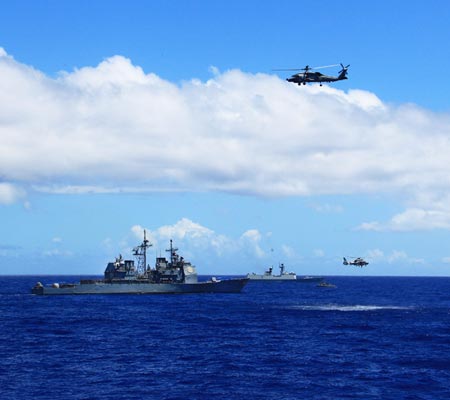
The US and PLA Navy conducting a joint exercise over the waters of Hawaii, Sept. 10. (Photo/Xinhua)

The US and PLA Navy conducting a joint exercise over the waters of Hawaii, Sept. 10. (Photo/Xinhua)

China’s PLA ground forces will for the first time set foot on US soil between Nov. 12 – 14 to participate in a joint military exercise, reports the Guangzhou-based Southern Metropolis Daily.

The Grid Security Exercise 2 (GridEx 2) has been launched across North America to test US, Candian and Mexican government measures in dealing with relief against natural disasters and large-scale attacks, reported the Canada Free Press. China’s participation in the Hawaii regional exercise was confirmed by Samuel Locklear, head of the US Pacific Command, on Nov. 5 during a press conference.

Locklear stated that joint humanitarian assistance and disaster relief exercises will be held in Hawaii as part of GridEx 2 to improve Sino-US relations, according to a state-run Xinhua News report. US Army Garrison-Hawaii has been preparing to host the Chinese regiment for some time, he added.

Soldiers from both nations will simulate humanitarian assistance and disaster relief operations on a fictional third country.

Even while China continues its protracted territorial dispute over the Diaoyutai (Senkaku) islands with Taiwan and Japan, key US allies in the Asia-Pacific theater, military relations are functioning well, according to the Southern Metropolis Daily. The US Navy and PLA Navy launched a joint search-and-rescue exercise in Hawaiian waters just two months ago.

JCs Royal New Zealand Navy Ships and New Zealand Defence, Also other World Defence Updates

Ships and Defence News Past and Present

Skip to content ↓