The legacy of Hartlepool’s US Navy ‘ghost ships’

By Phil MawsonBBC News

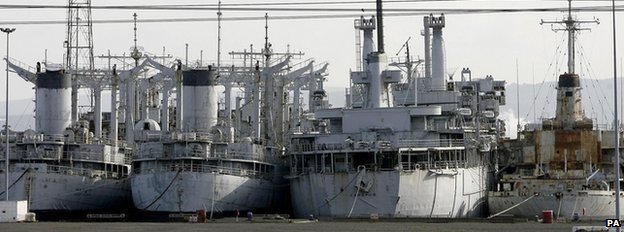
The US Naval Reserve vessels sit in a dry dock in Hartlepool

Ten years ago, a trans-Atlantic row broke out over the fate of 13 rusting US warships destined to be broken up in Hartlepool. Environmentalists claimed their toxic contents would endanger health but how has the town actually been affected?

Until 2003, if someone was asked where Hartlepool was, the answer might well have been “the place where they hanged the monkey“.

But on 12 November 2003, the arrival of a rusting American warship triggered a saga unequalled in the town’s history.

Four months earlier, businessman Peter Stephenson won a contract to scrap ageing ex-US naval vessels – dubbed “ghost ships” – at his Able UK yard.

That sparked a bitter environmental and legal fight, which has continued to this day.

Hartlepool-born Mr Stephenson said the contract was for an initial 13 vessels, but he ultimately hoped to dismantle 167 ships at the yard.

Jean Kennedy, left, and Iris Ryder of Friends of HartlepoolLandfill fight continues: Jean Kennedy, left and Iris Ryder from Friends of Hartlepool

Environmentalists mounted vociferous protests, claiming Hartlepool would become “the dumping ground of the world” but Able UK said the work would provide a much-needed boost to the local economy and create hundreds of new jobs.

The vessels, which had lain in the James River in Virginia for decades, contained hundreds of tonnes of hazardous substances, including asbestos, heavy diesel, mercury, lead-based paints and polychlorinated biphenyls (PCBs).

Five years of complex licensing rows, court cases, council meetings and government announcements followed, before work could begin.

In June 2008, the Environment Agency finally issued Able UK with the waste management licence it needed to start dismantling the vessels. The firm had overcome objections from Hartlepool Council, but had been forced to resubmit detailed plans to satisfy the agency that the work would not have a detrimental effect on surrounding wildlife.

But by then, only four ships had actually made it across the Atlantic and apart from a separate deal to scrap a French aircraft carrier, any chance of more work from America had disappeared.

‘Half capacity’”What stays with me is how a small number of protesters can do so much damage,” recalled Mr Stephenson.

“The town lost out on 250 jobs and £120m in wages because of all the delays and the eventual lost contract.

“To give a further indication of what this has meant for us, we have brought in oil and gas drilling rigs over the past five years to the value of about £100m and peaked at about 750 jobs.

Continue reading the main story

image of David ShukmanAnalysisDavid ShukmanScience editor, BBC News

When I first saw the vast grey hulks of the ghost ships, they were tugging at their moorings in the middle of the James River in Virginia.

With a rented boat, we circled the bizarre spectacle of an entire fleet bobbing around neglected, and gazed up at the abandoned deck gear and salt-stained windows towering above us.

For years the ships had been a problem no-one wanted to handle.

But now a British option was open and my next sight of a ghost ship was in the turbulent waters of the Atlantic.

Dutch tugs were towing four of the ships to Hartlepool.

The Environment Agency, which had initially given approval, had since changed its mind because of fears of the ships’ toxic contents.

As we took to the air, through a break in some heavy rain clouds, I had a glimpse of a lone tug and a single ship labouring in the swell, a final sea-crossing before the scrap yard.

“But we are only at half capacity because we’re not using our dry dock. There have been two very large jobs which we could have had – one alone would have brought in £100m for five months’ work.”

However, environmental group Friends of Hartlepool, which was formed in 2003 specifically to fight Able UK’s plans, remains unrepentant.

It says it is still concerned about the company’s Seaton Meadows landfill site, which contains some of the material from the recycled ships.

“The ghost ships were such a hurt to the town,” said the group’s founder Jean Kennedy.

“It was all forced on us by big business. We were designated as the dumping ground of the world. When we realised what was in the ships we knew it would be detrimental to this little town.

“Hartlepool has suffered a lot over the centuries and we felt this was the final blow to the health, security and welfare of every man, woman and child in this town.”

Fellow campaigner Iris Ryder said: “None of the statutory agencies stepped in to put a stop to it, which has meant that Friends of Hartlepool have had to fill that void.

‘Totally untrue’”It has all definitely been worth it though. We could have had the entire fleet over here if we hadn’t acted.

Continue reading the main story

The first US "ghost ship" arrives in HartlepoolThe first “ghost ship” – the Caloosahatchee – arrived on 12 November 2003

Continue reading the main story

1/7

“It hasn’t stopped even now. We’re still getting international waste dumped on this town. This isn’t waste that we’ve produced, it is coming in from all over the world.”

Continue reading the main story

Ghost Ships: Key dates

Ghost ships protest

July 2003: Able UK announces plans to scrap ex-US navy ships.

November 2003: The first vessel arrives in Hartlepool to protests.

December 2003: Able UK told it does not have the necessary permissions.

January 2004: Fresh plans are submitted by Able UK.

October 2007: Able UK given approval to dismantle the ships.

June 2008: Able UK begin dismantling four US ships.

February 2009: French aircraft carrier Clemenceau arrives at the Able UK.

January 2011: Work on all the vessels is completed.

Friends of Hartlepool are trying to block plans to expand the landfill site.

Mr Stephenson has stressed that the materials in the landfill site, including asbestos, heavy industrial and chemical waste and recycled oil and gas rigs, are safe.

He said: “It has been proven that the concerns about the environmental impact of the American ships were not valid. All the regulatory authorities had gone through the proper processes when we got our original planning permissions.

“These protesters came out making accusations which were totally untrue. There was less than 18 lorry loads of waste from the ships that went to landfill, which was less than 2% of the total tonnage we received. The rest was successfully recycled.

“I am aware that some of the protesters have continued to raise concerns about the material in the Seaton Meadows landfill. But these are unfounded, just as the concerns about the vessels were unfounded.

“I can assure the public that the legislation in the UK and the strictness of the regulatory authorities here ensures that there could never be anything in there that would harm anyone in the surrounding area.”

Stuart Drummond, who in 2003 was just a year into his job as the town’s mayor, after working as Hartlepool United’s on-pitch ‘H’angus the Monkey” mascot, has some sympathy for Able UK.

He said: “I think, knowing Hartlepool very well and, without being detrimental to the area, we are quite an insular town and something like this can get blown up very quickly.

“Rumours spread very quickly and if the right facts aren’t portrayed in the first place things can get blown out of all proportion, which I think is what happened with the ghost ships.

“When it came down to it, some of the people involved in the campaign groups were basing a lot of their arguments on hearsay and perception and not very much fact.”

But Jean Kennedy and Iris Ryder remain defiant.

“Hartlepool is in our hearts, minds and souls, so we’ll fight on to the last drop,” said Mrs Kennedy.

“It’s been 10 years and we still haven’t stopped and we won’t stop.”

Ghost ship

Hazardous material on the 13 ships

Heavy fuel oil:

2,300 tonnes

  • Oily water: 1,881 tonnes

    Other oils: 1,907 tonnes

  • Material contaminated withasbestos: 1,916 tonnes

  • Material that may contain PCB:769 tonnes

Mercury, Cadmium, Chromium and Lead: Quantity not known

Source: Able UK

More on This Story

Related Stories

Related Internet links

The BBC is not responsible for the content of external Internet

Ship to Shore Logistics – 17 (Expeditionary Port Access – Concept 1 – RORO Link Span and Cargo Handling)

The single largest advantage of a RORO vessel is that vehicles can be loaded and discharged to dockside without the aid of cranes, vehicles simple drive down the ramp and on to their destination.

For vehicles, it is a very efficient process.

Man cannot live of RORO link spans alone, the worlds logistic system revolves around the pallet and ISO container and military logistics  is not really very different. Containers provide security and protection, can be handled using a variety of equipment and most importantly, reduce the number of crane movements per weight, quantity or volume of what is in them.

If CONCEPT 1 has carried out surveys, cleared debris and munitions, repaired equipment and aids to navigations, provided security and dredged channels, the final piece of the jigsaw is allowing the facility to load and unload a variety ships of a variety of cargo, most likely vehicles and ISO containers but potentially break bulk as well.

RORO Ship Concepts

RORO ships are designed to carry wheeled cargo; trucks, tractors, excavators, cars and trailers, they have evolved from simple ferries to mixed vehicle and passenger ships, those that mix containers and vehicles and the large Pure Car and Truck Carrier (PCTC)

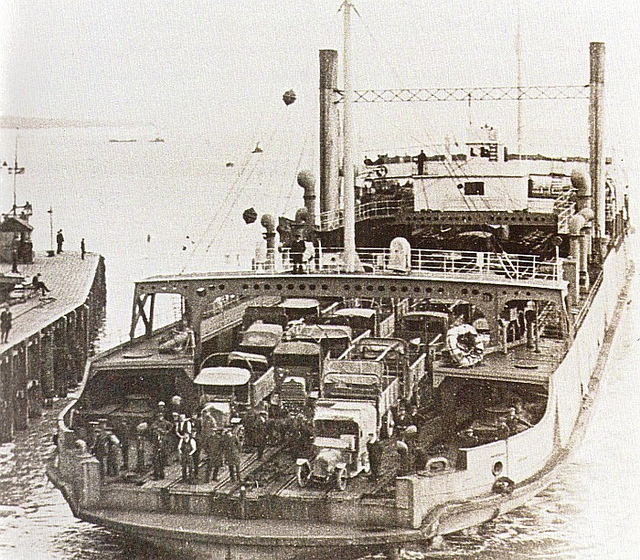
Modern RORO ships have their origins in railway ferries, the first of which was the Forfarshire used in the Firth of Forth, built in 1881 and it was a similar design used so effectively in WW1

9173692754 026524de4f z Ship to Shore Logistics – 17 (Expeditionary Port Access – Concept 1 – RORO Link Span and Cargo Handling)

During the early fifties the more familiar concept was developed in Europe and the USA, often using surplus WWII landing ships.

RORO vessels types include;

ROPAX and Ferries, mixed passenger and vehicles, usually on short sea routes and includes a wide variety of designs.

10765263604 80b1eb45bf z Ship to Shore Logistics – 17 (Expeditionary Port Access – Concept 1 – RORO Link Span and Cargo Handling)

CONRO, combining containers and roll on roll off, an example of which was the Atlantic Conveyor owned by the Atlantic Container Line.

6896815936 fcd50b53b4 z Ship to Shore Logistics – 17 (Expeditionary Port Access – Concept 1 – RORO Link Span and Cargo Handling)

7042905105 fa9a1bc3f0 z Ship to Shore Logistics – 17 (Expeditionary Port Access – Concept 1 – RORO Link Span and Cargo Handling)

ACL are bringing into service the G4, more details here

10765232303 d0a2381217 z Ship to Shore Logistics – 17 (Expeditionary Port Access – Concept 1 – RORO Link Span and Cargo Handling)

Pure Car Carrier and Pure Car Pure Truck Carrier, these are large specialist ships designed to move high volumes in intercontinental routes.

10764833225 e2f78a2741 z Ship to Shore Logistics – 17 (Expeditionary Port Access – Concept 1 – RORO Link Span and Cargo Handling)

10764922854 64a96d6594 z Ship to Shore Logistics – 17 (Expeditionary Port Access – Concept 1 – RORO Link Span and Cargo Handling)

Freight Only; carrying only vehicles and containers these are a common type of vessel and the UK’s Strategic RORO vessels are typical

7146352607 3bb8f7a4f0 z Ship to Shore Logistics – 17 (Expeditionary Port Access – Concept 1 – RORO Link Span and Cargo Handling)

10765568606 84c9a04829 z Ship to Shore Logistics – 17 (Expeditionary Port Access – Concept 1 – RORO Link Span and Cargo Handling)

10765770553 e5e839f23d z Ship to Shore Logistics – 17 (Expeditionary Port Access – Concept 1 – RORO Link Span and Cargo Handling)

10765492375 7f6254cc44 z Ship to Shore Logistics – 17 (Expeditionary Port Access – Concept 1 – RORO Link Span and Cargo Handling)

The medium sized landing ships in common use in areas with less well developed port infrastructure can also be classed as RORO vessels

9485946026 66675d2710 z Ship to Shore Logistics – 17 (Expeditionary Port Access – Concept 1 – RORO Link Span and Cargo Handling)

Also of course, vessels like the UK’s Landing Ship Dock (Auxiliary) and the US Joint High Speed Vessel are also RORO

9998927655 4a632a380a z Ship to Shore Logistics – 17 (Expeditionary Port Access – Concept 1 – RORO Link Span and Cargo Handling)

9694704430 ef4be7b806 z Ship to Shore Logistics – 17 (Expeditionary Port Access – Concept 1 – RORO Link Span and Cargo Handling)

This is all well and good but the really important aspect to consider is ramps.

The large Pure Car Pure Truck carriers have two ramps, one in the side of the hull and one at the stern but the stern ramp is angled so that when moored in a conventional position they can load and unload from both.

9153190689 99eb248eec z Ship to Shore Logistics – 17 (Expeditionary Port Access – Concept 1 – RORO Link Span and Cargo Handling)

Other designs only have the stern ramp but they are always angled to allow unloading and loading whilst berthed.

9153190913 7c5aa81c9b z Ship to Shore Logistics – 17 (Expeditionary Port Access – Concept 1 – RORO Link Span and Cargo Handling)

Some RORO vessels have two stern ramps.

10765768263 a34442987c z Ship to Shore Logistics – 17 (Expeditionary Port Access – Concept 1 – RORO Link Span and Cargo Handling)

A more military oriented example of a stern ramp can be found on the US Military Sealift Command’s Large Medium Speed Roll on Roll Off Ships, the images below shows the USNS Gillliland (T-AKR 298)

9155415024 502430dac8 z Ship to Shore Logistics – 17 (Expeditionary Port Access – Concept 1 – RORO Link Span and Cargo Handling)

9153190343 1bb59f91ed z Ship to Shore Logistics – 17 (Expeditionary Port Access – Concept 1 – RORO Link Span and Cargo Handling)

As can be seen from the two images the stern ramp is slewable for maximum flexibility.

The UK’s Point Class vessels, the RORO 2700 from Flensberger are the broad equivalent of the T-AKR ships

7146352607 3bb8f7a4f0 z Ship to Shore Logistics – 17 (Expeditionary Port Access – Concept 1 – RORO Link Span and Cargo Handling)

Instead of a slewable stern ramp they have a large stern ramp and smaller side ramp.

9691449445 09654d5ddc z Ship to Shore Logistics – 17 (Expeditionary Port Access – Concept 1 – RORO Link Span and Cargo Handling)

9554145393 9403efa1a8 z Ship to Shore Logistics – 17 (Expeditionary Port Access – Concept 1 – RORO Link Span and Cargo Handling)

The images below shows Hurst Point at Mare Harbour in the Falkland Islands

7000267168 efe46c8c8d z Ship to Shore Logistics – 17 (Expeditionary Port Access – Concept 1 – RORO Link Span and Cargo Handling)

7000266744 59d3726db1 z Ship to Shore Logistics – 17 (Expeditionary Port Access – Concept 1 – RORO Link Span and Cargo Handling)

And this one of a similar vessel ‘med moored’

10765569696 a684707e05 z Ship to Shore Logistics – 17 (Expeditionary Port Access – Concept 1 – RORO Link Span and Cargo Handling)

The stern ramp can be lowered onto a Mexeflote as shown below

9153191189 99cd8e4789 z Ship to Shore Logistics – 17 (Expeditionary Port Access – Concept 1 – RORO Link Span and Cargo Handling)

I guess no one approach is right or wrong, just different but if the Point Class is unable to dock stern on the small side ramp may well impede the speed of operations and I am not sure if it is rated for heavy loads like main battle tanks.

It is also likely that future operations, either national or multinational will use a range of civilian vessels. Not all these have such flexibility when it comes to offload and loading ramps.

Link Spans

However they are designed, stern ramps, side or bow, in order to interface with the dockside a link span is often used where the harbour is subject to tidal variation.

As can be imagined, they range from simple ramps to complex designs with split level ramps, hydraulic raising machinery and multiple roadways to facilitate rapid loading and unloading.

There are two components to a typical link span, a pontoon or fixed structure and the vehicle roadway.

Supporting the vehicle roadway can either be a floating pontoon that moves up and down with the tide or a permanent (usually concrete) structure that supports a hydraulically raised and lowered ramp. This structure can either be dockside or at some distance from the dockside depending on individual requirements.

The image below shows a typical single lane floating and spudded link span at Calais that was installed in 2007 for 2.6 million Euros by Marad

10767071044 a360039fd9 z Ship to Shore Logistics – 17 (Expeditionary Port Access – Concept 1 – RORO Link Span and Cargo Handling)

This image shows a non floating linkspan

10767036726 a7382a1446 Ship to Shore Logistics – 17 (Expeditionary Port Access – Concept 1 – RORO Link Span and Cargo Handling)

A good primer on the different types of linkspan can be found here and TTS have an equally good range of brochures on

Temporary solutions can be installed using barges and simple roadways as the example below shows

10767035316 cd91360cca z Ship to Shore Logistics – 17 (Expeditionary Port Access – Concept 1 – RORO Link Span and Cargo Handling)

The example I wrote about in the post on Iraq in 2003 also showed how a temporary solution could be used (in Kuwait) but again, it was not speedy.

The MoD had chartered a lot of RORO shipping to get the Army to Kuwait but although the port of Shuaiba was the preferred location the RORO facilities left a lot to be desired. It was not an option to crane the many hundreds of vehicles over the side so the technical people involved with FIPASS were drafted in.

In less than 30 days they had designed, built and installed a floating linkspan that comprised a 28x14m pontoon attached to two smaller pontoons and a 17m link bridge. The whole system was secured using tensioned steel rope and allowed an unused corner of the port to be used for offloading, a quiet success story

9446820816 556170d058 z Ship to Shore Logistics – 17 (Expeditionary Port Access – Concept 1 – RORO Link Span and Cargo Handling)

10767491285 22fb8feca4 z Ship to Shore Logistics – 17 (Expeditionary Port Access – Concept 1 – RORO Link Span and Cargo Handling)

What characterises all these solutions is they are not rapidly deployable and therefore not much use for CONCEPT 1.

A large pontoon based solution would no doubt be suitable but it would need towing to site, never a quick solution, and if CONCEPT 1 is to be limited to in service means of transport that means a modular pontoon, as highlighted in the previous post on debris removal and repair and some sort of compact bridging unit.

Any system cannot be load or size compromised because it will need to accommodate Heavy Equipment Transporters, main battle tanks and possibly Chinook helicopters.

Cimtec engineering have an interesting solution that uses a pontoon and what looks very much like a Mabey Compact 200 panel bridge i.e. son of Bailey

10768207573 45e55cde7a z Ship to Shore Logistics – 17 (Expeditionary Port Access – Concept 1 – RORO Link Span and Cargo Handling)

A deployable solution would need three components, the floating platform, the link bridge and some means of securing the whole thing.

The floating platform is obvious, modular pontoons from manufacturers including DamenHann OceanRobishaw EngineeringCombifloatModular Pontoon Systems,IntermarineInnovoBaarsPoseidon Barge and Ravenstein, the image below

10370623475 60a7a4146a z Ship to Shore Logistics – 17 (Expeditionary Port Access – Concept 1 – RORO Link Span and Cargo Handling)

0 Ship to Shore Logistics – 17 (Expeditionary Port Access – Concept 1 – RORO Link Span and Cargo Handling)

Securing the pontoon is essential for safe operation so it can either be moored to the dockside, most of the modular pontoon suppliers can provide bollard fittings.

An alternative is to use a jackup attachment, again, most of the pontoon manufacturers can provide these.

0 Ship to Shore Logistics – 17 (Expeditionary Port Access – Concept 1 – RORO Link Span and Cargo Handling)

0 Ship to Shore Logistics – 17 (Expeditionary Port Access – Concept 1 – RORO Link Span and Cargo Handling)

The jackup spud legs allow the platform to be raised and lowered not only to accommodate the rise and fall of tides but also for vessels with different ramp geometries.

0 Ship to Shore Logistics – 17 (Expeditionary Port Access – Concept 1 – RORO Link Span and Cargo Handling)

A jackup solution also allows the landing platform, that joins the vehicle roadway and ships ramp, to be secured at some distance from the dockside. Using mooring ropes means in order to provide stability it would need to be directly adjacent to the dockside. This arrangement would provide much greater positioning flexibility and therefore value in a compromised port.

The Combifloat is a good example, read the brochure here, even the compact C5 series has a deck loading of 15 tonnes per metre squared although its maximum deck load is 80 tonnes which puts it beneath the MLC 120 threshold for a HET and main battle tank so the larger C7 would be more applicable.

10768695236 b746982029 z Ship to Shore Logistics – 17 (Expeditionary Port Access – Concept 1 – RORO Link Span and Cargo Handling)

10768914983 73b53975e7 z Ship to Shore Logistics – 17 (Expeditionary Port Access – Concept 1 – RORO Link Span and Cargo Handling)

10768741484 734a331473 z Ship to Shore Logistics – 17 (Expeditionary Port Access – Concept 1 – RORO Link Span and Cargo Handling)

10768739904 1bfc603ca0 z Ship to Shore Logistics – 17 (Expeditionary Port Access – Concept 1 – RORO Link Span and Cargo Handling)

Finally, from the landing platform to dockside needs a roadway. These could either be in the form of a single piece or modular. Because the lift capacity available to CONCEPT 1 is limited by the Terex AC55 all terrain crane and large single span able to support a large weight is probably too heavy so the modular solution becomes the obvious answer.

The Logistic Support Bridge, a military version of the Mabey Compact 200, is already in service

6659822101 983436a4dc z Ship to Shore Logistics – 17 (Expeditionary Port Access – Concept 1 – RORO Link Span and Cargo Handling)

Although the LSB would seem ideal a new fabrication might be needed to secure and accommodate the rise and fall of the platform.

Cargo Handling

The Point class Strategic RORO vessels are often used for ISO containers in addition to vehicles, sometimes these ISO containers are carried on the same vehicles that will transport them to their destinations but when these vehicles are not available there is an obvious need for some means of transferring the containers from the RORO ship and into the port area where they can either be cross-loaded onto other vehicles, stored, repacked or otherwise handled.

In addition to vehicles and mobile plant, RORO vessels are increasingly used for break bulk and outsize cargo that is difficult to carry on container ships.

0 Ship to Shore Logistics – 17 (Expeditionary Port Access – Concept 1 – RORO Link Span and Cargo Handling)

For non containerised cargo a flat ‘Mafi trailer’ is used with a gooseneck

10776561566 81d2fa1876 z Ship to Shore Logistics – 17 (Expeditionary Port Access – Concept 1 – RORO Link Span and Cargo Handling)

10776639884 19b12f3cbf z Ship to Shore Logistics – 17 (Expeditionary Port Access – Concept 1 – RORO Link Span and Cargo Handling)

For containers, a container trailer

10776560086 8b73c26cbb z Ship to Shore Logistics – 17 (Expeditionary Port Access – Concept 1 – RORO Link Span and Cargo Handling)

For moving these container and flat trailers a specialised tractor avoids using normal road going trucks

10776638284 fd9a99e145 z Ship to Shore Logistics – 17 (Expeditionary Port Access – Concept 1 – RORO Link Span and Cargo Handling)

Terberg and Mafi are representative manufacturers, Terberg, incidentally, are the ones that supply the large Schopf RAF aircraft tractors

0 Ship to Shore Logistics – 17 (Expeditionary Port Access – Concept 1 – RORO Link Span and Cargo Handling)

These specialist solutions represent the most efficient means of loading and unloading trailers from RORO vessel but it would be equally simply to offload them using standard road going tractors and trailers.

They could also be loaded onto DROPS or MAN SV EPLS (and whatever replaces it) trucks.

7149750613 82b0f9195a z Ship to Shore Logistics – 17 (Expeditionary Port Access – Concept 1 – RORO Link Span and Cargo Handling)

The majority of ISO containers arrive at port on dedicated shipping, they are taken from the container ship cells by large port cranes onto the quayside for handling by straddle carriers or directly onto other container handling vehicles or trucks. Container handling in large dedicated ports is increasingly automated and ruthless efficient.

In the scenario envisaged by CONCEPT 1 there may be a complete absence of dockside handling equipment so bring your own is the order of the day but it would be impossible to match the container move rates of a dedicated port equipment such as straddle carriers.

The Points also have a fairly sturdy deck crane, capable of lifting 40 tonnes at 25m outreach and their container capacity is also impressive, 668 TEU’s on Mafi trailers. Many general cargo ships have deck cranes that can offload onto a dockside without port infrastructure.

For offloading RORO vessels, either civilian, military or the Strategic RORO ships, it would be reasonable to deploy a small number of tractor units to quickly offload conventional or Mafi style trailers. These would allow a rapid turn ship around and positioning within the port area.

For container vessels offloading containers requires high cost, very large and very much specialised equipment, completely beyond the scope of CONCEPT 1

The Terex AC55 mobile cranes could be used but container weight and reach would have to be limited.

Moving containers around the port area, onto vehicles and potentially, off ships the in service Rough Terrain Container Handler would be ideal

0 Ship to Shore Logistics – 17 (Expeditionary Port Access – Concept 1 – RORO Link Span and Cargo Handling)

0 Ship to Shore Logistics – 17 (Expeditionary Port Access – Concept 1 – RORO Link Span and Cargo Handling)

The Kalmar RTCH can also be used for container handling off Mexeflotes or other landing craft/pontoons

0 Ship to Shore Logistics – 17 (Expeditionary Port Access – Concept 1 – RORO Link Span and Cargo Handling)

For CONCEPT 1, therefore, the best solution is to make use of existing equipment, mobile cranes, reach stackers, DROPS/EPLS and container handlers,  with a small increment of trailers and terminal tractors.

Landing and Access Stages

The modular pontoons featured above tend to be steel construction and ISO container size, for some applications, such as landing stages for small craft or personnel access recent developments in plastic pontoons are seeing widespread adoption, including by the MoD that has installed units in the new RM Tamar amphibious warfare centre of excellence in Plymouth and they were also on show at the recent DSEI show in london.

The UK company Aqua Dock is one supplier, another successful and innovative British company we need to hear more about

0 Ship to Shore Logistics – 17 (Expeditionary Port Access – Concept 1 – RORO Link Span and Cargo Handling)

Click here for the brochure

10782754035 06dfcd6a29 z Ship to Shore Logistics – 17 (Expeditionary Port Access – Concept 1 – RORO Link Span and Cargo Handling)

10783007803 1a5a6d269b z Ship to Shore Logistics – 17 (Expeditionary Port Access – Concept 1 – RORO Link Span and Cargo Handling)

CONCEPT 1 would at very little cost include a small quantity

Sources and Further Reading

The design of ship to shore linkspans for ro-ro terminals

Design of Marine Facilities

McGregor Navire Linkspan Equipment

Other Posts in the Series

Ship to Shore Logistics – 01 (Introduction)

Ship to Shore Logistics – 02 (History – 1944 Europe)

Ship to Shore Logistics – 03 (History – 1982 the Falkland Islands)

Ship to Shore Logistics – 04 (History – 2003 Iraq)

Ship to Shore Logistics – 05 (History – 2010 Haiti)

Ship to Shore Logistics – 06 (Case Study Observations)

Ship to Shore Logistics – 07 (Doctrine and Concepts)

Ship to Shore Logistics – 08 (Requirements and Drivers)

Ship to Shore Logistics – 09 (Current Capabilities and Future Plans)

Ship to Shore Logistics – 10 (Allies – the USA)

Ship to Shore Logistics – 11 (Mid Point Review)

Ship to Shore Logistics – 12 (Ports, Beaches or Both)

Ship to Shore Logistics – 13 (Expeditionary Port Access Concepts)

Ship to Shore Logistics – 14 (Expeditionary Port Access – Concept 1 – Survey and Munitions Clearance)

Ship to Shore Logistics – 15 (Expeditionary Port Access – Concept 1 – Repair and Debris Removal)

Ship to Shore Logistics – 16 (Expeditionary Port Access – Concept 1 – Dredging, Aids to Navigation and Mooring)

Ship to Shore Logistics – 17 (Expeditionary Port Access – Concept 1 – RORO Link Span and Cargo Handling)

Ship to Shore Logistics – 18 (Expeditionary Port Access – Concept 1 – Deployment Options)

Ship to Shore Logistics – 19 (Expeditionary Port Access – Concept 2 – Introduction)

Ship to Shore Logistics – 20 (Expeditionary Port Access – Concept 2 – Lighterage and Intra Theatre Lift)

Ship to Shore Logistics – 21 (Expeditionary Port Access – Concept 2 – Piers and Causeways)

Ship to Shore Logistics – 22 (Expeditionary Port Access – Concept 2 – Materials Handling)

Ship to Shore Logistics – 23 (Expeditionary Port Access – Concept 2 – Wave Attenuation)

Ship to Shore Logistics – 24 (Expeditionary Port Access – Concept 2 – Transport and Deployment)

Ship to Shore Logistics – 25 (Expeditionary Port Access – Concept 2 – Organisation and Funding)

Ship to Shore Logistics – 26 (Summary)


The post Ship to Shore Logistics – 17 (Expeditionary Port Access – Concept 1 – RORO Link Span and Cargo Handling) appeared first on Think Defence.

Visit Website

Taranis First Flight

Home | Think Defence by martin  /  7h  //  keep unread  //  trash  //  preview

Taranis First Flight

4789729740 2f1edd25c4 z Taranis First Flight


It seems that the long awaited first flight of Taranis in Australia has already taken place but been kept a under wraps. I would love to know  more about this aircraft and many of the outlandish claims in the media including that it is super sonic with a 2,000 – 4,000 mile range and one of the lowest Radar Cross Sections ever recorded. But the men at the ministry are giving nothing away for once.


http://www.janes.com/article/28899/taranis-makes-maiden-flight


http://www.aviationweek.com/Article.aspx?id=/article-xml/awx_10_25_2013_p0-630512.xml

The post Taranis First Flight appeared first on Think Defence.

US sequestration buys time for UK Apache’s

Home | Think Defence by martin  /  7h  //  keep unread  //  trash  //  preview

US sequestration buys time for UK Apache’s

5036629914 b7cc451d2c z US sequestration buys time for UK Apaches


5208727366 444ffc5316 z US sequestration buys time for UK Apaches


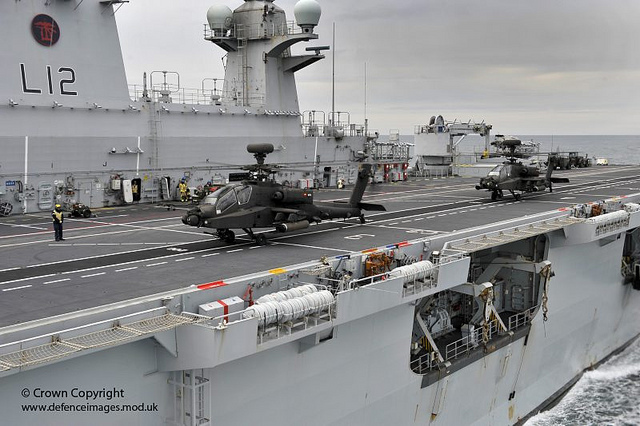
Due to the ongoing sequestration and budget battle in Washington the US Army has been forced to delay its Apache new build and rebuild programs to AH 64 E standards. This means the current type as used by the British Army is likely to be supported for longer giving the MOD some vital breathing space to decide what to do about its Apaches.

9376943319 2fd68d4b42 z US sequestration buys time for UK Apaches

Currently UK thinking seems to be slanted towards going for a rebuild on the current fleet but reported costs for the US program would put a rebuild on the entire UK Apaches fleet some where north of $600 million which is probably not something the MOD can consider for the next few years at the very least.

However as the rebuild will see the fuselage and main rotor replaced, if it was to go ahead would it be worth the UK looking at a marinised version? The aircraft is said to have performed very well from Ocean but it has some severe maintenance issues when being used in a salt water environment. Could a rebuild offer us the chance to solve some of these issues and produce a truly purple asset.

http://www.janes.com/article/29255/adex-2013-us-sequestration-buys-time-for-uk-apache-decision-makers


The post US sequestration buys time for UK Apache’s appeared first on Think Defence.

Australia, Indonesia in asylum-seeker ‘stand-off’

Australia, Indonesia in asylum-seeker ‘stand-off’

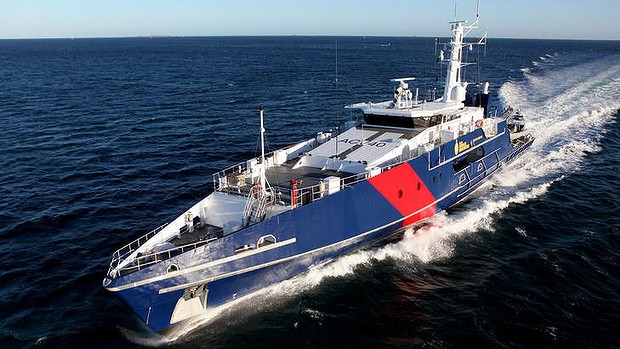
The first Cape Class Patrol Boat undertaking sea trials off Austal's Henderson shipyard. The boat was officially named Cape St George at a ceremony on March 15, 2013An Australian Customs patrol boat is trying to turn a boat with 56 suspected asylum seekers back to Indonesia within its search and rescue zone.

A mid-ocean stand-off between Australia and Indonesia appeared to be developing as a customs vessel tried to return a boatload of rescued asylum seekers to a reluctant Indonesia.

Up to 56 asylum seekers were rescued from their wooden boat in Indonesia’s search and rescue zone by an Australian ship on Thursday and, rather than taking them to Christmas Island, it is seeking to return them to Indonesia.

With tensions high over allegations of spying by Australia, and no agreement reached yet on a cooperative way of dealing with asylum seekers, the Indonesians may be reluctant to take the latest group.

Conflicting reports are emerging about the asylum seekers from the Indonesian search and rescue agency, Basarnas, and the Australian Customs department has declined to comment. Immigration minister Scott Morrison’s office released only a one-line statement late on Thursday saying:

“Australian authorities are liaising with their Indonesian counterparts in relation to a vessel that has requested assistance as the vessel is within Indonesia’s Search and Rescue zone”.

Advertisement

Basarnas’ deputy officer in charge, Adi Fachroni Azis earlier said Australia had “called us talking about evacuating the passengers [to Indonesia] but until now Indonesian authorities are still talking with their Australian counterparts. So far as I know, still no decision has been taken.”

On two occasions since the election of the Abbott government, rescued asylum seekers have been returned to Indonesian agencies in mid-ocean, ship-to-ship operations.

However, with tensions high over allegations of spying by Australia, and no agreement reached yet on a cooperative way of dealing with asylum seekers, the Indonesians may be reluctant to take the latest group.

Basarnas spokesman Mr Adi said the Rescue Coordination Centre in Australia had notified them of a distress call from a wooden asylum seeker boat at about 9.30am AEDT on Thursday morning. The boat had reported engine trouble 57 nautical miles south of the Indonesian coast, and within Indonesia’s search and rescue zone.

But when HMAS Ballarat arrived about three hours later, the crew found the engine was in working order, so the Australian navy vessel sailed away.

“After they left, the engine apparently really was broken,” Mr Adi said.

It’s understood the Ballarat then returned to the location and removed the people.

It’s unclear if the people aboard the boat sabotaged the engine after the Ballarat left them for the first time. However, if they did, it would highlight the risk of any Australian policy of attempting to turn-back even seaworthy boats to Indonesia.

That policy – a cornerstone of Tony Abbott’s election commitments – has been put on hold as the Australian government tries to negotiate an agreed position with Indonesia.

A meeting between Mr Morrison and the Indonesian justice and human rights minister Amir Syamsuddin last week failed to achieve any concrete commitments.

Comment was sought from Australian Customs.

Read more: http://www.watoday.com.au/national/australia-indonesia-in-asylumseeker-standoff-20131107-2x4p7.html#ixzz2k6qPz4wW

JCs Royal New Zealand Navy Ships and New Zealand Defence, Also other World Defence Updates

Ships and Defence News Past and Present

Skip to content ↓