|
Naval Today >> The industry’s seaborne news provider by Naval Today / 1h // keep unread // trash // preview
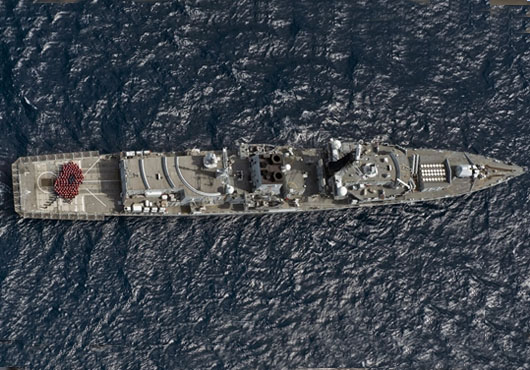
The red poppy is one of the most iconic symbols of remembrance and a Royal Navy ship is wearing hers with pride. The company of HMS Lancaster have taken time out of their busy patrols in the Caribbean to remember the brave men and women who have given their lives, or been injured, in the line of duty.Thousands of miles from home, the ship’s company mustered on the flight deck and paid their respect by creating a bright red poppy, bowing their heads in silence. HMS Lancaster’s Commanding Officer, Commander Steve Moorhouse, said:
Royal Navy personnel from across the Service have been donning their poppies and putting into words why they are wearing their poppies ahead of Remembrance Day on 11 November. Taking the photo onboard HMS Lancaster was Leading Airman (Phot) Jay Allen, who said:
The 2013 Poppy Appeal was launched at the end of October and every poppy helps raise the £1.6 million needed by the Royal British Legion deliver practical help and advice to the Armed Forces community. Follow Naval Today via: |


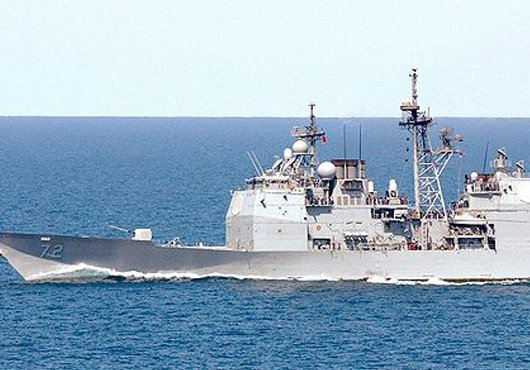
Coast Guard assets and the Navy cruiser USS Vella Gulf responded Thursday to alerts from three sailboats more than 200 miles offshore in the Atlantic Ocean.
|
Naval Today >> The industry’s seaborne news provider by Naval Today / 31min // keep unread // trash // preview
Coast Guard assets and the Navy cruiser USS Vella Gulf responded Thursday to alerts from three sailboats more than 200 miles offshore in the Atlantic Ocean.Coast Guard Fifth District watchstanders received two alerts via a satellite tracking device and a third alert via an emergency position indicating radio beacon, each from a separate sailboat. Two of the vessels are 230 and 275 miles east of Virginia Beach, and the third vessel is 230 miles east of Elizabeth City, N.C. Watchstanders launched crews aboard an HC-130 Hercules airplane and are preparing to launch an MH-60 Jayhawk helicopter from Coast Guard Air Station Elizabeth City, N.C. The watchstanders also contacted the Navy who diverted the USS Vella Gulf toward the location of the two northern sailboats, and they issued an alert via the automated mutual-assistance vessel rescue system for any vessels in the area to assist. Follow Naval Today via: |

Share this:

NZ Navy personnel earn medals for pirate patrol

NZ Navy personnel earn medals for pirate patrol

Friday, 8 November, 2013 – 11:20
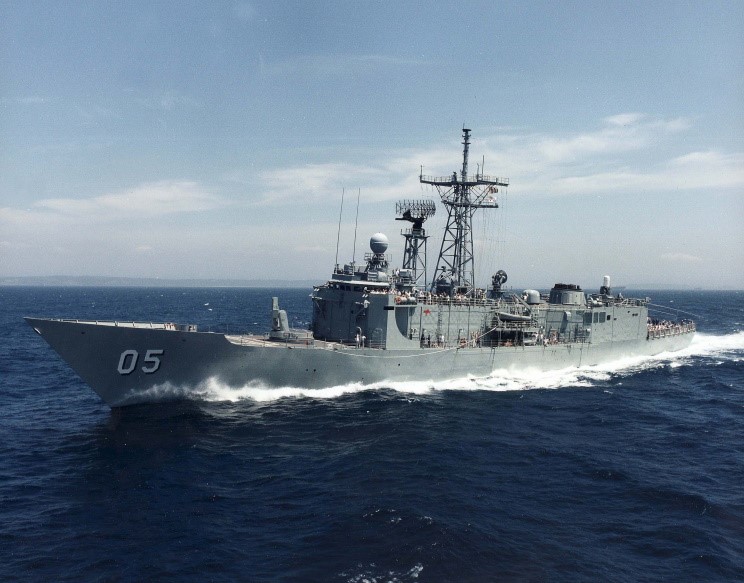
Three Royal New Zealand Navy sailors have earned the Australian Active Service Medal for their work on pirate patrol in the Gulf of Aden onboard an Australian frigate, the first New Zealand Defence Force personnel to receive this award.
The recipients are Leading Hydrographic Survey Technician Matthew Barber, Petty Officer Seaman Combat Specialist Josh Tatana and Able Seaman Combat Specialist Dylan Thomas.
Their medals were presented yesterday at Devonport Naval Base by the Chief of Navy, Rear Admiral Jack Steer, and Australian Defence Attaché, Captain Stephanie Moles.
The presentation recognises their service embarked in HMAS MELBOURNE in 2012 supporting the Combined Maritime Force operations in the Gulf of Aden. The three sailors were part of the ship’s boat crew, performing duties such as seaboat coxswain and boarding operations.
The awarding of the Australian Active Service Medal (AASM) with the International Coalition Against Terrorism (ICAT) clasp recognises the significant and longstanding defence relationship between New Zealand and Australia, said Rear Admiral Steer.
“Our Navy people regularly work closely with the services of other countries. I am proud of these sailors and their efforts serving alongside their Australian shipmates. The opportunity to wear an Australian medal offers a unique means of recognising their service.”
Captain Moles said: “The offer of the AASM and ICAT clasp to three Royal New Zealand Navy sailors is an acknowledgment by the Australian Government of the high value placed on the contribution made by NZ Defence Force personnel to the Australian Defence Force.”
“These NZDF personnel receiving these awards are special. They are the first recipients of this Australian award in the New Zealand Defence Force.”
Leading Hydrographic Survey Technician Matthew Barber said it was an honour to wear both the New Zealand and Australian medals. “Hydrographers don’t get many opportunities to deploy that far afield.”
The RNZN and Royal Australian Navy conduct regular exchanges of personnel for training and operational deployments.
Three more RNZN sailors are presently deployed onboard HMAS MELBOURNE supporting Combined Maritime Force operations in the Gulf of Aden.
Share this:

Irish Ferries Increase Dublin-Holyhead Capacity
Posted by staff
Thursday, November 07, 2013, 10:47 AM

Epsilon
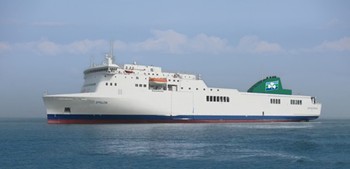
Irish Ferries has chartered the Epsilon (built in 2011) to supplement its existing Ireland to Britain services. The ship will provide two additional departures per day in each direction which will result in an increase in the company’s schedule to a maximum of twelve sailings between Dublin and Holyhead each day. The recently built vessel will provide significant vehicle capacity along with modern facilities on board including cabins, bar/cafeteria and self-service restaurant.
Currently, the ferry company operates eight sailings per day on the key Irish Sea route using its flagship Ulysses and the High Speed Craft Jonathan Swift.
Targeting the growing Freight and Tourism markets, the Epsilon will further improve Irish Ferries’ range of offers to its customers on the Irish Sea. In addition to the improved frequency on its Dublin to Holyhead route, the chartered vessel will also provide opportunities for improved annual dry-dock cover within the company’s fleet along with scope for increased capacity on other Irish Ferries’ Irish Sea and Ireland to France services.
Commenting on the announcement, Irish Ferries’ Marketing Director, Tony Kelly, said, ” Irish Ferries decision to invest in additional capacity at this time is a major vote of confidence by the Republic of Ireland’s leading ferry operator in the recovery of the country’s economy. We believe that Ireland has turned the corner and we are prepared to invest in the provision of improved services for our valued Freight and Tourism customers who have shown fantastic loyalty throughout the last five difficult years.”
Share this:

HamiltonJet HT900s for New High Speed Crewboat
MarineLink.com
Thursday, November 07, 2013, 12:01 PM

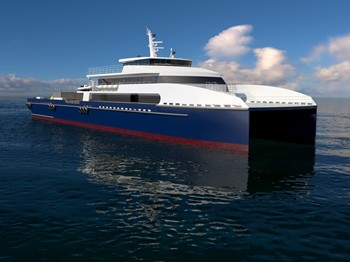
New Zealand waterjet manufacturer HamiltonJet said four of its HT900 waterjets were selected for IncatCrowther’s latest project – a first-of-type 70m Catamaran Fast Crewboat for operations in the Caspian Sea oil industry in Azerbaijan.
When completed in 12 months time, this vessel will reportedly be the world’s largest high speedcrewboat operating in the global oil industry. It will also be the largest vessel HamiltonJet has been involved in.
The DP2 class vessel will have four control stations, each utilizing HamiltonJet’s MECS control system integrating with a DNV DYNPOS-AUTR dynamic positioning system. This system provides improved safety during crew transfers in conditions up to sea state 4.
With four 2880kW MTU engines each turning 900mm diameter waterjets expected top speed is 36 knots with an efficient service speed of 30 knots at full load and 90% MCR. This speed performance will make the vessel more cost effective than helicopter transfer of crew and cargo, while the semi-SWATH hull design of the vessel, along with active ride control, will reduce stress on passengers so they arrive at an oil platform fit to work. She will be capable of carrying 150 passengers and 14 crew, along with 200 metric tons of deck cargo, in up to 40 knot wind and seas of 3m significant wave height.
The vessel is under construction at the Incat Tasmania shipyard, with the design by IncatCrowther and production engineering by Revolution Design. The final product incorporates key experience and strengths by each of the parties involved. Incat Tasmania has the specialized facilities, construction methodologies and experience of very large aluminum catamarans. Revolution Design has incorporated the production engineering design techniques optimized over multiple build projects at Incat Tasmania.
In designing this new 70m vessel class, IncatCrowther drew on its previous experience with the SEACOR CrewZer class of fast catamaran crewboats, with the forth of these recently launched in the U.S. These vessels also utilize HamiltonJet waterjet propulsion (quad HM811s) and the combination of catamaran hull form and waterjets has proven very successful.
According to the manufacturer, HamiltonJet waterjets work particularly well in DP capable vessels, where the powerful 360 degree thrust forces generated by the jet’s split duct reverse deflector at any boat speed effectively act as an azimuth thruster. The effect of the waterjet maneuvering thrust is further enhanced with the wide spacing of the jet units in a catamaran configuration – two jets per hull – which provides even better control of the vessel’s stern and can even assist with sideways movement of the bow. It is in no small part his low speed maneuverability provided by HamiltonJet waterjets compared to other waterjet manufacturers that has seen the company dominate in the fast crewboat sector.
Prior to this vessel, the largest vessel HamiltonJet waterjets were used in was the 68.5m Gulf Craft-built crewboat MsNetty. This monohull, designed by IncatCrowther, also utilizes quad HT900 waterjets and has a top speed of 32 knots.
HamiltonJet has not yet seen its largest waterjet model, the HT1000, fitted in a crewboat vessel, but the company reported the waterjet model is already in use in the patrol boat sector.


