Click a picture to see a full screen slideshow


Ships and Defence News Past and Present
|
2 Naval Today >> The industry’s seaborne news provider by Naval Today / 121d // keep unread // trash // preview
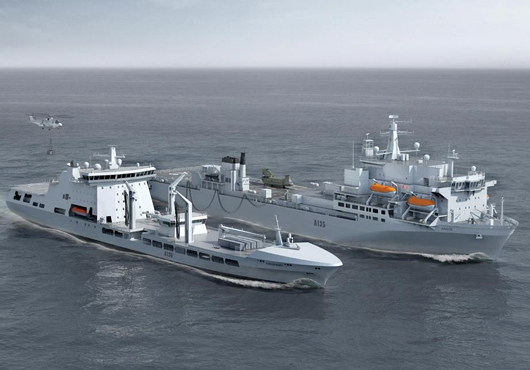
Design of UK Navy’s Tide Tankers Completed, Construction Begins in a Year
Work will begin on the UK Navy’s next-generation tankers in a year’s time after design teams in the UK completed their plans for the four vessels. RFA Tidespring, Tiderace, Tidesurge and Tideforce will provide the Fleet – including the giant future carriers – with fuel, water, spare parts and other supplies for a quarter of a century once they enter service from 2015. In around 12 months’ time the first steel will be cut on Tidespring, the first of the new 37,000-tonne vessels which will provide fuel, water, stories and supplies to sustain the Fleet – and especially its new carriers – around the world. Hundreds of design drawings and plans have been drawn up by BMT Defence Services, working with the Royal Navy and Royal Fleet Auxiliary. Scale models have been built and tested in the gigantic water tank at Haslar in Gosport, where Tidespring ‘refuelled’ HMS Queen Elizabeth in various sea conditions. With the designs for the £450m quartet – RFA Tidespring, Tiderace, Tidesurge and Tideforce – now complete, it’s down to Daewoo Shipbuilding and Marine Engineering to draw up the detailed plans so they can begin construction next year. The ships will carry 19,000 cubic metres – more than seven times the capacity of an Olympic-sized swimming pool – of fuel for a ship’s engines and aircraft. A new replenishment at sea rig has been built at HMS Raleigh in Torpoint to practise using both the new tankers and the ‘reception areas’ on the Queen Elizabeth-class carriers. As well as both the tankers and the carriers being much bigger than their predecessors, the tankers should also be able to deliver their supplies up to two and a half times faster than the vessels which have gone before them.
The Tides will be much more than mere floating filling stations. There’s space for eight ISO containers on the forecastle, holding anything from humanitarian aid to large stores or kit for special missions. Typically the ships will have a crew of 63, including 17 officers and 12 senior ratings. But there is accommodation on board for another 45 souls, such as RFA sailors undergoing training, Royal Marines and the ship’s helicopter; the flight deck can take a Merlin if required. All four ships will be built at Daewoo’s yard at Okpo-dong in south-east South Korea which produces 70 commercial and specialist ships – such as the South Korean Navy’s destroyers – every year. From the first steel being cut to launch will take each ship around ten months. After undergoing sea trials off the Korean peninsula, the ships will be brought to Britain where they’ll undergo ‘customisation’ – fitting classified and UK-only systems on board to support their mission alongside the RN. Tidespring is due to be handed over to the MOD in October 2015, with the final vessel, Tideforce, completed in April 2017. All are expected to serve at least a quarter of a century. |
|
Naval Today >> The industry’s seaborne news provider by Naval Today / 3h // keep unread // trash // preview
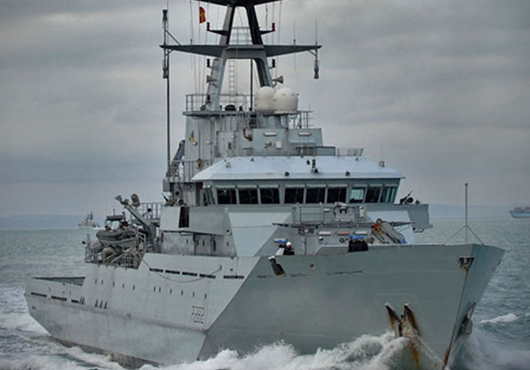
The Royal Navy’s offshore patrol vessel, HMS Severn, which is twinned with Newport, will visit her affiliated city from 7th to 10th November.During a busy few days, the ship will bring groups of school children on board for organised tours and conduct outreach events with local organisations over the weekend. HMS Severn will then host local dignitaries on board for a demonstration of capability on Saturday evening. Members of the ship’s company will also pay their respects on Sunday at the town’s Remembrance Day Service parading through the City to Cenotaph where the Remembrance Service will commence at 11am. Amongst the young people who will get the opportunity to look around the ship are students from St Michael’s RC Primary School, Bassaleg School and Sea Cadets from TS Resolute – all of which are affiliated to the Portsmouth-based Warship. For some of the more energetic amongst the ship’s company, the weekend’s activities kick off with a friendly football match against a team from Newport City Council on Thursday – the game will start at 5pm and is being played at Newport International Sports Visual. HMS Severn’s Commanding Officer, Lieutenant Commander Tim Berry said,
HMS Severn is one of a quartet of River-Class offshore patrol vessels, three of which were built to safeguard the sustainability of fishing stocks in the UK often operating hundreds of miles off the UK coast. The fourth is HMS Clyde and is the Falkland Islands’ Patrol Vessel continuously based there to provide protection to South Georgia and the Falkland Islands. HMS Severn, like her sisters, is one of the busiest ships in the Fleet and she spends on average nine out of every 10 days of the year at sea. Her primary role is enforcement of national and EU fisheries legislation within British Fishery Limits on behalf of the Marine Management Organisation. HMS Severn has also been designed to carry out a number of other tasks including – but not limited to – environmental protection, search and rescue and maritime security. With a crew of just 42, split into three watches, the ship is able to patrol for in excess of 300 days per year. The current HMS Severn (the ninth to bare the name) inherited her title from her predecessor, a World War II submarine which served in the Atlantic and Norwegian campaigns. The submarine survived the entire conflict, earning her the title ‘Lucky Severn’. The ship also celebrates her 10th anniversary and a decade of service this year since being commissioned into the Royal Navy’s Fleet in July 2003. She is the second River-Class built by Vosper Thornycroft at their Woolston yard. |
|
Naval Today >> The industry’s seaborne news provider by Naval Today / 2h // keep unread // trash // preview
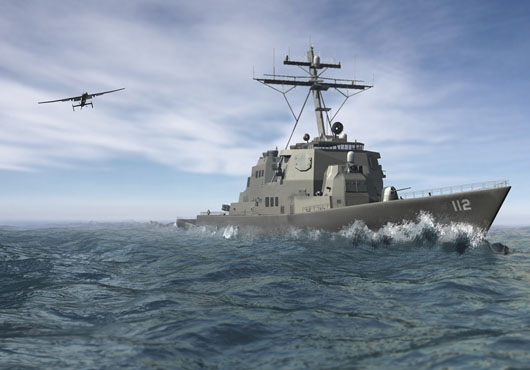
AeroVironment Chosen as DARPA’s Prime Contractor on TERN Program
The U.S. Defense Advanced Research Projects Agency (DARPA) has selected AeroVironment, Inc. to provide its expertise in unmanned aircraft systems (UAS) toward the development of a new category of this technology.AeroVironment will work as the prime contractor with DARPA on the Tactically Exploited Reconnaissance Node (TERN) Program to develop a medium-altitude, long-endurance (MALE) UAS designed to operate from small ships to provide persistent intelligence, surveillance, and reconnaissance (ISR) capabilities. Sierra Nevada Corporation will subcontract to AeroVironment on the project, which is valued at $2.3 million
The intent of the TERN program is to produce a low-cost, large-scale TERN prototype vehicle over the course of three development phases that would demonstrate automatic launch and recovery and key technologies required by a TERN objective system. The mission performance goals for the operational TERN system are comparable to emerging land-based MALE UAV capabilities. The ultimate goal for a TERN objective system air vehicle is to enable persistent ISR capabilities with payloads of 600 pounds while operating up to 900 nautical miles from a host vessel. The TERN objective system is intended to operate from multiple ship types, including Littoral Combat Ship 2 (LCS-2) class ships, and in elevated sea states. The phase 1 concept definition contract was awarded on August 26, 2013. |
|
Naval Today >> The industry’s seaborne news provider by Naval Today / 2h // keep unread // trash // preview
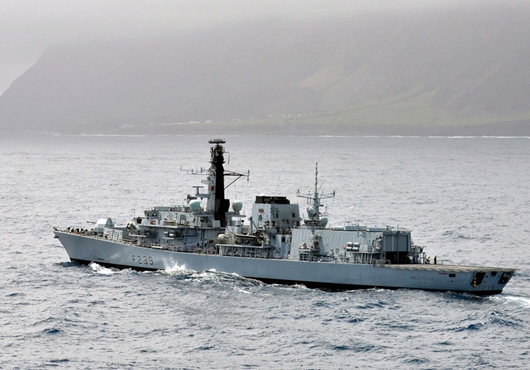
The beauty and ruggedness of the world’s most remote inhabited island has been captured in a series of photos during a recent visit from a Royal Navy warship. Portsmouth based frigate, HMS Richmond, has just paid a visit to the tiny island of Tristan da Cunha in the South Atlantic as part of her tasking in the region.The Company of the Type 23 frigate received a warm welcome when they anchored off the capital, and island’s only settlement, Edinburgh of the Seven Seas. The island – situated more than 1,500 miles from the nearest landmass – only has a population of 275 and with the arrival of Richmond that number nearly doubled when the men and women went ashore to provide reassurance in this remote part of the world. On the first day of a two day visit, the Commanding Officer, Commander Robert Pedre welcomed on board the island’s Administrator and Magistrate, Alex Mitham and the island’s Police Officer, Inspector Conrad Glass MBE, for lunch and a tour of the ship, highlighting some of the important roles that the Royal Navy undertakes in the South Atlantic ocean. On the second day the islanders hosted a reception at the Administrator’s Residence for a number of the Ship’s Company. Cdr Pedre said of the visit:
The South Atlantic Patrol see the Type 23 frigate undertake maritime security operations, including counter narcotics and anti piracy patrols, providing opportunities to work with a number of other navies to further strengthen ties and demonstrate the Royal Navy’s commitment to the region. |
Ships and Defence News Past and Present


