|
Naval Today >> The industry’s seaborne news provider by Naval Today / 32min // keep unread // trash // preview
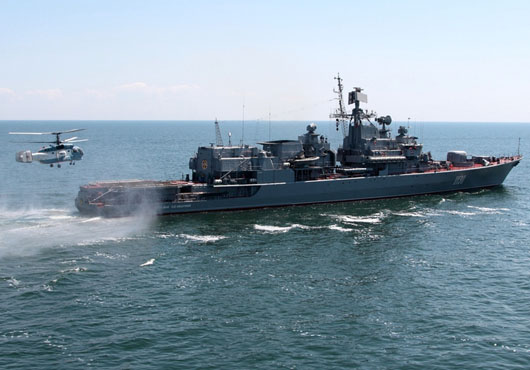
Civil vessel MANJIN CILD addressed the Ukrainian frigate Hetman Sahaidachnyi, which is rounding off its second patrol within the Ocean Shield counter-piracy operation, and informed to be followed by a small rapid vessel. The frigate crew established permanent satellite communication with the civil vessel.All the frigate groups were ready to give assistance and support to the ship but a small rapid vessel stopped following and disappeared. At that moment about 10 vessels were in the Gulf of Aden and they were informed about the situation.
Press Release, November 7, 2013; Image: Ukrainian Navy |


Ukraine: Navy, NATO Discuss Military Cooperation Issues

|
Naval Today >> The industry’s seaborne news provider by Naval Today / 32min // keep unread // trash // preview
The Ukrainian Navy Command hosted the delegation led by Ambassador Thrasyvoulos Terry Stamatopoulos, NATO’s Assistant Secretary General for Political Affairs and Security Policy.During the meeting with Acting Ukrainian Navy Vice Admiral Serhiy Eliseyev, the parties discussed ongoing cooperation with NATO, participation of the Ukrainian military naval personnel in the NATO-led operations, the Ocean Shield counter-piracy operation, and defined further directions and effective forms of military cooperation. The talks were also attended by Mr. Marcin Koziel, Director of the NATO Liaison Office in Ukraine, representatives of the Political Affairs and Security Policy Division, NATO Military Cooperation, representatives of the Ministry of Foreign Affairs of Ukraine in Crimea and Ukrainian Navy Command. The Ukrainian party spoke about the present and the prospects of reforms and development of the national navy, participation of the Ukrainian Navy in peacekeeping operations, demonstrated basic processes of the Ukrainian Navy professionalization and general system of personnel training. Vice Admiral Serhiy Eliseyev thanked NATO representatives for attention paid by Allied Senior Leaders to the Ukrainian Navy, especially, in training of the Ukrainian personnel for international exercises and other events within the Operational Capabilities Concept (OCC). Ambassador Thrasyvoulos Terry Stamatopoulos thanked Ukraine and Ukrainian Navy for contribution to the Ocean Shield counter-piracy and the Active Endeavors counter-terrorism operations and greeted Ukraine with successful operation completed by the Ukrainian Frigate Hetman Sahaydachnyi in the Gulf of Aden. |

Share this:

Arrivals and Departures – Royal Navy HMS TYNE P281 visits West India Dock
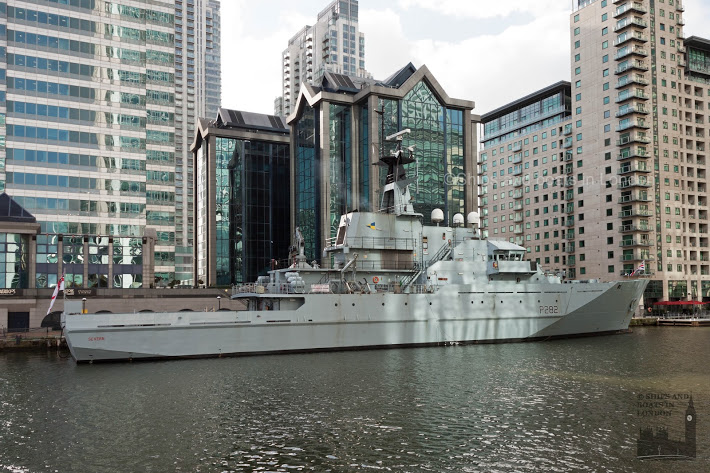
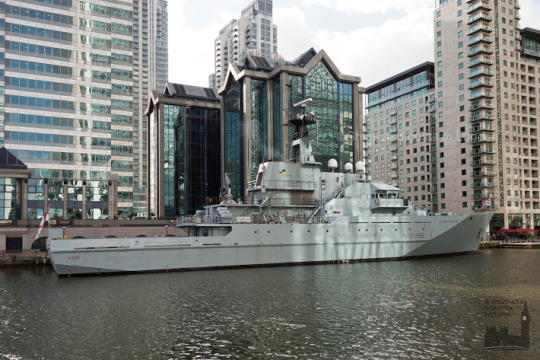
Arrivals and Departures – Royal Navy HMS TYNE P281 visits West India Dock
Royal Navy Offshore Patrol Vessel HMS TYNE P281 arrived at Wood Wharf, West India Dock near Canary Wharf on Tuesday 5th November at around 1430.
She is visiting to allow Royal Navy crew to participate in London Poppy Day collections and Remembrance Services in the Capital.
HMS TYNE P281 is a River Class Offshore Patrol Vessel operated by the Royal Navy Fisheries Patrol Squadron. She is based at HM Naval Base Portsmouth with sister ships HMS MERSEY P283 and HMS SEVERN P282.
The event has been marked by the arrival of an Offshore Patrol Vessel at the dock in the same way over the last few years. 2011 saw HMS MERSEY arrive and in 2012 HMS SEVERN.
A photo post on this blog of HMS SEVERN in 2012 can be found at
royal-navy-hms-severn-p282-visits-west-india-dock
Share this:

Upgrading the Royal Thai Naval Capabilities

Posted by Noam Eshel


The Royal Thai Navy confirmed it is purchasing two ton frigates from Daewoo Shipbuilding & Marine Engineering (DSME) in South Korea. Contract signature for the first frigate took place in August 2013. DSME’s design is derived from the KDX-1 destroyer in service with the South Korean Navy.
Thailand has traditionally turned to Asian countries as well to expand its naval fleet. In April 2012, the RTN received HTMS Ang Thong, a landing platform dock (LPD) vessels, similar to Singapore’s Endurance class LPDs. Built by ST Marine in Singapore, Thailand’s first LPD is sure to find practical use for any disaster relief missions around the region.
More recently, the Navy confirmed it is purchasing two ton frigates from Daewoo Shipbuilding & Marine Engineering (DSME) in South Korea. Contract signature for the first frigate took place in August 2013. DSME’s design is derived fr

Read the special coverage by Asian Defense & Diplomacy
om the KDX-1 destroyer in service with the South Korean Navy. The first frigate will be delivered to Thailand in 2018. DSME has already contracted SAAB via $134 million deal to integrate the company’s 9LV Mk4 CMS and radar systems onto the first frigate. Little detail has been released so far, but the new vessels are expected to feature ESSM in an eight-cell Mk41 vertical launch system from Lockheed Martin, an Oto Melara 76/62 Super Rapid gun and two MSI Defense Seahawk 30mm cannons. The contract for the second ship is dependent on sufficient government funding.

The HTMS Naresuan frigate was delivered from China in 1995.
Work is ongoing to upgrade two type 25T purchased from China and commissioned in 1995. BAE Systems was awarded a contact in July for three Mk 25 Model 0 quad pack canisters for Raytheon’s RIM-162 Evolved Sea Sparrow Missile (ESSM). These will be fitted to the two Naresuan Class frigates. SAAB was also awarded two contracts in June 2011 to fit its CEROS 200 fire control system, Sea Giraffe AMB radar, EOS 500 optronic director, data-link and 9LV Mk4 Combat Management System (CMS), to be fitted to each of the upgraded frigates. This work is expected to conclude in 2015.
Additionally, the Swedish company announced in April 2012 it was upgrading the RTN’s flagship, aircraft carrier HTMS Chakri Naruebet. The relevant contract includes the 9LV Mk4 CMS and Sea Giraffe surveillance radar as well When concluded, these three ships will be able to seamlessly intercommunicate with Saab built aircraft as Thailand expands its joint service network-centricity via the RTAF Defense System (RTAD).

River Class OPV operated by the RTN.
BAE Systems will have a presence at Defense & Security, fresh from commissioning the RTN’s first Offshore patrol Vessel (OPV), commissioned August 26, 2013. HTMS Krabi, a variant of the Royal Navy’s River Class, was built by Bangkok Dock under a technology transfer agreement. The 1,969 ton OPV features an Oto Melara 76/62 Super Rapid Gun and two MSI-Defense 30mm cannons. There is an expected follow-on requirement for three more OPVs of this class. Local shipbuilders are certainly growing in capability. In May 2013, three M21 patrol boats constructed by Marsum Company were commissioned. Marsum is also building three larger M26 coastal patrol boats that should enter service in 2014.
This article, first published by Gordon Arthur in Asian Defense & Diplomacy special edition for Defense & Security2013 is part of a three-part series reviewing recent acquisition programs in Thailand:
- Enhancing the Royal Thai Army
- Defense & Security 2013 Review
Share this:

BAE to close Portsmouth shipyard as naval ships rationalisation bites

Richard Scott, London – IHS Jane’s Defence Weekly
05 November 2013

Engineers from BAE Systems gather to watch the Forward Island, otherwise referred to as Upper Block 07, of the new UK Royal Navy aircraft carrier HMS Queen Elizabeth, slowly navigate a lock gate at Portsmouth Navy Base on 6 February 2013. BAE Systems is to axe 1,775 jobs across its naval ships business and to end shipbuilding at Portsmouth, one of the country’s most historic yards. Source: Chris Ison/PA Wire
BAE Systems is to cut almost 1,800 jobs from its UK-based Maritime-Naval Ships business and will cease shipbuilding operations at its Portsmouth facility next year, the company announced on 6 November.
At the same time, the company has reached agreement with the Ministry of Defence (MoD) on a series of measures to restructure its naval ships business in the UK. This includes the restructuring of the Queen Elizabeth-class (QEC) aircraft carrier programme, provision of additional shipbuilding work prior to the start of the Type 26 Global Combat Ship programme, and industrial rationalisation to match future capacity requirements.
In addition, BAE Systems has confirmed plans to consolidate its future shipbuilding operations – underpinned by the projected Type 26 Global Combat Ship programme – at its Govan and Scotstoun sites in Glasgow. Ahead of this, the MoD has announced plans to build three offshore patrol vessels (OPVs) for the Royal Navy (RN) to maintain key industrial capabilities on the Clyde between the end of QEC build and the ramp up to Type 26.
An announcement on the future of BAE Systems Maritime-Naval Ships’ facilities has been long expected. The company faces a significant reduction in workload following the completion of the six-ship Type 45 destroyer programme, the peak of activity on the QEC programme, and conclusion of two export contracts. The Type 26 programme will only partly fill that workload gap.
BAE Systems said that its shipbuilding operations at Portsmouth will cease in the second half of 2014. Subject to consultation, Lower Block 05 and Upper Blocks 07 and 14 of the future HMS Prince of Wales – the second QEC carrier – will be re-allocated to Glasgow.
A total of 940 employees at Portsmouth are expected to lose their jobs by the end of next year. A further 835 jobs will be lost at Filton, Glasgow and Rosyth through to 2016. The cost of the restructuring will be borne by the MoD.
BAE Systems said it “remains committed to continued investment in the Portsmouth area as the centre of its Maritime Services and high-end naval equipment and combat systems business”. Defence secretary Philip Hammond subsequently announced that more than GBP100 million (USD160.1 million) was to be invested in HM Naval Base Portsmouth, which will be home to the carriers HMS Queen Elizabeth and HMS Prince of Wales .
The MoD and BAE Systems also announced that, with the other participants in the Aircraft Carrier Alliance, they had agreed changes to the QEC contract, now estimated to have risen to GBP6.2 billion. Under the revised terms, the contract will be amended to accommodate programme changes and activities previously excluded from the contract.
Under the new Target Cost contract, the industrial participants’ fee will move to a 50:50 risk share arrangement providing greater cost performance incentives. The maximum risk to the industrial participants will continue to be limited to the loss of their profit opportunity.
A Terms of Business Agreement, entered into by BAE Systems and the MoD in 2009, was designed to provide an overarching framework for significant naval shipbuilding efficiency improvements in exchange for commitments to fund rationalisation and sustainment of capability in the sector. However, under this arrangement, the MoD would have remained liable to pay for any periods when no shipbuilding was taking place at UK yards.
Hammond said that the build of the three new modified River-class OPVs would funded from money that would have been used to pay for idle capacity, finance redundancies and meet the cost of industrial restructuring. “This is an investment not only in three ships, but in this country’s warship building industry. It prevents workers standing idle and sustains the vital skills needed to build the planned Type 26 frigate in the future,” he said.
Work on the helicopter-capable OPVs is planned to begin in 2014, with the first ship being delivered to the RN in 2017. It is currently assumed that the new ships will replace the current River-class vessels, in RN service since 2003.

