Royal Australian Navy – 1913 Fleet Entry

1913 Fleet Entry

The centrepiece of Australia’s new Fleet Unit, the Indefatigable class battlecruiser HMAS Australia, commissioned at Portsmouth on 21 June 1913. Two days later she hoisted the flag of Rear-Admiral (later Admiral Sir) George Patey, RN, already destined to become the first Flag Officer Commanding the Australian Fleet.

Before sailing for Australia, Patey hosted an inspection by King George V and, in a ceremony not seen since the time of Sir Francis Drake, he knighted Patey on Australia‘s quarterdeck. With a complement of 820 men, just less than half the ship’s company were regarded as Australian, either through birth or having transferred to the Royal Australian Navy from the Royal Navy. There was, however, no doubt that the departing battlecruiser was an Australian warship. Immediately after the cheers for the official party, a rating perched astride one of Australia‘s eight 12-inch guns shouted, ‘Three cheers for Wallaby Land’.

On 25 July 1913, Australia sailed from England in company with the new light cruiser HMAS Sydney. Rather than proceed by way of the Suez Canal the two ships made a successful visit to South Africa, where their appearance was expected to act as an inducement to naval development.

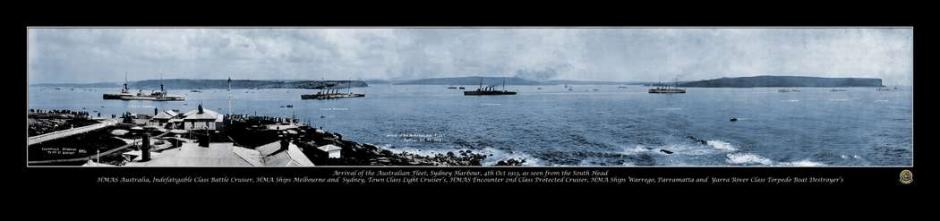
Australia and Sydney reached the sheltered anchorage of Jervis Bay, New South Wales, on 2 October 1913. There they were joined by the cruisers: Encounter andMelbourne, and the destroyers WarregoParramatta, and Yarra. Last minute preparations continued for the official entry into Sydney.

Early on 4 October 1913 the various units of the fleet got underway, took up station astern of Australia, and steamed north in single column. The spring weather was perfect, and once off Sydney the long grey line of ships turned towards the coast and materialised punctually out of a thinning sea mist in the east.

Sydney Harbour was no stranger to imperial and foreign warships, but the formation led by Australia, both majestic and forbidding at the same time, was something different. It was the embodiment of the Commonwealth’s own sea power and representative of something far greater than the sum of its parts. For the first time, Australia would have a real and independent voice on the world stage.


Extract from ‘The Daily Telegraph’, October 6, 1913:

“They came from due east. They rose up from the bosom of the sea – the distant horizon. Not a sound to announce the approach of the procession. Silently they glided, rather than ploughed, their way. Just outside the Heads the oncoming line deployed so as to take the guiding marks of the eastern channel. It was a splendid spectacle to watch. Each ship equidistant and following in its predecessors wake. On the precise spot where the flagship veered in her course the others as they reached it, veered also. So precise were the movements that the ships might have been railway engines running on a railway track. Those who had admired the skilful manoeuvring of the American fleet found equal praise for our own ships, which without exception took up their moorings in splendid style. Every detail was carried out with the mechanical precision of a clock work. It was all highly creditable to the young Navy.”

Extract from ‘The Daily Telegraph’, October 6, 1913:

“From every flagstaff, north, south, east and west flew the British – Australian colours. It was truly Australia’s national day, a day that meant much to its history. And notable, too, was the pride which the younger generation, seen on almost every vessel afloat, took in this spectacular demonstration that signified the realisation of ambitious hopes.”

As the fleet entered the harbour, hundreds of small craft provided an eager escort, while hundreds of thousands of sightseers crammed the many headlands to stare at their new warships. The event evoked a nationalistic euphoria never before experienced. “The sight of the Fleet meant more to the Australian people than the visit of any foreign fleet. It was our expression of patriotism, ships of defence bought in love of country and empire.” wrote the Sydney Mail, while the Australian Prime Minister, Joseph Cook, remarked:

“Since Captain Cook’s arrival, no more memorable event has happened than the advent of the Australian Fleet. As the former marked the birth of Australia, so the latter announces its coming of age, its recognition of the growing responsibilities of nationhood, and its resolve to accept and discharge them as a duty both to itself and to the Empire. The Australian Fleet is not merely the embodiment of force. It is the expression of Australia’s resolve to pursue, in freedom, its national ideals, and to hand down unimpaired and unsullied the heritage it has received, and which it holds and cherishes as an inviolable trust. It is in this spirit that Australia welcomes its Fleet, not as an instrument of war, but as the harbinger of peace.”

Since 1913, the RAN has many times conducted ceremonial fleet entries into Sydney Harbour, often to commemorate particular naval or national anniversaries. Such entries have also formed an important part of the procedure for a subsequent Fleet Review.

RENDER SAFE 2013 – Clearance Operations Commence – HMAS Diamantina leads HMAS Tarakan and HMAS Labuan as they begin to berth alongside Honiara for Operation RENDER SAFE 2013.

RENDER SAFE 2013 – Clearance Operations Commence

Published on 07 November 2013 WOCSMMW Darren Chapman (author), CAPT John Leathley (photographer), ABIS Nicolas Gonzalez (photographer)

Location(s): Honiara, Solomon Islands

21 pieces of World War 2 ordnance, which were located and  made safe near Honiara International Airport in the Solomon Islands as part of Operation RENDER SAFE 2013. (photo: CAPT John Leathley)
21 pieces of World War 2 ordnance, which were located and made safe near Honiara International Airport in the Solomon Islands as part of Operation RENDER SAFE 2013.

Less than 24 hours after the establishment of the headquarters for Operation RENDER SAFE 2013 in Solomon Islands, elements of the JTF 663 Advanced Party partnered with elements of the Royal Solomon Islands Police Force (RSIPF) Explosive Ordnance Disposal (EOD) team to locate and make safe explosive remnants of war near Honiara International Airport.

Commander Joint Task Force 663, Commander Doug Griffiths, said he was pleased with the seamless cooperation of the combined teams to deal with the 21 pieces of World War 2 (WW2) ordnance.

“The ability to partner with elements of the RSIPF EOD provided ADF EOD operators the ability to share best practices and learn from each other,” he said.

“The RSIPF have established a highly professional capability regionally acknowledged as the gold standard in South Pacific EOD capability.”

“This year, the RSIPF EOD element has disposed of nearly 11,000 individual pieces of explosive ordnance.”

Commander Griffiths said the remainder of the Op RENDER SAFE Task Force including HMAS DiamantinaLabuan and Tarakan, and EOD operators from the United States, Canada and New Zealand will arrive in Solomon Islands this week for the month long operation.


HMAS Diamantina leads HMAS Tarakan and HMAS Labuan as they begin to berth alongside Honiara for Operation RENDER SAFE 2013.

HMAS Diamantina leads HMAS Tarakan and HMAS Labuan as they begin to berth alongside Honiara for Operation RENDER SAFE 2013.

He said Solomon Islands saw some of the fiercest fighting of the WW2 Pacific campaign, and the legacy of war surrounds the local population on a daily basis, impacting development and safety.

Once fully established, the task force will embark on an extensive community engagement program throughout the primary operating areas of Guadalcanal and the Russell Islands in order to locate and dispose of the explosive hazards which remain after nearly 70 years.

Op RENDER SAFE is an enduring Australian Defence Force operation focused on the clearance of explosive remnants of war throughout the region. The operation will run until 6 December 2013.

End of era as England ceases warship building

End of era as England ceases warship building

Home » News » World
Thu, 7 Nov 2013

 0  0 ShareThis
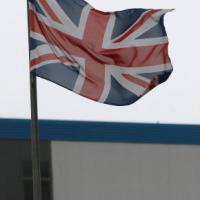
A union flag flies over the entrance to the naval dockyards, where BAE Systems are also located, in Portsmouth. REUTERS/Stefan Wermuth

A union flag flies over the entrance to the naval dockyards, where BAE Systems are also located, in Portsmouth. REUTERS/Stefan Wermuth

Britain, once the world’s mightiest seafaring power, has announced that it will shut down the last naval shipyard in England, eliminating nearly 1000 jobs and closing a chapter of history stretching back hundreds of years.Workers in the southern city of Portsmouth have been building warships since the reign of King Henry VIII, including the famous Mary Rose. But citing dwindling demand, the government and defense contractor BAE Systems have agreed to cease construction there.

Vessels for the Royal Navy will still be built in Britain, but only in Scotland. Though hundreds of jobs are to be cut at Scottish shipyards as well, workers in Portsmouth accused the government of sacrificing them for political reasons, to avoid angering Scots ahead of a referendum next year on whether they should separate from England and Wales to become an independent nation.

In Parliament, Prime Minister David Cameron defended the decision to close down operations in Portsmouth, noting that the city’s dockyards would continue to repair and maintain warships, just not build them. Although 940 jobs will be lost next year, 11,000 in the industry will remain, he said.

“Many more people have been involved in ship-servicing than in shipbuilding,” Cameron told lawmakers. “Some of the largest and best-equipped warships we have ever had in our country will be based and hosted at Portsmouth … which will mean a lot of work for Portsmouth and for our naval base there for many, many years to come.”

Defense Secretary Philip Hammond denied that the specter of next year’s referendum played a role in the choice to keep Scotland’s shipyards humming, albeit with 835 fewer workers by the end of 2016. He said the government would invest $160 million in ship-servicing work in Portsmouth to try to cushion the effects of the coming layoffs.

Perhaps just as hurtful to the city as the economic blow, however, is the loss of its historic status as the center of British shipbuilding, the busy workshop that helped turn a small island into a maritime power with a vast worldwide empire at its command.

Portsmouth has been a strategic coastal holding for English monarchs since the 13th century. In 1511, shipbuilders there launched Henry VIII’s beloved Mary Rose, one of the first war vessels able to fire a broadside, heralding the eventual rise of Britain as a naval powerhouse.

The ship sank 34 years later during a skirmish with the French fleet. The wreck lay undisturbed on the seabed for nearly 300 years until a diver accidentally came across it. The Mary Rose was raised from the water in 1982 and is now a prime tourist attraction.

Another historic craft, the HMS Victory – which saw action in the American Revolution and the Napoleonic Wars and was the flagship of Adm. Horatio Nelson at the Battle of Trafalgar in 1805 – is also anchored at Portsmouth.

Gerald Vernon-Jackson, the leader of the Portsmouth City Council, said the British government was putting itself in a dicey position by eliminating shipbuilding in England.

“Portsmouth was the last place in England that could build advanced surface warships,” Vernon-Jackson told Sky News. “If Scotland becomes independent, where will the Royal Navy build their ships? They’ll have to go to foreign countries to have their ships built, and that’s a terrible thing for an island nation that depends on sea trade like the United Kingdom.”

But Hammond said Britain would strive to keep military shipbuilding within its own borders – no matter how those borders may be drawn.

“I see no reason to expect that the U.K. will want to change from the position that we will build complex warships in the U.K. for reasons of maintaining sovereign capability in the future,” Hammond told the BBC.

Today in U.S. Naval History – November 6

Today in U.S. Naval History: November 6

MarineLink.com
Wednesday, November 06, 2013, 11:56 AM
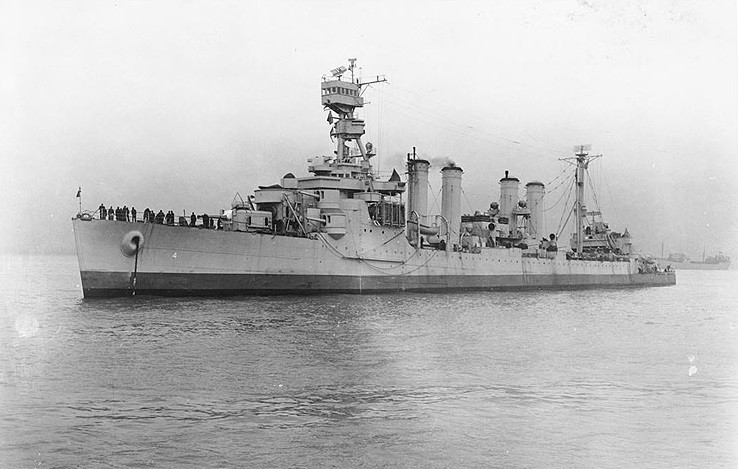
File USS Omaha (CL-4). Official U.S. Navy Photograph, from the collections of the Naval Historical Center.
USS Omaha (CL-4). Official U.S. Navy Photograph, from the collections of the Naval Historical Center.

Today in U.S. Naval History – November 6

1851 – U.S. Navy expedition under command of Lt. William Lewis Herndon, on a mission to explore the valley of the Amazon and its tributaries, reaches Iquitos in the jungle region of the upper Amazon after their departure from Lima, Peru.

1941 – On Neutrality Patrol, USS Omaha (CL-4) and USS Somers (DD-381) intercept the German blockade runner Odenwald disguised as U.S. freighter, board her after the German crew abandoned the ship, and brought the ship to San Juan, Puerto Rico, where the boarding party was awarded salvage shares.

1942 – First officer and enlisted women from training schools report for shore duty around the U.S.

1951 – Soviet aircraft shoot at Neptune Patrol bomber (VP-6) on weather reconnaissance mission near Siberia. U.S. aircraft fails to return.

1967 – Helicopter from USS Coral Sea (CVA-43) rescues 37-man crew of Liberian freighter Royal Fortunes aground on reef in Tonkin Gulf

For more information about naval history, visit the Naval History and Heritage Command website at history.navy.mil.

JCs Royal New Zealand Navy Ships and New Zealand Defence, Also other World Defence Updates

Ships and Defence News Past and Present

Skip to content ↓