
More Street Views here – click this link
Google SUB View: Explore Chatham’s last naval submarine – and even venture into the captain’s quarters
- 50-year-old HMS Ocelot is the first submersible on Google Street View
- Google Street View also lets you take a tour of the dockyard where the submarine was launched in in May 1962
- Featured areas include captain’s quarters, sonar room and 6 torpedo tubes
PUBLISHED: 12:15 GMT, 4 November 2013 | UPDATED: 12:51 GMT, 4 November 2013
26
View
comments
From a tour the Doctor’s TARDIS to a 1960s branch of Tescos, it seems there is nowhere Google Street View can’t go.
Now, the search giant has taken to the seas to add yet another celebrated British icon to its maps feature.
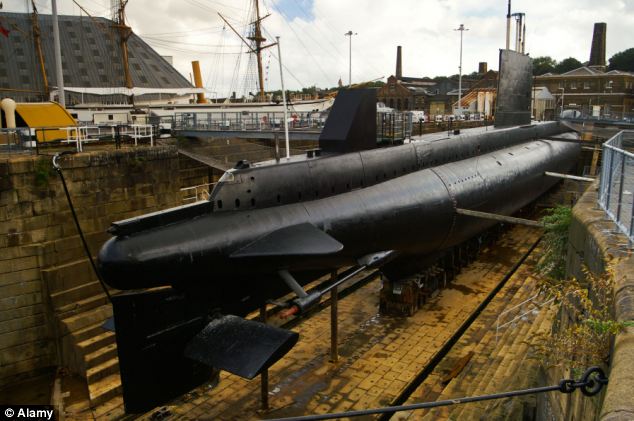
The decommissioned HMS Ocelot, located at Chatham Dockyard, has become the first submersible to be fully featured on Street View.
 The decommissioned HMS Ocelot, located at Chatham Dockyard, has become the first submersible to be fully featured on Street View
HMS OCELOT: THE LAST SUBMARINE BUILT FOR THE ROYAL NAVY
HMS Ocelot was one of the thirteen Oberon Class submarines built for the Royal Navy between 1959 and 1964.
The class of submarine was all diesel and capable of high underwater speeds of up to 17 knots (20 miles per hour) when submerged
Due to their low noise, these submarines were mainly used for continuous submerged patrols performing surveillance and intelligence gathering missions.
HMS Ocelot was the last submarine built for the Royal Navy at Chatham.
She was decommissioned in August 1991 as the conventional submarine fleet of the Royal Navy began to decline, making way for the nuclear fleet.
She was sold in 1992 and preserved as a fully tourable museum in Chatham Historic Dockyard.
By searching for HMS Ocelot in Google Maps Street View, you can take a tour of the baffling control room of the 50-year old Oberon-class submarine.
More…
Through narrow corridors, captain’s quarters and past six torpedo tubes, the site gives a close view of the submarine from all angles.
It also lets you take a tour of the dockyard and surrounding area where the submarine was launched in in May 1962.
HMS Ocelot was one of the thirteen Oberon Class submarines built for the Royal Navy between 1959 and 1964.
The class of submarine was all diesel and capable of high underwater speeds of up to 17 knots (20 miles per hour) when submerged
Due to their low noise, these submarines were mainly used for continuous submerged patrols performing surveillance and intelligence gathering missions.
HMS Ocelot was the last submarine built for the Royal Navy at Chatham.
She was decommissioned in August 1991 as the conventional submarine fleet of the Royal Navy began to decline, making way for the nuclear fleet.
She was sold in 1992 and preserved as a fully tourable museum in Chatham Historic Dockyard.
 The captain was the only person who had his own cabin on board the submarine. The one pictured here is around 2 metres by 1 metre and contains a pull down sink
 Moving through the submarine, you pass the radio and sonar compartments (imaged) on your left (the boat’s starboard side) and captain’s cabin on your right (the boat’s port side)
Once strictly off limits to the public, Google now lets anyone take a peek around the sonar and radio compartments.
However, much of this was removed by the navy when the submarine was decommissioned as it would have still been on the secret list.
HMS Ocelot was one of the thirteen Oberon Class submarines built for the Royal Navy between 1959 and 1964.
The class of submarine was all diesel and capable of high underwater speeds of up to 17 knots (20 miles per hour) when submerged.
Due to their low noise, these submarines were mainly used for continuous submerged patrols performing surveillance and intelligence gathering missions.
HMS Ocelot was the last submarine built for the Royal Navy at Chatham.
 The Control Room is where the boat was commanded by either the captain or the officer of the watch
 This picture shows the helmsman’s or steering position. The boat was steered from here via a control very similar to that found on aircraft
Earlier this year, the inside of the TARDIS from Doctor Who was shown by Google Street View outside Earl’s Court London Underground station.
The feature was added secretly but it wasn’t long before fans spotted the feature and posted hundreds of reviews.
Google is known for adding semi-secret bonus features known as ‘Easter Eggs’.
For instance, typing ‘do a barrel roll’ into its search engine will see results spin around the screen.
Others features in the past have included putting ninjas in its Reader and spam recipes in its Gmail spam folders.
 HMS Ocelot was one of the thirteen Oberon Class submarines built for the Royal Navy between 1959 and 1964. This view shows the submarine’s control room
Share or comment on this article
Read more: http://www.dailymail.co.uk/sciencetech/article-2487078/Google-SUB-View-Explore-Chathams-naval-submarine–venture-captains-quarters.html#ixzz2jqCGIPYb
Follow us: @MailOnline on Twitter | DailyMail on Facebook