Beachable Hybrid River Ferry Designed by Navtech

MarineLink.com

Tuesday, November 05, 2013, 9:35 PM
File Ferry
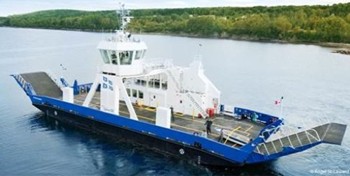
Ferry ‘Peter Fraser’: Photo courtesy of Navtech

Canadian naval architecture firm Navtech designed the recently delivered ‘Peter Fraser’, a 33-meter Ro-Ro ferry for operation on the St. Lawrence River in shallow waters between Isle- Verte and Notre-Dame-des-Sept-Douleurs.

Peter Fraser, say the designersis the very first in the Americas, to be equipped with a Hybrid diesel- electric and lithium ion battery power system. The green technology ferry was built by Chantier Naval Forillon of Gaspé (Quebec, Canada) for Société des traversiers du Québec following a Quebec Government investment worth over 10 million Canadian dollars for a low carbon emission ferry.

The ferry is equipped with four SCHOTTEL Pump-Jet model SPJ 57 RD each powered by an ABB 220 kW electric motor which provides outstanding manoeuvrability capabilities. The pilot chair is equipped with two  joysticks that provide fully integrated control of the pump-jets.

Power can be supplied either by two (2) Volvo Penta D16 MG diesel generators of 477kWe/600V each and/or by the EcoPower 400 kWh battery bank. The vessel hybrid electrical and control system was designed, supplied and installed by Techsol, an Imtech Marine company.

Shallow water operation
The vessel has a service draft of 0.85 m with 30 tons of pay-load and a maximum draft of 1.1m with 110 tons of pay-load. Due to the location of the service, the vessel has a strengthened bottom and is intended to be beached at every low tide.

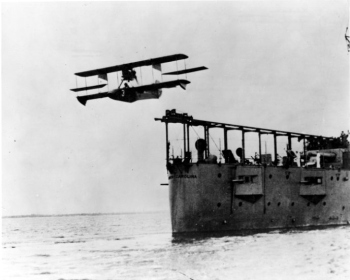
First Catapult Launch: November 5, 1915

100+ Naval History Blog by Naval Institute Archives  /  12h  //  keep unread  //  trash  //  preview

First Catapult Launch: November 5, 1915

First catapult launch from a ship.First catapult launch from a ship.


On November 5, 1915, Lt.Comdr. Henry C. Mustin, in an AB-2 flying boat, made the first catapult launching from a ship, flying off the stern of the USS North Carolina (ACR 12) in Pensacola, Fl.


Negotiation to Save Finnish Shipyard Completed

Tuesday, November 05, 2013, 9:37 AM

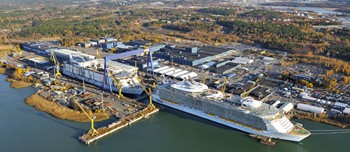
File The shipyard in Turku, which builds post-Panama class cruise vessels, is one of the biggest and most modern in Europe with a land area of 144 ha and a new building dock measuring 365 x 80 meters. (Photo: STX Finland)
The shipyard in Turku, which builds post-Panama class cruise vessels, is one of the biggest and most modern in Europe with a land area of 144 ha and a new building dock measuring 365 x 80 meters. (Photo: STX Finland)

STX Finland has been actively seeking solutions for saving the Finnish shipyard industry. In September 2013, the company launched a major restructuring aimed at safeguarding the operating potential of the company and, by extension, the entire maritime industry in Finland, thus ending the years of uncertainty.  

As part of the STX Finland Oy restructuring, cooperation negotiations concerning the Rauma and Turku Shipyards have been conducted between the personnel groups and the company management. The negotiations were completed on October 29, 2013. In accordance with the company’s earlier announcement, the current operations at the Rauma Shipyard will be closed down and functions shifted to the Turku Shipyard. By the end of June 2014, a total of approximately 670 employment relationships will be terminated: 620 at Rauma and 50 at Turku. In addition a total of approximately 80 people will transfer from Rauma to Turku. After workforce reductions, the total number of employees at STX Finland will be 1,655. The Turku Shipyard will have an overall strength of 1,365 employees, of which 870 are blue-collar workers and 495 white-collar workers.

”In collaboration with national and regional employment authorities, the company will be offering concrete support and employment measures for employees who will be laid off as a result of the restructuring,” said Jari Anttila, Deputy CEO of STX Finland.

STX Finland has been exploring employment opportunities in its other units in Finland and discussed the personnel needs of other maritime cluster companies with its local partners. Employment authorities have set up a new branch office in the City of Rauma, providing information about how to apply for unemployment benefits and supporting reemployment by various means. The personnel will be offered information on, for example, job-seeking, retraining, entrepreneurship, pension plan opportunities, and other social services and benefits. The representatives of the employer and personnel groups will continue their close cooperation to increase support measures for the personnel.

Both the Rauma and Turku Shipyards have been underutilized and the company’s financial performance has been negative. The decisions now taken will adapt the company capacity to the expected volume of demand. The Turku Shipyard is able to build all types of vessels, including ships requiring special arctic expertise, such as icebreakers. The restructuring will not limit the company’s offering or reduce the volume of its operations.

“STX Finland is committed to successfully completing the restructuring process required to secure the future of the Finnish shipyard industry,” said Jari Anttila, Deputy CEO of STX Finland.

stxeurope.com

  • The Rauma yard with a building dock measuring 260 x 85 meters is a leading ferry builder, which also specializes in small cruise ships, multipurpose icebreakers and naval craft. (Photo: STX Finland)The Rauma yard with a building dock measuring 260 x 85 meters is a leading ferry builder, which also specializes in small cruise ships, multipurpose icebreakers and naval craft. (Photo: STX Finland)
 

Email  AddThis Feed Button

Today in U.S. Naval History: November 5

MarineLink.com

Tuesday, November 05, 2013, 12:49 PM
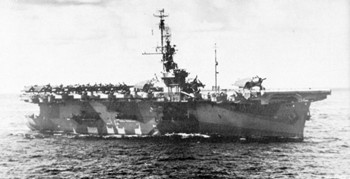
File USS Wake Island (CVE-65). Courtesy Aryeh Wetherhorn, U.S. Navy photo.
USS Wake Island (CVE-65). Courtesy Aryeh Wetherhorn, U.S. Navy photo.

Today in U.S. Naval History – November 5

1775 – Commodore Esek Hopkins appointed to Commander in Chief of the Continental Navy.

1915 – In AB-2 flying boat, L.Cdr. Henry C. Mustin makes first underway catapult launch from a ship, USS North Carolina, at Pensacola Bay, Fla.

1917 – German submarine torpedoes USS Alcedo off French coast.

1923 – Tests designed to prove the feasibility of launching a small seaplane from a submarine occur at Hampton Roads Naval Base. A Martin MS-1, stored disassembled in a tank on board USS S-1, was removed and assembled. Then the submarine submerged allowing the plane to float free and take off.

1944 – TF 38 (Vice Admiral John S. McCain) begins two days of carrier strikes on Luzon, Philippines.

1945 – Ensign Jake C. West (VF-41) makes first jet landing on board a carrier, USS Wake Island (CVE-65) .

For more information about naval history, visit the Naval History and Heritage Command website at history.navy.mil.

NASSCO Lays Keel of Third U.S. Navy Platform Ship

NASSCO Lays Keel of Third U.S. Navy Platform Ship

MarineLink.com
Tuesday, November 05, 2013, 3:16 PM
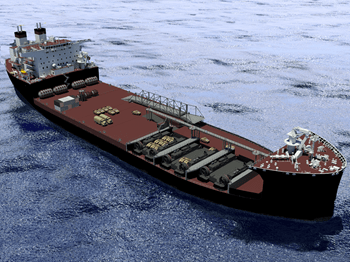
File Artist rendering of Mobile Landing Platform vessel (Photo: General Dynamics NASSCO)
Artist rendering of Mobile Landing Platform vessel (Photo: General Dynamics NASSCO)

General Dynamics NASSCO today hosted a keel laying ceremony for the USNS Lewis B. Puller, the third ship in the Mobile Landing Platform (MLP) class. The ship is named in honor of Lewis B. Puller, the most decorated U.S. Marine in history and the only one to be awarded five Navy Crosses. Mrs. Elizabeth Glueck was the honoree for the keel-laying ceremony. She is the wife of Lieutenant General Kenneth J. Glueck, Jr., deputy commandant for Combat Development and Integration; commanding general, Marine Corps Combat Development Command; and commander, U.S. Marine Corps Forces Strategic Command.

Mrs. Glueck validated the ship’s keel by welding her initials onto a steel plate which will be permanently affixed to the ship, remaining with the vessel throughout its time in service.

MLP-3 is the first ship of the class to be configured as an Afloat Forward Staging Base (AFSB). Delivery is scheduled for the second quarter of 2015.

“This third Mobile Landing Platform ship, configured as an AFSB, will provide significant new capability to the Navy and Marine Corps’ Maritime Prepositioning Force,” said Fred Harris, president of General Dynamics NASSCO. “The NASSCO team will continue to efficiently build and deliver these ships to help strengthen the forward presence of the Navy.”

The MLP AFSB is a flexible platform and a key element in the Navy’s large-scale airborne mine countermeasure mission. The ship is designed to facilitate a wide variety of future mission sets in support of special operations. With accommodations for 250 personnel and a huge helicopter flight deck, the MLP AFSB will provide a highly capable and affordable asset to the Navy and Marine Corps.

nassco.com

JCs Royal New Zealand Navy Ships and New Zealand Defence, Also other World Defence Updates

Ships and Defence News Past and Present

Skip to content ↓