CSL Tacoma Calls at Port of Redwood City

MarineLink.com

Tuesday, November 05, 2013, 4:23 PM
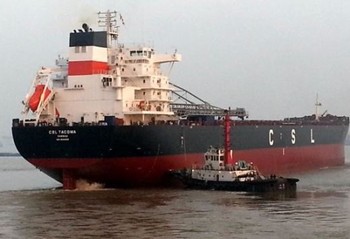
File CSL Tacoma
CSL Tacoma

The final in a series of five Canada Steamship Lines’ (CSL) state-of-the-art, new Trillium Class self-unloading Panamax vessels, the 228-meter long CSL Tacoma, embarked on her maiden voyage from the Chengxi Shipyard in Jiangyin, China on Oct. 12, and is making her maiden cargo voyage to San Francisco Bay. She is scheduled to arrive at the Port of Redwood City at noon on Wednesday, November 6, with sand and gravel construction materials from an Eagle Rock Aggregates quarry in British Columbia.

With the South Bay and Peninsula building boom resulting in skyrocketing demand for construction materials, imports of these materials by ship to the Port of Redwood City are expected to double to two million tons over the next 18 months, reports Port Executive Director Michael J. Giari. In fact, the Tacoma’s maiden call will be one of three ships arriving at the Port of Redwood City this week with construction materials, with a combined total of 100,000 tons.

The Port will hold a “maiden voyage” welcome for the ship at Wharf 1 at the Port Wednesday at 2 p.m., with Port Chair Lorianna Kastrop and representatives from CSL, Cemex, and Eagle Rock Aggregates expected to be at the welcoming.

The materials are being brought into the Port by Cemex Aggregates which handles and distributes the aggregate materials to readi-mix plants throughout the South Bay. Millions of tons of construction material are needed in the South SF Bay for the new Apple headquarters, housing, hotels, entertainment complexes near the new Levi Stadium, office campuses for Google and other Silicon Valley companies, and more, including the residential construction boom in Redwood City. The logistics chain for this material consists of the Orca Quarry on northern Vancouver Island with a large modern, high speed ship loader; newly built state-of-the-art, self unloading CSL ships; the Port of Redwood City’s new Wharf One facility that is scheduled to open in December; and new Cemex ready mix concrete plants at or near construction project sites in Silicon Valley. Private companies and the Port of Redwood City have invested millions of dollars in infrastructure, ships, and equipment to make the movement of this material as efficient as possible.

According to CSL Americas West Coast Director Garth Mitcham, the Tacoma “represents the latest in environmental technologies utilization and IMO Tier II propulsion among many other design achievements shared with her sister ships: Rt. Hon. Paul E. Martin, CSL Tecumseh, Balto and Balchen. Each of these vessels has performed their maiden voyages into the SF Bay area serving the State of California’s infrastructure needs.” The CSL Tecumseh is scheduled to call on the Port this Friday; the Rt. Hon. Paul E. Martin made its maiden cargo voyage to the Port of Redwood City in 2012.

According to Mitcham, CSL’s Trillium Class vessels are currently the most advanced self-unloading ships in the world. Equipped to meet the evolving business needs and high environmental standards, CSL’s next-generation vessels feature the latest engine technology and hull design to increase fuel efficiency and decrease air emissions, as well as state-of-the-art cargo handling systems to minimize dust and cargo residue.

CSL’s new Panamax self-unloaders feature the latest dust-suppression technology, including:
•Dust collectors and bin vents
•Conveyor belt sprayers
•Covered discharge booms
•Capacity to pinpoint cargo placement
•Ability to minimize or even eliminate dust and spillage while discharging
•Capacity to operate in areas where traditional bulk carriers can’t
•Reduced Environmental Footprint
•Loading and discharging cargo from a self-unloader can be carried out within a completely enclosed system. This ensures a clean ship and a clean dock, no dust pollution around the harbor and reduced noise levels.
•Advanced dust suppression equipment and fully enclosed or covered booms on many of our vessels further reduce the potential for dust or spillage.
•Noise generated by the ship’s self unloading machinery is controlled through the use of acoustic enclosures and sound barriers.

redwoodcityport.com

Propulsion Troubles for Royal Caribbean Liner

Tuesday, November 05, 2013, 4:43 PM

File Allure of the Seas (Courtesy Royal Caribbean)
Allure of the Seas (Courtesy Royal Caribbean)

Multiple sources reported that Royal Caribbean’s Allure of the Seas, the world’s largest cruise vessel, has encountered difficulties with its propulsion system, impeding full speed capabilities. The ship is reported to be functional, but sailing at reduced speeds.

Because of the propulsion issue, the 1,187-foot vessel and its passengers of the ship’s past two Eastern Caribbean sailings were forced to experience shorter port calls to compensate for longer sailing times.

USA Today reported that Royal Caribbean is currently looking into the issue and searching for means to fix it. Royal Caribbean has not said when the issue will be resolved.

Sources: USA Today, Royal Caribbean, staff

New post (HII Holds Keel Laying Ceremony for Future USS John Finn) has been published…

New post (HII Holds Keel Laying Ceremony for Future USS John Finn) has been published on http://www.navyandmarinenews.jcandmei.com/

1 Naval Today >> The industry’s seaborne news provider by Naval Today  /  15min  //  keep unread  //  trash  // preview
HII Holds Keel Laying Ceremony for Future USS John Finn

Huntington Ingalls Industries laid the keel for the future USS John Finn (DDG 113) during a ceremony at Ingalls Shipbuilding in Pascagoula, Miss., Nov. 4.

The keel of DDG 113 was authenticated as being “straight and truly laid” by Laura Stavridis – the ship’s sponsor and wife of retired Admiral James Stavridis -and Bob Merchant, Vice President, Surface Combatants and U.S. Coast Guard Programs at HII.
“DDG 113 is the first ship of the Arleigh Burke class destroyer program restart,” said Capt. Mark Vandroff, DDG 51 class program manager, Program Executive Office (PEO) Ships. “This keel laying represents the beginning of John Finn and continues the proud tradition of this highly successful shipbuilding program. I was especially honored to have Admiral and Mrs. Stavridis joining us here today. Admiral Stavridis, a former commanding officer of the first Ingalls DDG 51, USS Barry, knows how the hard work of Ingalls’ shipbuilders produces great warships.”
The DDG 51 class ship is a multi-mission, guided-missile destroyer designed to operate in multi-threat air, surface and sub-surface threat environments. The DDG 51 program continues to reinforce affordability and efficiency in its shipbuilding program with a commitment to deliver ships at the highest possible quality to the fleet.
John Finn is the 29th DDG 51 class destroyer to be constructed by Ingalls and is the first ship of the DDG 51 program restart. The Navy currently has 13 Arleigh Burke class destroyers under contract, including the recent Fiscal Year 2013 – 2017 multi-year procurement of nine ships awarded to HII and General Dynamics Bath Iron Works in June 2013.
John Finn is expected to deliver to the Navy in 2016.
As one of the Defense Department’s largest acquisition organizations, PEO Ships is responsible the development and procurement of all destroyers, amphibious ships, special mission and support ships, and special warfare craft.

Press Release, November 05, 2013; Image: Wikimedia

Read more by clicking this link – http://www.navyandmarinenews.jcandmei.com/

New post (NATO Ships Get Underway for Steadfast Jazz 2013) has been published on…

New post (NATO Ships Get Underway for Steadfast Jazz 2013) has been published on http://www.navyandmarinenews.jcandmei.com/

Naval Today >> The industry’s seaborne news provider by Naval Today  /  15min  //  keep unread  //  trash  // preview
NATO Ships Get Underway for Steadfast Jazz 2013

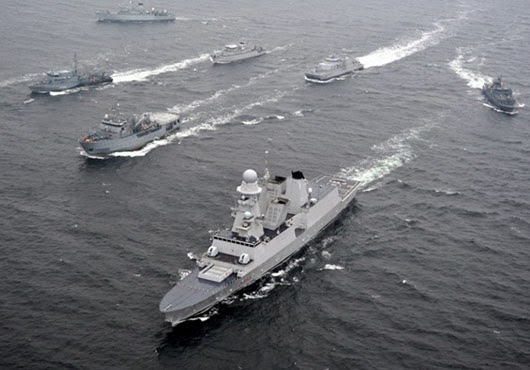
Shortly after dawn the alarm breaks the silence on board HNLMS De Ruyter as the crew of the flagship prepare to head out to sea. After months of planning, a week in port and some final preparations during the pre-sail conference, everyone is focused and excited about what is going to happen in the coming days.

On Saturday morning, 2 November 2013, the ships participating in exercise Steadfast Jazz 2013 left the port of Gdynia, Poland to start the main phase of the Maritime Live Exercise.
 ”This is something we’ve been preparing ourselves for and finally we can put the plans into reality,” said Task Group Commander, Capt. Mariusz Koscielski (Polish Navy). “The exercise staff is ready for the job, the ships left port as scheduled, so the mission for us now is to prove we can work as one, cooperate to achieve common goals and provide NATO with a cohesive force at sea,” he added.
The maritime assets will operate in the Gulf of Gdansk and adjacent waters for the next seven days – ensuring the safety of navigation and securing the strategic lines of communication especially the port approaches. Of paramount importance is the protection of Allied military and commercial shipping against submarine or air attacks. The Standing NATO Mine Countermeasures Group 1 will be responsible for neutralizing sea mines and other dangerous objects that could present a threat to maritime traffic. The task group will additionally practice multinational procedures such as formation maneuvering, communications and search and rescue operations at sea.

HNLMS De Ruyter is a Dutch air defence, command and control frigate appointed to be the flagship of the maritime component of exercise Steadfast Jazz 2013. Twenty-five officers and petty officers from Italy, Latvia and Poland are embarked on board to serve as the Task Group Commanders staff responsible for designating units to proper tasks, covering and coordinating all aspects of the exercise and providing subordinate units assistance as needed.
The force is comprised of the Polish submarine ORP ‘Sokol’, Italian destroyer ITS Caio Duilio, Polish frigate ORP Kosciuszko and SNMCMG1 command ship ORP Czernicki joined by seven minehunters: BNS Narcis (Belgium), ENS Admiral Cowan (Estonia), FGS Dillingen (Germany), HNLMS Makkum (Netherlands) and HNOMS Rauma (Norway), HMS Ledbury (Great Britain) and ORP Czajka (Polish). The maneuvers will also involve naval aviation with Polish navy Mi-14PL and SH-2G helicopters and Portuguese P-3C Orion patrol aircraft.
Exercise Steadfast Jazz is the largest NATO exercise since 2006, and is one of a series of exercises designed to maintain connected and interoperable forces at a high state of readiness. These events allow NATO to continue to develop and hone capabilities, employ new technology and test new tactics.

Press Release, November 5, 2013; Image: NATO ACO

Read more by clicking this link – http://www.navyandmarinenews.jcandmei.com/

New post (Northrop Grumman to Outfit Three US Navy Ships with AN/SPQ-9B Radars) has…

New post (Northrop Grumman to Outfit Three US Navy Ships with AN/SPQ-9B Radars) has been published on http://www.navyandmarinenews.jcandmei.com/ Naval Today >> The industry’s seaborne news provider by Naval Today  /  1h  //  keep unread  //  trash  // preview
Northrop Grumman to Outfit Three US Navy Ships with AN/SPQ-9B Radars

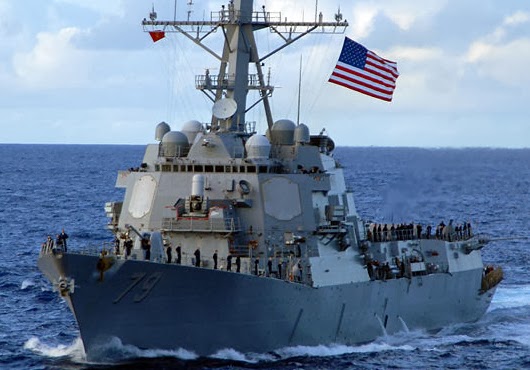
Northrop Grumman Corporation has been awarded a contract by the U.S. Navy to supply three AN/SPQ-9B radar systems for amphibious and Arleigh Burke class ships.

Under the $20.4 million contract award, Northrop Grumman will supply three AN/SPQ-9B radar systems for delivery in the second quarter of 2015. This contract adds to the 53 radar systems the company has already delivered, or is under contract to deliver. Northrop Grumman began low-rate initial production of the AN/SPQ-9B in 2000 and full-rate production in 2004.
This latest series of radars will be installed on the LPD-27, LHA-7 and DDG-79 ships. The latter will be the first guided missile destroyer (DDG) to be modernized, which will lead the way for installation of the AN/SPQ-9B radars onto the upcoming Flight III DDG-51 destroyers.
 ”This is a significant step for Northrop Grumman because it leads the way for a potential of more than 60 DDG-51 radar backfits as well 16 forward fits on the next Flight III destroyers,” said Bill Hannon, vice president of Northrop Grumman’s Maritime Systems business unit. “The AN/SPQ-9B’s performance supplies greater radar capability to surface ships, and represents another milestone in our long term legacy of supplying radars to the Navy.”
The high-resolution, X-band AN/SPQ-9B radar system will greatly improve the vessels’ ability to defend against small high-speed threats, such as surface-skimming anti-ship missiles, and will be integrated with the ships’ fire-control systems. The multimission radar system is designed to detect small fast-moving targets in the presence of clutter from ocean waves, rain and land returns, as well as chaff and jamming.
The work will be performed at Northrop Grumman’s facilities in Baltimore beginning in the second quarter of 2014.

Press Release, November 5, 2013; Image: Northrop Grumman

Read more by clicking this link – http://www.navyandmarinenews.jcandmei.com/

JCs Royal New Zealand Navy Ships and New Zealand Defence, Also other World Defence Updates

Ships and Defence News Past and Present

Skip to content ↓