|
100+ Navy Daily 8h // keep unread // trash // preview
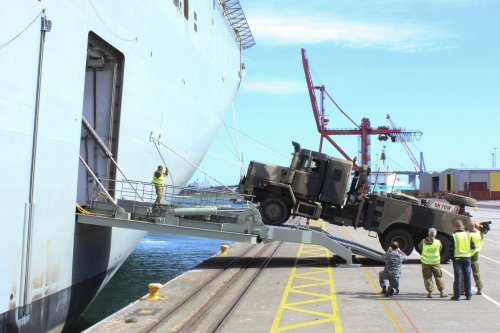
NUSHIP Canberra passes first harbour acceptance trial in Australia  Defence Material Organisation (DMO) has successfully completed a vehicle load trial on NUSHIP Canberra in the first Landing Helicopter Dock (LHD) Harbour Acceptance Trial to be done in Australia. |

Exercise Joint Warrior
|
1 Home | Think Defence by Think Defence / 9h // keep unread // trash // preview
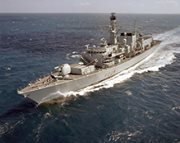
Royal NavyThe Royal Navy frigate HMS Somerset and other Plymouth-based ships are ready to take part in the major multi-national military exercise Joint Warrior. Read the full story http://www.royalnavy.mod.uk/News-and-Events/Latest-News/2013/October/09/131009-Somerset-Warrior To find out more about Joint Warrior visit http://www.royalnavy.mod.uk/Jointwarrior
The post Exercise Joint Warrior appeared first on Think Defence.           
+TAG
|


Share this:

HMS Scott in for refit


HMS Scott in for refit
One might argue HMS Scott is the most important Royal Navy ship no one has ever heard about
From Babcock;
Babcock has begun a seven month docking period for HMS Scott, the Royal Navy’s only ocean survey vessel – the first refit to be undertaken under the HMS Scott through life support (TLS) contract awarded to Babcock earlier this year.
Under the five year TLS contract, with the option to extend for a further five years, Babcock also provides fleet time maintenance, design services and spares management. The contract is delivered through a collaborative arrangement between MoD and Devonport-based ‘Scott Support Team’ comprising representatives from Babcock and Market Facing Category contractors (MFCs)
The docking period will see HMS Scott receive a number of upgrades and improvements that will significantly improve her sustainability and capability. These include fitting a new sewage treatment plant and two new lifeboat davits, as well as a new uninterrupted power supply to the ship’s sonar suite and installing new sea chests and strainers to the salt water system.
Additionally, a programme of deep maintenance will be carried out, including overhaul of over five hundred valves, two diesel engines, various motors, pumps and compressors as well as the rudder, propeller and shaft. A full structural survey will identify any repair work required and additional surveys will be carried out on more than a kilometre of ballast system pipework. A large paint package will also be undertaken, including preservation of the whole outer bottom, ship sides, all decks, super structure and over twelve thousand square meters in tanks.
Preservation of the entire hull in a new foul release coating (which will increase the ship’s fuel efficiency, reducing through life costs) will require removal of the 96 dock blocks on which the ship sits in dock – a considerable undertaking and the first time this has been done in such a short refit period. To achieve this Babcock has designed a new hydraulically-operated dock block that makes this complicated task and traditionally labour intensive and hazardous method of block removal significantly safer and quicker.
Other safety and process improvements at Devonport introduced by Babcock include improved working at height arrangements and a new suite of mechanical and electrical tag out equipment. HMS Scott will also be the first ship to trial a new tank access control process and a new plasma cutter for insert work.
Babcock’s HMS Scott Project Manager, Mo Morey, said: “In delivering this project Babcock, as an integral part of the Scott Support Team, will be drawing on our extensive experience of warship deep maintenance, to deliver HMS Scott safely, to quality, on-schedule, and at optimum value for money.”
He continued: “The refit will be challenging as HMS Scott is a unique vessel built to commercial standards. We have taken a proactive approach, utilising our fleet time experience of the platform and undertaking extensive surveys of the vessel prior to the refit period to understand her material state and identify and mitigate downstream risks to the project. We look forward to working closely with the MoD and ship’s staff to ensure successful completion of the first refit of HMS Scott’s through life support arrangements.”
DE&S Commercially Supported Shipping, Capt (RFA) Ian Schumacker, said: “This is going to be Babcock’s first refit of HMS Scott using commercial refit methodology. It will be a challenge, but one I am sure Babcock will rise to.”


One might argue HMS Scott is the most important Royal Navy ship no one has ever heard about
From Babcock;
Babcock has begun a seven month docking period for HMS Scott, the Royal Navy’s only ocean survey vessel – the first refit to be undertaken under the HMS Scott through life support (TLS) contract awarded to Babcock earlier this year.
Under the five year TLS contract, with the option to extend for a further five years, Babcock also provides fleet time maintenance, design services and spares management. The contract is delivered through a collaborative arrangement between MoD and Devonport-based ‘Scott Support Team’ comprising representatives from Babcock and Market Facing Category contractors (MFCs)
The docking period will see HMS Scott receive a number of upgrades and improvements that will significantly improve her sustainability and capability. These include fitting a new sewage treatment plant and two new lifeboat davits, as well as a new uninterrupted power supply to the ship’s sonar suite and installing new sea chests and strainers to the salt water system.
Additionally, a programme of deep maintenance will be carried out, including overhaul of over five hundred valves, two diesel engines, various motors, pumps and compressors as well as the rudder, propeller and shaft. A full structural survey will identify any repair work required and additional surveys will be carried out on more than a kilometre of ballast system pipework. A large paint package will also be undertaken, including preservation of the whole outer bottom, ship sides, all decks, super structure and over twelve thousand square meters in tanks.
Preservation of the entire hull in a new foul release coating (which will increase the ship’s fuel efficiency, reducing through life costs) will require removal of the 96 dock blocks on which the ship sits in dock – a considerable undertaking and the first time this has been done in such a short refit period. To achieve this Babcock has designed a new hydraulically-operated dock block that makes this complicated task and traditionally labour intensive and hazardous method of block removal significantly safer and quicker.
Other safety and process improvements at Devonport introduced by Babcock include improved working at height arrangements and a new suite of mechanical and electrical tag out equipment. HMS Scott will also be the first ship to trial a new tank access control process and a new plasma cutter for insert work.
Babcock’s HMS Scott Project Manager, Mo Morey, said: “In delivering this project Babcock, as an integral part of the Scott Support Team, will be drawing on our extensive experience of warship deep maintenance, to deliver HMS Scott safely, to quality, on-schedule, and at optimum value for money.”
He continued: “The refit will be challenging as HMS Scott is a unique vessel built to commercial standards. We have taken a proactive approach, utilising our fleet time experience of the platform and undertaking extensive surveys of the vessel prior to the refit period to understand her material state and identify and mitigate downstream risks to the project. We look forward to working closely with the MoD and ship’s staff to ensure successful completion of the first refit of HMS Scott’s through life support arrangements.”
DE&S Commercially Supported Shipping, Capt (RFA) Ian Schumacker, said: “This is going to be Babcock’s first refit of HMS Scott using commercial refit methodology. It will be a challenge, but one I am sure Babcock will rise to.”
Share this:

Aussie Sailors work with New Zealand Navy
Published on 02 November 2013 Ms Eliza Bavin (author)

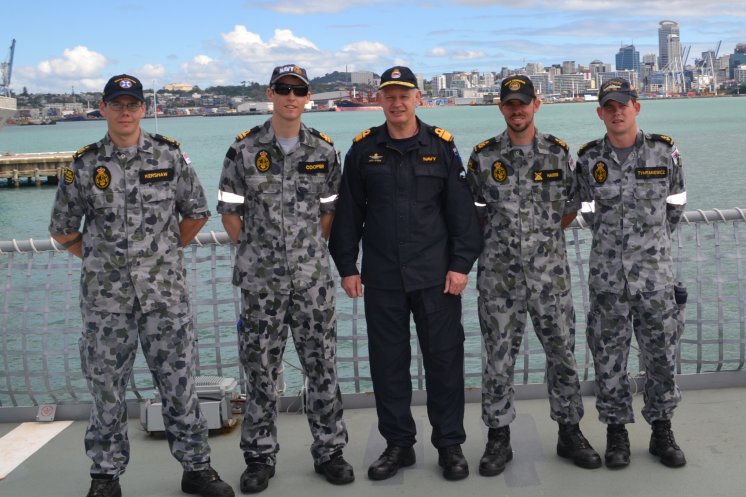
The New Zealand Chief of Navy, Rear Admiral (RADM) Jack Steer, thanked Royal Australian Navy personnel for their contribution within the last year in assisting the Royal New Zealand Navy (RNZN) in various operations from onboard HMNZSWellington.
RADM Steer was able to personally thank the Australians before they left for Exercise Southern Katipowith in HMNZS Wellington earlier this week.
Those currently serving in New Zealand are Petty Officer Khan Kershaw, Lieutenant Adrian Cooper, Petty Officer Nathan Harris and Leading Seaman Matthew Tymrackiewicz.
A fifth sailor, Leading Seaman Bradley Cochrane, who has recently returned home to Australia, has spent the most amount of time abroad with a total of eight months over two separate deployments up his sleeve to date.
LS Cochrane said all the Australians hold real, core billet positions onboard the ship.
“We are taking the lead in many areas in our respective departments.
“The Australians have worked very closely with our New Zealand counterparts on numerous RNZN Operations so far including, OP ZODIAC, OP KAUWAE, OP MULTUS and SOUTHERN KATIPO.
“The first activity we did was with Australia, the U.S and NZ, working with dive teams conducting explosive ordinance disposal in the Solomon Islands.”
“After that, we conducted a number of fishery patrols,” said LS Cochrane.
“It has been a very interesting and rewarding experience; we are really glad to assist our New Zealand Navy friends and to have the opportunity to learn from each other.”
Those who are currently deployed in New Zealand have served around two months so far, and will return to Australia December this year.
HMNZS Wellington is one of the Navy’s two Offshore Patrol Vessels (OPVs) and is designed to undertake surveillance, supply and support capability over long distances around NZ, the southern ocean and into the Pacific.
The main duty of Wellington is the surveillance of fishing vessels in the southern oceans. She operates with a core crew of 35, plus ten flight crew to operate a helicopter.
LS Cochrane said the Australians and Kiwi’s are working well as a team.
“Everyone gets along really well together, I had four Able Seamen working for me and I was working underneath the Chief; so we were fully embedded in the ship’s company and it was a really great experience.”
Share this:

USCG Overseas Damaged Vessel Transport in GoM
MarineLink.com
Friday, November 01, 2013, 11:26 AM

USCG photo
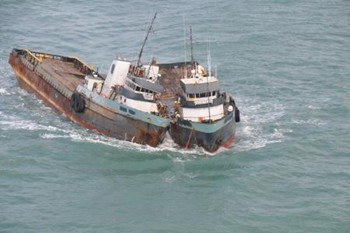
The Coast Guard and state and local authorities began working to ensure the safe transport of two troubled vessels being towed to a Brownsville scrap yard after one began listing into the other Thursday.
At approximately 8 a.m. Thursday, the captain of the tug with the vessels in tow called Coast Guard Sector Corpus Christi watchstanders to request assistance as one of the vessels was listing heavily into the other approximately two miles offshore and South of the Mansfield Jetties.
The Coast Guard activated its Incident Management Team, which will work with state and local authorities to evaluate the situation and mitigate any risks the vessel may pose to any persons or the environment. The IMT has diverted the Coast Guard Cutter Dauntless to assist and escort the vessels to the Port of Brownsville. Also, an additional tug has been dispatched from Brownsville to assist in the tow.
The vessels, both Offshore Supply Vessels, are approximately 200-feet in length, are being towed from Louisiana to the scrap yard in Brownsville. There are currently no persons onboard either OSV. The vessel names are Ken Tide and Louie Tide.
The owner of the vessels has been notified and has reported that neither vessel has an oil supply onboard that could pose a pollution risk to the environment, but Coast Guard pollution response personnel are on-scene investigating.
uscgnews.com

