|
Naval Today >> The industry’s seaborne news provider by Naval Today / 2h // keep unread // trash // preview
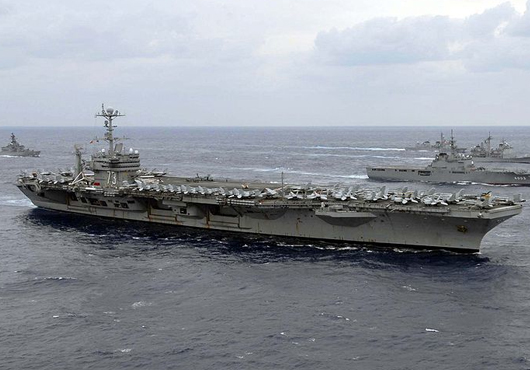
The U.S. Navy’s forward-deployed aircraft carrier USS George Washington (CVN 73) departed Republic of Singapore after a five-day scheduled port visit, Oct. 31.The Republic of Singapore welcomed more than 5,000 George Washington and embarked staffs’ Sailors to experience its culture, and to share goodwill and friendship between nations.
George Washington kicked off the port visit with a welcome reception and hosted more than 500 U.S. and Singapore dignitaries.
More than 1,200 students, military personnel, local officials and families were also provided the opportunity to tour the ship during its port visit.
George Washington’s command religious ministries department organized eight community service (COMSERV) projects that allowed Sailors to volunteer to help the local community.
George Washington will continue its 2013 patrol of the U.S. 7th fleet of operations.
George Washington and its embarked air wing, Carrier Air Wing 5, provide a combat-ready force that protects and defends the collective maritime interest of the U.S. and its allies and partners in the Indo-Asia-Pacific region. |


Standing NATO Groups Flex Their Muscles in the Med

|
Naval Today >> The industry’s seaborne news provider by Naval Today / 2h // keep unread // trash // preview
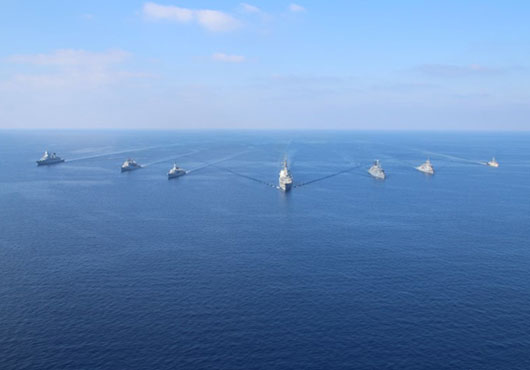
Standing NATO Maritime Group TWO (SNMG2) and Standing NATO Mine-Countermeasures Group TWO (SNMCMG2) met on Wednesday, 30 October 2013, for a joint training opportunity at sea near Crete, Greece.Both Groups have been operating in the Mediterranean in support of the counter-terrorism Operation ACTIVE ENDEAVOUR (OAE), demonstrating NATO’s resolve to help deter, defend, disrupt and protect against terrorism. COMSNMG2 Rear Admiral Eugenio Diaz del Rio welcomed aboard his flagship COMSNMCMG2 Commander Matthias Seipel for a brief meeting, discussing ongoing NATO operations and observing the combined twelve ships from eight different countries operating together. SNMG2 presently consisting of the frigates ESPS ALVARO DE BAZAN (Spain), FGS SACHSEN (Germany), TCG SALIHREIS (Turkey), ITS GRECALE (Italy), ROS REGINA MARIA (Romania), BGS DRAZKI (Bulgaria) and URS TERNOPIL (Ukraine). SNMCMG2 consisting of the mine hunters FGS MOSEL and FGS ROTTWEIL (Germany), TCG ERDEMLI (Turkey), ITS CROTONE (Italy) and HMS PENZANCE (United Kingdom). For four hours, the two Groups steamed in close formation while conducting an air defence exercise (ADEX) and a series of tactical manoeuvring exercises (MISCEX).
The SNMG2 flagship helicopter (TORO) was airborne for most of the morning, and conducted the first two landings of the deployment aboard SNMCMG2 flagship FGS MOSEL, providing an excellent opportunity for training of MOSEL’s Flight Deck Officer and crew.
Upon completion of the meeting of the two NATO Group commanders, Seipel returned to his flagship, and the two Groups departed the area to resume their support to counter-terrorism operations. Follow Naval Today via: |


Share this:

Ukrainian Navy Contributes to NATO’s Anti-Piracy Efforts
|
Naval Today >> The industry’s seaborne news provider by Naval Today / 2h // keep unread // trash // preview
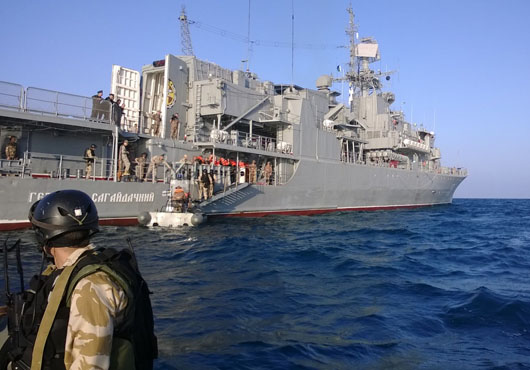
The Chairman of NATO’s Military Committee, General Knud Bartels, travelled to the Gulf of Aden on 28-30 October 2013 to visit the Ukrainian Navy frigate Hetman Sahaydachniy deployed there as part of Operation Ocean Shield, NATO’s counter-piracy mission.
The Ukrainian frigate joined Operation Ocean Shield on 10 October 2013, marking the first time a partner nation has contributed to the Alliance’s counter-piracy effort. The Ukrainian ship and its crew were supported by Allied Maritime Command (MARCOM) in the United Kingdom and individual Allies in preparation for the mission.
Before joining Ocean Shield, the Ukrainian ship briefly provided support to Operation Active Endeavour, NATO’s naval counter terrorism mission in the Mediterranean. As part of its contribution to Ocean Shield, Ukraine is also sending a liaison officer to Allied Maritime Command. In a joint visit to the Ukrainian frigate with Colonel General Volodymyr Zamana, Chief of General Staff of the Ukrainian Armed Forces, General Bartels praised Ukraine for its dedicated interest to interoperability with NATO. He added that “by working together on the maritime side, NATO and Ukraine make a real contribution to dealing with today’s global security threats such as terrorism and piracy”. Military cooperation between NATO and Ukraine has become well-established in a wide range of areas. In particular, Ukraine has made significant contributions to NATO-led operations in Afghanistan and the Balkans. Ukraine will also contribute personnel to Steadfast Jazz, the upcoming major NATO exercise which will take place in Poland and the Baltic region from 2-9 November. On board the NATO flagship, the Norwegian frigate HNOMS Fridtjof Nansen, General Bartels spoke with Commodore Henning Amundsen, the Commander of Operation Ocean Shield. General Bartels stressed that NATO’s maritime mission in the Indian Ocean has significantly reduced the threat of piracy in the region and has had wider effects.
Since August 2009, NATO warships and aircraft have been patrolling the waters off the Horn of Africa as part of the international efforts to counter maritime piracy. Ocean Shield also includes the HDMS Esbern Snare of the Royal Danish Navy and the US Navy Frigate USS De Wert. All four ships are operating together off the Horn of Africa, deterring acts of piracy. |

Share this:

Cathelco’s Pipework Anti-Fouling Systems for Six Russian Frigates
|
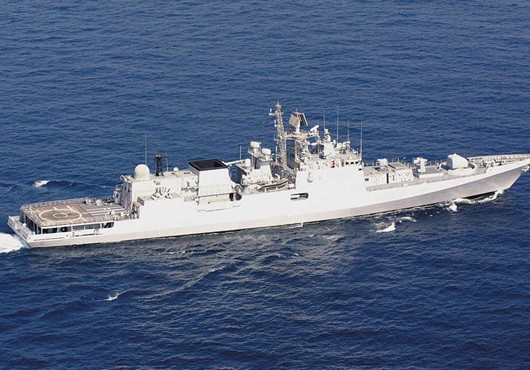
Cathelco are supplying seawater pipework anti-fouling systems for six frigates which are being built for the Russian Navy’s Black Sea Fleet by the Yantar Shipyard in Kaliningrad.The keel of the first warship, the Admiral Grigorovich, was laid down in 2010 and delivery of all of the vessels is scheduled between 2014 and 2016.
The orders have been won through Marine Bridge & Navigation Systems, Cathelco’s well established Russian agent based in St Petersburg. Because the warships have cupro-nickel pipework, pairs of copper and ferrous anodes will be installed in a total of eight seachests on each ship. The anodes are supplied with an electric current from control panels. In operation, the copper anodes produce ions which create an environment where barnacles and mussels do not settle or breed. At the same time, the ferrous anodes produce ions which create a protective oxide layer on the internal surfaces of pipes to suppress corrosion. Cathelco are world leading manufacturers of seawater pipework anti-fouling systems with a record of over 30,000 installations over a period of more than 50 years. This includes the supply of systems for over 40 navies around the world.
Press Release, November 01, 2013; Image: Yantar |

Share this:

USA: SUPSALV to Help with Recovery of CSS Georgia’s Artifacts
|
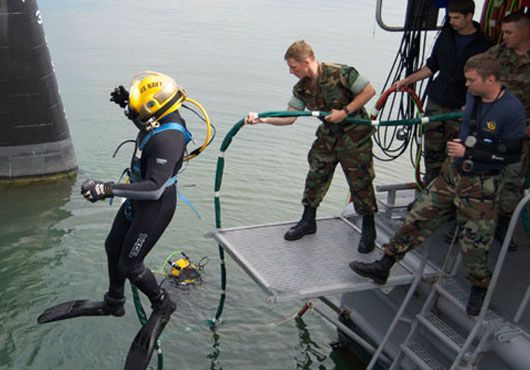
The U.S. Navy’s Supervisor of Salvage and Diving (SUPSALV) will begin a multi-phase salvage operation to survey and relocate historic artifacts from CSS Georgia, a Civil War-era Confederate Navy ship Nov. 7.The operation comes in anticipation a U.S. Army Corps of Engineers channel-deepening project in the Savannah Harbor that would disturb the historic shipwreck.
CSS Georgia, a Confederate iron clad, was used as a floating battery to defend the city of Savannah, Ga., during the Civil War. After a 20-month operational life, CSS Georgia was scuttled in December 1864 to prevent capture by advancing Union troops. It is located on U.S. Navy property and is listed on the National Register of Historic Places. Under the oversight of the Naval History and Heritage Command, the operation will be conducted in phases. During phase one, SUPSALV will direct a dive survey of the wreckage site and recover a small portion of the upper deck structure with the protective iron cladding. Phase one recovery will be used to evaluate the condition of the hull material and develop a plan to recover and relocate the historic artifacts during phase two. SUPSALV will work with Mobile Salvage and Diving Unit Two who will be providing diver support, conducting underwater survey and rigging and topside rigging support. SUPSALV will complete the first phase of the operation in mid November, weather permitting. The second phase is set to take place in 2014. The Office of the Director of Ocean Engineering, Supervisor of Salvage and Diving is part of the Naval Sea Systems Command and is responsible for all aspects of ocean engineering, including salvage, in-water ship repair, contracting, towing, diving safety and equipment maintenance and procurement. |


