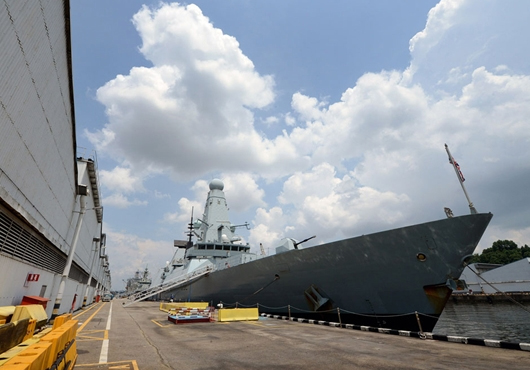
HMS Daring Arrives in Singapore

HMS Daring  Arrives in Singapore

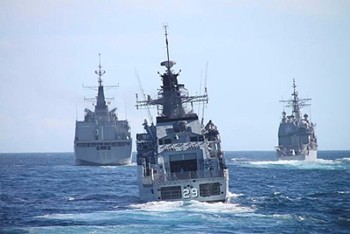
Working alongside the navies of Singapore, Malaysia, Australia and New Zealand, Daring will shortly take part in Exercise Bersama Lima under the Five Power Defence Arrangement (FPDA).

The FPDA was established in 1971 and provides for defence co-operation between the five signatories.

But before the exercise gets underway Daring, and her Company, will have the opportunity to take part in a series of engagements underlining the UK’s commitment to the region.

Daring will host a Defence and Security Industry Day for leading UK defence companies as well as participate in community outreach projects.

Commander Angus Essenhigh, Commanding Officer of HMS Daring, said:

“The presence of a Royal Navy ship is indicative of our support to our regional partners and also shows the interest the Royal Navy has in maintaining our presence in the region.”

HMS Daring, and her 190 crew, left the UK in May and have already clocked up more than 18,000 miles carrying out engagements and exercises in Puerto Rico, Panama, San Diego, Hawaii and Australia before arriving in Singapore.

In Australia the 8,500 tonne Type 45 destroyer welcomed more than 12,000 visitors onboard at the spectacular 100th birthday celebrations of the Royal Australian Navy.

Continuing her deployment Cdr Essenhigh said it was a privilege to now be taking part in Exercise Bersama Lima alongside regional partners.

“It has been two years since the Royal Navy was last in Singapore, so it’s fantastic to be back and participating in such a high-profile exercise,” he said.

Press Release, November 01, 2013; Image: Royal Navy

Fuelling The Fleet – HMAS Success

Fuelling The Fleet

This article has photo galleryPublished on 01 November 2013 LEUT Joseph McKay (author)

HMAS Success conducts a Replenishment at Sea (RAS) with HMAS Darwin in the East Australian Exercise Area. It was Success' first RAS since returning to sea following her extended refit period. (photo: Unknown)
HMAS Success conducts a Replenishment at Sea (RAS) with HMAS Darwin in the East Australian Exercise Area. It was Success’ first RAS since returning to sea following her extended refit period.

HMAS Success has successfully completed her first Replenishment at Sea (RAS) as part of Sea Qualification Trials, just days after returning to sea.

In flat seas and heavy rain Success held a steady course in preparation for HMAS Darwin (CMDR Terrence Morrison) to approach and hook up for the RAS (L). As Darwin appeared through damp EAXA weather,Success was well prepared to provide Darwin with a quick drink and prove her RAS rigs. 

Commanding Officer of HMAS Success, Captain Allison Norris said the first replenishment evolution achieved the aim as a fundamental step in re-establishing Success’ core capability.

“It’s exciting for us to be back at sea progressing so rapidly towards full operational capability. The energy around the ship is palpable, and there’s no doubt in my mind that we’re ready for the challenges of Unit Readiness (UR) workups and our 2014 program,” said Captain Norris.

It’s not only command that’s energized by the return to sea.

“It’s great to be back at sea.  We all put in a lot of effort to ensure we were ready to sail and now that we are out here we’re really keen to get the job done,” said ABML-SC Anthony Say.

Success will proceed to Unit Readiness Workups in the second week of November in preparation for a busy operational program in 2014.

The Royal Australian Navy battle tanker sailed from Fleet Base East last Friday after an extended refit and achieved Mariner Skills Evaluation (MSE) on 26 October in the East Australian Exercise Area (EAXA).

Spanish Warship Completes ‘Down Under’ Fleet Attachment

MarineLink.com

Thursday, October 31, 2013
 
File ESPS Cantabria (left): Photo credit RAN
ESPS Cantabria (left): Photo credit RAN

After 9 months operating as part of the Royal Australian Navy Fleet, Spanish Armada Ship, ‘ESPS Cantabria’ was farewelled from her temporary homeport of Garden Island, Sydney. The ship will be visiting ports in Indonesia, India and Turkey before arriving home for Christmas.

Chief of Navy, Vice Admiral Ray Griggs, AO, CSC, RAN joined the Spanish Ambassador to Australia, HE Mr Enrique Viguera, Commander Australian Fleet, Rear Admiral Tim Barrett AM, CSC, RAN and Consul-General of Spain, Alvaro Iranzo Gutierrez on the wharf to acknowledge the bonds developed between the nations.
 
“Today marks the conclusion of a very successful deployment. Cantabria integrated very effectively into the Royal Australian Navy Fleet and completed everything asked of her with great flexibility and efficiency,” said Vice Admiral Griggs.

“The ship provided the RAN with underway replenishment capability conducting over 58 replenishments, and a chance for over 234 Navy personnel to familiarise themselves with some of the systems we are about to acquire in our new Canberra Class Landing Helicopter Dock ships and the Hobart Class Air Warfare Destroyers.”

“The ground breaking initiative is testament to spirit of cooperation and collaboration that exists between the Spanish Armada and the Royal Australian Navy and is a good example of ‘Smart Defence’,” added Admiral Griggs.

Pictured: USS Chosin (right) conducting a breakaway after conducting a Replenishment at Sea Approach (RASAP) with ESPS Cantabria(Left); KD Jebat (center) is in the lifeguard station.

HNLMS Amsterdam Intercepts 1,450 Kilogrammes of Cocaine


HNLMS Amsterdam Intercepts 1,450 Kilogrammes of Cocaine

“A milestone”. This is how Brigadier General Dick Swijgman, Flag Officer Caribbean, described the seizure of 1,450 kilogrammes of cocaine by the CARIB guard ship HNLMS Amsterdam, earlier this week. The drugs represent a market value of over € 40 million.

“This last drug haul brings the total of drugs that we have managed, in close cooperation with our international partners and the Caribbean coastguard, to take out of circulation to over 10,000 kilos, says Swijgman. “It is a formidable result, and one that we can be justly proud of, as navy and as coastguard.”

NH90
One of the key factors in enabling the interception and the arresting of the crew were the coastguard’s DASH 8 patrol aircraft and the navy’s NH-90 helicopter. This was the NH90’s first deployment in the Caribbean since its entry into service.
Press Release, October 31, 2013; Image: Defensie


HMS Illustrious Fends Off Air Attacks for Middle Eastern Exercise

Naval Today >> The industry’s seaborne news provider by Naval Today  /  10h  //  keep unread  //  trash  // preview

HMS Illustrious Fends Off Air Attacks for Middle Eastern Exercise

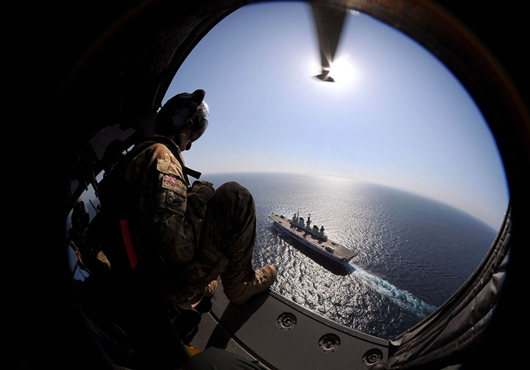
HMS Illustrious has had to fend off a succession of attacks from Omani jets off the coast of Oman during the opening stages of the last major exercise by the UK’s amphibious task group east of Suez.

The veteran warship was expected not just to thwart the attackers, but put Royal Marines ashore on the sands of Oman during the eight-day exercise, Omani Cougar.

The Royal Omani Air Force provided some of the ‘opposition’, sending its Jaguar and Hawks to attack Illustrious – one of the ‘high value assets’ during the exercise which had to be protected at all costs.

As one of the largest vessels in the Fleet – 22,000 tonnes, nearly 650ft long – the helicopter carrier presented a substantial target to the attacking bombers.

Omani warships provided the outer layer of defence for the duration of the exercise – and proved to be extremely effective.

But to ensure the carrier’s weapons systems, gunners, stokers and bridge team were also tested, some of the bombers got through.

All four Olympus gas turbines were cranked up to full power – pushing the carrier through the Arabian Sea at over 28 knots.

In addition to evasive manoeuvres, the ship has automated and manual guns to knock aircraft and missiles out of the sky.

Illustrious’ most effective defensive shield are Goalkeepers, seven-barrelled Gatling Guns which can track up to 15 targets at the same time, deciding which ones are the most dangerous before engaging them at ranges up to 1,500 metres (just short of a mile).

“Over the course of Omani Cougar, we had air defence exercises almost every day,” said Lieutenant Commander Steve Munday, whose weapon engineering department is responsible for the ship’s weapon systems and sensors.

“The Jaguars were good as they fly in much faster than the Hawks we usually exercise with during training in the UK.”

As for the wider benefits of Omani Cougar, Illustrious’ Commanding Officer Capt Mike Utley said he’d been “tremendously impressed” by the eight-day workout.

“Our hosts planned a very-well-thought-out exercise to meet specific objectives, which they executed in a very professional manner indeed,” he added.

“It has been a genuine pleasure to meet so many of our Omani colleagues and strengthen our bonds with one of our closest allies.”

Royal Omani Navy ships Al Muazzar, Al Munassir, Al Najah, Al Sharqayah and Al Mussandam as well as a contingent from the Royal Omani Coastal Regiment joined Royal Navy vessels for the exercise, led by flagship HMS Bulwark, and supported by amphibious vessel RFA Mounts Bay.

Omani Cougar concluded with a large maritime and amphibious demonstration to high profile military figures from both countries including: General Sir Richard Barrons (Commander Joint Force Command) and Lieutenant General Simon Mayall (Defence Senior Advisor Middle East), as well as Jamie Bowden, Britain’s Ambassador to Oman.
Press Release, October 31, 2013; Image: Royal Navy

JCs Royal New Zealand Navy Ships and New Zealand Defence, Also other World Defence Updates

Ships and Defence News Past and Present

Skip to content ↓