
|
1 Naval Today >> The industry’s seaborne news provider by Naval Today / 4h // keep unread // trash // preview
General Dynamics Bath Iron Works successfully launched the Navy’s first Zumwalt-class destroyer Oct. 28 at their Bath, Maine shipyard.The future USS Zumwalt (DDG 1000) will be the lead ship of the Navy’s newest destroyer class, designed for littoral operations and land attack. The ship began its translation from Bath Iron Works’ land-level construction facility to a floating dry dock on Friday. Once loaded into the dry dock, the dock was flooded and the ship was removed from its specially designed cradle. By late Monday, the dock had been flooded and the ship was floated off and tied to a pier on the Kennebec River.
Construction began on DDG 1000 in February 2009, and the Navy and its industry partners have worked to mature the ship’s design and ready their industrial facilities to build this advanced surface combatant. Zumwalt is currently more than 87 percent complete, and the shipbuilder will continue remaining construction work on the hull prior to planned delivery late next year. Because of the complexity of the first-of-class ship, the Navy will perform a two-phase delivery process. Bath Iron Works will deliver the ship itself to the Navy in late 2014. Upon delivery, the Navy will then conduct combat systems activation, tests and trials, to include multiple underway periods. The ship is expected to reach its initial operating capability in 2016. The ship, the first of three Zumwalt-class destroyers, will provide independent forward presence and deterrence, support special operations forces and operate as part of joint and combined expeditionary forces. The Navy has incorporated many new technologies into the ship’s unique tumblehome hull, including an all-electric integrated power system and an Advanced Gun System, designed to fire rocket-powered, precision projectiles 63-nautical miles. The shape of the superstructure and the arrangement of its antennas significantly reduce the ship’s radar cross section, making the ship less visible to enemy radar at sea. The design also allows for optimal manning with a standard crew size of 130 and an aviation detachment of 28 Sailors thereby decreasing lifecycle operations and support costs. The lead ship and class are named in honor of former Chief of Naval Operations Adm. Elmo R. “Bud” Zumwalt Jr., who served as chief of naval operations from 1970-1974. As one of the Defense Department’s largest acquisition organizations, PEO Ships, an affiliated PEO of the Naval Sea Systems Command, is responsible for executing the development and procurement of all major surface combatants, amphibious ships, special mission and support ships and special warfare craft. |


FORMER COAST GUARD CUTTER LEAVES UNDER BANGLADESHI COLORS
MarineLink.com
Wednesday, October 30, 2013, 4:54 AM

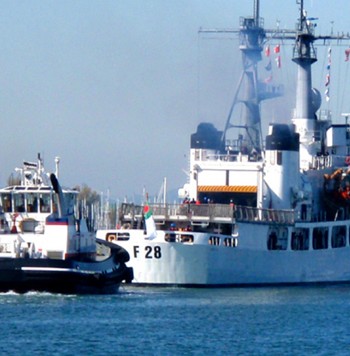
Former Cutter Jarvis departs: Photo courtesy of USCG
‘BNS Somudra Joy’ (formerly the Coast Guard Cutter ‘Jarvis’), sailed recently from Alameda, marking a major milestone in international cooperation between the United States and Bangladesh.
Joined by a small Coast Guard team of advisors, headed by Cmdr. Wendy Tomko, the Bangladeshi crew will make port calls at San Diego, Honolulu, Guam and Malaysia on their way to Bangladesh.
This concludes a two-year-long process of identifying the cutter for decommissioning, advising foreign allies of its availability, allocating it to a country with the capability of supporting it, and whose national defense objectives align with United States’ regional goals.
Additionally, the necessary Letters of Offer and Acceptance, decommissioning and transfer ceremonies, training a new crew, and establishing the initial support of what is probably the most complex combatant vessel the receiving country has seen, have all been accomplished.
This marks the fourth transfer as the Coast Guard brings its newest asset, the 418-foot national security cutter, into service.
Share this:

Poland: SNMCMG1 Marks 40th Anniversary
|
Naval Today >> The industry’s seaborne news provider by Naval Today / 2h // keep unread // trash // preview
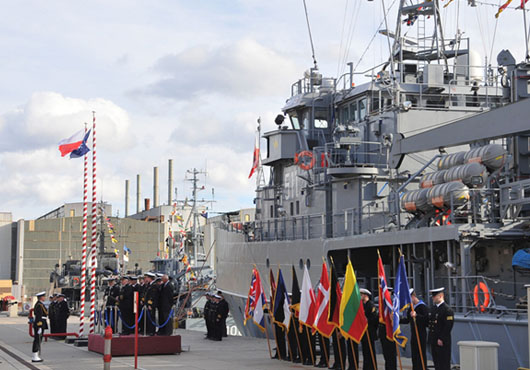
On Tuesday, 29 October 2013, SNMCMG1 marked 40 years of service afloat with a ceremony in port, during the harbour phase of Exercise STEADFAST JAZZ 2013.More than 260 crewmembers from six SNMCMG1 ships participated in this event along with former commanders of the Group and official guests from all over Europe. The ceremony marks 40 years of continuous mine counter-measures capability for the NATO Response Force (NRF) and non-NRF operations, as well as other activities provided by the Group during periods of peace and periods of crisis. The Standing NATO Mine Countermeasures Group 1 is currently comprised of the flagship ORP ‘Kontradmiral Xawery Czernicki’ (Poland) and five minehunters: BNS Narcis (Belgium), ENS Admiral Cowan (Estonia); FGS Dillingen (Germany), HNLMS Makkum (The Netherlands) and HNOMS Rauma (Norway). Maritime Command Deputy Chief of Staff for Plans, Commodore Dan MacKeigan, Royal Canadian Navy, participated in the ceremony alongside the Commander of the Maritime Operations Center of the Polish Navy, Vice Admiral Stanislaw Zarychta.
SNMCMG1 was formed in the Belgian port of Ostend on 11 May 1973, and was originally called ‘Standing Naval Force Channel.’ The Group was under the command of NATO’s English Channel Force Commander. The motivation behind this group’s creation was primarily to ensure safety of navigation around the ports of the English Channel and northwest Europe. In the event of a major conflict, the Group was to change area of operation for the North Sea around the coast of West Germany. In 2000, its area of operation was significantly expanded, and the name changed to ‘Mine Countermeasures Force Northern Europe.’ The emergence of new threats and security challenges led NATO to adapt to its new strategic environment and to expand the spectrum of its tasks. Following the 2002 NATO Prague summit, the group was renamed ‘NATO Response Force MCM Force Northern Europe’ to reflect this new responsibility.
In 2006, the group was given its current name. Like its Mediterranean counterpart, SNMCMG2, the command of the group is handed over annually to a senior officer appointed by one of the participating nations on a rotational basis. SNMCMG1’s mission is to provide continuous and far-reaching maritime mine countermeasures capability for operations in peacetime and periods of conflict. The group is therefore engaged in search and disposal operations within NATO but also with NATO partners. Among other missions, the Group conducts Historical Ordnance Disposal operations to minimize the threat from old WWII mines for all those who use the sea for their benefit – fishermen, cargo ships, ferries and the like. |


Share this:

FIRST US BIG SHIP LNG BUNKERING TERMINAL PROPOSED
MarineLink.com
Wednesday, October 30, 2013, 12:44 AM

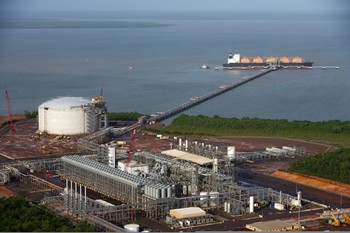
LNG liquefaction plant: Photo credit CLNG
A partnership including Calgary-based Ferus Natural Gas Fuels has unveilled plans to build in Florida the first U.S. terminal to supply liquefied natural gas as fuel for cargo ships, reports ‘The Calgary Herald’.
The Eagle LNG partnership was announced in September 2013, and includes Ferus, General Electric Co. and Clean Energy Fuels Corp., the transportation-fuel company co-founded by billionare investor T. Boone Pickens; all three are equal equity partners in the project.
Citing Ferus chief executive Dick Brown, ‘The Calgary Herald’, says that Eagle LNG Partners recently settled on a site for the plant in Jacksonville, Fla. It is to be the first of five in the United States to provide super-cooled natural gas to the transportation industry.
The newspaper adds that Harvey Gulf International Marine LLC is building an LNG fueling terminal in Port Fourchon, La., for ships supporting offshore drilling in the Gulf of Mexico.
Source: ‘The Calgary Herald’
Share this:

Two NATO Ships Assigned to SNMG2 Visit Port of Tunis
|
Naval Today >> The industry’s seaborne news provider by Naval Today / 46min // keep unread // trash // preview
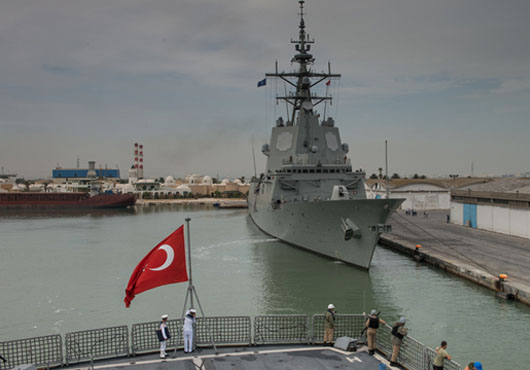
This past weekend, two NATO ships assigned to Standing NATO Maritime Group TWO (SNMG2) paid a visit to the port of Tunis.The port visit provided the crew of the SNMG2 ships a welcome break from the high tempo supporting NATO’s counter-terrorism Operation ACTIVE ENDEAVOUR (OAE), actively deterring threats to maritime security and trade. Under the command of Rear Admiral Eugenio Díaz del Río, Spanish Navy, the Group included the Spanish flagship ESPS ALVARO DE BAZAN and TCG SALIRHEIS of the Turkish Navy, and the ships’ crews enjoyed several opportunities to interact with their Tunisian counterparts. While in port, SNMG2 hosted a visit to the flagship by Tunisian Naval Academy students and conducted courtesy calls to the Coast Guard headquarters and the mayor. The Spanish ambassador to Tunisia visited the flagship, and the Turkish ambassador also visited SALIRHEIS while the ships were in port. The visit concluded with a passing exercise (PASSEX) between the NATO ships and their Tunisian counterparts as the ships departed the port.
Press Release,October 30, 2013; Image: NATO |


