General Dynamics to Christen U.S. Navy Submarine

General Dynamics to Christen U.S. Navy Submarine

MarineLink.com
Tuesday, October 29, 2013
 
File North Dakota (SSN-784) Photo: General Dynamics Electric Boat
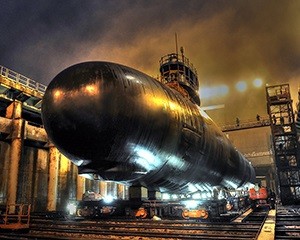
North Dakota (SSN-784) Photo: General Dynamics Electric Boat

General Dynamics Electric Boat, a wholly owned subsidiary of General Dynamics, will christen North Dakota (SSN-784), the U.S. Navy’s newest and most advanced nuclear-attack submarine, at its shipyard here on Saturday, Nov. 2, at 11 a.m.

Katie Fowler, wife of retired Vice Adm. Jeff Fowler, is the ship’s sponsor. The event’s principal speaker is Vice Adm. Michael J. Connor, commander – Submarine Forces.

The submarine North Dakota is the 11th ship of the Virginia class, the first U.S. Navy combatants designed for the post-Cold War era. Unobtrusive, non-provocative and connected with land, air, sea and space-based assets, North Dakota and the other Virginia-class submarines are equipped to wage multi-dimensional warfare around the globe, providing the Navy with continued dominance in coastal waters or the open ocean.

Electric Boat and its construction partner, Newport News Shipbuilding, have delivered 10 Virginia-class submarines to the Navy, and have contracts for eight additional ships.

gdeb.com

PCU Zumwalt (DDG 1000) – Water Under The Keel

PCU Zumwalt (DDG 1000) – Water Under The Keel

By Rear Adm. Thomas Rowden
Director, Surface Warfare, OPNAV N96

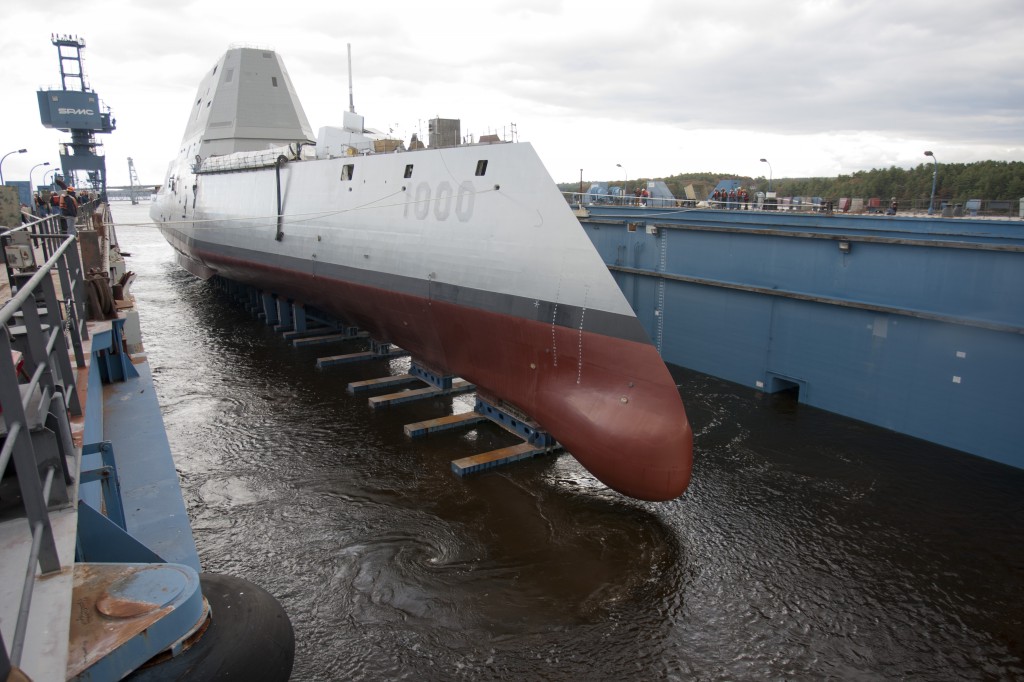
It is an exciting time for Surface Warfare as Pre-Commissioning Unit (PCU) Zumwalt (DDG 1000) transitioned yesterday from the land level construction facility to the Kennebec River in Bath, Maine.

The Zumwalt-class guided-missile destroyer DDG 1000 is floated out of dry dock at the General Dynamics Bath Iron Works shipyard.

The Zumwalt-class guided-missile destroyer DDG 1000 is floated out of dry dock at the General Dynamics Bath Iron Works shipyard.


Water under the keel marks an important milestone for this 600 ft, 15,000 ton, 78 mega-watt ship and it brings PCU Zumwalt and her sister ships, Michael Monsoor (DDG 1001) & Lyndon B. Johnson (DDG 1002), one step closer to operating with the fleet.

The Zumwalt-class guided-missile destroyer DDG 1000 is floated out of dry dock at the General Dynamics Bath Iron Works shipyard.

The Zumwalt-class guided-missile destroyer DDG 1000 is floated out of dry dock at the General Dynamics Bath Iron Works shipyard.


Commencing activation in 2014 and joining the fleet in 2016, PCU Zumwalt is a multi-mission warship designed, built and netted to execute Maritime Security, Sea Control and Power Projection missions, including Undersea and Strike Warfare. These multi-mission combatants will operate forward, providing significant full spectrum capability in both the open ocean and littoral with the ability to influence events ashore. Well over a decade of thought and planning has gone into the ship’s design, producing sophisticated new technologies like Integrated Electric Power, SPY-3 Radar, the Advanced Gun System, SQQ-90 Integrated Undersea Warfare Suite and the new MK 57 Vertical Launching System. The ship not only delivers an impressive warfighting capability package today, but provides the reserve margin to act as a springboard for insertion of advanced capability payloads in the future.

The Zumwalt-class guided-missile destroyer DDG 1000 is floated out of dry dock at the General Dynamics Bath Iron Works shipyard.

The Zumwalt-class guided-missile destroyer DDG 1000 is floated out of dry dock at the General Dynamics Bath Iron Works shipyard.


We’re excited as we begin to work with these new technologies and deliver this warfighting capability to the fleet.

Bigger And Better: MQ-8C Takes To The Skies

Bigger And Better: MQ-8C Takes To The Skies

By Capt. Patrick Smith
Fire Scout Program Manager

The Fire Scout system has proven itself in numerous and diverse operational deployments, supporting troops on the ground in Afghanistan, completing weapons Rapid Deployment Capability (RDC) testing with the Advanced Precision Kill Weapon System (APKWS), continuing deployments on Guided Missile Frigates (FFG) class ships, and now preparing to welcome a new air vehicle to its ranks. This week the newest Fire Scout variant, MQ-8C Fire Scout, will take to the skies for the first time.

MQ-8C

The MQ-8C Fire Scout.


Our MQ-8C is an RDC effort in response to an urgent request to provide maritime based Intelligence, Surveillance and Reconnaissance (ISR) at extended ranges from host ships in less than 24 months. First flight is set to occur this month, 18 months after the contract award to prime integrator, Northrop- Grumman.

Leveraging off the existing MQ-8 Fire Scout infrastructure, the C variant provides the Navy with double the endurance and triple the payload capability of its predecessor, allowing for 15+ hours of flight time and over 2,600 lbs. of payload. This increase in capability will allow us the opportunity to put additional weight, perhaps sensors, on the aircraft.

With the MQ-8C, we took a commercial Bell 407 helicopter and modified it to include additional fuel capability, upgraded engines and improved reliability to provide increased range and endurance and then integrated the majority of the MQ-8B avionics and payloads onto that air frame. This method allows us to maintain the entire infrastructure we have already invested in.

With its first flight, the aircraft will enter a rigorous test schedule before being deployed at sea. Our goal is to be ready for deployment by the fourth quarter of fiscal year 2014. The MQ-8C will complete ground testing at Naval Air Station Pt. Mugu and also be integrated into the Guided Missile Destroyer (DDG) for maritime assessment.

When the commanders issued a request for the rapid deployment of 28 MQ-8C Fire Scout aircraft, I saw an opportunity for the team to shine. They have met my expectations and I am excited to see how we will continue to perform in the future.

MQ-8C will allow us to better support maritime ISR operations, reduce impacts to shipboard manning and provide increased capability with less aircraft. We’ve had our challenges, as any other research, test and development program has, but I am very proud of the team for how far we’ve come and how we’ve reached this day.
Blackbeard’s Cannons Salved

Blackbeard’s Cannons Salved

MarineLink.com
Tuesday, October 29, 2013
 
File Blackbeard
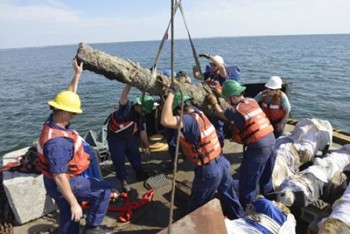
Blackbeard’s cannons lifted: Photo courtesy of USCG

The crew of the Coast Guard Cutter ‘Smilax’ worked with personnel from the North Carolina Department of Cultural Resources to recover 5 cannons and multiple barrel hoops from the ‘Queen Anne’s Revenge’ in Beaufort Inlet, N.C.

The Queen Anne’s Revenge was the ship of the pirate Edward Teach, better known as Blackbeard, for more than a year before the ship ran aground on the shoals in the inlet.

The crew of the Smilax, a 100-foot inland construction tender, worked with NCDCR divers to lift the approximately one-ton cannons aboard the Smilax using a combination of flotation bags and the ship’s crane.

According to Wikipedia, Teach captured a French merchant vessel, renamed her Queen Anne’s Revenge and equipped her with 40 guns. He became a renowned pirate, his cognomen derived from his thick black beard and fearsome appearance; he was reported to have tied lit fuses under his hat to frighten his enemies. He formed an alliance of pirates and blockaded the port of Charleston, SC. After successfully ransoming its inhabitants, he ran Queen Anne’s Revengeaground on a sandbar near Beaufort, North Carolina.

A video of the recovery is available at: http://www.piersystem.com/go/doc/4007/1945458/

First-in-Class Zumwalt Destroyer Launched

First-in-Class Zumwalt Destroyer Launched

MarineLink.com
Wednesday, October 30, 2013, 12:22 AM
 
File Zumwalt DDG 1000: Photo courtesy of USN
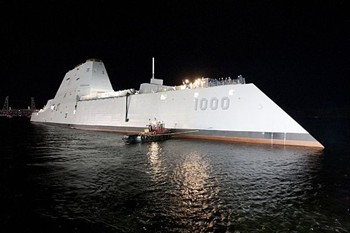
Zumwalt DDG 1000: Photo courtesy of USN

General Dynamics Bath Iron Works has launched the Navy’s first Zumwalt-class destroyer at their Bath, Maine shipyard. The future ‘USS Zumwalt’ (DDG 1000) will be the lead ship of the Navy’s newest destroyer class, designed for littoral operations and land attack.

The ship began its translation from Bath Iron Works’ land-level construction facility to a floating dry dock, which was flooded and the ship was removed from its specially designed cradle. Then it was floated out and moored alongside a Kennebec River pier.

“This is the largest ship Bath Iron Works has ever constructed and the Navy’s largest destroyer. The launch was unprecedented in both its size and complexity,” said Capt. Jim Downey, the Zumwalt-class program manager for the Navy’s Program Executive Office, Ships. “Due to meticulous planning and execution, the operation went very smoothly. I’m extremely pleased with the results and applaud the combined efforts of the Navy-industry team.”


Construction began on DDG 1000 in February 2009, and the Navy and its industry partners have worked to mature the ship’s design and ready their industrial facilities to build this advanced surface combatant. Zumwalt is currently more than 87 percent complete, and the shipbuilder will continue remaining construction work on the hull prior to planned delivery late next year.

Because of the complexity of the first-of-class ship, the Navy will perform a two-phase delivery process. Bath Iron Works will deliver the ship itself to the Navy in late 2014. Upon delivery, the Navy will then conduct combat systems activation, tests and trials, to include multiple underway periods. The ship is expected to reach its initial operating capability in 2016. 


JCs Royal New Zealand Navy Ships and New Zealand Defence, Also other World Defence Updates

Ships and Defence News Past and Present

Skip to content ↓