Today in U.S. Naval History: October 24

Today in U.S. Naval History: October 24

MarineLink.com
Thursday, October 24, 2013, 11:55 AM
 
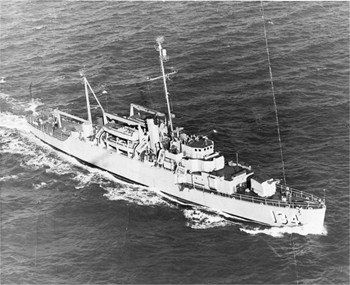
File USS Kleinsmith (APD-134). U.S. Navy photo
USS Kleinsmith (APD-134). U.S. Navy photo

Today in U.S. Naval History – October 24

1944 – In air-sea battle in the Sibuyan Sea, carrier aircraft attack Japanese Center Force.

1958 – USS Kleinsmith (APD-134) evacuates U.S. nationals from Nicaro, Cuba.

1962 – Atlantic Fleet begins quarantine operations to force Soviet Union to agree to remove ballistic missiles and long range bombers from Cuba.

For more information about naval history, visit the Naval History and Heritage Command website at history.navy.mil.

USS FORRESTAL, NAVY’S FIRST ‘SUPERCARRIER,’ SOLD FOR ONE CENT

USS Forrestal, Navy’s first ‘supercarrier,’ sold for one cent

Oct. 23, 2013  |  10:08 PM   |   7 comments


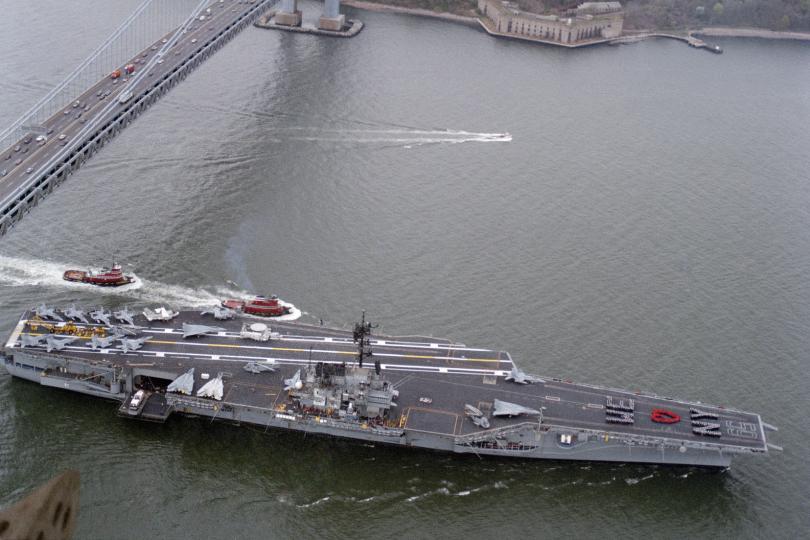
The aircraft carrier USS FORRESTAL (CV 59), escorted by a pair of tug boats, passes under the Verrazano Narrows Bridge as it approaches New York City for Fleet Week on April 29, 1989. (U.S. Navy)
WASHINGTON, Oct. 23 (UPI) – The aircraft carrier USS Forrestal, out of service for 20 years, is being sold to a Brownsville, Texas, scrap company for a penny, the Navy says.All Star Metals bid $0.01 for the job, the Navy said in a news release Tuesday. The company’s offer was based on its estimate of how much it can net from the sale of metal from the Forrestal.

The Forrestal, the first of the Navy’s “supercarriers,” was launched in December 1954 in Newport News, Va., and commissioned on Sept. 29, 1955. It was named after James V. Forrestal, the last Navy secretary to sit in the cabinet and the first secretary of defense, who committed suicide in 1949.

The carrier was decommissioned in 1993. The Navy offered to donate it as a museum or memorial but no suitable organizations offered to take the vessel.

The Forrestal is currently docked in Philadelphia.

Read more: http://www.upi.com/Top_News/US/2013/10/23/USS-Forrestal-Navys-first-supercarrier-sold-for-one-cent/UPI-16381382560484/#ixzz2ieARIGFo

Navy’s ammo ship Flint on last cruise enroute to scrap yard

Navy’s ammo ship Flint on last cruise enroute to scrap yard


Oct. 23, 2013 8:59 PM   |  
0 Comments
 
 
Big 'Ol Boat moored at Pensacola Naval Air Station
Big ‘Ol Boat moored at Pensacola Naval Air Station: The USS Flint, a Naval ammo ship, is moored at Pensacola Naval Air Station this week en route to Charleston, SC.
 
 
The USNS Flint (T-AE 32) is moored at the Pensacola Naval Air Station pier until Friday Oct. 25, 2013. The Military Sealift Command ship will depart Pensacola Friday afternoon bound for Charleston S.C. where it will be sent to the the scrap yard. The ammo supply ship was placed into service since in 1970.
The USNS Flint is moored at the Pensacola Naval Air Station pier until Friday. The ammo supply ship was placed into service in 1970.
Capt. John Olmsted will sail the USNS Flint from Pensacola Naval Air Station to Charleston, S.C., on Friday. / Tony Giberson/tgiberson@pnj.com

The Flint at a Glance

» Her title: Since her 1995 Navy decommissioning and reassignment to the civilian Military Sealift Command, she’s officially the USNS (United States Navy Ship) Flint, rather than USS. 
» Length: 564 feet. 
» Displacement: 19,940 tons. 
» Speed: 20 knots. 
Source: Military Sealift Command


The Flint’s captain can’t estimate how many layers of wax have been applied to her linoleum floors, or the number of coats of gray paint that cover the imposing vessel. But those careful attentions are coming to an end.

At 564 feet in length, the 43-year-old Flint, an ammunition hauler, is the largest ship to be moored at Pensacola Naval Air Station since the aircraft carrier Oriskany in 2006. The Flint has been docked there since Oct. 9 and is destined to leave Friday on her last cruise to a scrap yard in Charleston, S.C.

“She has served her country with honor,” said Jonathan Olmsted, a captain in the Military Sealift Command, a civilian transportation and supply arm of the Navy that has run the Flint since the military decommissioned her in 1995.

Indeed, the Flint’s proud history since being launched in 1970 includes combat support missions for American campaigns in Vietnam, Iraq and Afghanistan. With a capacity to tote 6,000 tons of bombs, bullets and missiles, the Flint, when fully loaded, can supply an aircraft carrier with ammunition for up to a week of 24-hour operations.

“She was a Wal-Mart of ammo,” said Ursula Rutledge, the Flint’s chief mate.

Carrying a crew numbering more than 300 at times, the Flint’s vast storage holds allowed sailors to stack missiles, rocket boosters and munitions in 10-foot-high arrangements. From there, the deadly cargo could be transferred to the Flint’s two CH-46 Sea Knight Helicopters that would carry them to fighting ships.

But now, the helicopter pads are empty and the Flint has a skeleton crew of just 43.

Named after the city of Flint, Mich., the ship is the last of the Navy’s Kilauea class of ammunition ships. They’re being replaced by a new generation of larger ammo carrier that also can haul food and a variety of other supplies — not unlike a Wal-Mart being supplanted by a Wal-Mart Supercenter.

The best public view of the Flint as she cruises out of Pensacola Bay on Friday should be from Fort Pickens between 2 and 3 p.m., according to Olmsted’s schedule.

Olmsted, who previously served on the Flint for nearly four years as a cargo officer before recently being assigned to her as captain, said, “It really means a lot to me to take her on her final trip and put her to bed.”

Follow Rob Johnson at twitter.com/RobJohnsonPNJ or atwww.facebook.com/RobJohnsonPNJ.


PLA electronic reconnaissance ship in Hawaiian waters

PLA electronic reconnaissance ship in Hawaiian waters


  • Staff Reporter
  •  

  • 2013-10-24
  •  

  • 11:47 (GMT+8)
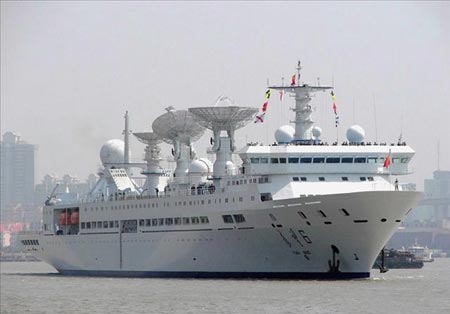
A Chinese electronic reconnaissance ship. (Internet photo)

A Chinese electronic reconnaissance ship. (Internet photo)

By sending a People’s Liberation Army electronic reconnaissance ship into Hawaiian waters, China is ready to project its influence to what it perceives as a “third island chain” which extends from the Aleutian Islands to Australia, what the Chinese have interpreted to be the “strategic rear” of the US military in the Asia-Pacific region, reports the Global Times, a tabloid published under the auspices of the Communist Party mouthpiece People’s Daily.

As professor James R Holmes wrote in his article written for the Diplomat, an online current affairs magazine based in Tokyo, the concept of a third island chain does not exist from the perspective of Asia specialists in the United States. However, the location of this island chain, positioned as it is only 2,400 miles from the coast of San Francisco symbolizes, from a Chinese point of view at least, the possibility of expanding Chinese maritime influence to the Eastern Pacific, according to Holmes.

Like the strategic location of Taiwan and Japan within the so-called first island chain, centered on Taiwan, and the second, stretching from Japan to Indonesia, China views Hawaii as the center of the third island chain. As the headquarters of the US Pacific Command, Hawaii from a Chinese perspective also serves as the “strategic rear” for Washington to reinforce its allies in the Western Pacific if a conflict with China were to take place. The Global Times in typically bombastic style said that it is time for China to demonstrate its capabilities to the United States.

From the perspective of the Ta Kung Pao, a Hong-Kong based newspaper funded by the Chinese Communist Party, the deployment of the US carrier, USS George Washington to the Yellow Sea for joint naval exercises with the Republic of Korea Navy and the Japan Maritime Self-Defense Force is an act of provocation. For this reason, the electronic reconnaissance ship had been deployed to Hawaiian waters and the Mobile 5 naval exercise was launched in an undisclosed location in the Western Pacific with the participation of China’s three major fleets.

The displacement of Chinese electronic reconnaissance ships is between 500 and 4,000 tonnes and they are equipped with a radio receiver, a radar receiver, a signal analyzer and even electronic jamming equipment. The appearance of the electronic reconnaissance ship in Hawaiian waters was posited as proof that China is able to conduct intelligence operations within the territorial waters of the United States, according to the paper, purportedly showing that the largest naval base in the Pacific is no longer safe from a potential Chinese naval attack.
SPANISH RESEARCH VESSEL PROMPTS BRITISH COMPLAINT

SPANISH RESEARCH VESSEL PROMPTS BRITISH COMPLAINT

by Brian Reyes

 A Spanish research vessel was ordered out of British waters yesterday after it was spotted gathering water samples on the east side of the Rock.


The Emma Bardan, a 200-tonne oceanographic and fisheries research vessel operated by Spain’s Ministry for Agriculture, Food and the Environment, stopped its activities when confronted by the Royal Navy’s Gibraltar Squadron.

The Spanish had been sailing in between vessels anchored in British waters off the east side.

Shadowed by the Royal Navy, it then sailed round the Rock

only to stop in the middle of the bay in a standoff with the Royal Navy.

At one point, Guardia Civil vessels were also spotted at the scene, as were boats from the Royal Gibraltar Police and the Gibraltar Defence Police.

A spokesman for the Convent said officials at the Foreign & Commonwealth Office in London and the British embassy in Madrid had been informed immediately of the incident.

“A formal complaint will be lodged,” he said.

The Emma Bardan was last spotted in British Gibraltar territorial waters in December last year, when it was also ordered out after it was seen carrying out survey work.

That incident, which coincided with the Spanish Government approving a law that purported to control environmental matters in British waters, also led to a formal complaint.

The vessel’s presence in Gibraltar yesterday coincided with widespread media interest in Spain over a shipment of rocks bound for Gibraltar from Portugal by sea.

JCs Royal New Zealand Navy Ships and New Zealand Defence, Also other World Defence Updates

Ships and Defence News Past and Present

Skip to content ↓