Indonesian illegal fishing boats destroyed

Indonesian illegal fishing boats destroyed

Updated 11 hours 36 minutes ago

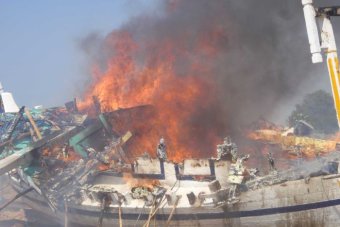
Three illegal Indonesian fishing boats intercepted by the Royal Australian Navy and Customs off the Northern Territory coast this month have been destroyed in Darwin.

They were the second, third and fourth vessels to be destroyed since July.

John Marrington from the Australian Fisheries Management Authority says the boats were burnt.

“The vessels are being destroyed as a result of the risk they pose to the environment,” he said.

“They are not very seaworthy.”

Charges are expected to be laid next week against some of the 20 people detained when the boats were seized in waters north of Darwin.

The Australian Fisheries Management Authority had previously destroyed several Indonesian boats involved in blast fishing in northern Australian waters after they were seized in October last year.

Chemical Tankship Cargo PIB Decided Category ‘X’

Chemical Tankship Cargo PIB Decided Category ‘X’

MarineLink.com
Thursday, October 24, 2013, 12:42 AM
 
File Chemical tanker: Photo courtesy of Odfjell
Chemical tanker: Photo courtesy of Odfjell

IMO’s  Working Group on the Evaluation of Safety and Pollution Hazards of Chemicals (ESPH 19), meeting at IMO Headquarters from 21 to 25 October, 2013, has agreed to classify high-viscosity PIB (Polyisobutylene) as category X  for carriage by ship, thereby prohibiting the discharge of cargo residues into the sea.

The categorization and carriage requirements for high-viscosity PIB will be included in the annual MEPC.2/Circular on the Provisional categorization of liquid substances, usually issued by IMO on 17 December each year and will be proposed for inclusion in the next edition of the  International Code for the Construction and Equipment of Ships carrying Dangerous Chemicals in Bulk (IBC Code)  which lists chemicals and their hazards and gives both the ship type required to carry that product as well as the environmental hazard rating.

Amendments to the IBC Code are usually put forward on an annual basis so the next amendments could be considered during 2014, and if included in the next set of amendments to the IBC Code then the provisions for PIB could have an effective implementation date of 1 July 2016.

Category X under the International Convention for Prevention of Pollution from Ships Annex II Regulations for the control of pollution by noxious liquid substances in bulk includes noxious liquid substances which, if discharged into the sea from tank cleaning or deballasting operations, are deemed to present a major hazard to either marine resources or human health and, therefore, justify the prohibition of the discharge into the marine environment.

Nimitz ARG Starts Operations in Central Mediterranean

Nimitz ARG Starts Operations in Central Mediterranean

Nimitz ARG Starts Operations in Central Mediterranean


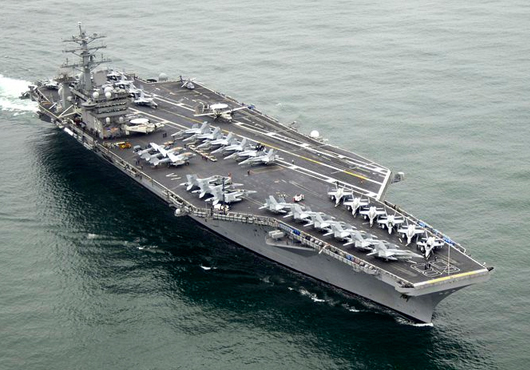
The Nimitz Strike Group commenced flight operations in the central Mediterranean Sea, Oct. 20.


The aircraft carrier USS Nimitz (CVN 68), along with embarked Carrier Strike Group (CSG) 11, Carrier Air Wing (CVW) 11, and Destroyer Squadron 23 is supporting maritime security operations and theater security cooperation efforts in the U.S. 6th Fleet area of operations.

“We look forward to strengthening the interoperability between our partner countries in the 6th Fleet region, and building on the common goal of maritime security through exercises and exchanges,” said Rear Adm. Michael S. White, commander, CSG 11.

Prior to arriving in the Mediterranean, Nimitz spent the majority of its time in the 5th Fleet with guided-missile destroyers USS Shoup (DDG 86), USS Stockdale (DDG 106) and USS William P. Lawrence (DDG 110) along with guided-missile cruisers USS Princeton (CG 59) and USS Monterey (CG 61).

“Our strike group and air wing have performed admirably during our time in 5th Fleet in the face of uncertainty,” said Capt. Jeff Ruth, commanding officer of Nimitz. “Everyone should be very proud of their ability to pull together as a team to get the job done.”

While in U.S. 5th Fleet area of operations, CVW 11 executed more than 1,200 sorties in support of Operation Enduring Freedom, tallying more than 6,500 flight hours.

“I’m very proud of the effort our Sailors and Marines have contributed during our time in the 5th Fleet AOR,” said White. “We have and will continue to remain focused on accomplishing our missions, and I think that shows in the work we’ve done.”

This will be the first time Nimitz will be operating in the 6th Fleet area of operation since 1998.

Press Release, October 24, 2013; Image: Wikimedia

UK: Joint Helicopter Operations on Cougar 13 Exercise

UK: Joint Helicopter Operations on Cougar 13 Exercise

Joint Helicopter Operations on Cougar 13 Exercise


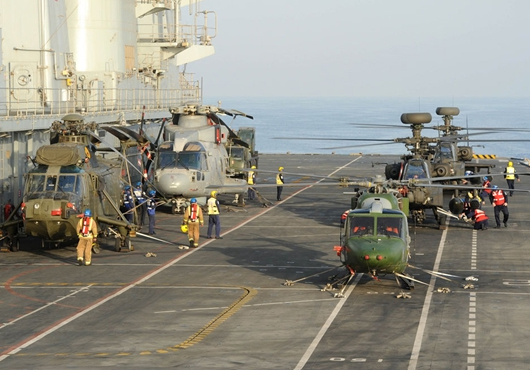
Army Apache helicopters have joined Navy Sea King, Merlin and Lynx helicopters on board HMS Illustrious for two weeks in the Gulf as part of the ongoing Cougar 13 deployment.


The Apache helicopters from 656 Squadron 4 Regiment Army Air Corps joined Illustrious in the waters off the United Arab Emirates as she took part in Exercise Sea Khanjar before then returning to the UK. This is the first time UK Apache helicopters have operated in the Gulf.

During the Libya conflict in 2011 Apaches flew from the deck of HMS Ocean making repeated strikes against Col Gaddafi’s forces.

Currently Britain’s helicopter gunship – in just 14 months’ time Apaches will be joined on the front line by Wildcat, which is entering service with the Fleet Air Arm at Yeovilton.

The Apaches, personnel and equipment of 656 Squadron arrived on Illustrious to augment the existing air group, demonstrating how well the Army Air Corps is starting to integrate with navy warships and squadrons – a role that will need to be developed further, especially as the new aircraft carriers come into operation.

Within two days of their arrival the Apaches were ready for their first operational sortie alongside the ship’s Sea King, Merlin and Lynx helicopters.

Officer Commanding 656 Squadron, Major Piers Lewis, said,

“The Royal Navy have been very patient with us learning their way of business. Together, we have proved the superb capability the Apache can deliver when working with the ship, its air surveillance helicopters and the Army and Navy Lynx aircraft.

“I can only imagine what could be achieved when Apache operates with the new Wildcat helicopter and HMS Queen Elizabeth.”

The Cougar 13 deployment departed the UK in August and operates in the Mediterranean, Red Sea, the Gulf, and Horn of Africa.

It involves exercising with partner nations, and demonstrating the UK Armed Forces’ capacity to project an effective maritime component anywhere in the world as part of the Royal Navy’s Response Force Task Group, commanded by Commodore Paddy McAlpine OBE ADC Royal Navy.

The RFTG is the United Kingdom’s high readiness maritime force, comprising Royal Navy ships, submarines, aircraft and a landing force of Royal Marines, at short notice to act in response to any contingency tasking if required.

Press Release, October 24, 2013; Image: Navy
USS Samuel B. Roberts Returns Home

USS Samuel B. Roberts Returns Home

USS Samuel B. Roberts Returns Home


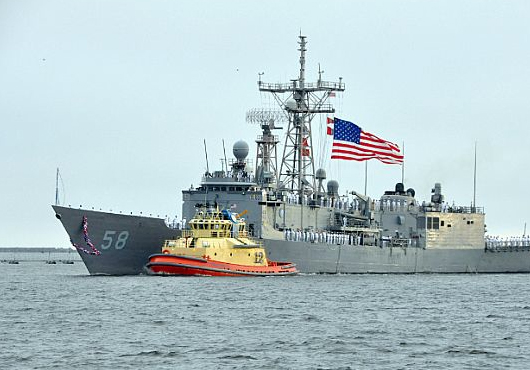
Guided-missile frigate USS Samuel B. Roberts (FFG 58) returned to Naval Station Mayport Oct. 23, marking the successful completion of a six-month deployment to the central Mediterranean working for U.S. Africa Command.


The ship, with Helicopter Maritime Strike Squadron 46 Detachment 9 embarked, deployed April 23 of this year and traveled to the U.S. 6th Fleet to support maritime security operations and theater security cooperation as well as Operation Active Endeavor.

While on deployment, Sammy B conducted 18 underway replenishments, 22 small boat evolutions, hosted a flight deck reception in Gaeta, Italy and steamed more than 30,000 nautical miles. Sammy B set a new Navy record of 1,712 Fire Scout Unmanned Aerial Vehicle flight hours in support of mission tasking, breaking the previous record by more than 800 hours.

Many Sailors found the deployment very rewarding.

Operations Specialist 1st Class Sean Gagne said, “It gives me great pleasure in taking part of tasking that made a difference and served our country well in the long run.”

Seaman Gavino Lopez said, “Being a part of the ship throughout the deployment made me feel that the little things contributed to the larger picture.”

The ship is named after Samuel Booker Roberts Jr, a coxswain who diverted enemy fire with his Higgins Boat during the Battle for Guadalcanal in World War II.

USS Samuel B. Roberts is the third ship named in honor of Samuel Booker Roberts Jr.

Press Release, October 24, 2013; Image: Navy

JCs Royal New Zealand Navy Ships and New Zealand Defence, Also other World Defence Updates

Ships and Defence News Past and Present

Skip to content ↓