Computer rendering of the New FFM. Note the new mast and bridge configuration and the added VLS. Japanese MoD image.
On October 20, Royal New Zealand Navy (RNZN) Chief of Navy Rear Admiral Garin Golding met with Japan’s Defense Minister Gen Nakatani and conveyed Wellington’s interest in introducing the upgraded version of the Japan Maritime Self-Defense Force’s Mogami-class frigate, known as New FFM, according to Japanese media reports. In response, Nakatani expressed his appreciation, according to Kyodo News.
Golding voiced concern over China’s growing maritime assertiveness and underscored the need for closer cooperation with Japan, the Japanese news agency reported. Nakatani, for his part, described New Zealand as “a highly important partner” and expressed his intention to further deepen defense cooperation.
Australia plans to acquire 11 new general purpose frigates. The first three ships will be built in Japan, with the first to be delivered to the Royal Australian Navy (RAN) in 2029 and enter service in 2030. The remaining eight will be built at Henderson shipyard in Western Australia.
DM Nakatani received a courtesy call from RADM Golding, Chief of Royal NZ Navy, and CDRE Scott, Air Component Commander on Oct 20 and welcomed the progress of defense cooperation such as bilateral exercise. (Japanese MoD picture)
Meanwhile, the Royal New Zealand Navy currently operates two ANZAC-class frigates commissioned also in the 1990s and plans to introduce new frigates to replace them.
Australia and New Zealand are military allies under the Australia, New Zealand and United States Security Treaty, or ANZUS Treaty, which was signed in 1951 to protect the security of the Pacific. Thus, in terms of a high level of interoperability between the two Oceanian navies, it should be quite natural for New Zealand Navy to express its interest in Japan’s upgraded Mogami-class frigate as well.
On June 18, 2024, New Zealand Prime Minister Christopher Luxon already visited the Yokosuka Base of the Japan Maritime Self-Defense Force with then Japanese State Minister of Defense Makoto Oniki and inspected the interior of JS Kumano, the second ship of the MOGAMI class frigate, thus showing strong interest.
The leaders of the two countries have agreed that strengthening cooperation in the Indo-Pacific region on a bilateral basis, which share fundamental values, is important for realizing a free and open Indo-Pacific.
For Japan’s government and defense industry, securing even a small number of orders for the new FFM from New Zealand would not only strengthen security and economic cooperation between the two countries, but also help reinforce Japan’s defense industrial base by boosting its record of overseas exports.
Welding, bolting and construction – it gets a lot more complex when it’s underwater.
20 October, 2025
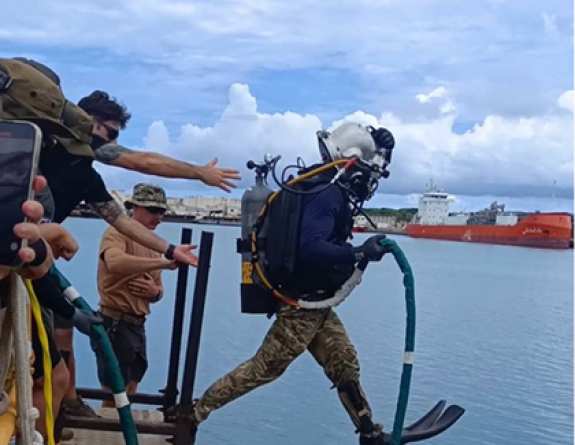
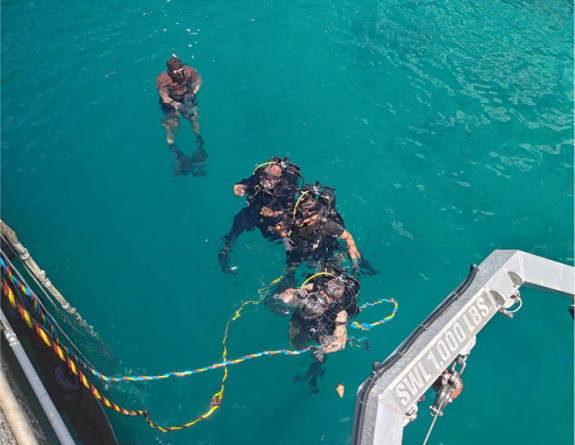
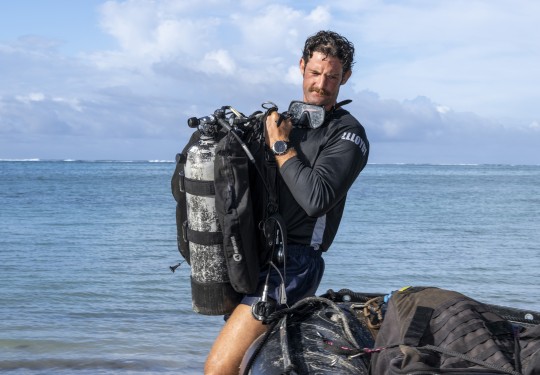
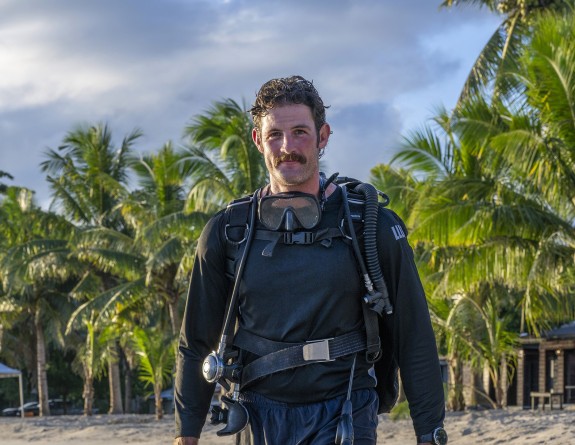
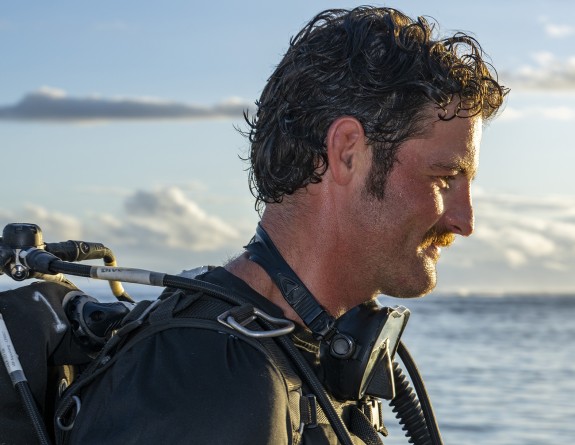
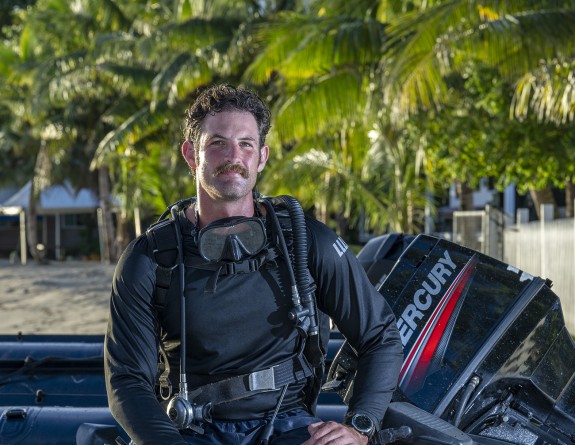
A team of 11 divers from HMNZS Matataua have just returned from a two-week training exercise in Guam, tackling underwater construction tasks alongside US Navy and Republic of Korea divers.
Exercise Mureng (Multinational Underwater Repair Engagement) is designed to test and improve the interoperability and skills of military divers and underwater construction teams.
Officer in Charge, Lieutenant John Duncan, says military divers are trained in welding, and an overseas exercise with partners provides an excellent opportunity to demonstrate their skills.
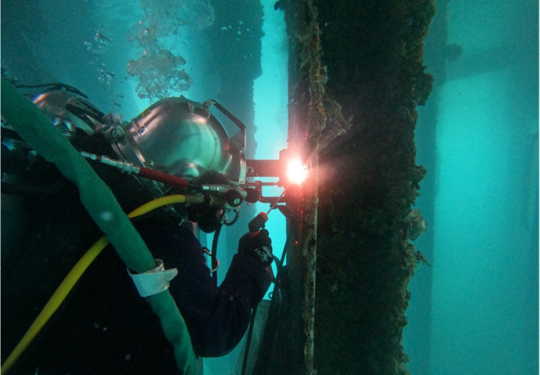
The exercise involved real time pier maintenance tasks. The teams undertook inspections on the main fueling pier at Naval Base Guam, using a marine growth removal tool called a “barnacle buster” to remove built-up encrustation.
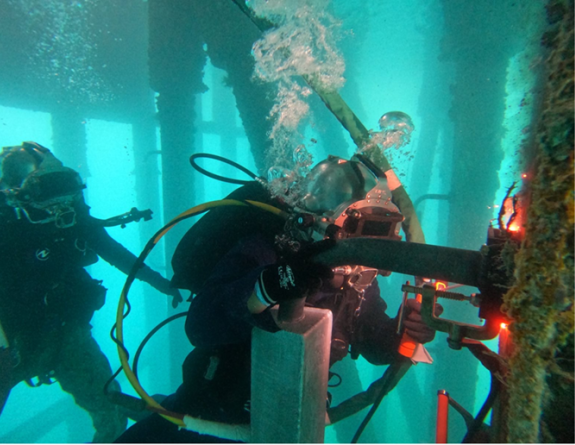
A weightier task involved welding and bolting replacement zinc anodes to the pier, at 1.6 metres in length and weighing 60kg. Metals in saltwater are naturally electrically reactive and will corrode, so zinc blocks – a far more reactive metal than the pier fittings – are used as a more attractive ‘sacrifice’ to prevent other metals being eaten away.
The team undertook buoy inspections, following the chain down from buoy to the mooring on the sea floor and checking for wear and tear.
Divers equipped with surface-supplied breathing apparatus undertake engineering tasks on a fuelling pier in Guam.
While it sounds more like custodial maintenance, the tasks provide training in two kinds of diving: scuba for mooring inspections and ‘surface-supplied’ diving for tasks involving concentrated engineering and hydraulic tool tasks.
Outside of these tasks, the team also had the opportunity to test their maritime explosive ordnance disposal expertise by participating in a US Navy-led underwater demolition exercise.
Lieutenant Duncan says wharf infrastructure maintenance and repair are core skillsets for Matataua’s clearance divers.
“These tasks are conducted in a similar way as they would be on the surface however, when overlaid with diving they become inherently more complex and require particular attention to detail to ensure they are completed safely to achieve the desired effect,” he says.
“It’s a capability we train for, but it’s not something we routinely get to practise in New Zealand. So this exercise provided an amazing opportunity to train with our partners and further develop some of the many skills required of a clearance diver.”
Christian Lloyd, who led the Royal New Zealand Navy diving contingent in Samoa in the aftermath of the sinking of HMNZS Manawanui, is being recognised with a Chief of Defence Force commendation for his actions in dangerous and challenging conditions.
16 October, 2025
The Hutt Valley man, who went to St Patrick’s College Silverstream, transferred from the NZ Army in 2023. Since then, he’s been the Officer in Charge of the Survey, Search and Recovery (Diving) unit, which is part of HMNZS Matataua’s Mine Warfare and Clearance Diving capability.
On the evening of Saturday 5 October, 2024, Lieutenant Christian Lloyd received a phone call; Manawanui had run aground on a reef off the south coast of Upolu, the main island of Samoa, and the crew were about to abandon ship.
“I thought, is this really happening?” he says.
“Then the Executive Officer calls. ‘How quickly can you put a team together?’ And within half an hour, I was at the naval base with a small group I had managed to get hold of on that Saturday night. We quickly started loading all our equipment for deployment, raising comms with the rest of the team to get ready.”
Lieutenant Lloyd returned home in the early hours of Sunday morning to pack his bags.
“I told my partner, I didn’t know when I’d be back. That’s something I’ve never done before. Then it’s back to Devonport for briefings and final equipment checks. At this point the other divers are coming in.”
He said they were eager to go, but apprehensive.
“We had little information about the situation, and we didn’t know what state the crew were in. We had to expect a worse-case scenario.
“In 24 hours, we had arrived by a C-130 Hercules in Samoa and within 48 hours, we were in the water.”
By this time, the entire crew had been recovered safely. Manawanui had sunk and was lying on its starboard side at around 30 metres down.
“For the first 24 hours, it was all about helping local authorities with what they needed and being boots on the ground from New Zealand.
“But we needed to get on that ship, and with the help of some Australian Defence Force personnel and local government officials who knew the ground well, we found somewhere close, a beach on the southern coastline where we could launch our operations from.”
Lieutenant Christian Lloyd was the Officer in Charge of the Royal New Zealand Navy diving contingent in Samoa in the aftermath of the sinking of HMNZS Manawanui
Lieutenant Lloyd said basing operations in Apia wouldn’t have worked.
“The quickest travel route from Apia to the southern coast meant a huge change in altitude, over a mountainous range. This has major implications for us as divers. Going around the island would also hinder and prolong operations. We knew we had to stay at sea level, where we had efficient access to Manawanui.”
With the operating post established, Lieutenant Lloyd set up a safety framework and routines for his team. The first five weeks would involve surveying and monitoring of the wreck and the recovery of forensic evidence for the future Court of Inquiry.
“That was the most intense time. It was challenging, exciting and a lot of pressure. I take my hat off to my team – the divers, the logisticians, the engineers. They worked so hard.
“Manawanui had run aground and sunk in a very difficult spot. In some of that initial media footage, you see this idyllic lagoon from our launching site, but once outside the safety of the lagoon, in open water, it was very, very rough, with a heavy swell.
“And then underwater, you have the hazards that come with operating in and around a wreck. This is probably some of the most dangerous and challenging types of diving you can do. Everyone had to be switched on, the moment you got on the dive boat.”
He said everything was about risk assessment.
“To put it into context, one day you are working in or looking down a passageway or a compartment. The next day, you could dive to the same location, and it would have collapsed.
“We did that for five weeks, conducting diving operations every day. That shows just how well trained and professional the team were. I was very proud of what they achieved throughout the period of operations.”
Lieutenant Lloyd’s award citation credits his ability to remain calm and maintain the safety and wellbeing of his team in extreme conditions.
Things calmed down during subsequent deployments, he said.
The Navy dive team supported the Samoan agency responsible for sea water testing, transporting them out to the locations selected for sample collection. They also took over aerial monitoring and surveillance from Air Force personnel, launching uncrewed aerial vehicles (drones) from the beach.
“We had moved from that rapid reaction search and recovery phase – which we are really good at – to monitoring the site and supporting the contracted salvors. Once the salvors were on site, we were able provide them with information and formally hand over so they could do their job in extracting the diesel fuel.”
The experience was a huge learning curve, said Lieutenant Lloyd.
“It was intense and at times frantic, but everyone performed incredibly well. I had a really good team and I couldn’t have done it without them. Especially the range of experience and skill level from the junior rates right through to the senior divers. Everyone brought something valuable to the table.”
His commendation notes his outstanding leadership, dedication and courage, something he said all his team shares. He credits his skills to the time he spent both as a platoon commander in the NZ Army and integrating with the Navy’s Clearance Divers before service changing.
“I enjoy working with small, specialist teams. In many ways Matataua and the divers run very similar to land-based units, so it was a natural progression when I came across.
“It’s great to get a commendation. But for me, it’s recognition for the team as well. We thrived in that operationally high-risk environment and the effort by all involved was immense. We learnt a lot from the whole event. I hope it never happens again but if it ever did, we’d be ready to go.”
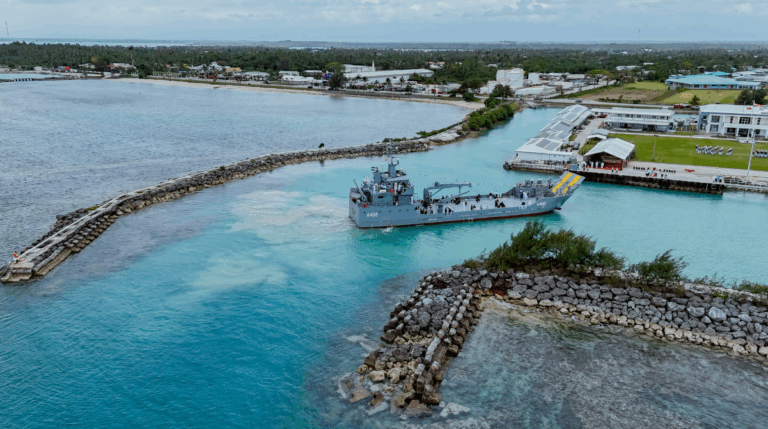
The Tonga Royal Navy has commissioned the newest landing craft VOEA Late in a ceremony held at the Masefield Naval Base.
Credit: Australian High Commission; Kingdom of Tonga via Facebook
The commissioning of VOEA Late is the latest demonstration of the enduring strength of the Australia and Tonga bilateral relationship and follows the recent signing of a Statement of Intent announcing a shared commitment to elevate ties between the two nations.
The vessel was provided under the Pacific Maritime Security Program (PMSP), Australia’s 30-year commitment to increase national and regional maritime security throughout the Pacific. The program builds on the three decades of success in the original Pacific Patrol Boat Program.
The handover ceremony of the landing craft was held in August this year.
The Royal New Zealand Air Force’s (RNZAF) T-6C Texan II fleet has reached a milestone with 40,000 flying hours – roughly equivalent to flying non-stop for four and a half years.
17 October, 2025
Since its introduction in 2015, the aircraft have been central to the RNZAF’s pilot training programme at No. 14 Squadron and are also flown by the Black Falcons aerobatic team.
Since the Texans’ arrival, 97 pilots have successfully earned their brevets. Of those, 91 were from the RNZAF and Royal New Zealand Navy, and six were from the Royal Australian Air Force.
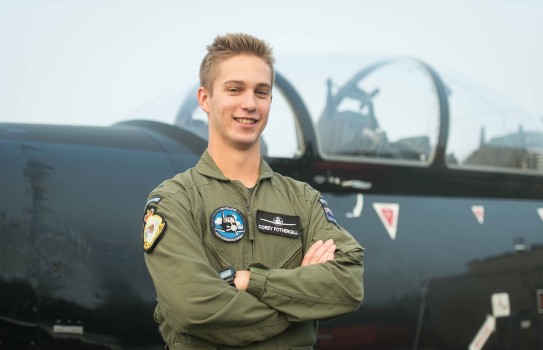
Flight Lieutenant Corey Fothergill was on the first course, learning to fly the Texans in 2016. A decade on he is now an instructor on the same course.
Flight Lieutenant Corey Fothergill graduating as one of the first pilots to train in a T-6C Texan II
“It’s definitely a full-circle sort of moment, which is cool,” Flight Lieutenant Corey Fothergill says.
Recalling the moment he first sat in a Texan as a beginner pilot was “overwhelming”.
“It’s a very powerful training aircraft for someone who hadn’t done flying before. It was a humbling moment.”
Flight Lieutenant Fothergill went from the Texans to flying NH90 helicopters with No. 3 Squadron, which provided career highlights including flying in Australia and Solomon Islands, as well as being involved in search and rescues around the country.
“But being back at No. 14 Squadron for the past six months has been really rewarding.”
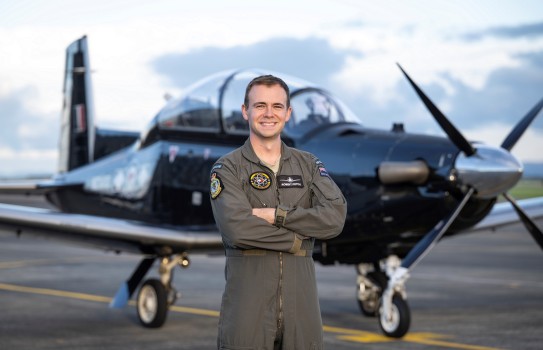
One of the squadron’s latest graduates, Flying Officer Robert Petch, received his Wings in June.
Flying Officer Robert Petch, one of the latest pilot graduates.
He described flying the aircraft as “learning to drive in a sports car”.
“No. 14 Squadron takes you from having zero aviation experience to navigating at 250 feet at speeds of 210 knots [389km/h].”
Ensuring the pin was pulled from his seat to enable ejection in case of an emergency was a sobering moment on his first flying day, Flying Officer Petch said.
The new pilot will now put his lessons into practice, also as an instructor at No. 14 Squadron, before moving to a frontline squadron in a couple of years.
Reaching 40,000 flying hours for the fleet was impressive and reflected the large number of sorties – about 18, but up to 24 – scheduled each day, he said.
Officer Commanding No. 14 Squadron, Squadron Leader Simon Isemonger said the serviceability rates of the aircraft were among the highest in the world.
“We’ve worked through several significant issues over the past 10 years that have been resolved by an amazing team.”
The aircraft was ideal as a training plane with its modern flight deck and multi-function displays, he said.
“It also has pretty decent range to get around New Zealand so that the pilots can experience what we have to offer at home in terms of different locations.
“It offers a broad spectrum of flying disciplines, preparing pilots well for their future employment on New Zealand Defence Force operational fleets, and also provides a capable platform for display flying by the Black Falcons.”
This milestone also highlights the strength of the squadron’s international partnerships with Textron Aviation Defence, for providing the training aircraft, engineering, and logistical support; Airbus, for ensuring fleet readiness through maintenance and support; and CAE, for delivering and taking care of the simulation and training systems.