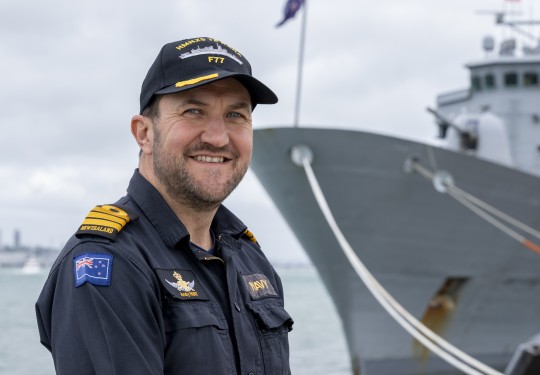
A sailor whose mother reckoned the Navy wouldn’t work out for him has taken command of a Royal New Zealand Navy frigate nearly 30 years later.
17 October, 2025
Commander Andy Hunt uttered the words “I have the ship” in a ceremony on board HMNZS Te Kaha at Devonport Naval Base, Auckland on 17 October, receiving the ship’s symbol of command from outgoing Commanding Officer Commander Fiona Jameson, overseen by Acting Chief of Navy, Commodore Shane Arndell.
This is his first command as he takes charge of one of the Royal New Zealand Navy’s two Anzac-class frigates.
Born in Nottingham, UK, Commander Hunt grew up in Portsmouth. He joined the Royal Navy in 1996, aged 20.
Prior to this he had been working in a sports shop and looking around for something a bit different. The Royal Navy seemed like a “why not” option, he says.
“I’d like to be able to say something about having ideals of defending the country, but it was more that I was only really interested in football and following Portsmouth FC around the country.
“I thought there could be more to life and I was looking for an outlet. My dad had worked as a civilian in the Royal Navy. My brother was in the Navy but got injured.
“My mum had no idea I had gone to see a careers officer and when I told her she said, ‘you won’t last five minutes in the Navy!’ And here I am, 29 years later.”
Commander Hunt says he loved being in the Navy, starting as a sailor and commissioning from the ranks in 2001.
While in the Royal Navy he served in Type 42 destroyers, Type 22 and 23 Frigates, Aircraft Carrier HMS Invincible, a minesweeper, and was fortunate enough to serve in HMS Victory, the oldest commissioned warship in the world.
“You get a real sense of belonging, a sense of purpose,” he says. “HMS Invincible was a fantastic opportunity, although I spent six months getting lost on board.”
As a family they moved to New Zealand in 2013, with CDR Hunt transferring to the Royal New Zealand Navy.
“I had two children at this point and we had never been to New Zealand – but we had talked about it for a long time.
“I had been on this course with someone from New Zealand, who was in the United Kingdom on an exchange. He talked about New Zealand and the culture and we kind of took a punt. We thought, why wouldn’t we try this out? It was a challenge for the whole whānau (family), but it’s worked out brilliantly.”
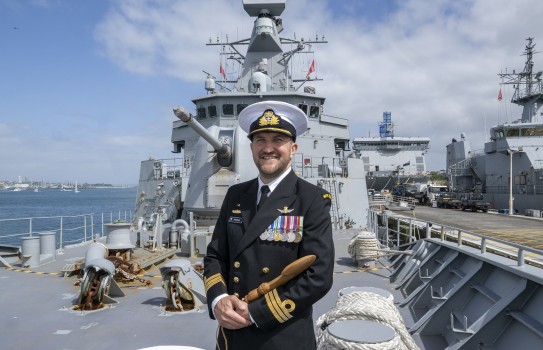
Commander Andy Hunt on HMNZS Te Kaha’s bow, holding a wahaika (Māori hand weapon), the ship’s symbol of command, named Te Kaha Nui A Tiki.
In New Zealand he has served aboard logistics ship HMNZS Canterbury and has been the Executive Officer of the RNZN’s Littoral Warfare Unit HMNZS Matataua. His most recent posting was to Combined Task Group 153 in Bahrain, tasked with international maritime security and capacity building efforts in the Red Sea.
When he got the phone call regarding his new command, he was blown away, he says.
“I am absolutely stoked. It’s a challenge I have never experienced before, and there’s the responsibilities and expectations that come with it. When you look at the work Te Kaha has done so far this year, I get to pick it up from there and get the ship ready for the next thing.”
In August Te Kaha completed a six-month deployment, which included monitoring of a Chinese Task Group near Australia, undertaking counter-narcotics and maritime security patrols in the Arabian Sea, high-end warfare scenarios and international training during Exercise Talisman Sabre in Australia and integrated operations with the HMS Prince of Wales Carrier Strike Group in the Indo-Pacific.
Commander Hunt says the support from his family makes this possible.
“All these things in my Navy career have been achieved because they have allowed me to do it. I’ve done some really exciting, fun things while my wife has taken command at home. I’ve been very lucky and very thankful to her.”
Japan Maritime Self-Defense Force ship JS Sazanami sails behind Royal New Zealand Navy ship HMNZS Aotearoa while conducting a dual-replenishment at sea with HMAS Sydney (left) and USS Howard (right) during a Multilateral Maritime Cooperative Activity (MCA)in the South China Sea. Picture: Department of Defence
10 hours ago
In his inaugural address on January 20 this year, US President Donald Trump declared that “America will soon be greater, stronger, and far more exceptional than ever before”, adding “America will be respected again and admired again”.
Nine months on, at least one of those promises, with its characteristic hyperbole, is being fulfilled.
America certainly is “far more exceptional” in its rhetoric and behaviour. What’s troubling, though, is that Washington directs this at allies as much as, if not more than, at adversaries.
Despite avowing China to be the biggest strategic threat to US interests, the Trump administration is hitting its Indo-Pacific partners with punitive tariffs; gutting aid programs throughout the region; sowing doubt about its commitment to Taiwan’s security; making nice with authoritarians from Pyongyang to Moscow; and pressuring allies, including Australia, to lift defence spending, preferably on American weapons and platforms.
The President’s speech to the UN General Assembly on September 23 was a litany of unsubstantiated boasts and grievances. His claim that America was “blessed with … the strongest friendships” sat awkwardly with his lambasting of Europe, the UN itself, and the retribution he pursues against those who criticise him or oppose his policies.
This aggravated American exceptionalism has long-term ramifications for Australia’s national security interests.
Through whim and volatility, and without obviously extracting any quid pro quo, America is surrendering the collective Western strategic bridgehead which, supported by staunch allies like Australia, it had fought hard and paid dearly to win and sustain for many decades.
This is the backdrop to Anthony Albanese’s first formal meeting with Mr Trump, on October 20. It underscores the need to switch from Australia’s traditional “gotcha politics” to more of a domestic “unity ticket” on defence and national security. This is logical, given the largely shared assessment of our deteriorating strategic circumstances that informed both the Coalition’s Defence Strategic Update 2020 and Labor’s inaugural National Defence Strategy 2024. The first biennial update of the latter is due by min-2026.
US expectations of us are the least of many compelling reasons to exert greater national effort to build sovereign defence capabilities and enhance our self-reliance, mindul that we cannot aspire to autarky. A genuinely bipartisan approach would give industry, investors, and our education and training sectors confidence to make the long-term commitments necessary to increase our industrial depth and sustain the workforce which our military and its related industrial ecosystem require.
We don’t have sufficiently sober and honest public conversations about the strategic threats we face and their implications for our national security and resilience. This is the prerequisite for the social licence government requires to spend what we must to ensure proper military and industrial preparedness, commensurate with the tasks we expect the Australian Defence Force to perform now, as well as in an ever more uncertain future. For some, the dissonance emanating from Washington is just the “outrage machine” of performative US domestic politics in overdrive, with America again bluntly exercising the economic and security leverage it has had, but not always applied, since the end of the Cold War.
But our adversaries are emboldened, reassured in their conviction that the West is in terminal decline and democratic governments are too timid to take hard and costly decisions that provoke short-term public discontent.
Even as they try to avoid disfavour in DC, governments across the region feel driven to hedge the risk of future US unreliability by increasing their economic and political engagement with China.
Among those attending last month’s Victory Day parade in Beijing – where the Chinese Communist Party distorted history by appropriating the nationalist Kuomintang-led struggle against Imperial Japan – were the presidents or prime ministers of Vietnam, Malaysia, Indonesia, and India.
Hefty US tariffs on India have cast doubt upon plans for a meeting of Quad leaders from Japan, India, Australia and the US this year. Meanwhile, a quartet of leaders from Russia, China, India and North Korea shared a platform as Chinese offensive military capabilities were ostentatiously on show in Beijing.
The US brand is tarnished. Exhorting anti-wokers of the world to unite, Washington is quitting forums and defunding programs that have helped project American global soft power since the end of World War II. Where American and allied voices once shaped the strategic narrative, there is a growing void, which Moscow and Beijing are filling with their hypocritical accusations of Western double standards and neo-imperialist ambitions.
In Australia, raucous AUKUS antagonism, spurred and blurred by anti-Trumpism, risks becoming a dishonest ideological pretext to jettison our most important and enduring security partnership. Those who assert that we are investing in a soon-to-be redundant capability seem to know better than the combined navies of 40 countries that operate submarines, including the six with nuclear-powered vessels (five of which are permanent members of the UN Security Council).
Pillar Two of AUKUS will expand the combined industrial base of the three nations, with benefits of scale, cost, more resilient and trustworthy supply chains, and increased interchangeability of common platforms and weapons systems. Even leading US defence companies acknowledge the constraints of their national manufacturing capabilities and are calling for swifter and less-encumbered sharing of technologies.
Although not as showy as nuclear submarines, this work is making progress and is vital to enhancing both the lethality and survivability of our respective forces and their industrial bases. However, while our militaries remain deeply intertwined, we cannot assume the old verities that have underpinned the alliance for seven decades will endure and suffice in future.
The political dalliance with “100 years of mateship” has run its course. Americans have always been hard-headed about their national security; we must adopt a similar attitude, reinforced by faith in our ability to bolster self-reliance and reinforce political and industrial partnerships with other accountable governments that share our strategic world view.
These partnerships are harder to build in the Indo-Pacific, which lacks the relative homogeneity of Europe and the longstanding unifying bonds that NATO and the European Union have provided for almost 70 years.
Nonetheless, Australia is forging stronger military-industrial ties with key regional players, including through the selection of Japan’s Mogami-class frigates and South Korea’s Huntsman self-propelled howitzers and ammunition carriers. This builds on our deepening political collaboration and joint military activities, in particular our combined naval transits in the South China Sea with a diverse array of allied navies, including Canada, The Philippines, Japan and France.
As we contend with Trumpian transactionalism, we must remind Americans and ourselves that Australia reliably has carried its weight in this relationship through multiple wars and conflicts.
Solid bonds of trust, forged in shared adversity and endurance, underpin the intensity and intimacy of our military interoperability, which rivals that of any of America’s allies.
Joint military facilities like Pine Gap served the vital security interests of both nations – and the collective West – throughout the Cold War. Even as the nature of conflict and contemporary security challenges evolves, they remain a strategic asset for the Alliance.
Our geography helps to disperse US forces and maintain a more persistent regional presence, with reliable access to repair, maintenance and overhaul facilities for their militaries for both the US and other allies.
This shared commitment to common strategic goals has enabled successive Australian governments, at comparatively modest cost to our GDP over many decades, to create a sophisticated and highly capable, if relatively small, professional military.
Consequently, all Australians have benefited from proportionally more spending on health, education and other priorities.
The government’s recent announcements of a $12bn investment in the HMAS Stirling naval base and Henderson naval precinct near Perth, as well as the $1.7bn for the Ghost Shark uncrewed underwater vehicle, are welcome and not before time. They should not be downplayed in the febrile fulminating which passes for public commentary about our defence. Even so, we are far from where we should be by the measures we have set ourselves.
Our biggest challenge is that of scale. A nation of 27 million people, with a professional military of roughly 60,000 people and a manufacturing base accounting for just 5 per cent of GDP, must think realistically about what can be achieved and how quickly, and at what sustainable cost.
The task of enhancing and protecting Australian sovereignty, national resilience and social cohesion increasingly must fall upon our own shoulders and wallets.
Better integrating our defence industry into regional and global networks is vital if we are to build and sustain greater self-reliance and contribute proportionally to the collective AUKUS industrial effort.
As British analyst Keir Giles wrote, having “hit the snooze button for a decade”, in the wake of Russia’s full-scale invasion of Ukraine in February 2022, Europe finally has woken up and is scrambling to bulk up its defence industrial base. The signals and rhetoric are encouraging, but the pace is slower than the urgency of the times demands.
Conclusion of the Australia-EU Security and Defence Partnership, possibly this year, will enable Australian business to bid in partnership with European companies for access to the new €150bn ($267bn) Security Action for Europe (SAFE) loan instrument for joint procurement.
European firms like Thales, Rheinmetall, Kongsberg, and SAAB are Australian defence primes, whose products are meeting not only Australia’s military needs, but are being exported to other countries. The EU became a strategic partner of ASEAN in 2020 and launched its EU Strategy for Cooperation in the Indo-Pacific in 2021. It signed security and defence partnerships with Japan and the ROK in 2024.
A new tier of innovative and resilient European nations, notably Poland and the Nordic and Baltic countries (the “NB8”), has crystallised. Deeply integrated into the Ukraine defence innovation ecosystem and, like Australia, having strong connections to the US defence base, they are outward-looking, activist, and clear-eyed on China and Russia.
We have much to gain from greater collaboration with them in military technologies like drones and other autonomous systems. We also can benefit from comparing our experience of authoritairans’ increasing efforts to subvert and suborn democracies and sabotage critical infrastructue.
The Partnership for Indo-Pacific Industrial Resilience, which was launched as an American initiative in 2024, supports greater collaboration between Europe and Australia. It aims to create a trusted ecosystem among industry, capital providers, and defence customers to foster information exchange, technical co-operation, supply chain resilience, and co-production and co-sustainment. Its 14 members span the Euro-Atlantic and Indo-Pacific regions and include key European countries and Australian partners like Japan and the ROK.
Regardless of the outcomes of the 2026 US congressional midterm and 2028 presidential elections, we should not expect the status quo ante to be restored. The task of enhancing and protecting Australian sovereignty, national resilience and social cohesion increasingly must fall upon our own shoulders and wallets.
So, as the Oval Office beckons for the PM, the question is whether we can rise above partisan politicking and unite society, investors, and industry in a properly funded, truly whole-of-nation effort to this end. If we can, allies and adversaries alike will take heed, and Australia will be the beneficiary.
Peter Tesch is a former deputy secretary of Defence and Australian ambassador to Russia and Germany. He is a Visiting Fellow at the ANU Centre for European Studies and holds similar positions at the ANU National Security College and the Australian Strategic Policy Institute.
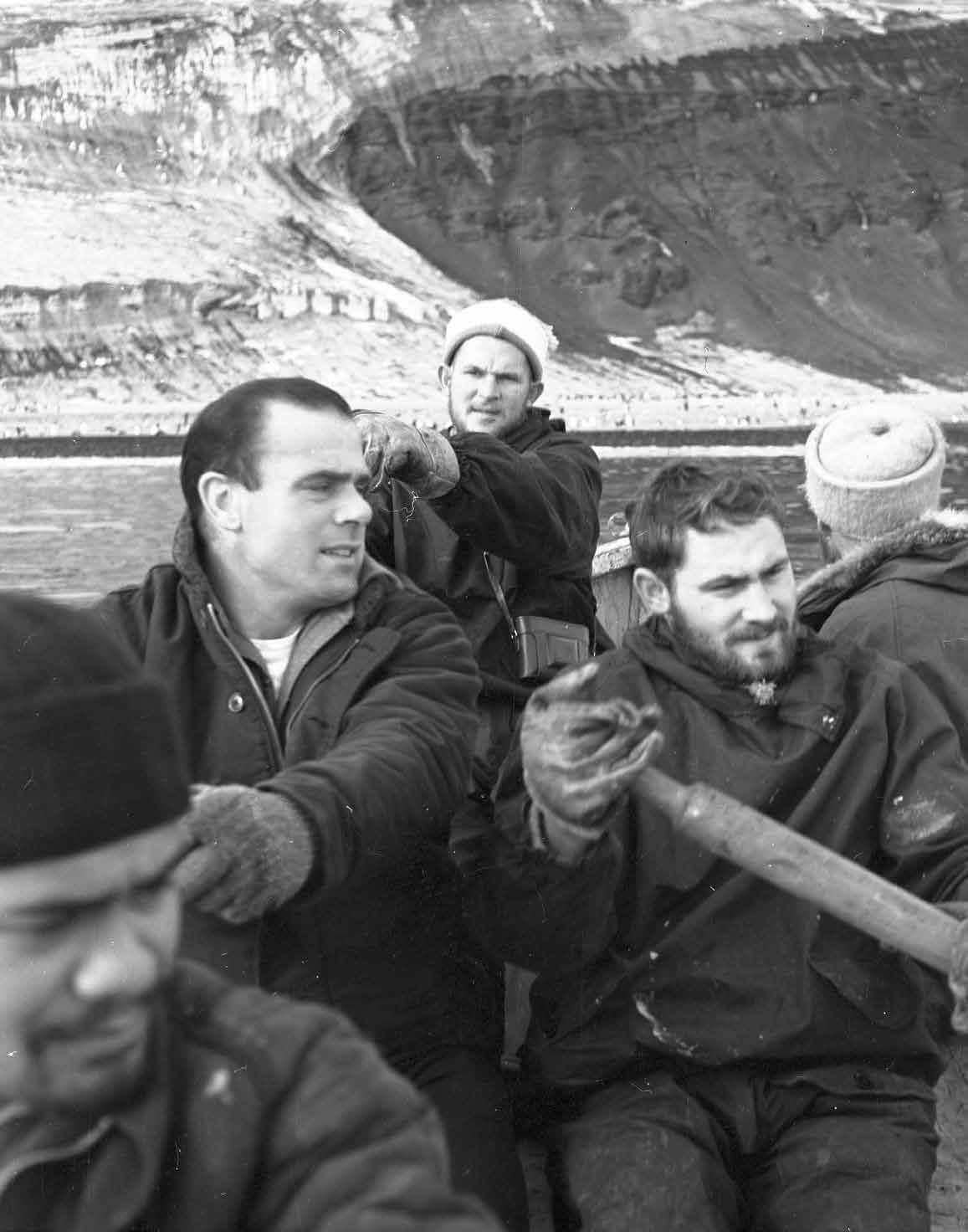
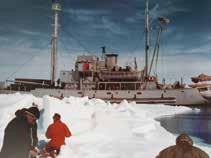
“That image brings back memories,” says Bob Pinker, former crewman of netlayer HMNZS ENDEAVOUR (I), the Royal New Zealand Navy’s first Antarctic supply vessel.
When HMNZS AOTEAROA heads to Antarctica next year, it will be the first visit and resupply to McMurdo by an RNZN ship in over fifty years. Editor Andrew Bonallack talks to former crewmen about the first missions to Antarctica in the late fifties.
Advertisement
He’s looking at the image opposite, taken in the beginning of 1958 near Cape Evans, Antarctica. “In the bow, facing aft, is Able Seaman EA ‘Tug’ Wilson, while on the left rowing is Chief Joiner E Voison.” He recognizes Able Seaman Brian ‘Brushes’ Nolan on the oars on the right, notable for being the youngest RNZN seaman to serve in the Korean War at age 16. The closest person to the camera is Able Seaman Ray Tito. A year earlier, A/B Tito had hoisted the flag at the new Scott Base, built to support New Zealand’s participation in the Commonwealth Trans-Antarctic Expedition of 1957–1958, the overland crossing of the continent by British explorer Vivian Fuchs with Sir Edmund Hillary in support.
In the picture, the crew are on their way to Scott’s Hutt at Cape Evans to screw a brass plaque to the hut. “I’m in the boat somewhere. I had a special drill the Navy gave me, and I wouldn’t lend it to Voison.”
This was during EM1 Pinker’s second trip to Antarctica, on board ENDEAVOUR I, also the ship’s second mission to the continent (1957/58). The wooden-hulled ship had been purchased and commissioned to transport and support the Expedition and a year earlier (1956/57) had transported Sir Edmund Hillary and his team, Hillary’s Massey tractors, two aircraft, dog teams and the components for Scott Base, which the ENDEAVOUR crew helped build. In the 1957/58 season, Hillary used the tractors to create supply depots between Scott Base and the Pole for Fuchs’ transcontinental journey from the opposite side of Antarctica (Hillary famously decided to continue on and reach the Pole before Fuchs). Mr Pinker ultimately did nine trips to Antarctica in his Navy career. In 1956 he remembers boarding ENDEAVOUR in Bluff in December, with 18 dogs and a load of mutton for dog food. He says ENDEAVOUR had stopped at Wellington, Lyttelton, Dunedin, apparently fundraising for the Expedition on the way down from Devonport. “We had about 50 fruitcakes donated from a local high school, and schoolgirls were knitting us gloves and scarves to take with us.” Mr Pinker had obtained a 16mm projection licence, in order for him to show movies on the trip down. “We didn’t celebrate Christmas until 29 December, when the ship stopped in the ice. I’ve got a picture of Hillary sitting on the ice next to the ship eating Christmas dinner.” He remarks that the White Ensign they sailed under was a different one than today (the Navy Ensign changed from the Royal Navy White Ensign to the New Zealand version in 1968). “I remember the crow’s nest often was in a ball of strange colours they called St Elmo’s Fire.”
His nine trips including missions in the second HMNZS ENDEAVOUR, the former USS NAMAKAGON (AOG-53) that he helped deliver from the United States to New Zealand in 1962. He says in January 1957 the USS NESPELEN (AOG-55), a sister ship to the NAMAKAGON, berthed alongside them in McMurdo Sound, and he reckons that inspired the purchase. “ENDEAVOUR I was very comfortable,” he says. “She was a diesel electric ship and a wooden ship, she wasn’t cold like a steel ship. She made very little water, and the galley got most of it. There’s no water in Antarctica. It took a gallon of diesel to make a gallon of water. But we had plenty of beer – Leopard lager.” Mr Pinker had received training in diesel electric engines in Australia, at a time when the usual propulsion was steam turbine. It made him valuable for both ENDEAVOUR I and II.
There are a variety of stories of clashes between Sir Edmund and the ship’s Commanding Officer, Captain Harry Kirkwood RN. “I remember Hillary wanted to send messages out without the Captain’s approval and the Captain said, there’s only one captain on this ship. Get down below.” This acrimony is something Ann Nolan, Brian’s widow, remembers from her husband’s stories.
Above: HMNZS ENDEAVOUR I stops for Christmas. Sir Edmund Hillary is in the dark blue on the left eating Christmas lunch. Photo supplied by Bob Pinker.
“What Captain Kirkwood said was law,” says Mrs Nolan. “He was a cleanliness fanatic which was a good thing on a ship but that is where Hillary and Kirkwood’s friendship came to grief. Hillary was not used to such a regime of cleanliness and Kirkwood’s rules were “my ship, my rules, like it or leave” and everyone accepted that except Hillary. “Captain Kirkwood loved the ship as he had captained it when it belonged to the Falklands Dependency and called the JOHN BISCOE. He was a real English gentleman and the crew referred to him as “my father”. He was such a nice man and kept in touch with Brian and I after he retired in England. He used to say that he would sail anywhere in the world on that ship.” A classmate of Mr Pinker’s, LME Mervyn Tyree, was also among the delivery crew for ENDEAVOUR II, and thinks he and Bob are the only two of that crew left alive. He also notes they are the only two people left who have stood on the decks on all three ENDEAVOURs, thanks to the pair being invited to the decommissioning of fleet tanker ENDEAVOUR III (which never went to Antarctica) in 2017. He remembers ‘bad years’ when the ice was so bad the ships couldn’t get into McMurdo. “Everything would have to be offloaded, to go into sledges towed by tractors. It could be 11 miles.” The second ENDEAVOUR was a huge improvement, he says, but it wasn’t really designed for the ice. “After one mission, you could see the ice had pushed in the hull against the ribs, all the way along.” Another former sailor, Geoffrey Bourke, was a junior watchkeeper in ENDEAVOUR I for the 1958/59 mission to Antarctica. He served in the Navy from 1951 to 1985, finishing as a Commander. He’s not so sure the ship was that comfortable. “We had bunks, but the sailors used to take their hammocks because it was more comfortable. She had a round bottom and would roll.”
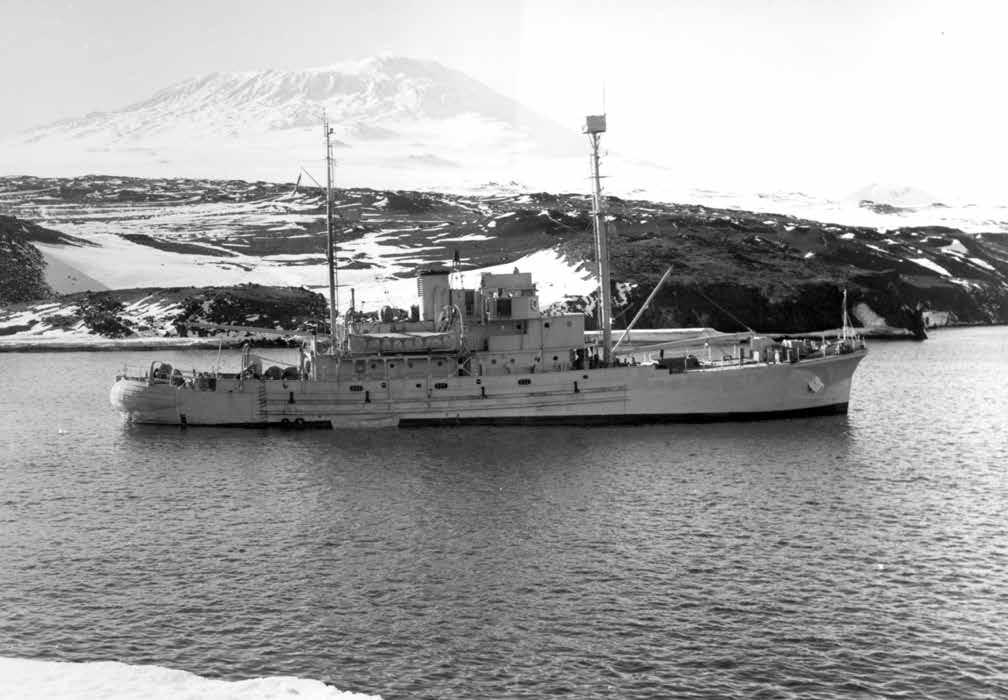
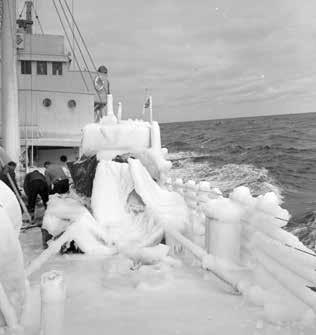
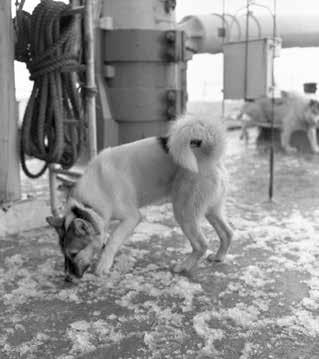
From top: HMNZS ENDEAVOUR in Antarctica; Ice building up on ENDEAVOUR I (1958); Sled dogs on the deck of ENDEAVOUR I, 1958.
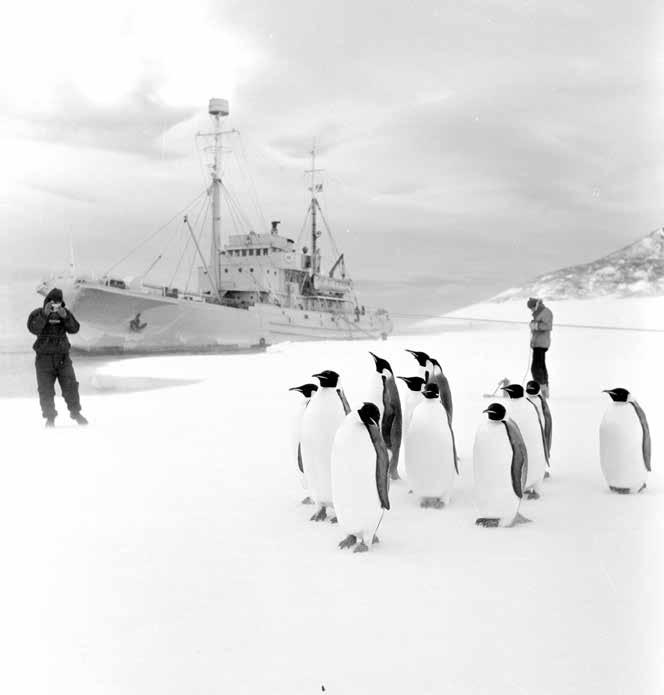
The crew would be acclimatised to the cold by the time they got to McMurdo. “The ship wasn’t airconditioned or any nonsense like that. It could be beautiful outside if the wind wasn’t blowing. You could be wearing a pair of shorts with heavy boots and socks, playing soccer. The penguins would come up to you, because they hadn’t seen a human before.”
When they reached McMurdo, they would come alongside the ice. “The trucks would come alongside, the stores people would unload all the stuff, and the trucks would drive back to McMurdo. It was a chain gang of trucks, going around and around until the ship left.” Two things struck him about the continent. “Mt Erebus, which looked like a hill but was higher than Mt Cook. And there’s nothing red. It takes a while for you to notice that. That’s why an orange snowcat stands out for miles and miles.”
ENDEAVOUR paid off on 7 November 1961 and was sold to Shaw Steam Ship Co. in Canada the following year. Renamed ARCTIC ENDEAVOUR, she was used for sealing in the Arctic until she sank at her moorings in November 1982 and was broken up in 1983. ENDEAVOUR II decommissioned in 1971.
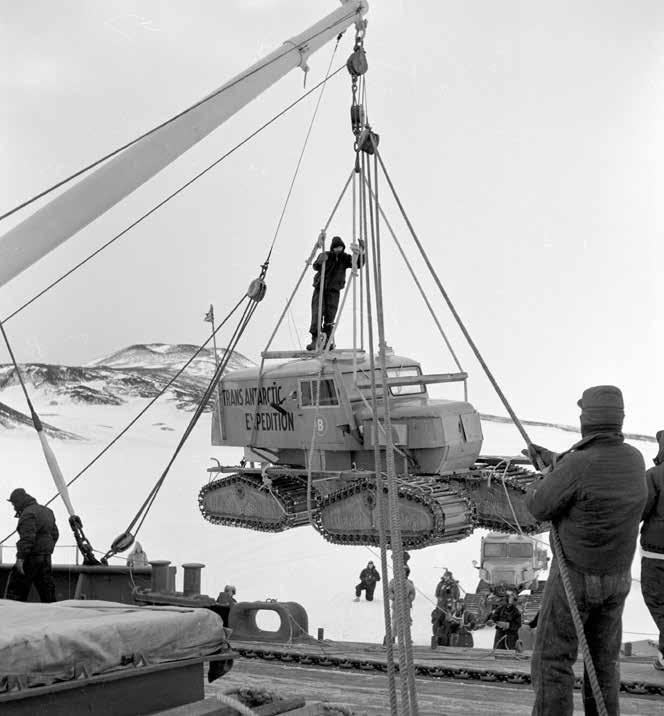
From top: The crew photograph Emperor penguins (1958); British explorer Vivian Fuchs’ Tucker 6.5-tonne Sno-cats are loaded onto ENDEAVOUR I, not long after the successful overland crossing of Antarctica (completed 2 March 1958).
HMNZS Endeavour was a Royal New Zealand Navy Antarctic support vessel. She was the first of three ships in the Royal New Zealand Navy to bear that name.
The ship was built in the United States in 1944 as Satinwood (YN-89) as a net tender of the Ailanthus class (but later redesignated as AN-76, a net layer) and transferred to the Royal Navy under Lend-Lease in August 1944. Commissioned as HMS Pretext (Z284), she served the United Kingdom until she was returned to United States Navy custody in November 1945. Sold by the United States Maritime Commission in 1947, she served as a research vessel for the Falkland Islands Dependencies Survey under the name SV John Biscoe. She was briefly renamed Pretext when another ship was assigned the John Biscoe name, before being sold to the Royal New Zealand Navy, renamed Endeavour, and employed in supporting the Commonwealth Trans-Antarctic Expedition and subsequent New Zealand research activities in Antarctica. Sold again in 1962, the ship, renamed Arctic Endeavour for sealing work in the northern hemisphere, foundered off the coast of Canada in November 1982.https://en.wikipedia.org/wiki/HMNZS_Endeavour_(1944)
Extending the life of the Royal New Zealand Navy frigate HMNZS Te Kaha is part of the Defence Capability Plan.NZ Defence Force
Taranaki businesses are hoping the region’s collective expertise in engineering and innovation can secure them lucrative projects from the Government’s $12 billion Defence Capability Plan.
In April, the Government announced ambitious plans to invest $12b into defence over the next four years.
The money, which involved $9b in new spending, included new maritime helicopters and armoured vehicles, investment in software, replacing the Boeing 757 fleet and extending the life of the frigates.
Soldiers, sailors and aviators stand in front of a fleet of 4×4 vehicles by the edge of the water at Devonport Naval Base. Photo: NZDF
The New Zealand Defence Force has introduced 18 new emergency response vehicles into service to support Joint Military Police Unit personnel during a ceremony at Devonport Naval Base.
The new Ford Rangers are designed to assist Joint Military Police Unit (JMPU) personnel as they undertake a range of tasks within NZDF camps, bases and training areas, and will provide assistance during civil emergency and natural disaster responses.
The vehicles cover a range of modern policing capabilities, such as speed and alcohol detection, investigation equipment, and immediate first aid support such as automated electronic defibrillators. New vehicles will be rolled out elsewhere in New Zealand in late October.
Commander Joint Support Group, Colonel Ant Blythen confirmed that the new fleet of universal response vehicles arrived on time and within budget.
“The introduction of the new vehicles is a great step forward for the NZDF policing capability with modern, fit-for-purpose vehicles,” Colonel Blythen said.
“Getting these vehicles into service is the result of a lot of work by the Headquarters JSG Logistics Cell and JMPU working with Capability Branch and Defence Equipment Management Organisation.”
JMPU responsibilities include crime prevention, incident response services and a fundamental mission to increase community safety and wellbeing and maintain the military justice system.
Staff have previously used a mixed fleet of seven different vehicle types, some approaching end-of-life timing.