RNZ Navy enlisted in Zealandia lake survey effort

The survey is like mowing a lawn, traversing back and forth mapping the lakebed below.

Kate  Green

Kate Green , Senior journalist – kate.green@rnz.co.nz

The survey is like mowing a lawn, traversing back and forth mapping the lakebed below. Photo: Kate Green / RNZ

The Navy has descended on a Wellington eco-sanctuary – but it’s not to prevent an invasion, pests or otherwise.

Rather it is conducting a survey of the Zealandia lake, good practice for the crew and useful information for the sanctuary.

Zealandia chief financial officer John Diggins watched on while the Navy crew set up their black, inflatable Zodiac with surveying equipment on Wednesday morning.

“It’s really exciting,” he said. “It actually shows us how the lake sits underneath, you can see the old creek that runs through, the original creek from before the dam was actually built, and just shows us any submerged logs.

“There’s also potentially a little goldmine down there, a little goldmine shaft that they saw on the last survey.”

Navy conducting survey of Zealandia lake

Checkpoint6 August 2025Queue

The Navy crew sets up their surveying equipment aboard the Zodiac on Wednesday morning.

The Navy crew sets up their surveying equipment aboard the Zodiac on Wednesday morning. Photo: Kate Green / RNZ

That survey was done in 2018, and since then, technology had advanced and would hopefully give them a better look.

The results would make it safer to navigate Zealandia’s electric boat, Ara Kawau, around the man-made lake, Diggins said.

“It’s a really cool trip, and it’s just really good to know if there are submerged logs that are hazards for the boat so we can just stay away from them.”

The Navy crew would be on deck for the next couple of days, and Diggins hoped they might get time to map the Upper Dam as well, which had never been surveyed before.

Chief petty officer Julie O'Hara of HMNZS Matataua and the Navy's search, survey and recovery team.

Chief petty officer Julie O’Hara of HMNZS Matataua and the Navy’s search, survey and recovery team. Photo: Kate Green / RNZ

Chief Petty Officer Julie O’Hara of HMNZS Matataua and the Navy’s search, survey and recovery team explained the portable multi-beam surveying system could see down to depths of 300 metres – but she was not expecting anything deeper than 15 metres.

Three crew members set out across the lake in the Zodiac just after 10am. The boat would traverse back and forth across the lake, mapping the floor below.

“It’s kind of like mowing the lawns,” O’Hara explained.

The end product would come in the form of a map, with different colours representing different depths, which Zealandia could use to steer clear of shallows and obstacles – and it could be ready as soon as Friday.

Zealandia's chief financial officer John Diggins watches on, as the Navy crew sets up the boat for the lake survey.

Zealandia’s chief financial officer John Diggins watches on, as the Navy crew sets up the boat for the lake survey. Photo: Kate Green / RNZ

As well as being useful for Zealandia, O’Hara said it was good training.

“We had a bit of an operational pause at the start of the year from the Manawanui sinking [in October 2024], so we came together as a trade and looked at how we can improve.”

“A lot of training, getting back into it, and then doing this training exercise here to really consolidate it.”

Zealandia's electric boat, Ara Kawau.

Zealandia’s electric boat, Ara Kawau. Photo: Kate Green / RNZ

The team carried out a huge variety of work – uncovering landmines, recovering vehicles, searching for missing people and surveying sea floors.

“We never know where we’re going to deploy in the world, and what’s asked of us, so by doing different lakes it really gives us the training that we need to move from normally working salt water, to working in fresh water.”

Sign up for Ngā Pitopito Kōrero, a daily newsletter curated by our editors and delivered straight to your inbox every weekday.

RNZ Navy trio work alongside Fiji in piloting uncrewed vessels

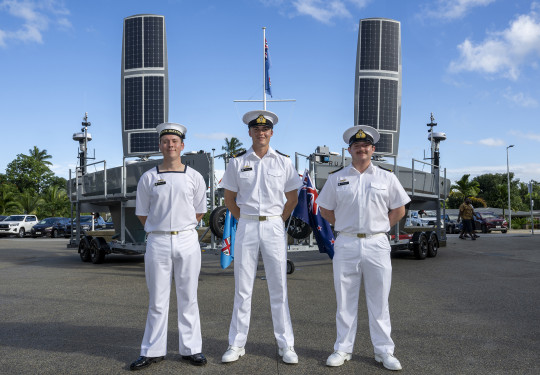
Three Royal New Zealand Navy (RNZN) specialists will work side-by-side with the Republic of Fijian Navy personnel this month piloting two uncrewed surface vessels (USVs) to monitor suspicious activity in Fiji’s waters.

Three sailors stand in a row in uniform, hands behind their backs

31 July, 2025

Ensigns Cameron Trotter and Alex Rendle, both warfare officers, and Able Hydrographic Survey Operator Christopher Cornell, are part of a team from HMNZS Matataua introducing autonomous maritime technology to the Fiji Navy.

The three operators, using RNZN Bluebottles Tahi and Rua, will work with Fijian Navy personnel at Fiji’s new Maritime Essential Services Centre (MESC) in Suva to help identify and track vessels operating suspiciously in Fiji’s exclusive economic zone – including those potentially involved in narcotics trafficking.

The autonomous vessels are propelled and powered by sun, wind and wave action can conduct long-endurance operations without requiring refuelling or crew.

A Royal New Zealand Air Force No. 42 Squadron King Air 350 aircraft will provide identification and surveillance oversight while a Fijian Navy vessel is available to carry out boarding and seizure tasks.

ENS Trotter, 22, from Nelson, says the monitoring will run for 24 hours in 12-hour shifts, with operators in Devonport handling the night-time shift.

The USVs are straightforward to handle, using a hand-held controller when launched for responsive close-in control, and then a mouse and keyboard in an operations room when the USV is in open water.

Operators are often from the warfare trade due to the ship handling and navigation skills taught, he says.

“I got the drone bug when I was 16, and I’ve always been interested in the whole uncrewed idea. I joined the Navy in 2023, and while I was training I heard about the USVs. I put my hand up to become an operator. It’s very new, but it’s becoming so relevant overseas. I wanted to get involved.”

ENS Rendle, 22, from Devonport in Auckland, graduated from the same class as Cameron.

“Seeing the Navy practically on my doorstep at Devonport Navy Base, watching them go in and out, drew me in. My father was a squadron leader in the Royal New Zealand Air Force and I’ve always been interested in Defence.”

He too was interested in this “up and coming” drone space in the Navy.

“There’s a lot of people interested in this. It’s the beginning of a new world for Navy and it’s amazing to be one of the people at the start of the journey.”

AHSO Cornell, 27, joined the Navy in 2022 and has been with HMNZS Matataua since his basic training.

Like Ensigns Trotter and Rendle, he got interested in the Defence Force while in high school in Christchurch, attending a Defence Experience Week at Burnham Military Camp.

He has posted to a variety of vessels for Pacific deployments before attending courses with the Bluebottle manufacturer in Australia to learn how to use them.

“I’ll be helping with the vessel launches and recoveries and working as an operator. It’s great to have Fijian sailors working alongside us not just because they know these waters so well but because they are getting the opportunity for hands-on experience with this new technology.”

HMNZS Canterbury concludes week-long Fiji deployment

HMNZS Canterbury has combined an Operation Calypso tasking with a week-long series of diplomatic and community events while berthed in Suva, Fiji.

25 July, 2025

The ship was in Fiji in support of the South West Pacific Heads of Maritime Forces (SWPHMF) and to participate in events celebrating the Fiji Navy’s 50th anniversary.

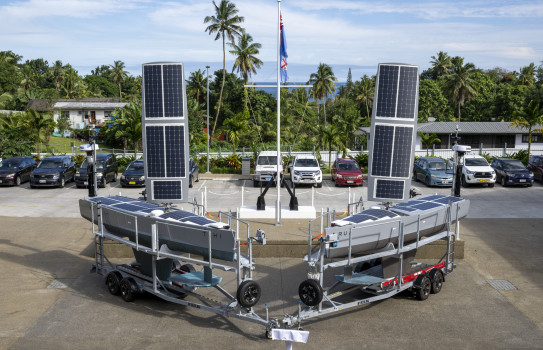
On berthing in Suva on 17 July, the crew unloaded the Royal New Zealand Navy’s two Uncrewed Surface Vessels (USVs) the Bluebottles Tahi and Rua.

Under Operation Calypso, a Royal New Zealand Navy (RNZN) team from HMNZS Matataua will remain in Suva for the next two months working with Republic of Fiji Navy personnel to deploy the Bluebottles to help identify and track vessels operating suspiciously in Fiji’s exclusive economic zone, partnered with RNZAF aircraft and Fijian patrol vessels.

Fijian Minister of Defence and Veterans Affairs, Pio Tikoduadua, praised the abilities of the Bluebottles during a press conference at Suva’s Maritime Essential Services Centre (MESC) on 21 July.

He described the deployment of uncrewed surface technology to Fiji as “historic” and a clear indication of both countries’ responsiveness to challenges around illegal fishing and narcotics trafficking.

“For both New Zealand and Fiji, we are facing a more dynamic and challenging security environment than we have for some time,” he said.

“Both countries have large exclusive economic zones that we need to safeguard. I would like to extend a sincere thanks to New Zealand for the deployment of these vessels in Fiji. It is a continued testament to the close cooperation among our forces, and our joint willingness to adapt to a changing security environment.”

Two small vessels covered in solar panels sit on trailers in a car park in Fiji.

The two Bluebottle USVs at the Bluebottle press conference at the Maritime Essential Services Centre.

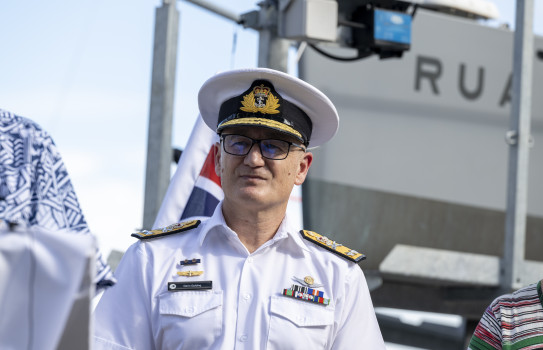
For RNZN Chief of Navy, Rear Admiral Garin Golding, attendance at the SWPHMF meeting was invaluable as it put the maritime and navy heads of 14 nations on the same page when it came to understanding regional challenges and how best to respond to them.

“Fiji, for example, has a significant issue with the trafficking of narcotics through the islands and they are having a terrible effect on its citizens and the country. That’s why there is joint operation utilising our Navy and Air Force assets along with Fijian Navy personnel and vessels to assist in disrupting the supply. This is the real value that comes from meetings such as this.”

RADM Golding made the point that the challenges faced by Pacific Island nations are not theirs alone.

“What affects our neighbours, directly or indirectly affects us so we have a critically important role to play in the region.”

The Chief of Navy stands in front of the a flag and the Bluebottle USV on a trailer.

Chief of Navy, Rear Admiral Garin Golding at the Bluebottle press conference at the Maritime Essential Services Centre.

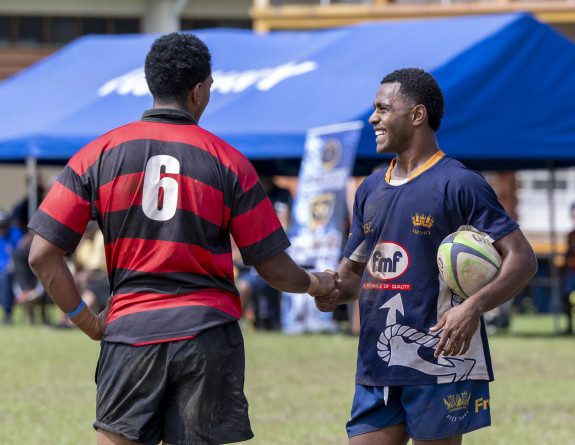
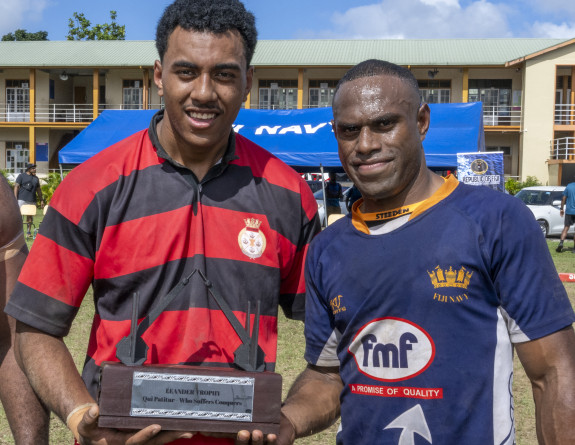
Another New Zealand-Fiji collaboration which Minister Tikoduadua hoped would remain constant was the inaugural Leander Trophy rugby competition, created to celebrate the Fijian Navy’s 50th anniversary and intended as a challenge to visiting Royal New Zealand Navy rugby teams.

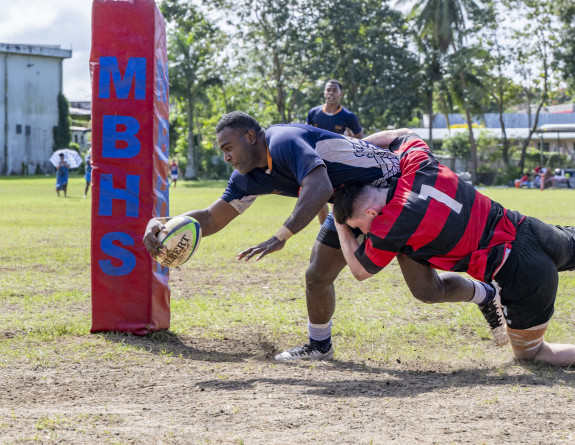
The Fijian Navy emphatically cemented their right to hold the trophy during a one-sided match against HMNZS Canterbury’s rugby team in Champagnet Park on Saturday 19 July. The trophy now resides in a new display cabinet at the MESC, awaiting the next challenger.

A rugby player gets a try as another player tackles him.
Rugby players shake hands and share smiles.
Two rugby players from different teams hold a trophy.

HMNZS Canterbury’s rugby team played a game of rugby against the Fijian Navy.

Canterbury’s 50th anniversary events continued with a Women in Navy luncheon on the ship’s bridge on Monday, hosted by Commanding Officer Commander Bron Heslop.

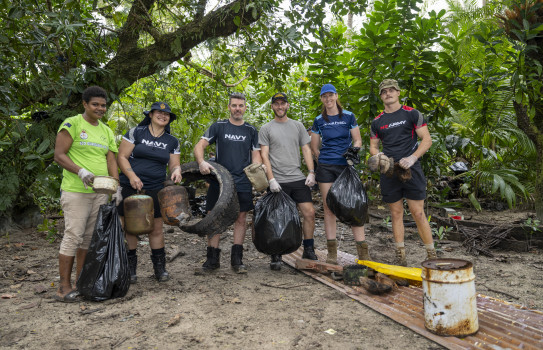
The following day around 60 volunteers headed to Mosquito Island, a popular picnic island near Lami Bay, to conduct a substantial beach clean-up in support of environmental group Eco Guardians of Fiji.

The rubbish, much of it accumulated in several piles, took four hours to bag up and transport back to shore in multiple trips. Many items were substantial, including large sheets of corrugated iron and fence netting.

Canterbury’s Operations Officer Lieutenant Commander Jack Walters, in charge of the clean-up, said they were happy to volunteer their time.

“The awesome thing about this is, Eco Guardians and the New Zealand Defence Force, we’re here because of our values and making the world a better place. This time, it’s a battle against pollution.”

Personnel from the Navy, Army and Air Force collect rubbish and are holding black rubbish bags, a tyre and other items of trash.

Around 60 volunteers headed to Mosquito Island, a popular picnic island near Lami Bay, to conduct a substantial beach clean-up in support of environmental group Eco Guardians of Fiji.

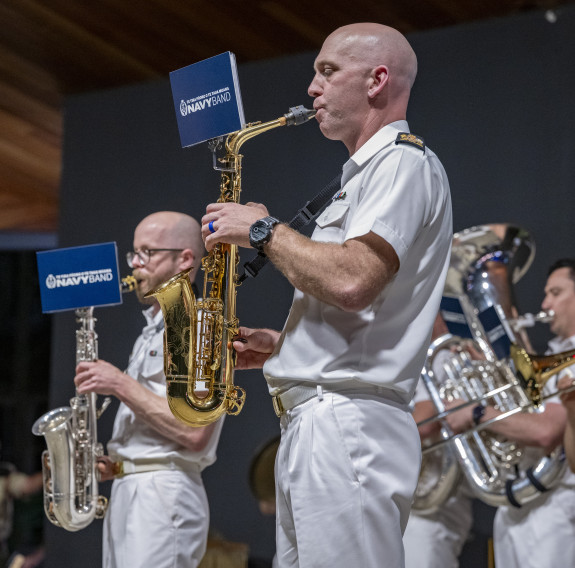
On Tuesday night the Royal New Zealand Navy Band, quartered on board Canterbury, performed with the Fijian Navy Band and the Republic of Fiji Military Forces Band in an evening concert at Albert Park, attracting hundreds of locals.

Canterbury hosted members and guests of the SWPHMF for a cocktail function on Wednesday night, which included a Multi Culture Group performance.

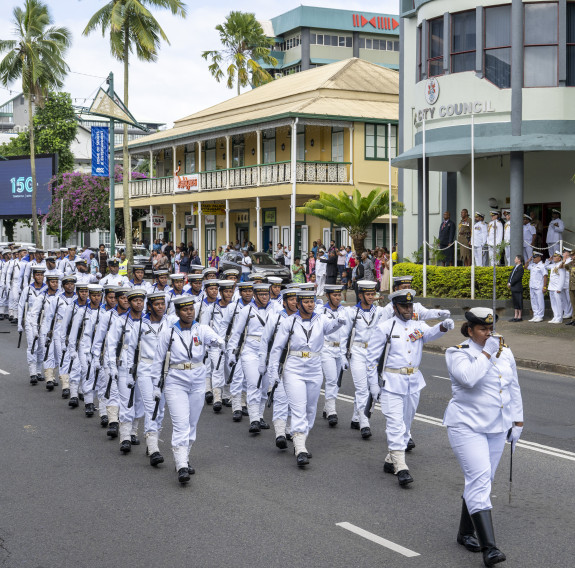
On Thursday members of the Ship’s Company and the Royal New Zealand Navy Band supported the Fijian Navy and Fiji veterans in a 50th anniversary street march in Suva.

It was Canterbury’s final activity before departing Suva on Friday for Gladstone, Australia, to resume logistics duties for Exercise Talisman Sabre, a major multi-national military exercise.

Canterbury’s motto, kotahitanga, means unity, and reflects the diverse, multi-service culture fostered aboard.

An example was four Fijian chefs coming on board during the week for galley experience on board a large ship.

Canterbury’s recent travels have included New Zealand Army and Air Force personnel obtaining sea riding experience and a contingent of 20 Royal Australian Navy officers and sailors undergoing training and sea time. Canterbury also has a Ship’s Amphibious Load Team (SALT) of New Zealand Army personnel.

The ship’s “embarked forces” population will jump as it conducts two trips between Australia and Wellington, collecting NZ Army and RNZAF personnel, equipment, armoured vehicles and aircraft following Talisman Sabre.

Commander Heslop says it has been an honour and a privilege to participate in the week’s activities in support of SWPHMF and the RFN’s 50th Anniversary.

“This visit has demonstrated New Zealand’s commitment to our Pacific neighbours, and we stand ready to face the challenges of today, and tomorrow, together.”

20250723 NZDF C1033116 028
20250724 NZDF C1033116 011
20250724 NZDF C1033116 016

Scroll to previous imageScroll to next image

Related stories

NZ Army soldiers link up with Aussies for amphibious training

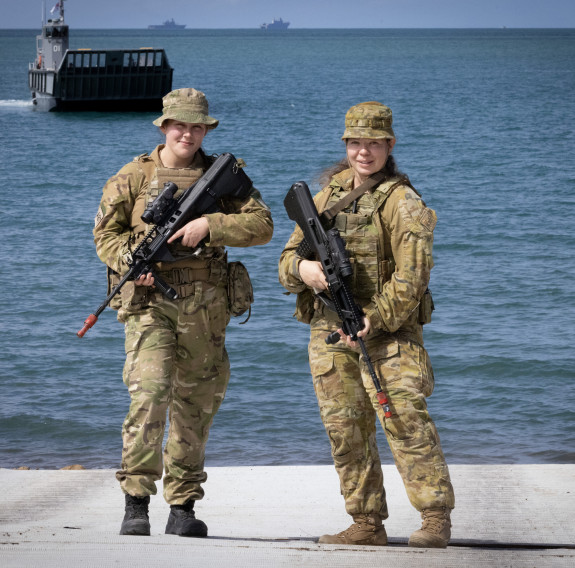
Australian Army soldiers from the 1st Battalion, The Royal Australian Regiment at Cowley Beach as part of Talisman Sabre

Boots and heavy vehicles hit the shores of Queensland’s Cowley Beach, kicking off the first phase of Exercise Sea Master – a littoral amphibious training exercise running concurrently with Talisman Sabre 2025.

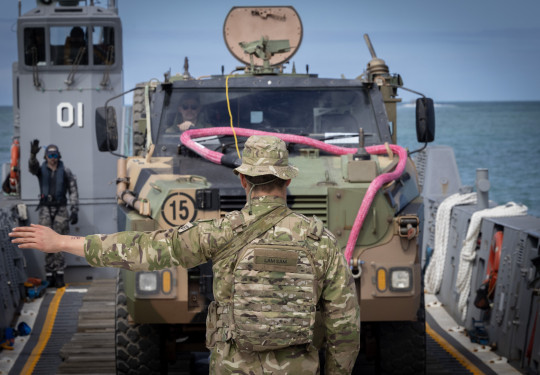
A NZ Army soldier guides an Australian armoured Bushmaster vehicle onto the beach at Cowley Beach

24 July, 2025

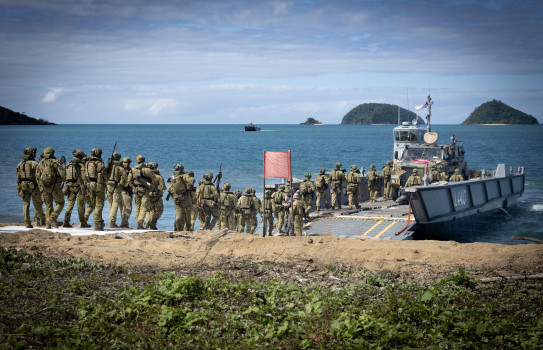
The rehearsal included vehicle loading and unloading drills, beach recovery operations and patrol movements between Australian, New Zealand and Japanese forces, with vehicles and personnel disembarking from HMAS Canberra and HMAS Choules.

The coastal training area, located in Queensland’s Cassowary Coast Region, provided the setting for serials to prepare for more complex amphibious missions at Bowen and Shoalwater Bay.

Integrated within the Australian Amphibious Beach Team, six New Zealand soldiers gained hands-on experience in amphibious beach operations. They practised vehicle marshalling tasks, including guiding vehicles on and off landing craft.

Lieutenant Gabby Williams, from the New Zealand Army’s 2nd Combat Service Support Battalion, observed the ABT serials and supported command.

She said the training provided a valuable opportunity for New Zealand to practice amphibious operations alongside Australian forces.

“We’re observing the Australian ABT to adapt their procedures for our own use, while also helping manage the team on the ground,” Lieutenant Williams said.

“New Zealand doesn’t get to train in the littoral environment very often, so to have an opportunity like this to work alongside Australia is incredibly valuable. It’s a crawl, walk, run process – this phase is about learning so that we’re ready to fully integrate at Shoalwater Bay.”Two soldiers stand side-by-side in uniform holding weapons. In the background is water and a military craft.

New Zealand Army officer Lieutenant Gabby Williams (left) and Australian Army Sergeant Chloe Pentland (right) at Cowley Beach

Corporal Joshua Jauchius, a plant operator foreman from the Amphibious Beach Team within the Australian Army’s 10th Force Support Battalion (10 FSB), said the training was critical for preparing troops to operate in coastal conditions.

“We’re creating access lanes, rolling out beach mats and rehearsing vehicle recovery – making sure everything from tracked vehicles to personnel can get safely from ship to shore,” Corporal Jauchius said.

“It’s pretty fascinating that earthmoving gear like dozers and loaders can play such a big role in amphibious operations – It’s not just about digging trenches. It’s all about keeping the beach open so if something gets stuck or bogged, we’re ready to recover it fast so the landing keeps moving.”

Australian Army soldiers from the 1st Battalion, The Royal Australian Regiment at Cowley Beach as part of Talisman Sabre

For the New Zealand soldiers, the serials provided a chance to shift from observation to hands-on roles in the next phases of the exercise, and were part of a broader push to improve joint amphibious capability across the region, ensuring forces can respond together when called upon.

“It’s a good training opportunity for us to integrate with the ADF and build relations as we continue training,” Lieutenant Williams said.

Alongside the ABT, Japanese troops tested new communications equipment alongside Australia’s 1st Battalion during patrol serials, while 10 FSB rehearsed clearing access lanes and recovering heavy vehicles along the shore. 

Environmental teams also observed the activity to refine future amphibious procedures and minimise impact on the coastal site.

Replenishment by air for Navy ship – HMNZS Te Kaha

A new method of Maritime Air Delivery (MAD) was trialled for the delivery of essential supplies to a Royal New Zealand Navy (RNZN) ship last week.

20250719 A1051744 003

23 July, 2025

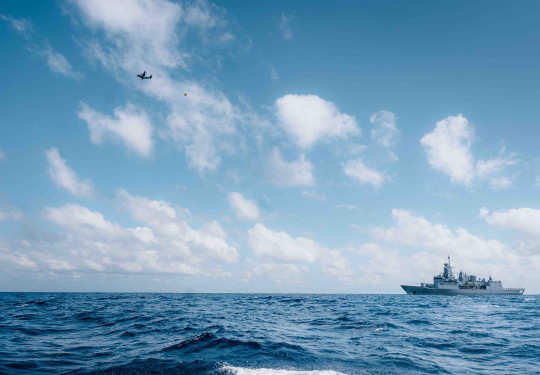
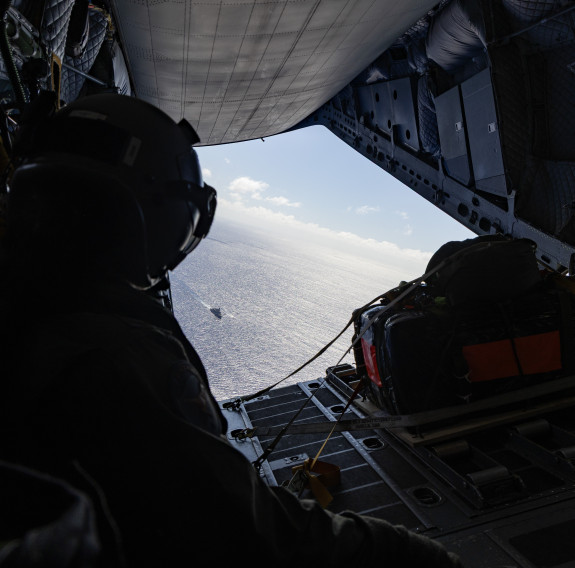
Off the coast of Queensland recently, a joint air drop tasking was conducted between a Royal Australian Air Force (RAAF) C-27J Spartan transport aircraft and the RNZN frigate HMNZS Te Kaha to trial another method of resupply to a ship at sea. This tasking was part of Exercise Talisman Sabre, the world’s largest multi-domain warfighting exercise currently underway in northern Australia, Papua New Guinea and the Coral Sea. 

Lieutenant Commander George Blackmore, Maritime Logistics Officer aboard Te Kaha, explained that the Maritime Air Delivery (MAD) was a planned opportunity to test another method of receiving essential items while a ship remains on tasking at sea.

“Typically, on deployment we receive resupplies of fuel, food, water and equipment by replenishment vessels, so this was a great opportunity to test the concept of an aviation resupply,” said LTCDR Blackmore. 

“Being able to remain at sea and still receive supplies allows us to maintain operational tempo and avoid having to come into port or rely solely on embarked helicopters.”

The delivery required detailed coordination between Australian Defence Force (ADF) and New Zealand Defence Force operations teams—both ashore and at sea. The Royal Australian Navy, RAAF and RNZN worked closely to ensure timing, location, and sea conditions were just right.20250719raaf8691356 0179

A Royal Australian Air Force C-27J Spartan circles past HMNZS Te Kaha in preparation to deliver a cargo pallet during Exercise Talisman Sabre 2025.

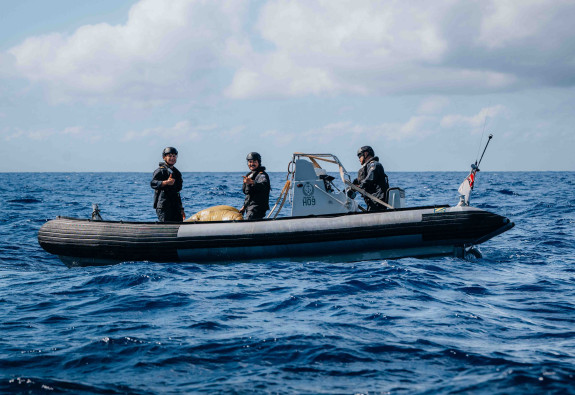
The load—contained in a protective suitcase – was recovered by Te Kaha’s RHIB team and  brought aboard and handed over to the ship’s Logistics Supply Specialists.

Onboard the aircraft, Lieutenant Alex Dooley and Petty Officer Omarama Sutcliffe from the RNZN observed the drop firsthand. As logistics personnel embedded with the Australian Expeditionary Logistics Team Maritime, the experience gave them a front-row seat to how their Aussie counterparts deliver in complex, contested environments.

“We were there as observers to see how they operate and how we might bring elements of that capability back to New Zealand,” said LT Dooley. “The ADF’s model of having a dedicated deployable logistics team that can operate remotely, even without ships coming alongside, is impressive—and it gave us plenty of ‘lightbulb’ moments.”

Working alongside the Australians also strengthened professional networks. PO Sutcliffe noted that the exercise improved interoperability not just in systems—but in knowing which people to call. “It’s about building those connections so when we need to move something from A to B, we’ve already got someone to reach out to.”

Read more about our involvement in Exercise Talisman Sabre here.

20250719 A1051744 006

JCs Royal New Zealand Navy Ships and New Zealand Defence, Also other World Defence Updates

Ships and Defence News Past and Present

Skip to content ↓