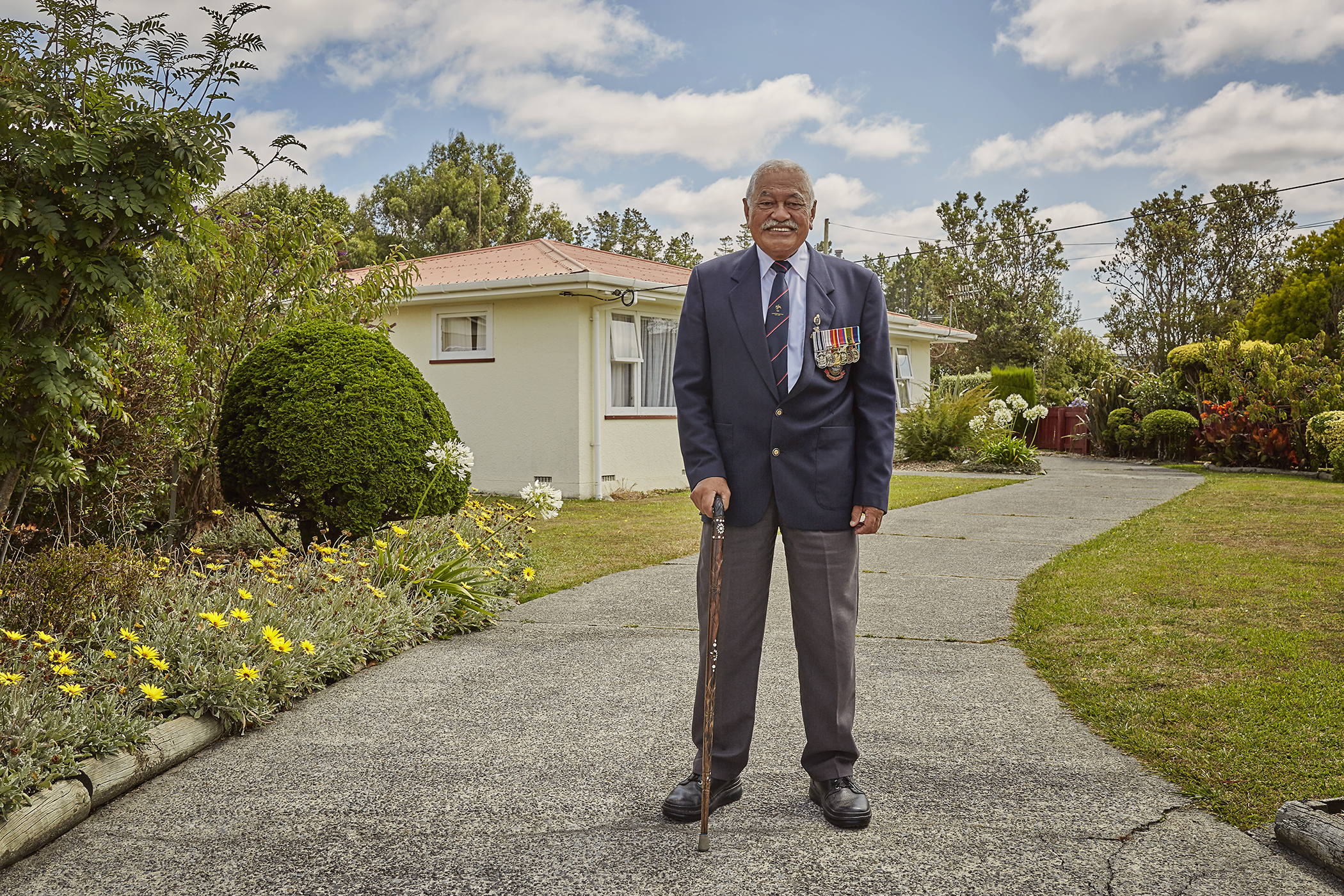
Two New Zealand Loch Class frigates attended the series of detonations: HMNZS Pukaki and HMNZS Rotoiti.
Image: Portrait of Tere Tahi, photographed by Denise Baynham.
About the event
In 1957/58 the British Government conducted a series of nuclear weapons tests at Christmas Island and Malden Island in the mid-Pacific Ocean. This series of detonations was given the codename “Operation Grapple”.
Operation Grapple consisted of 9 nuclear detonations between May 1957 and September 1958. The biggest of the detonations, Grapple Y, was equal to 140 Hiroshima bombs.
Two New Zealand frigates attended the series of detonations: HMNZS Pukaki and HMNZS Rotoiti. Over the course of these tests, a total of 551 New Zealand naval personnel manned these ships. Their duties consisted of witnessing the detonation of the nuclear devices and collecting weather data as close as 37 kilometres to Ground Zero.
In Operation Grapple: We Were There, Denise Baynham presents portraits of 19 New Zealand nuclear test veterans. Photographed in their own homes so you can see where and who they are now, the accompanying stories about Operation Grapple are told in the veterans’ own words.
According to information published by the New Zealand Defence Force on July 18, 2025, the Royal New Zealand Navy (RNZN) has deployed Bluebottle Uncrewed Surface Vessels (USVs) to Fiji in support of Operation Calypso, a key regional initiative aimed at enhancing maritime security in the South Pacific. New Zealand Navy HMNZS Canterbury vessel transported the two USVs, named Tahi and Rua, into Suva as part of a broader joint operation to monitor Fiji’s exclusive economic zone and counter narcotics trafficking and illegal fishing activities. Follow Army Recognition on Google News at this link
New Zealand Navy HMNZS Canterbury vessel deploys a Bluebottle Uncrewed Surface Vessel in Suva, Fiji, as part of Operation Calypso 2025 to support joint maritime surveillance and security operations with the Republic of Fiji Navy. (Picture source: New Zealand Navy)
Operation Calypso is conducted in close partnership with the Republic of Fiji Navy and reflects New Zealand’s ongoing commitment to Pacific maritime security. The Bluebottle USVs, developed by Australian company Ocius Technology, are autonomous platforms powered by solar, wind, and wave energy, enabling them to perform long-duration missions without onboard crew or refueling. These systems are suited for surveillance, border protection, fishery enforcement, and ocean data collection, making them valuable tools in efforts to deter transnational crime and safeguard vital marine resources.
HMNZS Canterbury, a Multi-Role Vessel (MRV) and the largest ship in the Royal New Zealand Navy, serves as the operational platform for the deployment. With a displacement of over 9,000 tonnes, the vessel is designed for amphibious sealift and humanitarian assistance missions. It features a well dock for landing craft, a flight deck for helicopter operations, and extensive cargo and troop transport capacity. In this operation, Canterbury not only delivered the autonomous USVs but also functions as a command and support hub for joint maritime activities with the Fijian Navy.
Alongside the USVs, aerial support is provided by a Royal New Zealand Air Force No. 42 Squadron King Air aircraft, delivering reconnaissance and surveillance coverage. Fijian Navy vessels are on standby to intercept and board any vessels engaged in illegal activity. Monitoring of the Bluebottles is carried out at the Maritime Essential Services Centre in Suva, jointly staffed by RNZN and Fijian Navy personnel. Outside regular hours, command and control shifts to HMNZS Matataua operating from Devonport Naval Base in Auckland.
Commodore Shane Arndell, the Maritime Component Commander of the New Zealand Defence Force, emphasized the importance of addressing regional security threats such as narcotics trafficking, which he described as having serious and lasting effects on Fijian society and the broader Pacific region. He noted that operations like Calypso are vital not only for intercepting criminal activity but also for deepening military cooperation and readiness across partner nations.
While docked in Suva, HMNZS Canterbury’s crew will take part in the Southwest Pacific Heads of Maritime Forces meeting and join the Fijian Navy’s 50th Golden Jubilee celebrations. Canterbury’s participation in Operation Calypso follows its recent role in Exercise Talisman Sabre, a major multinational military drill in Australia, where the ship transported New Zealand Army and Air Force units, vehicles, and aircraft. This back-to-back operational tempo underlines the MRV’s versatility and central role in the RNZN’s strategic engagement across the Pacific.
The partnership between New Zealand and Fiji is rooted in decades of defense cooperation, regional trust, and shared values aimed at maintaining peace and prosperity across the South Pacific. As an island nation with a vast exclusive economic zone, Fiji faces persistent threats from illegal fishing and maritime crime, but lacks the extensive surveillance infrastructure needed to monitor its waters independently. New Zealand fills this critical gap through sustained naval deployments, technical support, and joint operational initiatives. By integrating autonomous systems like the Bluebottle USVs and deploying multi-role platforms such as HMNZS Canterbury, the RNZN directly enhances Fiji’s ability to detect, deter, and respond to maritime threats. This cooperation ensures the protection of regional resources, strengthens collective maritime governance, and reinforces New Zealand’s role as a committed security partner in the Pacific.
Personnel from the New Zealand Defence Force disembark from a Royal New Zealand Air Force Boeing 757-2K2 at Royal Australian Air Force Base Townsville in Queensland ahead of Exercise Talisman Sabre 2025. Photo/Supplied.
Fresh off a build-up exercise with their Australian counterparts, around 300 New Zealand Army personnel had a quick turnaround to prep their gear and vehicles for the biggest warfighting test of the year, while Royal New Zealand Navy and Royal New Zealand Air Force assets and personnel have been in Australia prepping for the big show.
Australian Army personnel from the 1st Battalion, The Royal Australian Regiment embark on a NH90 helicopter from the Royal New Zealand Air Force as part of preparations for Exercise Talisman Sabre 2025 at Lavarack Barracks, Queensland. Photo/Supplied.
The NZ Army Combat Team – made up of infantry, armour, artillery, engineers, signals and logistics personnel – finished its build-up Exercise Diamond Strike, where they fine-tuned their interoperability and battlefield connections with their Australian ally and other key partners, before turning to the much bigger Talisman Sabre 25, which involves 19 countries and more than 30,000 personnel.
New Zealand Army Light Armoured Vehicle (NZLAV) in the field in Australia for Exercise Talisman Sabre 2025. Photo/Supplied.
Advertisement – scroll to continue reading
The Royal New Zealand Navy frigate Te Kaha and aircraft from both No 3 and No 5 Squadrons of the Royal New Zealand Air Force (RNZAF) as well as other personnel and assets from both Services are also taking part in the exercise.
A Royal New Zealand Navy mine countermeasures (MCM) team from HMNZS Matataua is already at sea off the coast of Queensland on a US naval vessel before returning to conduct an operational scenario with Australian and United States explosive ordnance team and MCM teams in the strategic port of Gladstone.
RNZN frigate HMNZS Te Kaha, fresh from a deployment with the UK Carrier Strike Group, will be exercising with maritime units from other participating countries in the Coral Sea protecting and defending key sea lanes from opposing forces.
Royal New Zealand Air Force (RNZAF) crews from both the P-8A Poseidon aircraft and NH90 helicopters have also spent time prepping their aircraft for the exercise, including NH90 crews integrating with the Australian Army.
Both HMNZS Canterbury and the RNZAF’s Boeing 757 have also played vital roles in getting NZDF personnel to the exercise, which also rehearsed and tested the NZDF’s ability to project forces around the region.
“This exercise has felt a long time coming for a number of our deployed contingent and so to have everyone in-country and prepped to go is great. I know there’s a lot of excitement at sinking our teeth into some high-quality exercises and scenarios alongside our ally and partners at a scale that we just can’t replicate at home,” Lieutenant Colonel Tim Tuatini said.
There will also be a significant NZDF presence in the Headquarters element of the exercise, which Lieutenant Colonel Tuatini said is testament to the leadership and expertise of our people.
“Comparatively speaking yes we may be a smaller force than some of our partners, but we certainly punch above our weight when it comes to contributing high-quality personnel to exercises like these. It shows that we can contribute effectively across all levels and across all domains in a complex multinational environment. We can’t wait to get started,” he said.
The exercise will be formally underway following an opening ceremony on Monday 14 July, before the NZDF contingent gets stuck in to a variety of tasks.
A New Zealand Army Ammunition Technician runs the ammunition point, alongside one of our Fijian partners in Shoalwater Bay training area Exercise Talisman Sabre 2025. Photo/Supplied.
New Zealand Army Captain Stephen Carruthers reflects on being part of a 75-year legacy of monitoring along the length of the demilitarized zone (DMZ) dividing North and South Korea.
11 July, 2025
People may come and go, but the Armistice Agreement between North and South Korea is constant, says Captain Carruthers.
Seventy-five years after the Korean War began, a multinational team continues to conduct regular inspections along the length of the demilitarized zone (DMZ) dividing North and South Korea to ensure compliance with the 1953 Korean Armistice Agreement which ceased hostilities.
United Nations Command Military Armistice Commission (UNCMAC) members visit and inspect Republic of Korea (ROK) brigade tactical operation centres, guard posts, observation posts and the land corridors between the two Koreas.
UNCMAC assistant operations manager, New Zealand Army Captain Stephen Carruthers says the commission has been “on the front line” since the Armistice Agreement was signed.
“Knowing that the Armistice Agreement is still in effect and I’m there helping that legacy continue, especially when you can see what could happen if we weren’t there, is very important to me.”
He must ensure that ROK divisions within his area of operations consistently follow the rules and guidance provided by the Armistice Agreement.
The July 27, 1953 agreement between the Commander-in-Chief, United Nations Command, the Supreme Commander of the Korean People’s Army and the Commander of the Chinese People’s volunteers suspended open hostilities and withdrew all military forces and equipment from a four-kilometre-wide demilitarized zone.
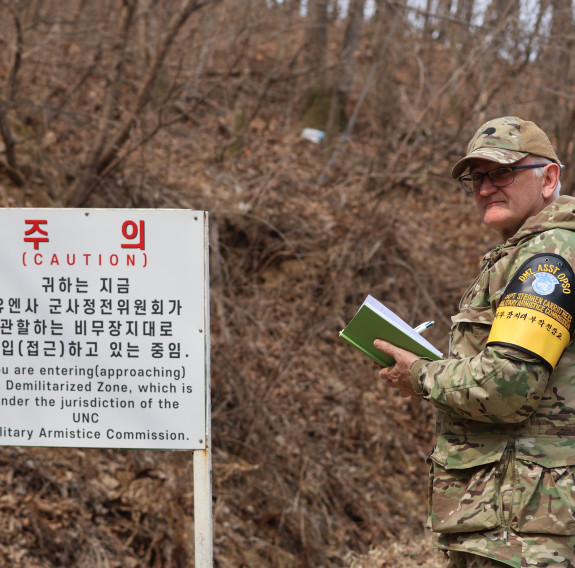
United Nations Command Military Armistice Commission DMZ Assistant Operations Officer, New Zealand Army Captain Stephen Carruthers (center) stands by a marker on the edge of the demilitarized zone which separates military forces on the Korean Peninsula on
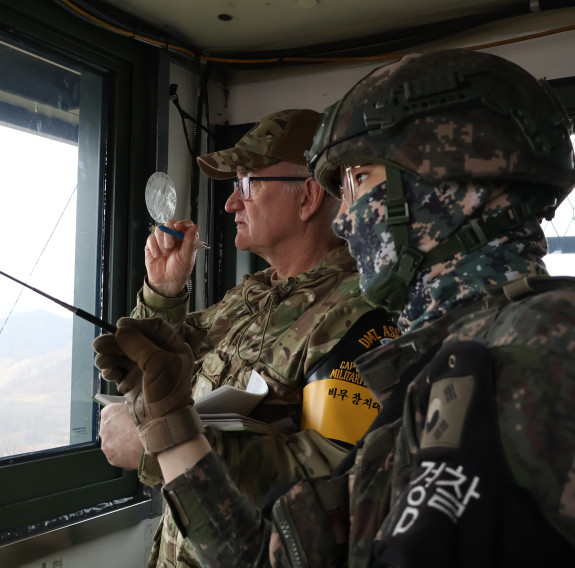
United Nations Command Military Armistice Commission DMZ Assistant Operations Officer, New Zealand Army Captain Stephen Carruthers (left) interviews a Republic of Korea Army soldier during an inspection on the edge of the demilitarized zone which separate
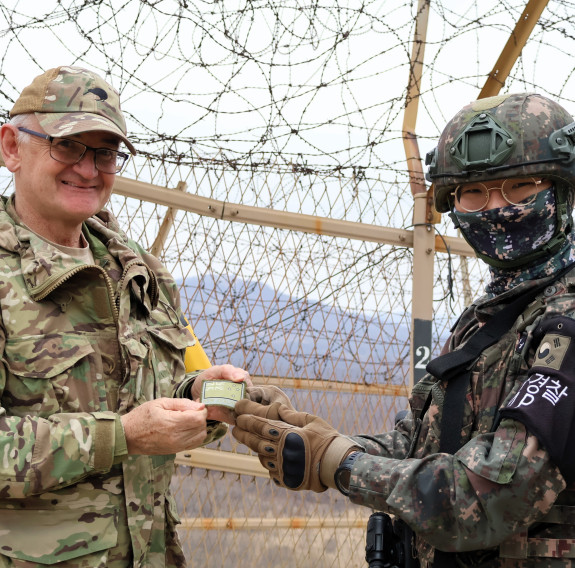
Captain Stephen Carruthers swaps a New Zealand patch with a Republic of Korea Army soldier.Scroll to previous imageScroll to next image
A key provision is neither side shall execute any hostile act within, from, or against the demilitarized zone.
Potential Armistice Agreement violations range from firing across or into the DMZ and operating drones in the DMZ to not displaying the appropriate flag on vehicles or buildings.
Captain Carruthers’ deployment to Korea will run for 12 months.
“I discussed the idea with my family first, ensuring they were involved with the decision to apply and what it would mean. I believe I was chosen because I had the desired skills and maturity that was looked for. Army has given me a lot of opportunities so saying, yes, I’ll step up and do that, gave the organisation a solution and allowed them to then focus on other things.”
He says he works with an amazing group of people. “I work alongside Colombians, Danes, Australians, Canadians, US, and importantly South Koreans – all on board with the mission to ensure the Armistice is enforced.
“In some cases, I lead inspections with this multinational flavour, to places few people go. During these inspections I ensure everyone is included and their contribution valued. This means being patient and listening to people, being not just open to new ideas, but receptive of viewpoints that challenge your view on the world.
“It’s a collaborative, dynamic and at times fast paced environment. It’s inspiring and fits in with who I am.”
Captain Carruthers says one thing that resonates with him is seeing young, conscripted Koreans reacting when he hands out kiwi patches.
“The patch I take is one that represents Operation Monitor, with a history that dates back to the Korean War when our forebears drove their trucks and hauled our artillery in support of the United Nations Command Forces. The Kiwi was seen by everyone that encountered the New Zealand Forces.
“I give these patches to young Korean conscript soldiers, stationed along the DMZ in places I’m privileged to visit. I tell them the story behind the patch, and I invariably get to see the smile on their face when they know that New Zealand has been there supporting Korea for a very long time. Seeing that reaction is priceless.”
Captain Carruthers, from Christchurch, joined the New Zealand Army in 1987. He’s been deployed to former Yugoslavia, East Timor and Afghanistan.
“I joined because I had, and still have, a sense of service. It’s a willingness to go further, do more, help others, do something where you’re constantly thinking on your feet and to support the goals of New Zealand.
“For me, it’s being able to help people less fortunate get their lives back on track and collaborate in a team environment that makes a real difference.”