The America-class amphibious assault ship USS Tripoli (LHA 7) arrives at Sasebo (CFAS), June 23, 2025, to replace USS America (LHA 6) in U.S. 7th Fleet’s Forward Deployed Naval Forces-Japan. US Navy photo by Mass Communications Specialist 2nd Class Sophia H. Bumps.
HMNZS Te Kaha alongside in Jakarta with representatives of the Indonesian Navy, members of the ship’s company and the NZDF Defence (Photo/Supplied)
The Royal New Zealand Navy (RNZN) frigate HMNZS Te Kaha has arrived in Jakarta on a goodwill port visit – the first visit to Indonesia by a RNZN vessel since 2017.
The two day visit forms part of HMNZS Te Kaha’s role in supporting the United Kingdom Carrier Strike Group, currently operating in the Indo-Pacific. The ship is berthed alongside Royal Navy and Spanish Navy vessels also visiting Jakarta during this period.
Commodore Shane Arndell, the RNZN’s Maritime Component Commander, who is in Jakarta to welcome Te Kaha to Indonesia’s capital, will also take the opportunity to meet with senior leaders of the Indonesian Navy (TNI-AL), including the Republic of Indonesia Fleet Commander.
“This visit by Te Kaha reflects the importance of the defence relationship between New Zealand and Indonesia,” said Commodore Arndell. “Ours is a shared commitment to regional maritime security and stability in the Indo-Pacific and this is a welcome opportunity to continue our dialogue and cooperation with the Indonesian Navy.”
While in Jakarta, sailors from HMNZS Te Kaha will take part in a programme of engagement with their Indonesian Navy counterparts, including sporting matches and a professional exchange briefing on the ship’s recent deployment with the New Zealand-led Combined Task Force 150.
Advertisement – scroll to continue reading
CTF150 is a multinational maritime security operation focused on denying funds to terrorist and criminal organisations through narcotics smuggling in the Middle East. Over the last six months, ships attached to CTF150 have seized over 7,000kg of narcotics worth $NZ1.8billion.
Other activities being conducted during the visit include a courtesy call by HMNZS Te Kaha’s Commanding Officer, Commander Fiona Jameson, on the local naval base commander, and an official ship reception co-hosted by Commodore Arndell and New Zealand Ambassador to Indonesia, Mr Phillip Taula.
HMNZS Te Kaha’s visit follows the RNZN’s Chief of Navy, Rear Admiral Garin Golding’s participation in the International Maritime Security in Bali earlier this year, and underscores New Zealand’s ongoing commitment to maritime partnerships and freedom of navigation in the Indo-Pacific.
When HMNZS Te Kaha departs Jakarta it will sail to Australia to participate in Exercise Talisman Sabre.
On Saturday 28 June 2025, Offshore Patrol Vessel (OPV) Arafura was Commissioned into service in a ceremony at Fremantle, Western Australia. HMAS Arafura is the first of class. (LSIS Zac Dingle / RAN)
Share
The Royal Australian Navy commissioned the first Arafura-class Offshore Patrol Vessel, HMAS Arafura, into its fleet on 28 June, 2025. The commissioning comes more than three years after the vessel was launched.
Australian ministry of defence press release
Today marks a major milestone of the Australian Government’s implementation of the Surface Fleet Review with the commissioning of HMAS Arafura into the Royal Australian Navy fleet.
HMAS Arafura is the first Arafura class offshore patrol vessel (OPV) of the Navy’s surface fleet.
HMAS Arafura will enter into the fleet at a commissioning ceremony in Western Australia today.
Navy’s OPVs will help patrol and secure Australia’s maritime border alongside the evolved Cape class patrol boats. They will also play a role in humanitarian and disaster relief, enhance regional engagement and support other Navy missions.
These new capabilities have a greater range of 4,000 nautical miles, and can perform roles that previously required numerous vessels. These OPVs will also have improved living quarters and amenities to better support personnel.
The Government’s Independent Analysis into Navy’s Surface Combatant Fleet (Surface Fleet Review) reaffirmed the need for the Arafura class OPVs whilst recommending they operate alongside the evolved Cape class patrol boats.
HMAS Arafura was built by German shipbuilder Luerssen Australia at the Osborne Shipyard in South Australia.
The second OPV, NUSHIP Eyre, has been built and is awaiting acceptance by Navy. The remainder of the four ships are under construction at the Henderson Shipyard in Western Australia.
On Saturday 28 June 2025, Offshore Patrol Vessel (OPV) Arafura was Commissioned into service in a ceremony at Fremantle, Western Australia. HMAS Arafura is the first of class. (LSIS Zac Dingle / RAN)
Deputy Prime Minister, the Hon Richard Marles, said:
“The commissioning of HMAS Arafura marks an important milestone in the implementation of the Government’s Surface Fleet Review. “HMAS Arafura means that the Navy can continue to ensure the safety and security of our maritime borders. “The commissioning of HMAS Arafura is a turning point, and we will continue to see the Navy introduce new vessels into its fleet.”
Minister for Defence Industry, the Hon Pat Conroy said:
“The delivery of these offshore patrol vessels is an excellent example of our partnership with defence industry in action. “The Australian Government has worked collaboratively with Defence and Luerssen Australia to successfully deliver HMAS Arafura, with another ship on the way and four more under construction at Henderson. “The construction of the remaining four ships is on track, and continues the Australian Government’s investment in a productive, continuous naval shipbuilding and sustainment industry.”
Minister for Defence Personnel, the Hon Matt Keogh said::
“HMAS Arafura delivers on our plan for Australian workers to build vessels for the fleet faster than Australia has for decades, to ensure the Navy has what it needs to secure our national interests at sea. “Arafura also provides improved living quarters and amenities to support our highly skilled naval personnel as they patrol and protect our coastline.” “My best wishes go to the crew of the Arafura as they take on this new challenge, and may they have fair winds and following seas. My thanks also go to their families, whose support enables our personnel to do what they do each and every day for our nation.”
Chief of Navy, VADM Mark Hammond said:
“A strong Australia relies on a strong Navy, one that is equipped to conduct diplomacy in our region, deter potential adversaries, and defend our national interests when called. “The Arafura class offshore patrol vessels will perform a number of roles, including regional engagement, patrol duties, and employment of uncrewed systems in a variety of missions.”
NUSHIP Arafura on first sea trial August 26, 2024. Photo author Trevor Powell, shared with kind permission.
Naval News comments:
When Arafura was launched in December 2021 at the Osborne Naval Shipyard, it was intended to be the first of 12 ships armed with 40mm main guns. They were destined to replace the Royal Australian Navy’s (RAN) fleet of smaller Armidale and Cape class patrol boats in their entirety. Instead, as NUSHIP Arafura finally approaches entry into service, it is armed with a 25mm cannon and is one of only six vessels.
Those six ships, rather than making up the RAN’s patrol force, will instead constitute less than half of the Navy’s patrol force going forward. In their place, Austal-built Evolved Cape class patrol boats, which were originally set to provide only an interim capability between the Armidale and Arafura classes, have been commissioned into the RAN and ordered by the Australian Border Force.
Delays in the program has disappointed the RAN and Defence, who have been forced to once-again assign frigates to border patrol work, and industry alike. Indeed, the company’s experience with the Arafura class program appears to have so soured Luerssen Australia that its parent company, NVL Group, has announced plans to divest from the country. In June 2025 Civmec announced a deal with NVL Group which will see the latter’s stake in Luerssen Australia sold to Civmec.
What caused the program, which appeared simple in nature, to experience such delays and issues is the subject of intense debate in Australia. While the exact causes of the problems may never be known, the Australian National Audit Office (ANAO) has derived lessons learned from the process that bode poorly for Australia’s Sea 3000 project:
“Inadequate timeframe to conduct procurement can diminish the opportunity for due diligence during tender evaluations. Providing sufficient time for due diligence is crucial to ensure the integrity and effectiveness of the procurement process,” the ANAO concluded in its annual report on Defence procurement.
“The use of reference ship designs from other navies provided reassurance in the procurement process but it remains crucial to thoroughly understand the intended capabilities and requirements, and ensure alignment with project objectives,” it further stated.
The LE Aoibhinn (sister ship to Gobnait) docked in Cork – Ex – HMNZS Rotoiti
The USS Constellation is a guided missile frigate of the United States Navy, which is due to be commissioned and will come into service in 2029. She will displace 6,700 tonnes, and carry a crew of 140 sailors and servicemen, and have a range of 6,000 nautical miles, allowing her to sail almost halfway across the globe without re-fueling. She will cost the United States taxpayer almost exactly one billion dollars.
By way of contrast, the LE Aoibheann, pictured above, (formerly His Majesty’s New Zealand Ship Rotoiti) is the newest addition to the Irish Naval Service. She cost $13million, meaning that we would have to buy 77 more such ships to spend the same amount that the Americans are spending on Constellation.
She was commissioned as a New Zealand Navy in 2009, and managed ten years of service before the New Zealand Navy decided that she and her sister ship HMNZS Pukaki (now the LE Gobnait) were unsuited to the kind of rough seas typically found in the outer reaches of New Zealand’s territorial waters. This is relevant because the Irish Naval Service itself describes Irish waters as the roughest in the world. But that factor was apparently no barrier to acquiring the two ships.
They were both sold to Ireland for a knock-down price: €26 million for two ships.
Since their acquisition, it was revealed this week, the LE Gobnait has not been to sea even once. That is because – per the Naval service – of a shortage of crewmen and women. The ships only require twenty people each to set to sea, but the Naval Service is incapable of finding sufficient people to crew the Gobnait. In addition, both ships require significant upgrades to their equipment for the (one would have thought not overly taxing) job of patrolling and policing Irish fishing.
The Irish Naval service has a total of eight vessels. In theory, two of these are supposed to be at sea at any one time, though the Irish Times tells us that “this has not always been possible over the last year”. The entirety of the Naval Service comprises 740-odd personnel. For comparison, the flagship of the Royal Navy, the HMS Queen Elizabeth, carries a crew and complement of almost 1,000.
Few would argue that the Irish naval service needs either a billion-dollar frigate, or an Elizabeth-class aircraft carrier. Nevertheless, for a maritime nation, it can hardly be denied that the state of this country’s naval service is a national embarrassment. Perhaps you consider the comparison with the USA and the UK unfair? Well, then, pick two similarly sized and geographically situated countries: Denmark, and Portugal.
The Royal Danish Navy is five times the size of the Irish Naval Service in terms of personnel (3,400 men in arms) and twice its size in terms of main fleet vessels (16 versus 8). Its flagship, the Absalon, is an anti-submarine warfare frigate roughly the same size as the USS Constellation with 100 full-time crew members and room for an additional 300. It carries advanced sonar for submarine detection, and advanced offensive capabilities. It is four times larger than the largest ship in the Irish fleet, the LE Roisin.
The Portugese Navy (also known in Portugal as The Portugese Armada, which is pretty cool) comprises 79 ships and 5 supporting aircraft as well as one advanced submarine. The standing naval manpower is over 8,000 men at arms. It has two advanced frigates, a bunch of corvettes, and dozens of smaller craft for policing fishing and the coastline.
Now, you might argue that neither Portugal nor Denmark are “neutral countries” like Ireland, but this is hardly the point: Both of them are coastal European countries with large territorial waters and where the fishing industry is important. Both of them like Ireland are home, in their territorial waters, to vitally important strategic infrastructure in the form of undersea cables and offshore wells.
And both of them take the task of policing their waters seriously. Ireland does not.
The argument that Ireland does not need to because “we would never be at war” or that “the UK and US would protect us” is also moot. Portugal and Denmark by virtue of their NATO membership can be absolutely guaranteed military aid and assistance should they need it. Ireland is not guaranteed such assistance. Indeed, our neutrality cannot even be enforced: NATO ships can sail through our waters with impunity, just as Russian submarines can utilise our waters without fear of detection.
This week, we reported on Gript the fact that Ireland is spending €300,000 of its defence budget to convert two old Land Rovers from Diesel Engines to Electric Engines. This is on top of the €350m spent not very long ago to “climate proof the defence estate”.
Yes: Ireland spends more on projects to climate-proof the defence forces than it does to equip or staff them.
You can say many things about this. But you cannot possibly say that this is a serious country that takes its own defence seriously. And when European Countries dismiss – as they do – Ireland’s views on the wars in Ukraine and Gaza, it is partly (as foreign affairs commissioner Kaja Kallas noted last week) because nobody mistakes us for serious people on defence and security.
Why do people in the Middle East listen to Donald Trump but not Simon Harris? There are many reasons. But a big one is that Trump can deploy the USS Constellation. And Ireland cannot even deploy the tiny boats that it already owns.
If the public are content with that, so be it. But we should not harbour any delusions about what the rest of the world sees.
Note: An earlier version of this article said that “neither the Aoibheann nor the Gobnait have been to sea”. In fact, the LE Aoibheann has been to sea on several occasions. We regret the error.
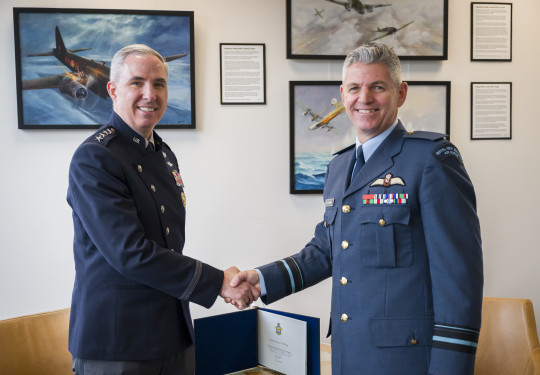
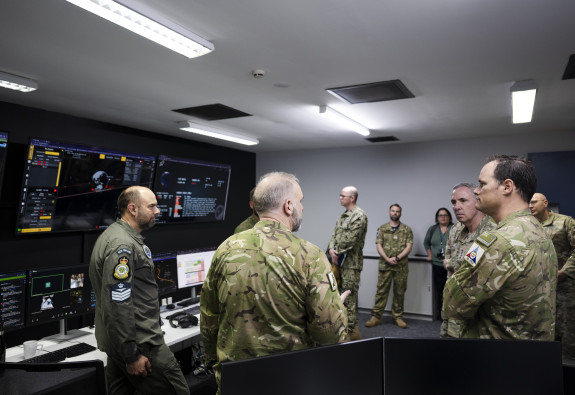
This week the Commander US Space Command General Stephen Whiting had a whirlwind visit to New Zealand, speaking with senior military leaders and meeting New Zealand Defence Force Space Operations personnel.
27 June, 2025
General Whiting held talks with a number of people including Minister for Space Judith Collins, Chief of Defence Force Air Marshal Tony Davies and Chief of Air Force Air Vice-Marshal Darryn Webb.
They spoke about how the importance of Space continues to rise for both nations, the increase of threats in the domain and the importance of partnerships.
“We believe we are better when operating together and we have a long tradition and history of operating with our Kiwi allies and friends and we are excited about the steps we are taking forward in Space,” General Whiting said.
In addition to his role leading USSPACECOM, General Whiting is dual-hatted as the commander of Multinational Force – Operation Olympic Defender, which New Zealand accepted an invitation to join in 2024. The US-led multinational space initiative is designed to coordinate the space capabilities of member nations, enhance the resilience of space-based systems, and deter hostile actions in space.
General Whiting also visited Royal New Zealand Air Force’s Base Auckland ahead of the launch of the Air Force’s No. 62 Squadron, which will implement New Zealand Defence Force Space Operations. He was welcomed with a Quarter Guard, haka and pōwhiri, before discussions with the squadron.
General Stephen Whiting visits RNZAF Base Auckland ahead of the launch of No. 62 Squadron, which will implement New Zealand Defence Force Space Operations.