Navy checks on domestic fisheries fleet – HMNZS Taupo

Navy, HMNZS Taupo, Devonport: Inshore Patrol Vessel (IPV) HMNZS Taupo on its delivery voyage from Whangarei to Devonport Navy Base, Auckland. Onboard was the Associate Defence Minister Hon Heather Roy. HMNZS Rotoiti sits infront of the Auckland Skyline.

Inshore Patrol Vessel HMNZS Taupo has helped ensure fisheries compliance amongst the northern fishing fleet in a sustained boarding operation last month.
20250520 NZDF C1033116 030

27 June, 2025

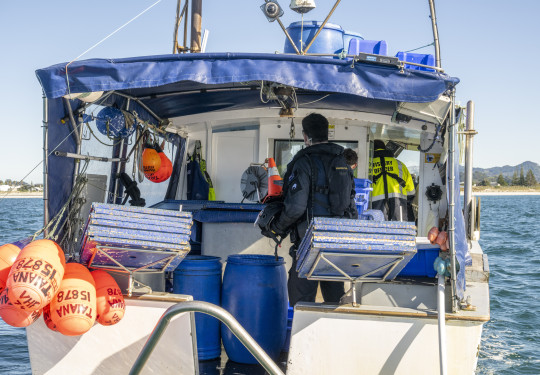
For three weeks, HMNZS Taupo patrolled from North Cape to East Cape, hailing commercial fishing vessels and getting Fisheries New Zealand Fishery Officers on board to conduct checks.

Lieutenant Commander Toby Mara, Taupo’s Commanding Officer, estimated they covered the bulk of the northern fishing fleet, with 26 boardings undertaken.

The Fishery Officers were checking the fishing vessels’ electronic reporting, paperwork and fishing practices. Pleasingly, a high degree of compliance was found.

LTCDR Mara says they rotated two fisheries officers in each week.

“It’s not always achievable for Fishery Officers to get to vessels off the coast, so this is where the Navy can help in getting them on board.”

Fisheries New Zealand Director of Fisheries Compliance Steve Ham agrees.

“Working with our partners at NZDF in a joint operation provides us greater capacity to inspect commercial fishing vessel operations at sea,” Steve Ham says.

“This vital work enables us to gain a greater picture of fishing operations outside of territorial limits which we could not do without our support from NZDF.”20250520 NZDF C1033116 042
Watch Checking on domestic fisheries fleet | Royal New Zealand Navy video

Checking on domestic fisheries fleet | Royal New Zealand Navy

Each day’s routine would start with a briefing on the bridge, with the Fisheries New Zealand Fishery Officers displaying their operating picture. Fishing vessels must report their location regularly, says LTCDR Mara.

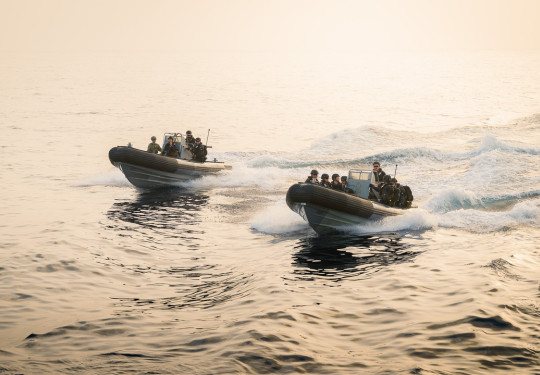
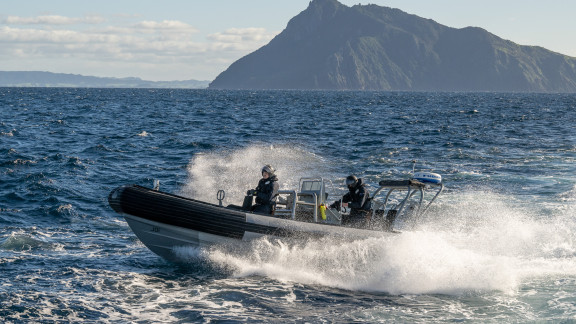
“We then hail the vessel by radio, but if they’re all on deck they may not respond immediately. If we don’t get a response, we’ll check with MPI about previous interactions, then go to boarding stations. The inspectors and our boarding party will go across in a RHIB and request to board.”

He says the response from the crews is generally good. “This time, the vessels were generally compliant in their practice. There were a few minor issues, but nothing significant was found.”

As well as the three-week operation, Taupo has training obligations for officers and sailors and is one of the fleet’s busiest ships.

The ship cut short its schedule in the Bay of Plenty to avoid bad weather, expected swells to pick up to around the 4-metre mark. LTCDR Mara said that while the ship avoided the worst of it, the transit back north to Auckland was still rough.

“The crew is well prepared for it,” he says. “What can get to people is the confined living, with shared cabins and a small amount of space. We often go into a port for a weekend, with the crew proceeding ashore for activities and a look-around.”

He says he’s pleased with their latest time at sea. “After two days settling in, it went really smoothly. We’ll spend a week alongside in Auckland, prior to getting back out there and continuing with our programme.”

“An Inshore Patrol Vessel’s programme can be pretty relentless, and we keep our bunks fill with sailors and officers who need sea training. A lot of people don’t realise how busy we can be.”

Navy divers neutralise Second World War mines in Hauraki Gulf

Royal New Zealand Navy (RNZN) divers have safely disposed of Second World War-era mines recently discovered on the seafloor near Auckland.

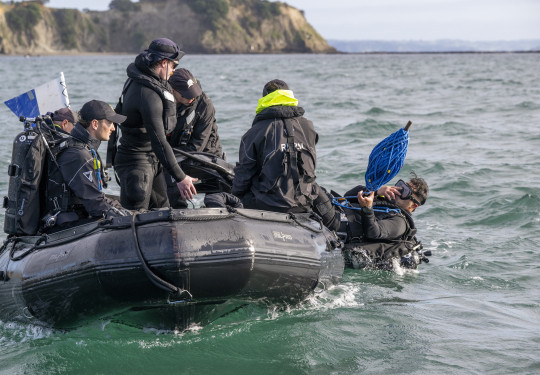
A diver from HMNZS Matataua leaves a Zodiac, a small boat. Five other sailors and divers remain in the boat.

26 June, 2025

The mines, which were more than 80 years old, were originally part of a defensive minefield laid in the early stages of the war to protect Auckland Harbour and the Hauraki Gulf from German and Japanese naval threats. The controlled minefields were designed to be detonated from shore stations in the event of an enemy sighting. 

By 1944, with the threat of attack significantly reduced, the mines were decommissioned by being remotely detonated. 

However, in the channel between Whangaparaoa Peninsula and Tiritiri Matangi Island, a number of mines misfired. It is believed that during the subsequent clearance by minesweepers, some mines became dislodged from their moorings and, over time, corroded and sank to the seafloor where they drifted with the currents. 

In 2014, an RNZN Maritime Explosive Ordnance Disposal team located and disabled some of these historical munitions. In March this year, five further mines were discovered in the area at a depth of between 21 – 28 metres.

This week, over three days, divers from the Navy’s littoral warfare unit HMNZS Matataua made the mines safe in a carefully planned operation.

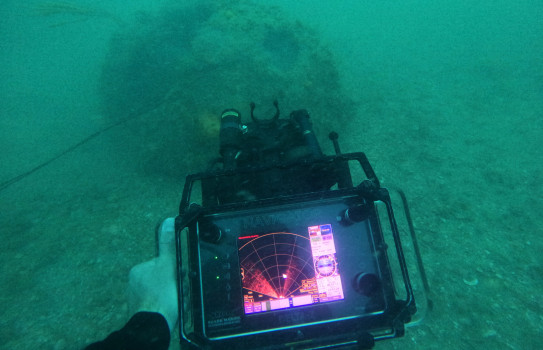
An underwater mine is scanned by a device that shows the mine on a radar-looking scanner.

A Diver Underwater Search System uses both sonar to detect mine-like objects and GPS to help navigate a diver to a position.

Low-level explosive charges cracked the mine casings and allowed seawater to render the high explosives inside inert. These carefully calibrated charges are designed to minimise environmental impact and disturbance to marine life.

The controlled explosions which effectively defused the mines were barely audible and created no visible disturbance on the surface. 

Marine mammal observers monitored for the presence of whales, dolphins, and other protected species during the operation to ensure the area was clear prior to the charges detonating.

Lieutenant Warwick Creasy, officer in charge of the disposal team, says while dangerous, this type of work is routine for the Navy in the Pacific Islands, where unexploded ordnance remains a concern.

“But these mines are very close to home, so we wanted to take every precaution to ensure they no longer posed a threat to commercial and recreational fishers, divers, or the marine environment.

“The task went exactly according to plan which reflects the intensive training we undertake, careful preparation and the type of extreme care that goes with the handling and placement of high explosives. Job done. Home safe.”

NZDF targets unexploded ordnance in Papua New Guinea

Four New Zealand Army Explosive Ordnance Disposal (EOD) operators have joined an Australian Defence Force-led operation to locate, identify and plan for disposal of Second World War-era ordnance in the East New Britain region of Papua New Guinea.

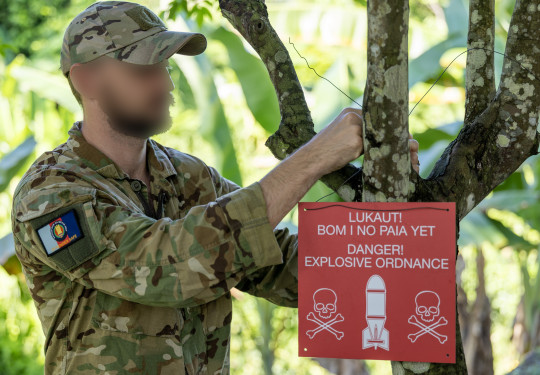
A member of the Kiwi team deployed to Operation Render Safe hangs up a warning sign.

24 June, 2025

The Kiwis joined personnel from Australia, Canada, France, Japan, Papua New Guinea, the United States and United Kingdom for Operation Render Safe, an operation that has been targeting explosive remnants of war (ERW) left throughout the Pacific after the Second World War for over 20 years.  

More than 25,000 people have been injured or killed in Papua New Guinea by ERW since the Second World War.

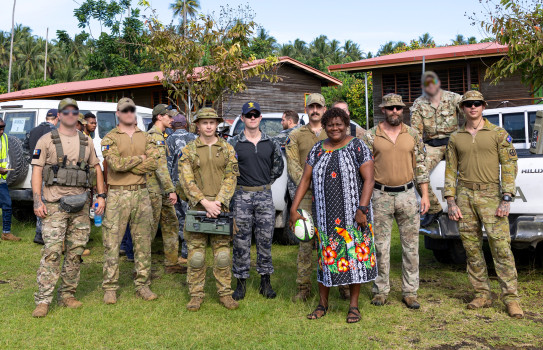
Soldiers stand with a local in front of white vehicles, buildings and tres

Operation Render Safe personnel with members of the East New Britain community.

Captain C led the New Zealand Defence Force (NZDF) team working within Combined Joint Task Force Wallaby to reduce explosive threats facing the communities of East New Britain.

“Alongside our partners over three weeks, we have located, marked and indexed over 2800 items of Explosive Remnants of War and Unexploded Ordnance. These were primarily of US and Japanese origin and ranged from 75mm anti-aircraft shells to 500lb bombs to Type 93 torpedoes. 

“Concurrently, we conducted an education programme at local schools to inform the children about the dangers of these items, as they are the ones who are commonly finding them while playing in the jungle.”

Operation Render Safe will return in 2026 to conduct disposal of the identified items.

U.K. Aircraft Carrier HMS Prince of Wales Arrives in Singapore

Dzirhan Mahadzir

June 24, 2025 4:55 PM

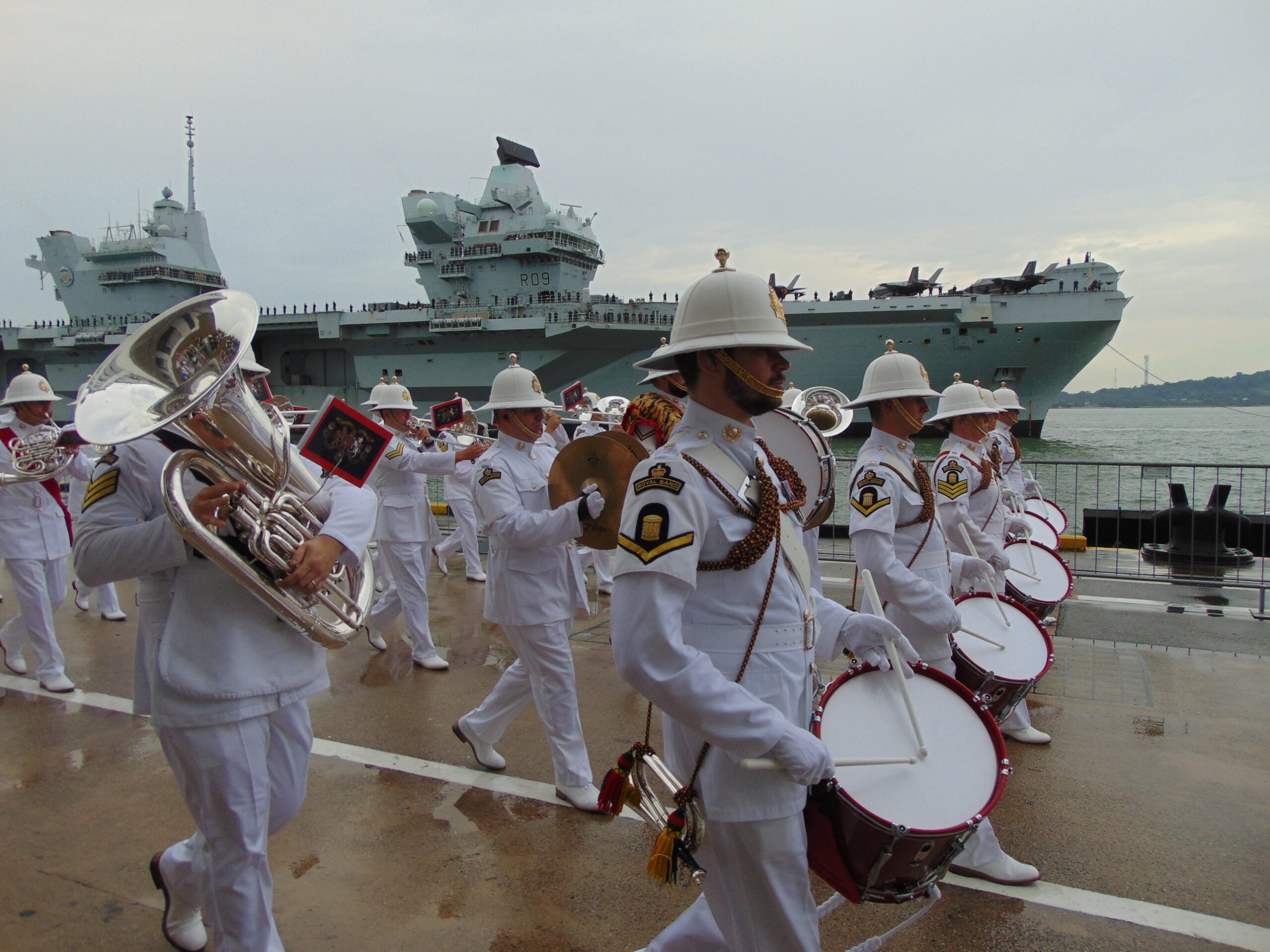
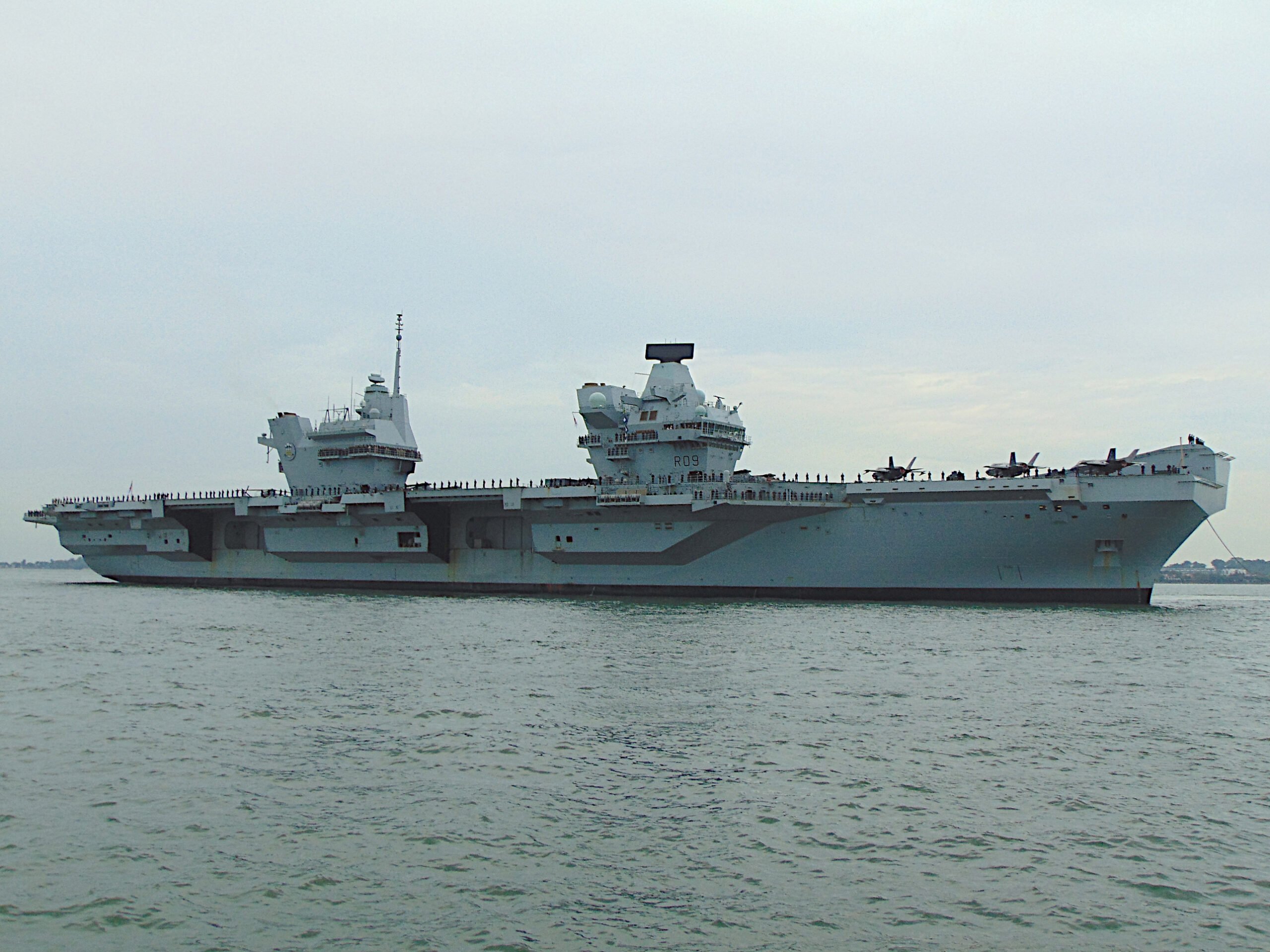
Royal Marines Band providing the ceremonial music for the arrival of Royal Navy Carrier HMS Prince of Wales (RO9) on Monday at the Marina Bay Cruise Center on June 23, 2025. USNI News Photo

SINGAPORE — Royal Navy aircraft carrier HMS Prince of Wales (R09), flagship of the U.K. Carrier Strike Group (UKCSG), docked at the Marina Bay Cruise Centre, Singapore, on this week for its first Indo-Pacific port visit for its Mediterranean and Indo-Pacific deployment known as Operation Highmast.
Following its port visit to Singapore, the UKCSG will head straight to Darwin, Australia to participate in multinational exercise Talisman Sabre, which kicks off on July 13 with a number of naval task forces now en route to participate in the drills

Since its departure from the U.K. in late April, the UKCSG operated in the Mediterranean carrying out Nato exercises in the region, which included exercise Mediterranean Strike 25 in the Ionian Sea, conducting dual CSGs operations together with the Italian Navy Cavour CSG. The UKCSG transited the Suez Canal on May 24 and subsequently the Red Sea and then carried out an exercise in the Arabian Sea from June 9-10 with Indian Navy INS Tabar (F44), an Indian Navy submarine and an Indian Navy P-8I Poseidon Maritime Patrol Aircraft (MPA).

The UKCSG currently consists of carrier Prince of Wales, RN destroyer HMS Dauntless (D33), RN frigate HMS Richmond (F239), Royal Canadian Navy (RCN) frigate HMCS Ville De Quebec (FFH332), Royal New Zealand Navy frigate HMNZS Te Kaha (F77) Royal Norwegian Navy (RNN) frigate HNoMS Roald Amundsen (F311), Spanish Navy frigate ESPS Mendez Nunez (F-104) and fleet oiler RFA Tidespring (A136). Royal Australian Navy destroyer HMAS Sydney (DDG42) is inbound to Singapore to join the UKCSG. On Monday, in a posting on social media channel X, the UK Permanent Joint Headquarters (PJHQ) stated that Sydney together with RN offshore patrol vessel HMS Spey (P234) conducted Freedom of Navigation Operations (FONOPs) around the Spratly Islands in the South China Sea.

The U.K. chose to have Prince of Wales docked at the Marina Bay Cruise Centre instead of Changi Naval Base in order to have the carrier being more visible, accessible and engaging, particularly with the UK and Singapore celebrating 60 years of diplomatic relations, stated UK High Commissioner to Singapore Nik Mehta in a press briefing on Thursday, “We could have put the carrier into Changi (Naval Base), and that is what every other country does, but we wanted to do something different, we wanted to make it more accessible, more visible and more engaging,” Mehta said.

The arrival of the carrier on Monday morning was welcomed by Mehta together with U.K. Vice Chief of the Defence Staff General Sharon Nesmith and invited guests. In a quick media session, Commodore James Blackmore, Commander of the UKCSG, stated that the UKCSG expects to depart next week for Australia to participate in Talisman Sabre and following Talisman Sabre, the UKCSG will sail through the Philippine Sea to head to Japan. Blackmore stated that during the passage through the Philippine Sea, the UKCSG will work closely with the U.S. Navy.

Royal Navy Carrier HMS Prince of Wales (RO9) on Monday at the Marina Bay Cruise Center. USNI News Photo

The UKCSG is now spread among three nations, Indonesia, Malaysia and Singapore on port visits. Roald Amundsen arrived in Singapore in mid-June and is docked at Changi Naval Base, DauntlessTidespring and Te Kaha are docked at Sembawang Port in Singapore, having arrived respectively on ThursdaySunday and MondayVille De Quebec pulled into the Port Klang Cruise Terminal, Malaysia on Monday. UK Defense Adviser Col. Eddie Maskell-Pedersen stated in Thursday’s media briefing that Richmond and Mendez Nunez will call into Indonesia.

Along with the UKCSG, a number of naval forces are heading towards Australia for Talisman Sabre which takes place from July 13 – Aug.4. The America Amphibious Ready Group (ARG) comprising of amphibious assault ship USS America (LHA-6), amphibious transport dock ship USS San Diego (LPD-22), amphibious dock landing ship USS Rushmore (LSD-47) along with the embarked 31sr Marine Expeditionary Unit (MEU) are wrapping up a port visit to Sydney, Australia and expected to make their way north to the waters off Queensland where amphibious drills are carried out. A U.S. CSG normally takes part in the drills but with the rerouting of the Nimitz CSG to the Middle East, it is unclear whether the George Washington CSG, currently in the Philippine Sea and the only U.S. Navy CSG in the region, will take part in the drills.

Two units of the Japan Maritime Self-Defense Force’s (JMSDF) Indo-Pacific Deployment (IPD25) are also heading towards Australia, namely the 2nd Surface Force consisting of landing ship tank JS Osumi (LST-4001) and the Second Surface Force, consisting of destroyer helicopter carrier JS Ise (DDH-182) and destroyer JS Suzunami (DD-114). The Republic of Korea Navy (ROKN) amphibious assault ship ROKS Marado (LPH-6112) together with embarked Republic of Korea Marine Corps (ROKMC) and naval special forces, and destroyer ROKS Wang Geon (DDH-978) departed South Korea on Wednesday for the drills. RNZN multirole vessel HMNZS Canterbury (L421), together with embarked New Zealand Army personnel and armored vehicles, left New Zealand on June 6 for the drills.

New Zealand-led navies conclude counter narcotics operations in Middle East waters

The New Zealand-led Combined Maritime Task Force 150 (CTF 150) has concluded counter narcotics operations in the Middle East.

CTF 150 2

25 June, 2025

Over the six-month period of command from the Royal New Zealand Navy’s Commodore Rodger Ward, ships operating in direct support to CTF 150 conducted 55 boardings.

The boardings resulted in the seizure and destruction of 7 tonnes of narcotics with a combined street value of more than NZ$1.8 billion. 

CTF 150 is one of five operational task forces under the Combined Maritime Forces (CMF) based in Bahrain and is focussed on maritime security in the Middle East, in particular the disruption of drug smuggling operations.

The New Zealand-led team was supported by personnel from the militaries of Australia, Canada, India, Singapore and the United States, which contributed members to the headquarters. 

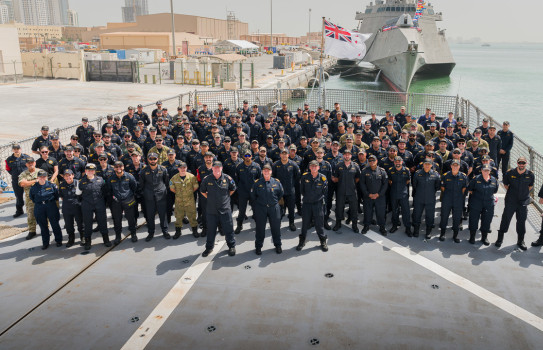
A large group of personnel stand with their arms behind their backs, legs shoulder-width apart on the flight deck of HMNZS Te Kaha.

Frigate HMNZS Te Kaha spent two months working for the Middle East’s Combined Maritime Taskforce 150, which was under New Zealand command for six months.

“The strength of the CMF is the 46 nations working together with a common aim of enhancing and upholding the rules-based international system,” Commodore Ward said. 

“In particular ensuring the freedom of the global maritime commons, the waters which allow our trade to flow safely from nation to nation.

“Our mission was anchored by four objectives: whakapono (trusted partners), mahi tahi (working together), kaitiakitanga (guardianship) and he heremana tatou (we are sailors). We based all of our operations and activities on these and they ensured that we got the most out of this opportunity.”

During the six-month period, CTF 150 conducted more boardings than over similar periods in previous years but found fewer drugs.

“The evidence of our success is not just the amount of drugs we interdicted,” Commodore Ward said. 

“Our engagement with partners across the region indicates that the amount of narcotics we disrupted could be as much as three times that. CMF is focused on countering this illicit activity and the smugglers know that.”   

Commodore Ward said he was proud of what the 26-strong multinational staff were able to achieve.

“We can all go home happy with the fruits of our labours.”  

HMNZS Te Kaha was assigned to CTF 150 for a period of two months before leaving the region, and conducted a significant number of boardings during that time.  The intelligence collected also resulted in the disruption of further smuggling operations.

JCs Royal New Zealand Navy Ships and New Zealand Defence, Also other World Defence Updates

Ships and Defence News Past and Present

Skip to content ↓