RNZAF building up for major combat exercise in Australia

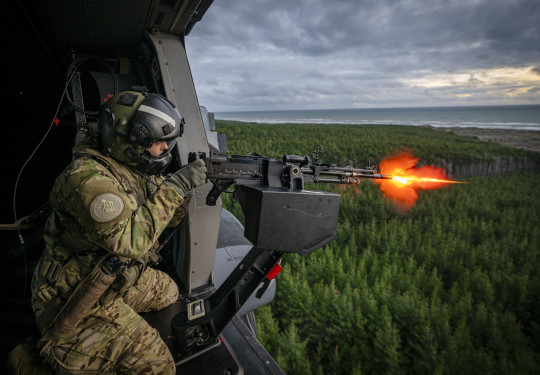
In the build-up to the high-tempo international warfighting Exercise Talisman Sabre in Australia next month the Royal New Zealand Air Force’s (RNZAF) NH90 helicopters and crews have been working on live-firing and formation flight skills.
20250603 NZDF K1055157 018

13 June, 2025

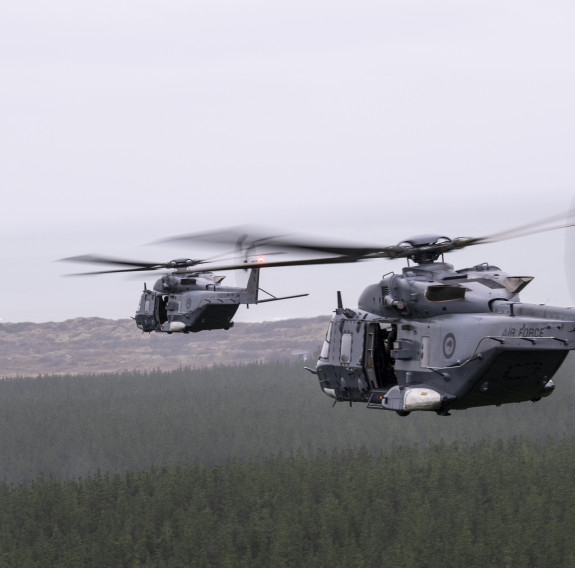
Priorities for No. 3 Squadron were to ensure its crews were qualified on gunnery skills and experienced with low-level formation flying.

“We went back to basics working on flying larger formations in the low-level environment than we do day-to-day, ending with adding tactical overlays,” NH90 pilot Flight Lieutenant Rob Kenyon said.

It was a busy week, which was reflective of how it would look during Talisman Sabre and the training worked well, he said.

The gunnery training took place at night as well as during the day, to highlight the different challenges of shooting without daylight.

“At night there’s obviously restricted vision and crew members needed to use night vision goggles. It’s also been two years since we’ve done that gunnery qualification training, so it was challenging and beneficial for the planners from that perspective.”

Talisman Sabre was designed as a conflict scenario exercise, so it was imperative to build up those skills, FLTLT Kenyon said.

“We need to be a combat-capable unit for if the government ever calls on us to work in that warfighting environment. The big thing with Talisman Sabre is the multi-national force integration. When we get to Australia, the work will be the same, but on a much bigger scale.”

For helicopter loadmaster Corporal Sam Swift the training was a chance for her to gain currency in the weapons and formation flying skills.

“We did day and night practise, firing from a hover, firing from a departing hover, doing a fly past while firing and firing while approaching a hover. Now we’re qualified on the MAG 58 machine gun.”

The training took place at the weapons range at Raumai, north of RNZAF Base Ohakea.20250603 NZDF K1055157 007
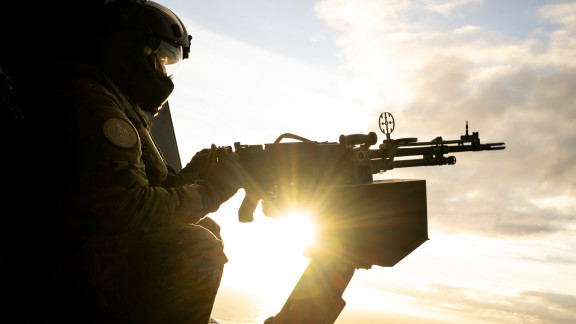
Watch Live-fire from an NH90 helicopter | Royal New Zealand Air Force video

Live-fire from an NH90 helicopter | Royal New Zealand Air Force

“It’s great for contributing to our operational effectiveness as a squadron because battlefield support is one of our outputs.”

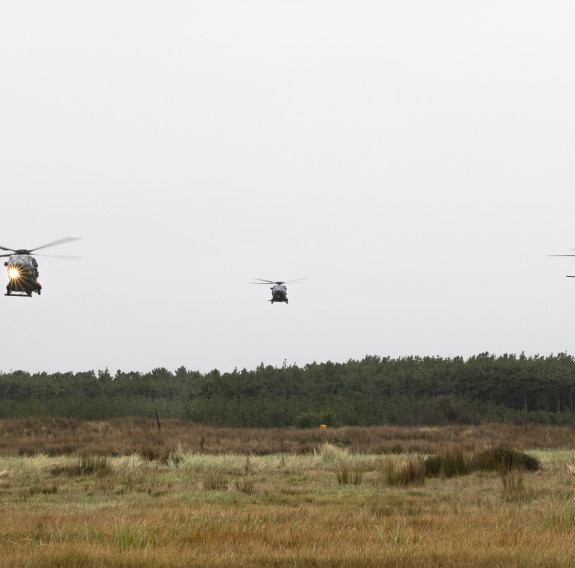
CPL Swift also took part in the three-ship formation flying training in preparation for the multi-national helicopter formations that will take place in Australia.

“Doing a formation of more than two aircraft is really beneficial for us to build in those skills of working together in a formation and having that awareness of other aircraft around us. It builds in that complexity of how we manoeuvre in the space.”

No. 3 Squadron crews will be working alongside the Royal Australian Air Force’s Chinook fleet, she said.

“I’m really excited. This will be my first big international exercise and it’ll be my first time going on Talisman Sabre. Battlefield operations and battlefield support is what I really wanted to do and what I enjoy the most in our job,” CPL Swift said.

In total, more than 680 New Zealand Defence Force personnel will deploy on the exercise and work alongside more than 30,000 military personnel and platforms from 19 nations.

Included in the RNZAF’s contribution to the exercise will be three NH90 helicopters a P-8A Poseidon and a number of supporting ground and air units.

Talisman Sabre will incorporate joint training scenarios including amphibious landings, maritime identification and interception, air operations, live-fire exercises, and logistics support across a vast training area, including in Australia’s Northern Territory and Queensland, and in the Coral Sea.Two large dark grey helicopters fly in formation over a pine forest under grey clouds.
Priorities for No. 3 Squadron were to ensure its crews were qualified on gunnery skills and experienced with low-level formation flying.Three NH90 helicopters fly towards the camera, heading to an empty paddock in the foreground. In the background is a forest to the horizon under grey clouds.
Priorities for No. 3 Squadron were to ensure its crews were qualified on gunnery skills and experienced with low-level formation flying.Two NH90 helicopters bank to the left, on in front of the other, over the ocean under great clouds.
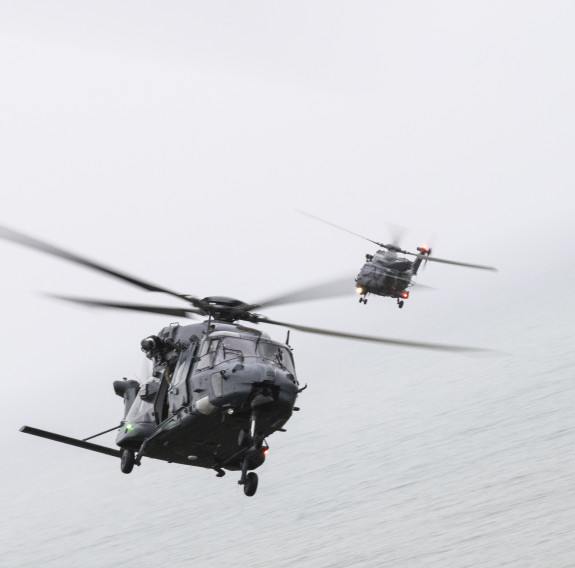
Priorities for No. 3 Squadron were to ensure its crews were qualified on gunnery skills and experienced with low-level formation flying.A loadmaster stands at the open side-door of an RNZAF NH90 helicopter as it comes into land. In the distance is a RNZAF A109 helicopter flying above the trees under a sky full of cloud.
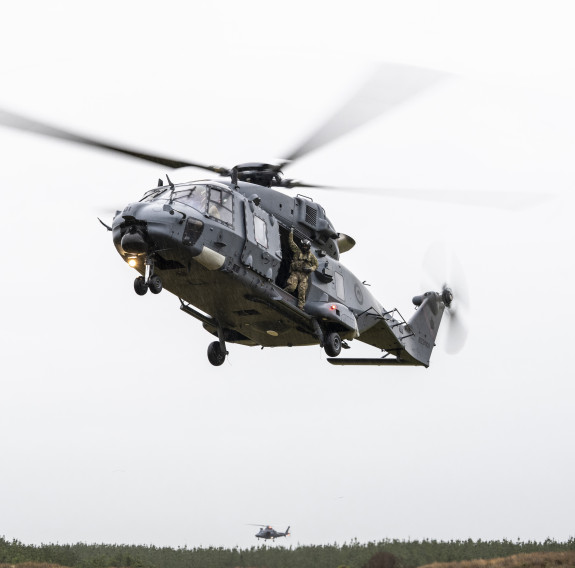
Priorities for No. 3 Squadron were to ensure its crews were qualified on gunnery skills and experienced with low-level formation flying.With the NH90 helicopter a loadmaster stands on the exterior step, under the side door of the helicopter. They have one hand up holding on the frame. The person takes up less than half of the open door space and the helicopter fills the frame.
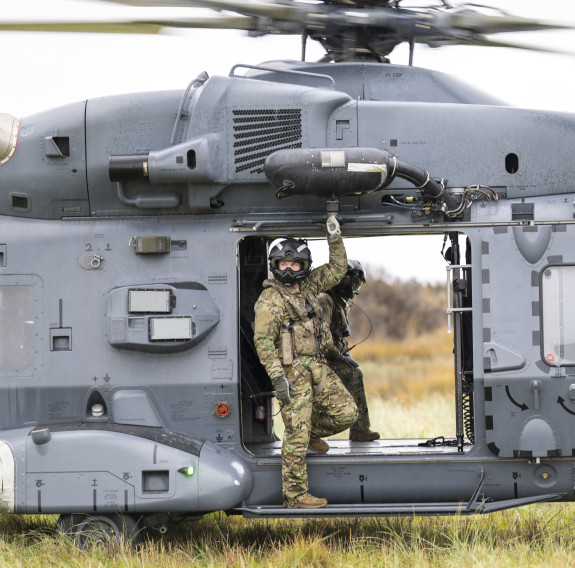
Priorities for No. 3 Squadron were to ensure its crews were qualified on gunnery skills and experienced with low-level formation flying.Scroll to previous imageScroll to next image

Kiwi sailor joins HMS Collingwood team for second shot at Navy’s field gun contest – includes video

Petty Officer Taane Tapp
Petty Officer Taane Tapp will be joining HMS Collingwood’s Field Gun Crew for the prestigious annual competition (Picture: Royal Navy)

13th June 2025 at 9:12am

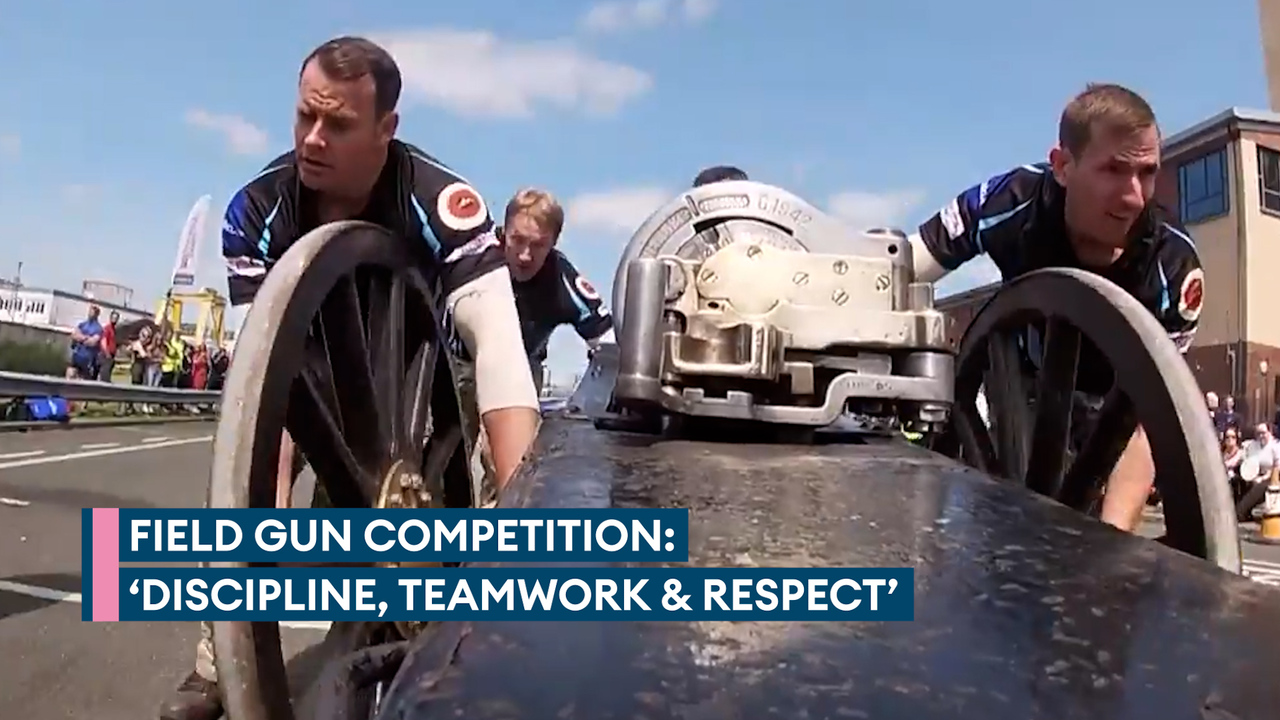
Petty Officer Taane Tapp from the Royal New Zealand Navy will once again compete in the Royal Navy and Royal Marines Charity (RNRMC) Field Gun competition later this month, representing HMS Collingwood in one of the service’s most gruelling ceremonial events.

The 33-year-old instructor is part of the base’s Warfare Training Group and has been selected for the final crew after months of preparation.

Originally from Te Tai Rāwhiti, New Zealand, PO Tapp now lives in Gosport with his wife Belinda and their two children.

“I am honoured to be part of the HMS Collingwood Field Gun Crew this year,” he said.

This will be his second time competing in the historic contest, which sees teams from across the country, and beyond, race to manoeuvre heavy field guns over obstacles in a timed test of teamwork, discipline, and raw physical strength.

New Zealand Naval Instructor joins HMS Collingwood's Field Gun Crew for prestigious annual competition
The RNRMC Field Gun competition is a prestigious annual event (Picture: Royal Navy)

Training began in February with gym sessions on base, whittling down more than 40 hopefuls to the final crew.

Full track training with the field guns begins on Monday 23 June under strict safety protocols.

PO Tapp brings extensive operational experience to the team.

He previously served on HMNZS Te Mana during disaster relief efforts for Cyclone Gabrielle, and on Operation Crucible, a five-month deployment around Southeast Asia.

Also part of HMNZS Te Kaha’s deployment to Gallipoli for the 100th anniversary of the ANZAC landings, he supported maritime security operations near the Gulf of Oman.

His medals include the New Zealand Operational Service Medal, the NZ General Service Medal (Greater Middle East), and the NZ Defence Service Medal, all awarded in 2015.

The proud tradition of the Field Gun Competition

The Field Gun competition, which dates back to 1907, commemorates the Royal Navy’s role in lifting the Siege of Ladysmith during the Second Boer War.

Teams of 18 run, dismantle, carry, and reassemble a field gun and limber in a dramatic race against the clock.

The final event will take place during HMS Collingwood’s Open Day on Saturday 28 June, offering the public a rare chance to witness this iconic tradition in action.

Related topics

Carrier Strike Group meets up with the Indian Navy in the western Arabian Sea

Jonathan Moyniha – 12th June 2025 at 1:45pm

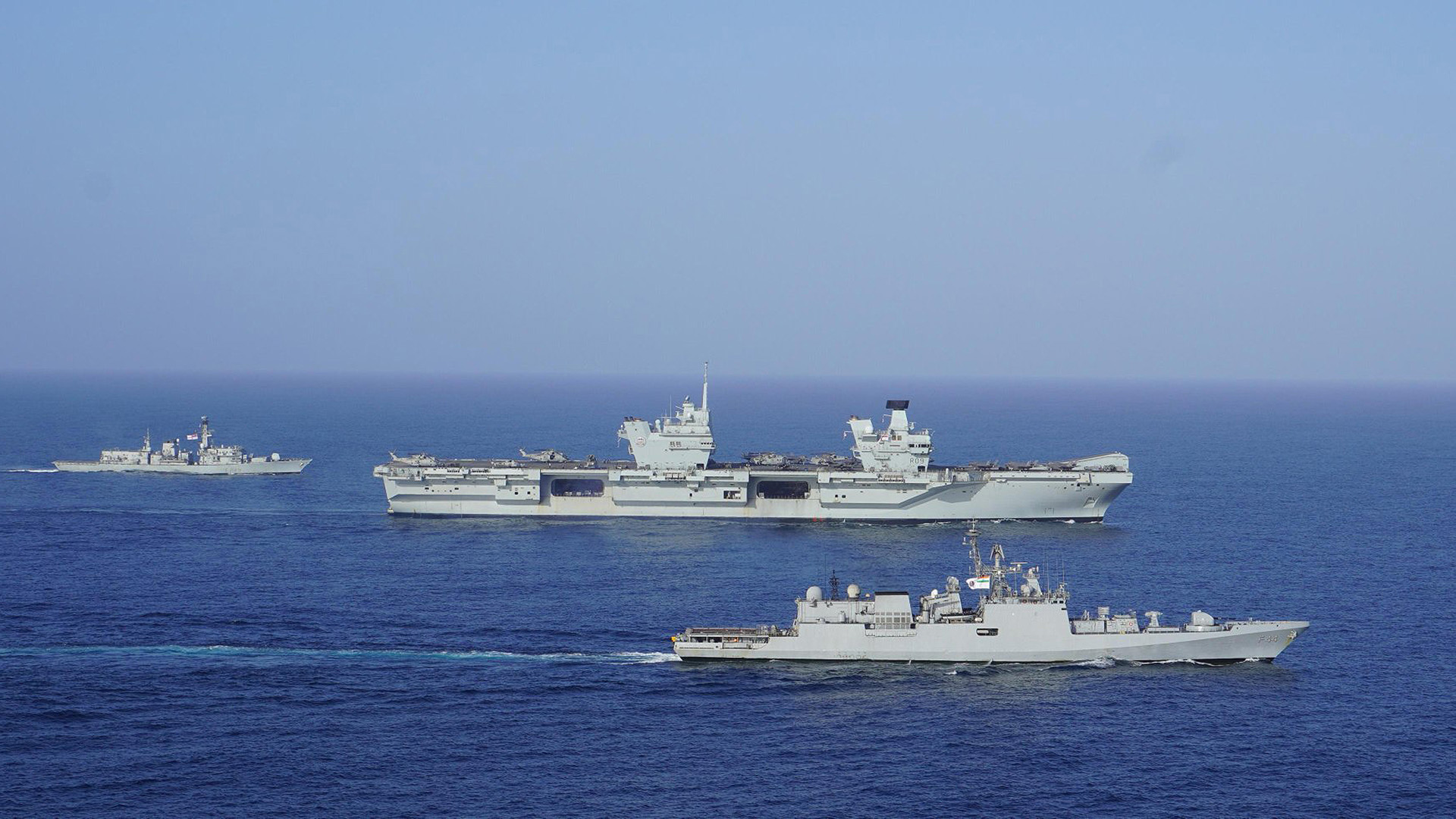
Carrier Strike Group 25 has joined the Indian Navy in the western Arabian Sea to conduct an exercise on its way down towards Australia.

It comes after RFA Tidespring carried out its first replenishment at sea of the week, as it refuelled New Zealand warship HMNZS Te Kaha in the Gulf of Oman.

CSG25 completed a passing exercise, widely known as a passex, where the ships of the two navies sail together, conducting drills to work on their communications and interoperability.

The Indian Navy posted images of the Talwar-class frigate INS Tabar in formation with HMS Prince of Wales and HMS Richmond.

“UK CSG25 joined the Indian Navy for an exercise in the western Arabian Sea,” the UK Carrier Strike Group said in a social media post on X.

“This marked the strike group’s first major engagement upon sailing into the Indo-Pacific.”

There was also an Indian submarine involved in the drills and an Indian P8 maritime surveillance aircraft.

The frigate HNoMS Roald Amundsen separated from CSG25 after the ships left the Red Sea and visited Sri Lanka on a port visit.

The Norwegian vessel is operating well ahead of the wider group.

“The multi-faceted naval exercise included unified control of integral helicopters, tactical manoeuvres, coordinated anti-submarine ops and professional exchange of officers,” the Indian Navy’s spokesperson wrote in a post on X.

“The joint exercise underscores the deepening cooperation between the two navies and showcases shared commitment to maritime security and robust bilateral ties.”

The Carrier Strike Group has passed through the Suez Canal

The deployment, also known as Operation Highmast, involves around 4,500 British military personnel, including nearly 600 RAF and 900 soldiers alongside 2,500 Royal Navy sailors and Royal Marines.

For more reports about Carrier Strike Group 25, click here.

History of HMNZS Takapu I (Q1188)(P3556) as far as I can find out.

HMNZS Takapu (Q1188/P3556)


Commissioned 22 May 1943 as Q1188
Survey Equipment: Fitted to Q1188 when rebuilt 1946-50
The USN supervised the construction and then took charge of the finished HDML for allocation to the Allied navy. Both Q1187(Tarapunga) & Q1188(Takapu) were shipped as deck cargo from Vancouver aboard SS Kootenay Park and arrived at Wellington on 30 April 1943. There they were unloaded by floating crane and underwent full commissioning trials.

HDMLQ1188 joined the 125th Motor Launch Flotilla based in Wellington. They then carried out routine patrols in their respective areas through to 1945. As the war came to an end in 1945 the launches were concentrated at Auckland to pay off.
Q1188 had been cannibalised for parts to keep the other HDMLs that were in service so she had to be rebuilt. This was completed in February 1950 and she was commissioned as SML 1188 and was sent to Wellington in March. After arriving in Wellington, she began a survey of Cook Strait. In April she was given the pennant number P3556.

HMNZS Takapu – taken during Queens Visit, Waitangi Day 1963

In November 1979 Takapu arrived at Auckland for paying off and was decommissioned in December. At this time the IPC vessels marked for survey duty were under construction at Whangarei and had been assigned the names Takapu & Tarapunga. Both SDMLs were repainted to the standard colour scheme and refitted for use by the RNZNVR. Takapu was renamed Kahawai II and was sent to HMNZS Toroa in August 1980. 

HMNZS Kahawai, ex HMNZS Takapu – Philomel in the background – Oct 30, 1982
Ex HMNZS Kahawai/ Takapu and being refitted for civilian use
Ex HMNZS Takapu

History of HMNZS Tarapunga (Q1187)(PP3566) as far as I can find out.

8 x depth charges

ASDIC

Complement: 10 officers and ratings

Builder: Everett Marine Ways Inc near Seattle, Washington, United States – ordered 21 February 1942, completed January 1943

Key Dates:

Commissioned 13 May 1943 as Q1187 [Tarapunga]

Paid off 19 September 1945 [Tarapunga] sold privately but returned in 1950 to the RNZN

Pennant No.: Q1187 as SDML

Renamed: Tarapunga as Mako 1980

Colour Schemes – in wartime service the HDMLs had a mixture of dark and light grey overall. Post 1945 this was changed to a light grey. The Survey Motor Launches [SML] were given an all white scheme as was standard for survey vessels in this period as per the images above.

This type of vessel was designed in 1939 by the Admiralty for harbour patrol and anti-submarine duties. It was designed for construction in civilian boatbuilding companies. Between 1940 and 1945 over 500 were built. They were considered very robust and seaworthy craft with good sea-keeping qualities. In January 1942 the Admiralty agreed to allocate HDMLs to New Zealand and ordered 24 from the United States under the Lead-Lease arrangements. Twelve vessels were ordered in May 1942 from the United States to be built in boatyards on the West Coast and East Coast.  The final vessel varied between each boatyard as to fit out and appearance. The USN supervised the construction and then took charge of the finished HDML for allocation to the Allied navy. Both Q1187 & Q1188 were shipped as deck cargo from Vancouver aboard SS Kootenay Park and arrived at Wellington on 30 April 1943. There they were unloaded by floating crane and underwent full commissioning trials.

HMNZS Tarapunga Ex Q1187 – arrives in New Zealand

It was intended that they would be used for anti-submarine patrols in the port approaches. They would replace the NAPS launches. Q1187 after commissioning joined the 124th Motor Launch Flotilla in Auckland. 

HMNZS Q1186, HMNZS Paea Ex Q1184, HMNZS Tarapunga Ex Q1187 alongside HMS Philomel – the original Philomel

Q1188 joined the 125th Motor Launch Flotilla based in Wellington. They then carried out routine patrols in their respective areas through to 1945. As the war came to an end in 1945 the launches were concentrated at Auckland to pay off.

   Q1187 sold and renamed COAST GUARD CUTTER No 1.

At the same time Q1188 and Q1187(ex-Coast Guard Cutter No 1)  the two coastal survey launches were fitting out for their new roles . They didn’t get Radar or lattice masts, but were fitted with modern Echo Sounding equipment.

Q1187 arrived on 30 June 1945 followed by Q1188 on 11 July. After paying off they were laid up at Pine Island. In July 1946 ownership passed to the Marine Department who was selling off war surplus. Once the Lend-Lease agreements were concluded the government put them up for sale. However, during the sale process the government realised the value and in February 1947 Q1188 was withdrawn from sale.

In 1949 the RNZN purchased the frigate Lachlan for use as the first survey vessel in RNZN commission. It was decided that two smaller vessels would be needed to assist her in the survey task which HDMLs would be suitable. Q1188 had been cannibalised for parts to keep the other HDMLs that were in service so she had to be rebuilt. This was completed in February 1950 and she was commissioned as SML 1188 and was sent to Wellington in March. After arriving in Wellington, she began a survey of Cook Strait. In April she was given the pennant number P3556.  A second launch was required for survey duty so that Auckland Coastguard’s Cutter No. 1, formerly Q1187 reverted to the RNZN on 29 May 1950 and was given the pennant number P3566 in October 1950. She was converted to SML in March 1951 and commissioned as a survey vessel on 21 March 1951. In April she proceeded to Wellington to carry out surveys of the Cook Strait. From then until 1979 both vessels carried out surveys right across the New Zealand coastline mostly by themselves or as a pair. They would also work with HMNZS Lachlan & Monowai.

HMNZS Tarapunga and Takapu SML’s parked up alongside Mothership Monowai
          Q1187 given the pennant number P3566 and was commissioned H.M.N.Z.S TARAPUNGA (Black Backed Gull)   

In 1948 the Admiralty reclassed HDMLs as Seaward Defence Motor Launches [SDMLs]. The RNZN changed the classification in August 1949. By March 1950 orders were issued to change the pennant numbers. Q1187 was assigned the number P3566 and Q1188 assigned P3556. This caused some confusion in signalling and the keeping of records. There is still today some uncertainty about which vessel is being referred to due to errors in recording the correct number. To try ad solve the problem for the signallers from May 1951 P3556 had [A] added and P3566 [B]. These were added to the hulls in 1953. On 28 October 1954 P3556A chased a stolen yacht off Whangaparaoa.

HMNZS Tarapunga [RNZN Museum]

HMNZS Tarapunga [RNZN Museum]The next change was to assign names to the SDMLs that were in service with the RNZN. Those SDMLs that were assigned to fisheries protection were assigned Maori names for fish while other vessels were given Maori names for sea-birds. On 21 July 1955 P3556A was renamed Philomel, P3566B was renamed Maori from the shore establishments. As per NO 14/56 of 19 January 1956 Philomel was renamed Takapu [Gannet] from October 1955. Maori was renamed Tarapunga [Black-backed Gull] also from October 1955. They would serve as survey vessels under these names until they were released from survey duty in 1979.

In 1979 Q1187, P3566 H.M.N.Z.S. TARAPUNGA one of the Survey S.D.M.L. was taken off survey duties, refitted and converted, had a lattice mast and radar fitted, similar to the Fisheries vessels, recommissioned, renamed H.M.N.Z.S. MAKO and handed over to the R.N.Z.N.V.R. Division at Wellington.
HMNZS Mako Ex HMNZS Tarapunga

September 1983, Q1187, P3566, H.M.N.Z.S. MAKO ex TARAPUNGA, R.N.Z.N.V.R. Division Wellington Stripped and declared surplus.

Renamed: Tarapunga as Mako 1980

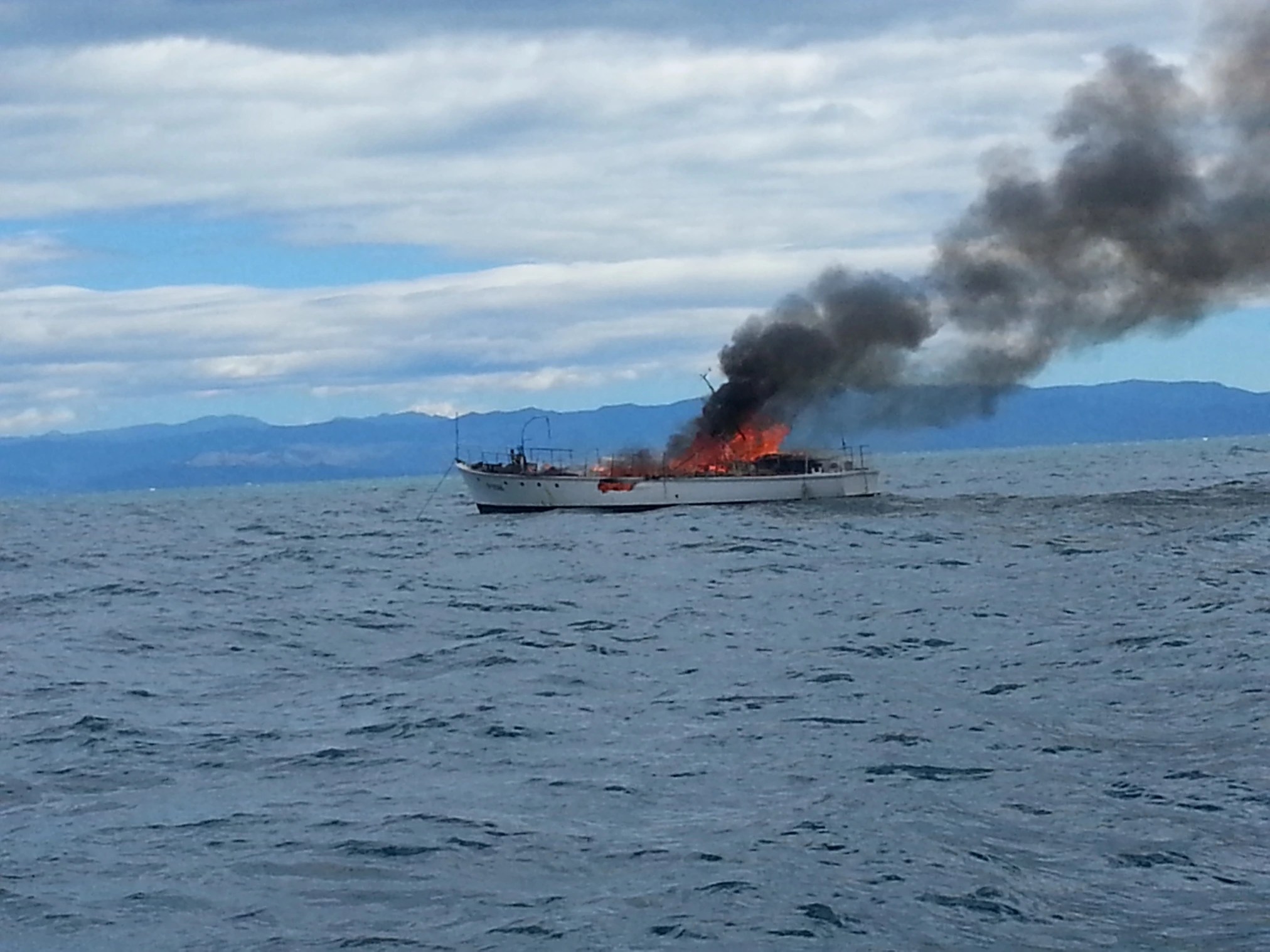
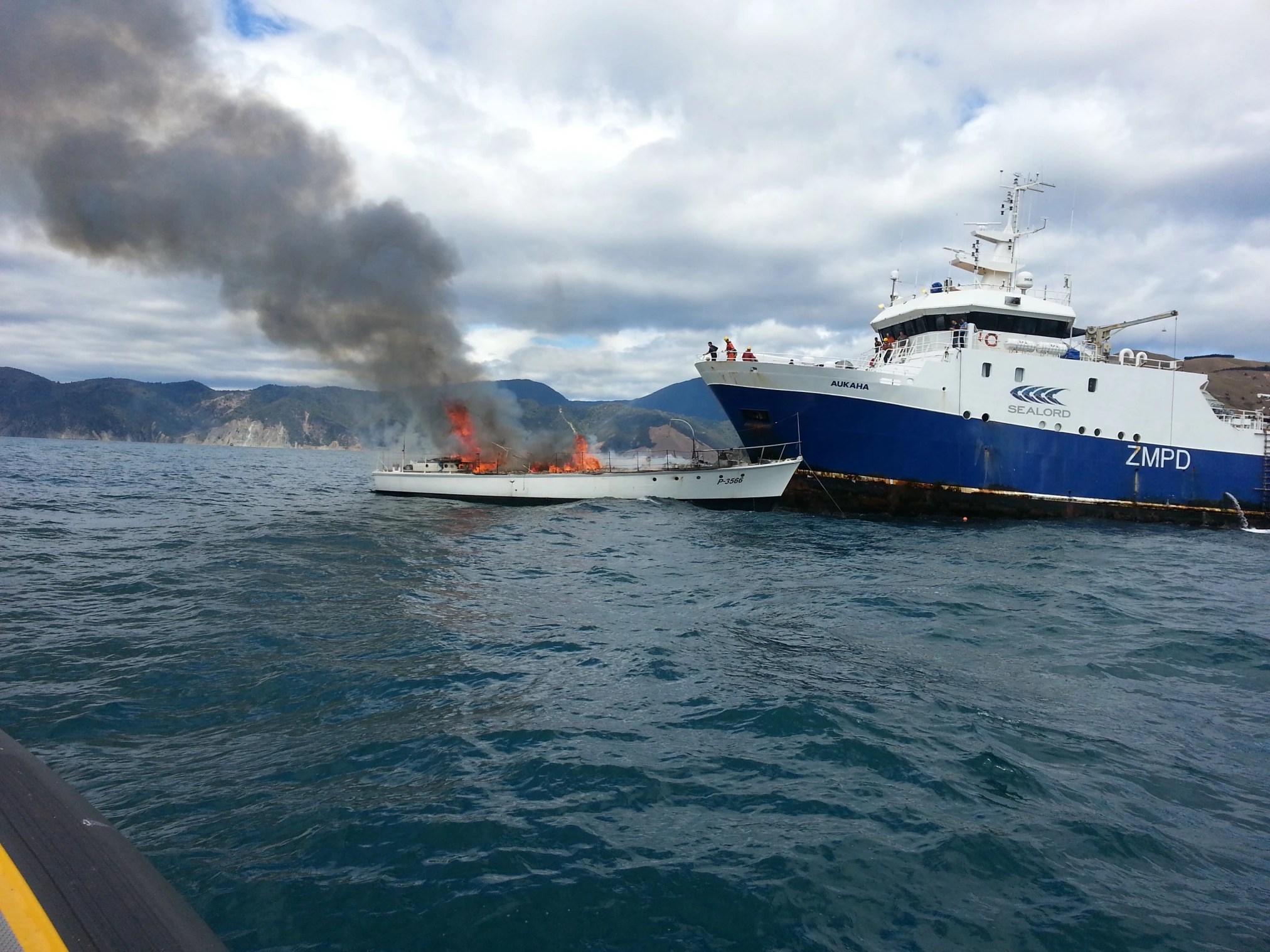
Ex HMNZS Tarapunga comes to an ignominious end in Cook Strait

JCs Royal New Zealand Navy Ships and New Zealand Defence, Also other World Defence Updates

Ships and Defence News Past and Present

Skip to content ↓