Captain Cook’s Long-Lost Ship HMS Endeavour, Confirmed in Newport Harbor

Mike Schuler

Painting by Samuel Atkins (1787-1808) of HMS Endeavour off the coast of New Holland during Cook’s voyage of discovery 1768-1771. Credit: Samuel Atkins (c.1760-1810) – National Library of Australia

The Australian National Maritime Museum (ANMM) has released its final report confirming the discovery of one of maritime history’s most significant vessels – HMS Endeavour – in Newport Harbor, Rhode Island.

The shipwreck, officially designated as site RI 2394, represents the remains of the British troop transport Lord Sandwich, formerly known as HMS Endeavour. The identification comes after an extensive 25-year study involving underwater investigations and research across multiple institutions.

Originally launched in 1764 as Earl of Pembroke, the vessel was renamed Endeavour by the British Royal Navy in 1768 for its famous Pacific voyage. Under Captain James Cook’s command from 1768 to 1771, the ship circumnavigated the globe, charted New Zealand’s coastline, and mapped Australia’s eastern coast.

Following its return to England, the vessel served as a naval transport before being sold to private owners who renamed it Lord Sandwich. Its final role was as a prison ship during the American War of Independence. In 1778, when American and French forces besieged British-held Newport, the British deliberately scuttled Lord Sandwich along with twelve other vessels to create a defensive blockade.

“This Final Report is the culmination of 25 years of detailed and meticulous archaeological study on this important vessel,” said Ms. Daryl Karp AM, Director and CEO of the museum.

Archaeological site plan of shipwreck site RI 2394, located in Newport Harbor, Rhode Island, USA. Credit: James Hunter

The breakthrough in identification came through extensive archaeological investigation. Site RI 2394 measures 18.2 meters long by 7.3 meters wide and features distinctive characteristics matching Endeavour’s original specifications, including a linear stone ballast pile, substantial timber frames, four iron cannons, and a lead scupper.

Dr. Nigel Erskine’s research in 2016 proved crucial in narrowing down the search area to a specific location north of Goat Island. Detailed excavation between 2019 and 2021 revealed key structural elements that matched Endeavour’s 1768 Royal Navy survey measurements.

The identification was based on multiple lines of evidence, including timber analysis showing repairs consistent with the vessel’s documented 1776 maintenance. The site also features unique characteristics such as paired and tripled floor timbers corresponding exactly with Endeavour’s main and fore mast locations.

While the Rhode Island Maritime Archaeological Project (RIMAP) continues to consider other candidate sites, no substantive responses have refuted the identification of RI 2394 as HMS Endeavour since the preliminary announcement in 2022.

Given the vessel’s immense historical and cultural significance to multiple nations, including Australia, New Zealand, England, the United States, and First Nations peoples throughout the Pacific, efforts are now underway to secure legislative and physical protection for the site.

Royal Navy men’s and women’s hockey teams face difficult Royal New Zealand Navy tests on tour down under

Kyle Dixon – 9th June 2025 at 4:19pm

Royal Navy men hockey v Royal New Zealand Navy Credit Royal Navy Hockey Date 09062025.jpg
Royal Navy hockey have been testing themselves on an overseas tour in New Zealand (Picture: Royal Navy Hockey)

The Royal Navy hockey association have been testing their men’s and women’s senior teams on an overseas tour in New Zealand.

In a series of matches against the Royal New Zealand Navy teams, the British side have struggled for results in some competitive clashes.

The first round of matches saw the hosts beat the UK team in both men’s and women’s fixture by the same 1-0 scoreline.

In the women’s series, the RNZN team made it two wins from two with a 3-1 victory but the men’s fixture saw the British Navy provide a sterner test.

A 1-1 draw saw neither side able to be separated and sets things up for an important series finale on Thursday.

HMNZS Resolution (A14) was a hydrographic ship of the Royal New Zealand Navy (RNZN).

HMNZS Resolution

Originally the United States Naval Ship USNS Tenacious (T-AGOS-17), the Stalwart-class ocean surveillance ship was used by the United States to locate and track Soviet submarines from 1989 to 1997, when she was transferred to the RNZN for use as a hydrographic survey ship.

The ocean surveillance ship USNS TENACIOUS (T-AGOS-17), foreground, and USNS CONTENDER (T-AGOS-2) lie tied up at Bishop’s Point. http://en.wikipedia.org/wiki/HMNZS_Resolution_(A14)

She served until 27 April 2012. She was subsequently sold to EGS Group, a private surveying company, and renamed RV Geo Resolution.

The ocean surveillance ship USNS TENACIOUS (T-AGOS-17), foreground, and USNS CONTENDER (T-AGOS-2) lie tied up at Bishop’s Point. http://en.wikipedia.org/wiki/HMNZS_Resolution_(A14)
HMNZS Resolution
HMNZS Resolution in Nelson
HMNZS Resolution


https://en.wikipedia.org/wiki/HMNZS_Resolution_(A14)

Carrier USS George Washington Back in Japan Ahead of Summer Patrol

Dzirhan Mahadzir – June 6, 2025 11:44 AM – Updated: June 6, 2025 12:06 PM

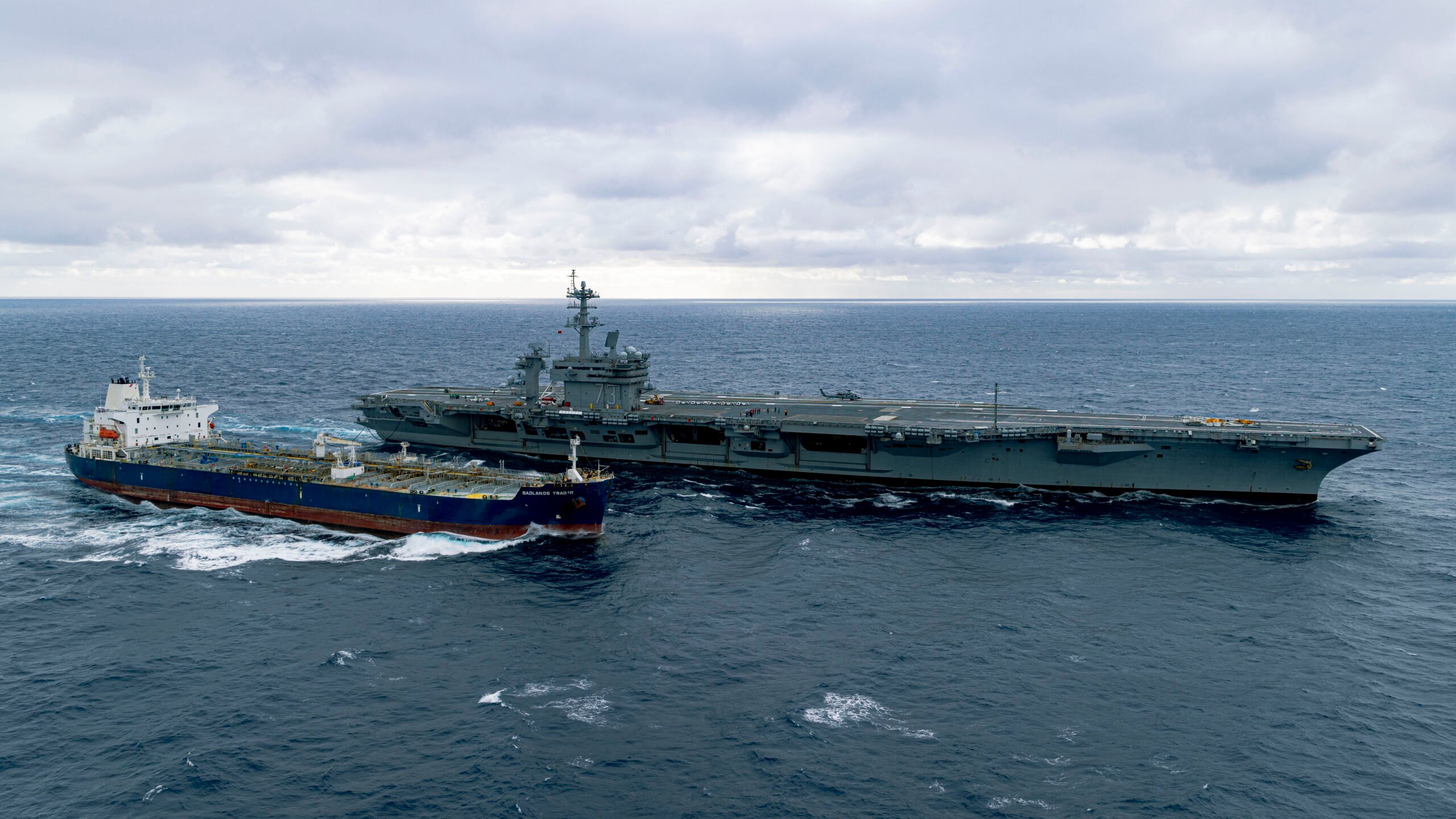
Military Sealift Command chartered ship motor tanker Badlands Trader positions alongside Nimitz-class aircraft carrier USS George Washington (CVN-73) during a fueling-at-sea while underway in the Philippine Sea, May 28, 2025. US Navy Photo

Forward-deployed aircraft carrier USS George Washington (CVN-73) returned to Yokosuka this week after wrapping up sea trials ahead of a summer patrol. Meanwhile, Carrier Air Wing (CVW) 5 wrapped up Field Carrier Landing Practice (FCLP) drills on Iwo To (Iwo Jima) on Saturday.


George Washington
 arrived on Wednesday and docked at Yokosuka, reads a release from the Yokosuka City Council, with ship spotters confirming the arrival. The carrier had departed Yokosuka on May 25 to carry out trials and training.

During its underway, George Washington sailed in the Pacific Ocean and Philippine Sea waters near Japan with Helicopter Sea Combat Squadron (HSC) 12 “Golden Falcons”, operating MH-60S Knight Hawks and part of CVW-5, embarked on the carrier and conducting flight operations on May 28 while also on the same day, George Washington conducted a fueling-at-sea with Military Sealift Command (MSC) chartered tanker Badlands Trader.

Meanwhile, the fixed-wing aircraft squadrons of CVW-5, consisting of Strike Fighter Squadron (VFA) 27 “Royal Maces”, VFA-102 “Diamondbacks” and VFA-195 “Dambusters” operating F/A-18E/F Superhornets, VFA-147 “Argonauts” operating F-35C Lightning IIs, Electronic Attack Squadron (VAQ) 141, operating EA-18G Growlers and Airborne Command & Control Squadron (VAW) 125 “Tigertails”, operating E-2D Hawkeyes, carried out FCLP training on Iwo To from May 19 to Saturday, marking the first time U.S. Navy F-35Cs had drilled on the island according to a Navy release.

Japan has been constructing an airbase on Mageshima, an uninhabited island lying roughly 30 miles south of the southeast tip of the main island of Kyushu and seven miles east off the island of the island of Tanegashima which houses Tanegashima Space Center, Japan’s largest space development center. However, labor and material shortages have pushed back the completion of the airbase from 2027 to 2030. The airbase will enable Japan Air Self-Defense Force (JASDF) F-35Bs and U.S. carrier-based aircraft to conduct FCLP training there.

George Washington’s parent command, Command Task Force (CTF) 70, conducted annual staff talks with the Japan Maritime Self-Defense Force (JMSDF) on May 28 at Destroyer Squadron (DESRON) 15 headquarters at U.S. Fleet Activities Yokosuka with Rear Adm. Greg Newkirk, commander of Task Force 70 and Vice Adm. Yoshihiro Goka, commander of the JMSDF Fleet Escort Force, leading the meetings, according to a release.

The meetings saw Task Force 70 and Fleet Escort Force staff members discuss maritime strategy, as well as upcoming patrols, operations and exercises, “These staff talks include the detailed planning and coordination that sets the foundation for those bilateral operations over the course of the year, and allows our combined naval force to come together as a single, formidable deterrent team,” said Newkirk in the release.

Currently, the Nimitz CSG is the only U.S. carrier strike group deployed in the Western Pacific. The CSG includes aircraft carrier USS Nimitz (CVN-68) with embarked CVW-17 and destroyers USS Curtis Wilbur (DDG-54), USS Gridley (DDG-101) and USS Lenah Sutcliffe Higbee (DDG-123). The Nimitz CSG is operating in the South China Sea, having sailed back there on May 25 after wrapping up a port visit to Malaysia. USNI News reported that Nimitz is on its final deployment before a scheduled decommissioning in 2026.

On Thursday, Japan’s Joint Staff Office (JSO) said on Wednesday, PLAN cruiser CNS Lhasa (102) and frigate CNS Weigang (550) were sighted sailing southeast in an area 31 miles southwest of the Kusagaki Islets and subsequently between Wednesday and Thursday, sailed east through the Osumi Strait, located between the main island Kyushu and Tanegashima Island, to enter the Pacific Ocean.

On Thursday, PLAN frigate CNS Yantai (538) and fleet oiler CNS Kekexilihu (903) were sighted sailing southeast in an area 74 miles northeast of Miyako Island and subsequently sailed south in the waters between Okinawa and Miyako Island to enter the Philippine Sea.

JMSDF destroyer JS Teruzuki (DD-116), frigate JS Noshiro (FFM-3), fast attack craft JS Otaka (PG-826) along with a JMSDF P-1 Maritime Patrol Aircraft (MPA) of Fleet Air Wing 1 based at JMSDF Kanoya Air Base on the main island of Kyushu, shadowed the PLAN ships, according to the release.

In other developments, JMSDF destroyer JS Haguro (DDG-180) and Royal Australian Navy destroyer HMAS Sydney (DDG-42) carried out a one-day exercise named Nichi-Gou Trident 25 in the East China Sea on Sunday that involved the two ships carrying out tactical maneuvering, cross deck exercises and personnel exchanges, according to a JMSDF releaseSydney left Australia in late March for a Regional Presence Deployment scheduled to end in early July and from the middle of May to the end of May, was conducting monitoring and surveillance operations in the East China Sea against maritime sanctions violations by North Korea. The Australian destroyer is now docked at Yokosuka, Japan for rest and replenishment before continuing its deployment.

USS Cabot/ESPS Dedalo

BySeaWaves Magazine – Jun 5, 2025

The US entered World War II with seven aircraft carriers but by early 1942 only one remained operational. In June of that year, in order to meet the Navy’s pressing demand for carriers while the Essex class was under construction, President Roosevelt ordered the conversion of nine Cleveland-class light cruiser hulls to the Independence-class light aircraft carrier. Nine of these carriers were completed by the end of 1943. The U.S.S. Cabot (CVL-28) was the only one of the nine to survive for nearly five decades.

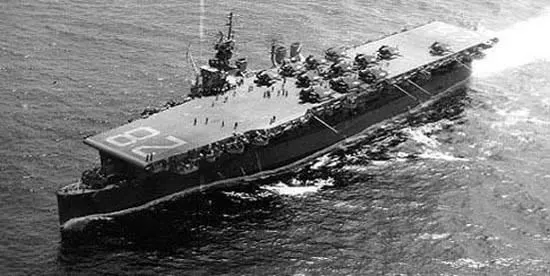
U.S.S. Cabot earned nine battle stars and the Presidential Unit Citation for service during World War II. US Navy Photo

Cabot was built by the New York Shipbuilding Corporation and entered service in January 1944. Throughout 1944 and 1945 she participated in raids on Truk, the Marshalls, Palau, Hollandia, and the Marianas, and in the invasions of the Philippines, Leyte, Iwo Jima, Okinawa, and Wake Island. Dozens of enemy ships were sunk by the Cabot and 252 planes were downed. She was also selected as the carrier to host war correspondent Ernie Pyle when he covered carrier operations late in the war. It was Pyle who gave the vessel the nickname “Iron Woman” after it underwent multiple attacks without ever stopping for repairs. Cabot served in nearly every major naval engagement in the Pacific for which she earned nine battle stars and the Presidential Unit Citation. Decommissioned in 1947, she was transferred to Spain in 1967 and renamed Dedalo as part of a lease program. Purchased by the Spanish government in 1973, she served in their navy until 1989.

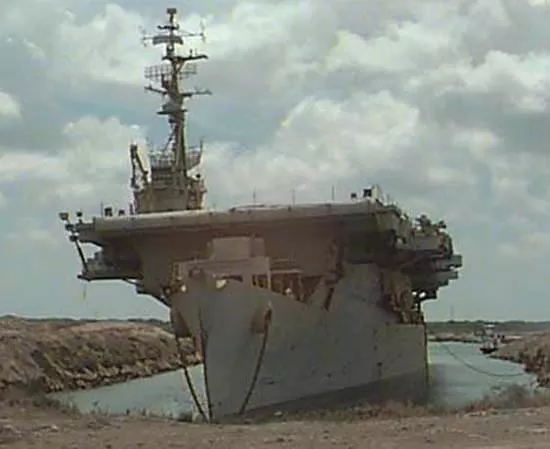
Cabot’s final dock, at the scrapping facility in the Port of Brownsville, TX.
ECOSAT Photo

Cabot was acquired from Spain by the New Orleans-based Cabot-Dedalo Museum Foundation. The vessel was designated a National Historic Landmark on June 29, 1990, but the museum foundation folded when it was unable to secure sufficient funds for restoration. The carrier remained moored in New Orleans, deteriorating and accumulating large fees for dock space and environmental clean-up. Considered a danger to shipping traffic in the Port of New Orleans, she was moved to Texas in 1997. In 1998 the vessel was seized by US Marshals and auctioned off in 1999 to pay the accumulated debts. While the vessel was named a national treasure by the National Trust for Historic Preservation shortly before the auction, efforts by preservation groups failed to raise sufficient funds to purchase Cabot. The vessel was purchased by Sabe Marine Salvage; subsequently, the Environmental Protection Agency barred the company from taking the ship overseas for salvage because of the presence of hazardous materials.

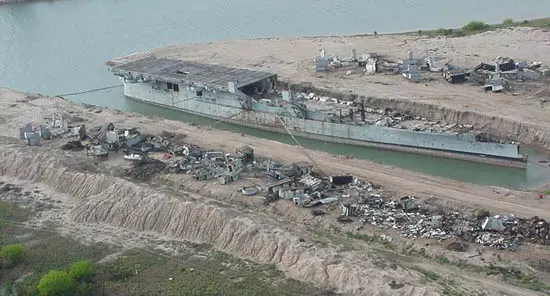
March 19, 2001: Parts of Cabot are removed and ready for sale, as the vessel meets its end at the Port of Brownsville. ECOSAT Photo

Scrapping of Cabot began in November 2000 at the Port of Brownsville, Texas, in a special scrapping facility built by Maruti Steel, Inc. Much of the flight deck was first dismantled and portions of the deck including the island tower, antennas, and gun mounts were sold to aircraft carrier museums. Some miscellaneous artifacts were removed and deposited with museums or the Curator Branch of the Naval Historical Center, US Navy.

The Landmark designation of Cabot was withdrawn on August 7, 2001, as the qualities that originally led to its designation had been destroyed. The fate of the vessel does illustrate an important point about the National Historic Landmark designation. The designation of a property as National Historic Landmark does not restrict the manner in which the property may be used, altered, or disposed of by a private owner.

JCs Royal New Zealand Navy Ships and New Zealand Defence, Also other World Defence Updates

Ships and Defence News Past and Present

Skip to content ↓