Tugboats move the USS Enterprise aircraft carrier at its launching at Newport News Shipbuilding and Drydock Company, Newport News, Va., September 24, 1960. (U.S. Navy) (Tribune News Service) —
A Vermont company has been awarded more than a half-billion dollars to dismantle a historic aircraft carrier in Mobile, Ala. According to a Pentagon procurement notice posted Friday, NorthStar Maritime Dismantlement Services LLC of Vernon, Vt., has been awarded a $536,749,731 firm-fixed-price contract for “the dismantling, recycling, and disposal” of the former USS Enterprise, CVN-65. The Enterprise was the world’s first nuclear-powered aircraft carrier when it was commissioned in 1961. It was the only vessel of its class to be built, and 1,123 feet, was the longest ship to ever serve in the U.S. Navy. “The Big E” completed 25 deployments during 51 years of service, according to Naval History and Heritage Command. The carrier was deactivated in 2012 and decommissioned in 2017. The Navy’s effort to dispose of the decommissioned nuclear-powered carrier has been more than a decade in the making, AL.com has reported. The Navy has said it would see significant cost savings by outsourcing the dismantling to a private company rather than undertaking it at a Navy facility. The notice states NorthStar Maritime Dismantlement Services will be responsible for any hazardous materials encountered during the dismantling, “including low-level radioactive waste, [which] will be packaged and safely transported for disposal at authorized licensed sites.” Work is expected to be completed by November 2029.
Serving with the USN from 1963 to 1970, these ships were designed to perform acoustic experiments on sound transmission underwater, and for gravity, magnetism and deep-ocean floor studies.
Charles H. Davis underway in Boston Harbor, 30 January 1963, five days after being placed in service
The ship was recommissioned into the RNZN in late 1970, and as HMNZS Tui served as an oceanographic survey and research ship until her decommissioning in 1997. In 1999, the ship was scuttled as a dive wreck.RNZN In 1970, she was transferred to the RNZN, and was commissioned on 11 September 1970 as HMNZS Tui. Tui was named after the Tui bird, and was the second of two ships with this name to serve in the RNZN.
After a partial refit and the installation and testing of scientific equipment, Tui began a program of work for the Defence Scientific Establishment in Auckland. For years Tui went unobtrusively about the kind of work she was designed for, primarily underwater acoustics.
Tui worked in Australian, Indian Ocean and South Pacific waters. She worked on Auckland University research, with DSIR scientists, and with other oceanographic ships. Tui also took part in several American research programs. Her acoustic research was mainly to do with the detection and tracking of submarines.
HMNZS Tui – returning home after RIMPAC
During the 1970s she made an extensive search for the Maria Theresa Reef.
Decommissioning and fate In 1997, Tui was decommissioned and was replaced by the hydrographic ship HMNZS Resolution.
In February 1999, Tui was scuttled 2 kilometres (1.2 mi) from Tutukaka Heads to serve as a tourist attraction and wreck for divers, following a period of work on her which removed any objects in danger of breaking free and welding shut any areas that may have posed a hazard for wreck divers.[1] Her anchor was presented to the City of Napier
Say hello to the first of a new generation of ships for the Royal Navy
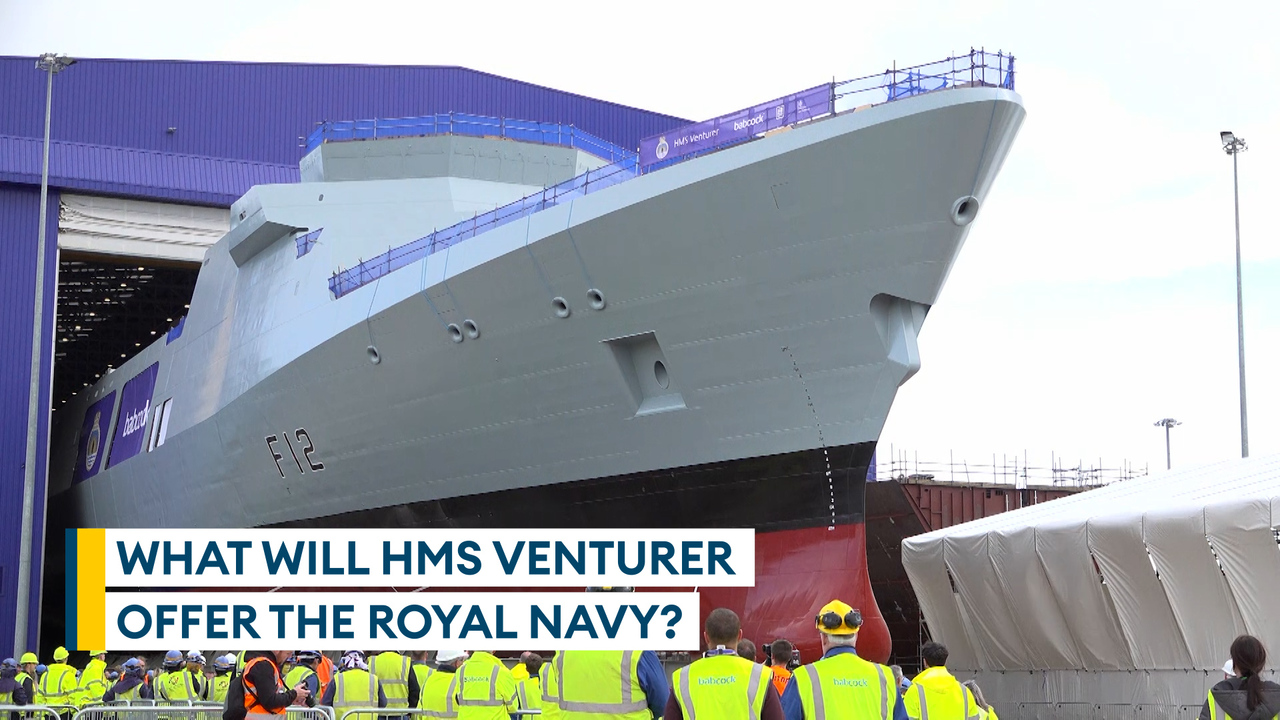
This week marked a significant milestone for the Royal Navy as the Type 31 HMS Venturer was officially rolled out of the build hall in Rosyth, receiving applause from gathered workers and officials.
The Venturer is the first of five new Inspiration-class frigates, playing a vital role in the Royal Navy’s strategy to modernise its ageing fleet.
Costing up to £300m, the Venturer is viewed as a crucial and cost-effective response to the Royal Navy’s ongoing shortage of ships and personnel.
Speaking on BFBS Sitrep, defence analyst Professor Michael Clarke explained the current state of the Royal Navy, saying: “The challenges are legion.
“It’s a very busy Navy, and it’s going to get a lot busier if we’re going to meet our current strategic expectations.”
The Royal Navy currently comprises about 60 operational ships, not including the Royal Fleet Auxiliary (RFA).
However, deployable numbers are a concern as Prof Clarke explained, saying that around 10 frigates and destroyers might be available for deployment at any given time.
He said: “I remember when they used to regard 32 as the irreducible minimum.
“They said, we can’t possibly exist without 32.”
Highlighting a critical gap between strategic ambitions and available resources, he said: “We’re sending a carrier battlegroup around the world with our allies, yet we’re very short of deployable ships.”
BFBS Forces News reporter David Sivills-McCann was present during HMS Venturer’s rollout and described the event as impressive, especially for the workers involved in its construction.
The ship’s exit from the build shed took approximately 45 minutes and was accompanied by changing weather typical of Scotland.
Of the pride felt by those who worked on HMS Venturer, Mr Sivills McCann said: “It was a lovely day for a lot of the workers gathered who were involved in the construction, just to watch the whole thing unfold.
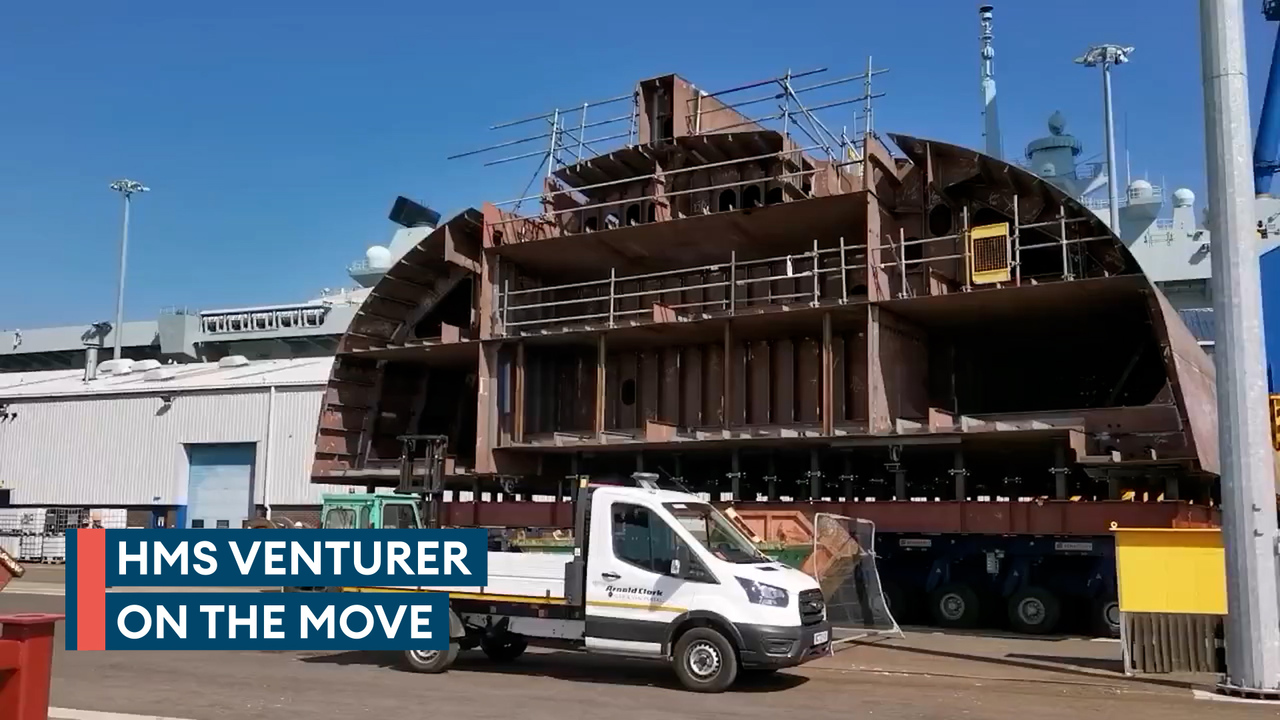
A section of HMS Venturer’s hull was moved for its paint job in May 2023
“There was a lovely moment, actually, when they broke into spontaneous applause when it ended.”
Sir Nick Hine, former Second Sea Lord and now Chief Executive of Marine at Babcock, the company overseeing the Type 31 construction, expressed the day’s importance, saying: “What a great day… the first rollout of a ship that has been built entirely by Babcock in Rosyth.
“First time we’ve ever done that. The first of many.
“We’ve got [HMS] Venturer out today, we’ve got [HMS] Active in the shed. We’ve got another, [HMS] Formidable, in bits around the yard that we’re going to put in the shed.
“I mean, that’s a pretty impressive drumbeat of platform delivery.”
HMS Venturer’s first nine crew members visited her at the factory in July 2023
Operating from the Caribbean, South Pacific, Mediterranean, Middle East and the Indo-Pacific, the new Type 31 vessels are designed to deter aggression and maintain the security of the UK’s interests, delivering a warship presence across the globe.
HMS Venturer can pack a punch during maritime security patrols because she is equipped with a 57 mm gun, two 40 mm guns and the Sea Ceptor.
The naval air defence weapon system can protect an area the size of Greater Manchester (500 square miles/1,300 square kilometres) by engaging multiple targets simultaneously, reaching speeds of up to three times the speed of sound as it intercepts.
The Type 31 frigate can also be used as a launchpad for commando raids, anti-piracy operations, escorting vessels encroaching on UK waters, plus disaster relief efforts and diplomacy overseas.
HMS Venturer’s flight deck is the largest of any Royal Navy Frigate or Destroyer and can operate a range of aircraft types such as Merlin, Wildcat and Chinook.
These ships will replace ageing Type 23 vessels, providing modernised capabilities with a smaller crew size – 60% larger than their predecessors but requiring only 60% of the workforce.
The first steel was cut for HMS Formidable in October 2024
Sir Nick emphasised that with recruitment and retention issues affecting the Armed Forces, designing affordable and efficient ships is paramount for future naval operations.
He said: “All navies all over the world suffer from not enough money and not enough people, so we’ve got to build ships that are affordable and we’ve got to make them be able to be operated by less people.”
As the Royal Navy faces challenges such as budgetary constraints and personnel shortages, the rollout of HMS Venturer is an encouraging step toward building a more capable fleet ready to meet the demands of modern naval warfare.
The aim is to have all five Inspiration-class ships operating at sea by 2030.
You can listen to Sitrep wherever you get your podcasts, including on the BFBS Forces News YouTube channel.
Reservists from three Royal New Zealand Navy units combined with Regular Forces to provide on-the-water security for a visiting US Navy ship in Wellington last week.
30 May, 2025
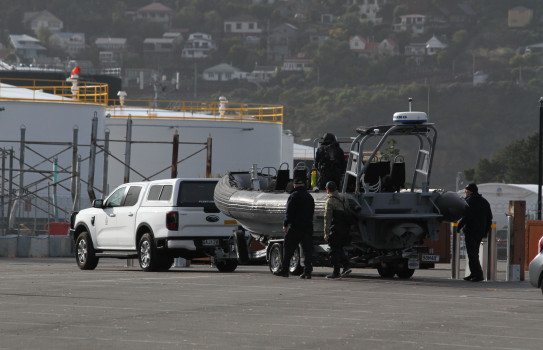
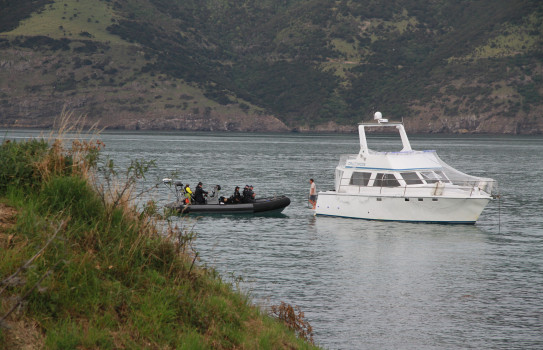
Personnel from Christchurch Reserve Unit HMNZS Pegasus brought up their J3 RHIB on a trailer to Wellington, while Regular Force personnel from the Boat Squadron at HMNZS Philomel trailered their RHIB down from Auckland.
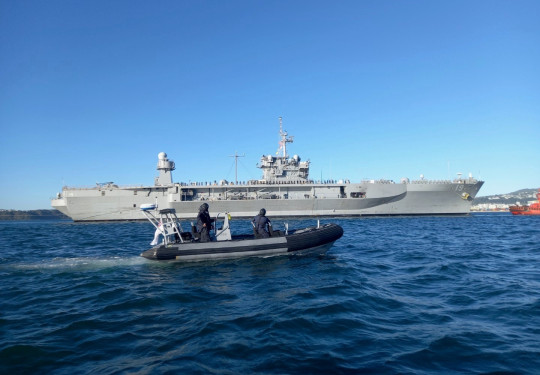
As part of a Force Protection team of Navy and NZ Police, the work involved escorting the 7th Fleet flagship USS Blue Ridge into Wellington Harbour on 16 May and patrolling the ‘Defence Zone’ around the ship during the days and nights it was berthed at Centreport wharves.
The work required the rotation of the two boats on 24/7 shifts using Philomel personnel and reservists from Pegasus, Dunedin Reserve Unit HMNZS Toroa and Wellington Reserve Unit HMNZS Olphert. The New Zealand Police launch Lady Elizabeth IV and a Police RHIB shared patrolling duties.
The Blue Ridge departed Wellington on 21 May.
Warrant Officer Combat System Specialist Richard Murray, Regular Forces and Acting Divisional Coxswain Pegasus, was the Officer in Charge for the tasking. He came with one reservist from Toroa, three Pegasus reservists and ‘Razor’, the unit’s RHIB.
The tasking was short notice but the reservists were keen to support, he said.
The Royal New Zealand Navy prepare to launch a RHIB.
The crews and boats rotated four-hour shifts, basing the RHIBs out of Seaview Marina across the harbour.
Petty Officer Maritime Trade Operations James Dunlop-Storey, HMNZS Olphert, says it’s great to see Reserves working closely with other agencies. “It was good to work so closely with Police and I look forward to working with other Government agencies in the future.”
He said they experienced the full range of Wellington weather during the protection period, including torrential rain over the weekend.
“It’s always good to spend time on the tools, and having little blue penguins and seals coming to check what we were doing is always heart-warming.”
For Christchurch, it’s another solid tasking for ‘Razor’, which is with the unit for a ‘proof of concept’ trial to test the return of small boat capability to the Naval Reserve Force.
Early this year Pegasus assisted the Environment Canterbury Harbourmaster on a Safe Boating project, taking their RHIB to harbours and lakes in Canterbury and talking to boaties.
The crews and boats rotated four-hour shifts, basing the RHIBs out of Seaview Marina across the harbour.
Lieutenant Commander Tim Johns, Commanding Officer HMNZS Pegasus, says it was a very good demonstration of how Reserves and Regular Forces could merge seamlessly.
“It was 50 percent Reserves, 50 percent Regular Forces, doing the same tasking together. And from the perspective of our trial, it shows our deployability of our RHIB from land. This kind of tasking grows our Navy’s collective knowledge and skill.”
The other benefit was showing the talents of the Reserve Force to Regular Force personnel.
“The Regular Force have very limited opportunity to interact with Reserves. It can be difficult to comprehend the way we operate given that reservists have other careers to manage while still providing support for the Navy.
“So this was a really good engagement piece where members of the two force elements got to learn from each other. The Reserves are staffed with a lot of ex-Regular Force personnel, and there’s a lot of recent experience we can bring to the table. This is a very good starting point to show how we can operate together on a more regular basis.”
HMNZS Tui (T234), a bird-class minesweeper of the Royal New Zealand Navy, 1944
Tui was the first of two ships with this name to serve in the Royal New Zealand Navy and was named after a native bird from New Zealand.
War service
In March 1942 in Scotland, Tui and the four Isles-class trawlers, Killegray, Inchkeith, Sanda and Scarba had been newly built for New Zealand. They were formed into a flotilla and departed from the River Clyde with a convoy bound for Canada. The trawler flotilla then left for Auckland, arriving there in August.
In Auckland, Tui was assigned to the 25th Minesweeping Flotilla and sailed for Suva to replace Matai. In December she joined her sister ships Kiwi and Moa at Nouméa. The 25th Minesweeping Flotilla had been offered to COMSOPAC, and by early December Tui, Moa, and Kiwi with Matai as flotilla leader, were all together at Nouméa ready to move north. They sailed for the Solomons, escorting a convoy some of the way. Making Tulagi their base they began anti-submarine screen patrols on 19 December 1942 off Tulagi and Lunga Point, Guadalcanal.
Torpedo Bay Navy Museum · In 1943, Minesweeper Bird Class Trawler, HMNZS Tui had a near miss whilst patrolling off Guadalcanal when a Japanese torpedo bomber fires at her, narrowly missing. Only her slow speed, 8 knots, saved her. Photo: HMNZS Tui Red Watch c1940s ABJ 0171
Landing barges
On 21 January 1943, Tui and Moa came across four Japanese landing barges stopped close inshore. When Tui and Moa closed in, those aboard the barges opened fire with machine guns and small arms and got underway. At close range Moa fired on the leading barge, but a fluke shot passed through the 4-inch (102 mm) gun aperture, ignited a cordite charge and injured all seven in the gun crew. Moa managed to silence the first barge and sink the last in line with 20 mm (0.79 in) gunfire, then withdrew and attended to the cordite fire and injuries. Tui then opened fire on the barges, sinking one with her 4-inch gun, and the remaining two escaped inshore in the darkness.[1]
Submarine I-17
On 19 August 1943, while escorting a convoy from Nouméa, Tui picked up a submarine contact. She made an initial run over it without using depth charges, a second run dropping two depth charges, and a third run throwing another two depth charges. Contact was lost and Tui signalled some US Kingfisherseaplanes of US Scouting Squadron VS-57, based in New Caledonia, to join the search. One of these indicated that Tui should investigate smoke on the horizon, where a submarine was sighted on the surface and Tui opened fire at maximum range, scoring one, possibly two hits. The aircraft then dropped depth charges and the submarine sank at 23°26′S 166°50′E.
The submarine was the Japanese submarine I-17, 2,190 tons, 108 metres (354 ft) long, built in 1939. Ninety-one crewmen were lost and Tui picked up six survivors who said that Tui‘s depth charge attacks had damaged the submarine and forced it to the surface.
The commanding officer and anti-submarine control officer on Tui had doubted whether the contact was really a submarine, so the depth-charge attacks were not properly carried out. A later Naval Board report concluded that “had the proper procedure been followed and a full depth-charge pattern fired in the original attack, there is little doubt but that the submarine would have been destroyed.”[2]
I-17 was the first Axis ship to shell the United States mainland when she shelled an oil refinery near Santa Barbara on 23 February 1942.[3]
Other service
COMSOPAC released the New Zealand ships in June 1945, and Tui departed the Solomons escorting a group of six RNZN Fairmiles. On her return to Auckland, Tui worked with Kiwi and the 7th Trawler Group on the final clearing of the German minefield in the outer Hauraki Gulf.
In 1952 the Navy wanted to free some Loch-classfrigates for service in the Korean War. Tui was recommissioned in February 1952 to take over training duties previously undertaken by the frigate Kaniere. This training was carried out for the Naval Volunteer Reserve and included training for compulsory reservists as well as volunteer reservists and sea cadets.
She was also used part-time by the DSIR and the Naval Research Laboratory (NRL).
Oceanographic research
Tui as an Oceanographic Research Ship
In October 1955 Tui was docked for conversion to an oceanographicresearch ship. On 5 March 1956, the now disarmed Tui was recommissioned and reclassified as a fleet auxiliary. She made many scientific cruises for the DSIR and NRL to places around New Zealand and Pacific islands. She investigated shipwrecks, notably MV Holmglen off Timaru in 1959 and MV Kaitawa off Cape Reinga in 1966.
Fate
Tui was decommissioned for the last time on 22 December 1967. She was stripped of her equipment and sold in December 1969 to Pacific Scrap Ltd who demolished her.
She was replaced in 1970 by a purpose-built oceanographic ship with the same name.
HMNZS Tui (A2, A05) , formerly USNS Charles H. Davis (T-AGOR-5), was one of nine Conrad class oceanographic ships built for the United States Navy (USN), that later saw service in the Royal New Zealand Navy (RNZN). Serving with the USN from 1963 to 1970, these ships were designed to perform acoustic experiments on sound transmission underwater, and for gravity, magnetism and deep-ocean floor studies.
The ship was recommissioned into the RNZN in late 1970, and as HMNZS Tui served as an oceanographic survey and research ship until her decommissioning in 1997. In 1999, the ship was scuttled as a dive wreck.RNZN In 1970, she was transferred to the RNZN, and was commissioned on 11 September 1970 as HMNZS Tui. Tui was named after the Tui bird, and was the second of two ships with this name to serve in the RNZN.
After a partial refit and the installation and testing of scientific equipment, Tui began a program of work for the Defence Scientific Establishment in Auckland. For years Tui went unobtrusively about the kind of work she was designed for, primarily underwater acoustics.
Tui worked in Australian, Indian Ocean and South Pacific waters. She worked on Auckland University research, with DSIR scientists, and with other oceanographic ships. Tui also took part in several American research programs. Her acoustic research was mainly to do with the detection and tracking of submarines.
During the 1970s she made an extensive search for the Maria Theresa Reef.
Decommissioning and fate In 1997, Tui was decommissioned and was replaced by the hydrographic ship HMNZS Resolution.
In February 1999, Tui was scuttled 2 kilometres (1.2 mi) from Tutukaka Heads to serve as a tourist attraction and wreck for divers, following a period of work on her which removed any objects in danger of breaking free and welding shut any areas that may have posed a hazard for wreck divers.[1] Her anchor was presented to the City of Napier