At the time Kiwi was under the command of Lieutenant Commander Gordon Bridson who was awarded the DSC and the United States Navy Cross[2] for this action. Leading Signalman Campbell Howard Buchanan (7 April 1920, Port Chalmers – 31 January 1943, Tulagi) manned the Kiwi’s searchlight during the action and remained at his post despite having been mortally wounded. He was posthumously mentioned in despatches and awarded the United States Navy Cross.
WW 2 – HMNZS Phyllis (T22) at the Devonport Naval Base, HMNZS Kiwi (T102) inboardHMNZS Kiwi
Kiwi was the first vessel with this name to serve in the Royal New Zealand Navy and is named after the national bird of New Zealand.
The ship’s company of HMNZS Kiwi, led by Lt-Cdr G. Bridson, on left, marching through the streets of Auckland
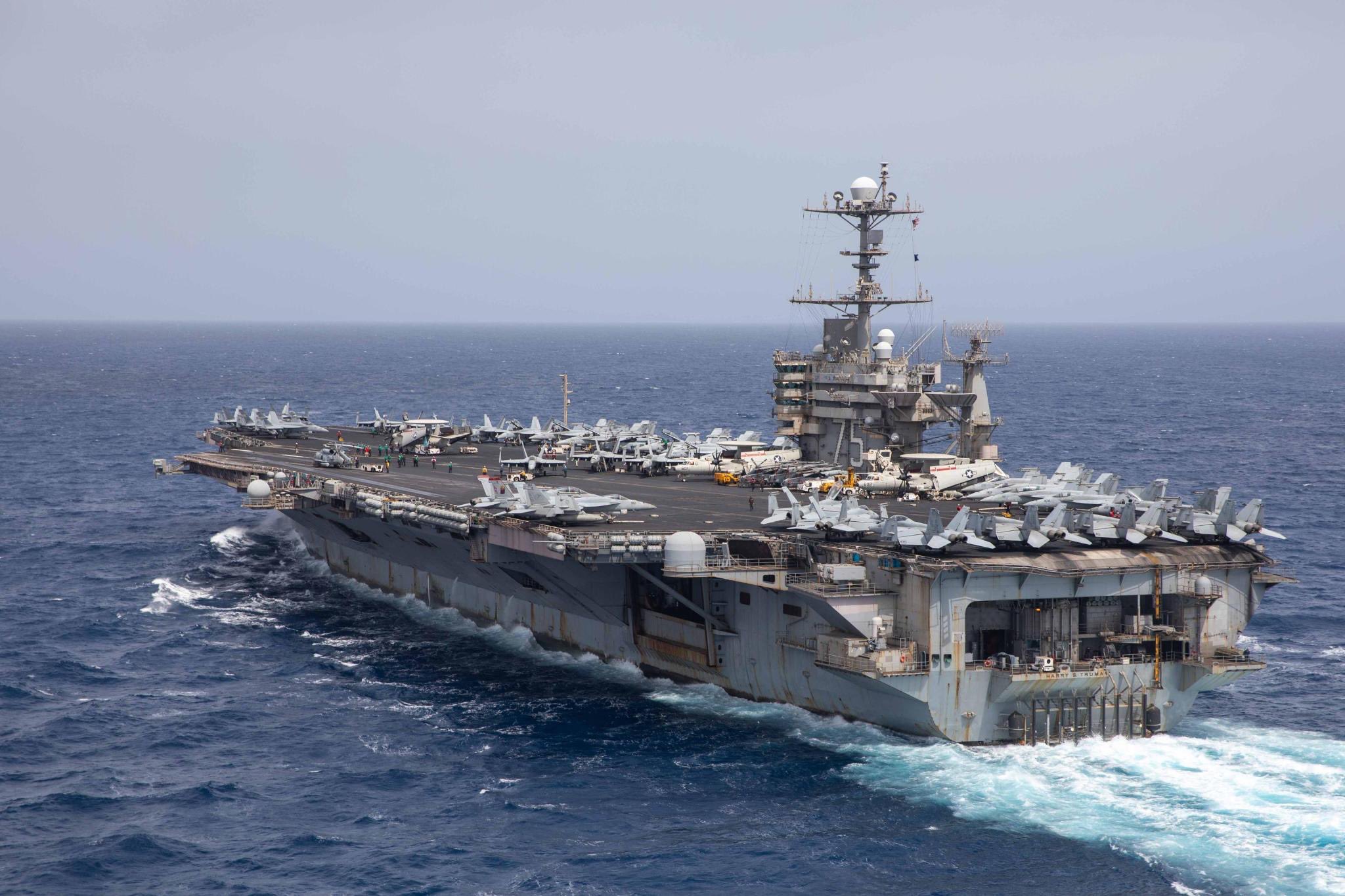
USS Harry S. Truman (CVN-75) on April 15, 2025. US Navy Photo
Aircraft carrier USS Harry S. Truman (CVN-75) sailed through the Strait of Gibraltar early this morning as it headed home following an eight-month deployment. Truman is westbound in the Atlantic Ocean, a Navy official confirmed to USNI News Friday. The carrier transited the strait at around 1:45 a.m. local time, according to a ship spotter.
Truman briefly participated in the NATO Neptune Strike drills as it sailed through the Mediterranean Sea this week. The carrier transited the Suez Canal on Saturday.
The Nimitz-class carrier, which left its homeport of Naval Station Norfolk in mid-September, operated in the Red Sea for much of its deployment as the Yemen-based Houthis continued targeting both military and commercial shipping.
Defense Secretary Pete Hegseth extended the carrier’s deployment several times due to Operation Rough Rider, the Trump administration’s renewed campaign to degrade the Houthis’ drone and missile capabilities used to attack commercial and military shipping. That campaign, which included Truman‘s F/A-18 Super Hornets conducting strikes, has been on pause since early May.
Truman lost three F/A-18 Super Hornets during this deployment and collided with a merchant ship near near Port Said, Egypt, in February. The Navy relieved the carrier’s commanding officer due to the collision and brought Capt. Christopher “Chowdah” Hill, the CO of USS Dwight D. Eisenhower (CVN-69) during its most recent deployment to the Middle East, as a replacement. No sailors were killed in any of the Super Hornet losses nor in the collision.
The carrier operated in the North Sea for NATO drills at the beginning of its deployment before sailing to the Eastern Mediterranean and the Red Sea.
HMNZS Stawell RAN The majority of Stawell’s career was spent in three areas. Initially, she served as a convoy escort along the east coast of Australia.[1] Following this, Stawell participated in a variety of escort, minesweeping, and combat roles throughout New Guinea waters.[1] In the final third of her career, the ship spent time in Hong Kong waters, performing minsweeping and anti-piracy duties.[1] Stawell returned to Brisbane in November 1945.
HMAS Stawell
HMNZS Stawell as HMAS Stawell
The corvette received three battle honours for her wartime service: “Pacific 1943–45”, “New Guinea 1943–44”, and “Borneo 1945”.[10][11]
RNZN Stawell was removed from RAN service on 26 March 1946.[1] On 5 March 1952, Stawell and three other Bathurst-class corvettes (HMA Ships Echuca, Inverell, and Kiama) were transferred to the Royal New Zealand Navy.[12]
She was commissioned into the RNZN during May 1952 and given the prefix HMNZS.[13] Stawell operated primarily as a training vessel until 1959, when she was placed into reserve
HMNZS Stawell alongside HMAS Voyager – Daring Class
Fate Stawell was sold to Pacific Scrap Limited of Auckland, New Zealand in July 1968, and was broken up for scrap.
HMNZS Royalist and HMNZS Stawell being readied for scrapping. Royalist towed to Japan – Stawell was sold to Pacific Scrap Limited of Auckland, New Zealand in July 1968, and was broken up for scrap
HMAS Kiama, named for the coastal town of Kiama, New South Wales, was one of 60 Bathurst-class corvettes constructed during World War II, and one of 36 initially manned and commissioned solely by the Royal Australian Navy (RAN).
After World War II, the corvette was one of four sold to the Royal New Zealand Navy (RNZN). She served as HMNZS Kiama from 1952 until 1976, when the corvette was paid off and marked for disposal.
Design and construction Main article: Bathurst-class corvette In 1938, the Australian Commonwealth Naval Board (ACNB) identified the need for a general purpose ‘local defence vessel’ capable of both anti-submarine and mine-warfare duties, while easy to construct and operate.[2][3] The vessel was initially envisaged as having a displacement of approximately 500 tons, a speed of at least 10 knots (19 km/h; 12 mph), and a range of 2,000 nautical miles (3,700 km; 2,300 mi)[4] The opportunity to build a prototype in the place of a cancelled Bar-class boom defence vessel saw the proposed design increased to a 680-ton vessel, with a 15.5 knots (28.7 km/h; 17.8 mph) top speed, and a range of 2,850 nautical miles (5,280 km; 3,280 mi), armed with a 4-inch gun, equipped with asdic, and able to fitted with either depth charges or minesweeping equipment depending on the planned operations: although closer in size to a sloop than a local defence vessel, the resulting increased capabilities were accepted due to advantages over British-designed mine warfare and anti-submarine vessels.[2][5] Construction of the prototype HMAS Kangaroo did not go ahead, but the plans were retained.[6] The need for locally built ‘all-rounder’ vessels at the start of World War II saw the “Australian Minesweepers” (designated as such to hide their anti-submarine capability, but popularly referred to as “corvettes”) approved in September 1939, with 60 constructed during the course of the war: 36 (including Kiama) ordered by the RAN, 20 ordered by the British Admiralty but manned and commissioned as RAN vessels, and 4 for the Royal Indian Navy.[2][7][8][9][1]
Kiama was constructed by Evans Deakin & Co, at Brisbane, Queensland.[1] She was laid down on 2 November 1942, and launched on 3 July 1943 by Mrs. G. Lawson, wife of the Minister for Transport.[1] Kiama was commissioned into the RAN on 26 January 1944.[1] The coastal community of Kiama, after which the vessel was named, donated recreational materiel for her crew including a radio set, books, and a 16 mm movie projector.[10][11]
Mar. 16 1944 HMAS KIAMA in Sydney
Operational history World War II Kiama’s first deployment was in March 1944 to Milne Bay in New Guinea.[1] From her arrival until September 1944, the corvette’s main duty was to escort convoys along the New Guinea coastline, although a reassignment for the duration of June saw Kiama perform anti-submarine patrols in the Solomon Sea.[1] In September, Kiama was used to transport soldiers between New Guinea and New Britain.[1] On conclusion, she resumed her convoy escort role until the end of 1944, when she departed for Sydney.[1] During her eight months in New Guinea waters, Kiama travelled over 30,000 nautical miles (56,000 km), was at sea for more than 3,000 hours.[1]
In September 1944 ‘C’ Troop and a small detachment from ‘B’ Troop, from the 2/8th Commando Squadron were landed from HMAS Kiama on a reconnaissance operation at Jacquinot Bay on the island of New Britain, to collect intelligence in preparation for an assault by the 5th Division.[12]
The corvette arrived in Sydney on 21 December 1944.[1] On 25 December, the crew was recalled from leave to go to the assistance of the liberty ship SS Robert J. Walker, which had been torpedoed by German submarine U-862.[1] Kiama, along with Quickmatch, Yandra, and USS PC597 were dispatched to the last known location of the ship and began to search the area for the liberty ship’s crew and the attacking submarine; finding the 67 survivors of the attack at 05:45 on 26 December but failing to locate U-862.[13] Kiama was assigned to anti-submarine patrols near Sydney for the final days of the year, before sailing to Adelaide for a month-long refit on 3 January 1945.[1]
Post-refit, Kiama was assigned to Fremantle for two months of anti-submarine warfare exercises with the United States Navy, before returning to New Guinea on 7 May 1945.[1] In May and June, the corvette performed several coastal bombardments in the Bougainville area.[1] In July, Kiama transported Prince Henry, Duke of Gloucester from New Guinea to the Solomon Islands, then spent the rest of the month moving troops and military cargo between these two locations.[1] From 5 to 24 August, the corvette was based in Brisbane, before returning to New Guinea waters.[1] Kiama spent the rest of 1945 as a troop and supply transport, minesweeper, and general duties vessel.[1] When the war ended, Kiama took part in the Japanese surrender at Rabaul.[14] In November, Kiama was assigned to escort demilitarized Japanese cruiser Kashima as the cruiser embarked Japanese soldiers in New Guinea for repatriation.[15]
Kiama returned to Sydney on 29 January 1946.[1] In February she paid a six-day farewell visit to the town of Kiama, ahead of her decommission into the Reserve on 3 April.[1][16] During her wartime service, the ship had been at sea for 6,369 hours, and had sailed a distance of 60,822 nautical miles (112,642 km).[1] She earned two battle honours: “Pacific 1944–45” and “New Guinea 1944”.[17][18]
HMNZS Kiama alongside HMNZS Waikato.
Transfer to RNZN On 5 March 1952, Kiama and three other Bathurst-class corvettes (Echuca, Inverell, and Stawell) were transferred to the Royal New Zealand Navy.[19] Kiama was commissioned into the RNZN,[when?] receiving the prefix HMNZS. Upon acquisition by New Zealand, the corvette was converted into a training ship.[20] Kiama’s 4-inch gun and aft minesweeping equipment were removed, and replaced with two 40 mm Bofors anti-aircraft guns.[20] This is contradicted by a 1996 newspaper article which said it had been mothballed by the New Zealand Navy and converted to a training ship and for use on fisheries patrols in 1966.[21]
HMNZS Kiama alongside in Kiama
In 1966, Kiama was re-commissioned under command of Lieutenant-Commander E Burrows in the 27th Fisheries Protection Squadron to join her sister ship HMNZS Inverell.[22][23] Other duties included search-and-rescue operations and transportation of scientific teams to small island along New Zealand’s coastline.[24][25]
In May 1966 the Kiama was involved in the search for the Kaitawa which was lost with all hands near 90 mile beach.[26] Apart from the initial search, the Kiama formed part of Operation Seabed, along with the Inverell and the frigate Taranaki.[27]
The corvette revisited her namesake town in Australia in late 1966.[28]
RNZN Commanders 1966 Lt Commander E Burrows 1967 Lt-commander M C Verran 1968 Lt-Commander L J Tempero[29] 1970 Lt-Commander F D Arnott[30] 1971 Lt-Commander D L Douglas[31] 1973 Lt Commander N Cameron[32] Fate On 27 May 1968 the Chief of Naval Staff, Rear Admiral J O Ross, described the Kiama and Inverell as obsolete and no longer fit for purpose.[33] The Kiama remained in service until 1975 when it was placed in reserve. The ship was paid off for disposal on 19 August 1976 and broken up in 1979.
Her Royal Highness The Princess of Wales, Sponsor of HMS Glasgow, gave her blessing to the Royal Navy’s newest Type 26 class frigate.
Royal Navy press release
Smashing a bottle of whisky against the hull for good luck, Her Royal Highness formally named HMS Glasgow, the first of eight Type 26 frigates at the leading edge of naval warfare.
To cheers from hundreds of friends, family, workers, VIP guests and the 45-strong ship’s company at BAE Systems shipbuilding facility in Scotstoun, The Duchess of Rothesay, as she is known in Scotland, declared the time-honoured words: “I name this ship Glasgow. May God bless her and all who serve in her.”
Her Royal Highness was accompanied throughout her visit by The Prince of Wales.
Proceedings opened with an inspection of the Royal Guard, followed by the 25-minute naming ceremony, during which Second Sea Lord Vice Admiral Sir Martin Connell thanked Their Royal Highnesses for their support and all those involved in the Type 26 endeavour to reach this milestone in the programme.
“From the first ever HMS Glasgow, sailing under the Royal Navy flag at the end of the 17th Century to the ship we see here in the 21st Century, HMS Glasgow has evolved and adapted to meet the warfighting and operational demands of its day.
“Each metamorphosis saw shipbuilders adapting materials and designs so that crews could operate each successive HMS Glasgow on operations and in conflict and war.
Princess of Wales delivering her speech at the ceremony (Credit: Prince and Princess of Wales official X account)
“The result of this being 11 battle honours – HMS Glasgow’s pedigree is awe inspiring.”
He hailed the latest ship as “a pure-bred Anti-Submarine Warfare platform, setting the standard for naval warfare”, ready to “meet the global and geopolitical challenges of today”.
He continued: “HMS Glasgow and her class represent the next chapter of naval innovation, safeguarding the UK’s interests and contributing to national prosperity.”
Following prayers for the new ship led by Chaplain of the Fleet the Venerable Andrew Hillier, Her Royal Highness was invited to step up to the ceremonial platform and activate the device which blessed the hull with whisky.
Once the service was over, The Prince and Princess were given a short guided tour of the frigate, which will serve as the Fleet’s shield and sword against hostile submarines.
Showing them around was the ship’s chief bosun’s mate (buffer) Petty Officer (Sea) Abigail Baker.
“It was an honour and privilege to meet Their Royal Highnesses. The Princess of Wales projected a keen interest in the ship’s company and their families – and we in HMS Glasgow are proud to have her as our Ship’s Sponsor.”
They then met some of those responsible for building the 8,000-tonne warship, the sailors charged with bringing the vessel to life, and the families of both who support them.
Senior Naval Officer Commander Phil Burgess – the very first member of HMS Glasgow’s ship’s company, who joined in October 2021 – called the frigate “a 21st Century warship for a 21st Century Royal Navy”.
A wave from the shipwrights involved in HMS Glasgow’s construction (Royal Navy picture)
He says being involved with the Type 26 programme and laying the foundations for the next 30 or so years of front-line operations around the globe has been “an enormous professional privilege”.
He continued: “HMS Glasgow – and the rest of her class – are the most advanced anti-submarine warfare frigates which have ever been built for the Royal Navy and possibly anywhere in the world.
“It has been a great honour to be the Senior Naval Officer of HMS Glasgow and as I approach the end of my tenure, hosting Their Royal Highnesses on their inaugural visit to the ship to name her, has been the pinnacle of over three and half years in post.”
Her Royal Highness accepted the honour of Royal Sponsor – historically, the title has served to bestow good luck and divine protection upon a ship – to HMS Glasgow four years ago.
Although the Princess of Wales has hosted members of the Ship’s Company at Windsor Castle, she has never seen the 8,000-tonne warship until today. Similarly, for the first time the Royal Standard was hoisted on HMS Glasgow’s yardarm throughout Their Highnesses time on site.
Regarded as a permanent member of the ship’s company, Sponsors attend milestones in a vessel’s life – such as the naming ceremony – are kept regularly informed of the sailors’ activities and deeds, send messages of support in return in hard and challenging times, and generally act as ambassadors for and champions of the crew and their vessel.
RN Writer Lola Nicholson, who looks after the many administrative requirements of her 44 shipmates, cannot believe the difference between HMS Glasgow and the previous ships in which she’s served.
“When I look at Glasgow, she’s impressive, like no ship I’ve ever seen before – and it’s the same on board, really impressive and exciting and much better accommodation for the sailors,” she said.
Leading Engineering Technician Ross McDowall, responsible for HMS Glasgow’s electrical systems, was born in and grew up around the city.
He’s been assigned to the ship for the past year and has got stuck into community projects forging ties with the frigate’s affiliates besides his engineering day job.
“It’s exciting. Seeing the ship built here in the city, carrying the name Glasgow,” he said.
“I’ve really been looking forward to the naming ceremony and bringing my family on site. It’s the first time they’ll have seen the ship, while for me, this is the first time I’ve come face-to-face with members of the Royal Family.”
Fellow Glaswegian Nico Miller, a senior project manager at BAE Systems, has been involved with the Type 26 programme for the past three years and previously worked on the Royal Navy’s Type 45 destroyers.
“Because she is HMS Glasgow, because she is the first of her class, because she is built here on the Clyde, everyone has been looking forward to this day,” he said.
“Everyone is proud by what they’ve achieved on the ship and rightly so. She is hugely impressive, the levels of technology involved are quite incredible. We are setting the standard here for the future ships of the Fleet. That’s something special to be part of.”
Work continuing to fit out HMS Glasgow, installing and testing sensors and systems, resumes next week.


 New Zealand