Kiwi sailors thrive on US Navy flagship

Four Royal New Zealand Navy sailors enjoyed a historic arrival into New Zealand aboard a US Navy warship this month.
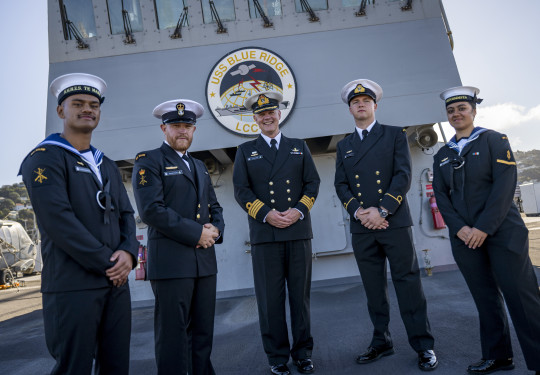
Five Navy sailors stand in uniform in front of a large "USS Blue Ridge". The ship casts a shadow on the sailors on a cold sunny day.

23 May, 2025

USS Blue Ridge (LCC 19), based with the US 7th Fleet in Yokosuka, Japan, arrived in Wellington on May 16, marking a New Zealand first for the 55-year-old ship. It is the third US Navy warship visit since 2016.

Ensign Edward Suckling, Petty Officer Seamanship Combat Specialist Alex Croucher, Leading Communication Warfare Specialist Ashley O’Connor-Palmer and Able Seamanship Combat Specialist Te Matauranga Akuhata joined the ship in Yokosuka on 24 March as crewmembers for the journey south.

The USS Blue Ridge is a command and control ship that supports the US 7th Fleet’s operations in the Indo-Pacific region. It is the oldest deployed warship in the US Navy.

At around 1,000 crew and nearly 200 metres long, the New Zealanders found Blue Ridge very different to Royal New Zealand Navy ships.

But the four were positive about the experience, citing easy-going Americans who were fun to be friends with and genuinely curious about ‘small navy’ culture in New Zealand.
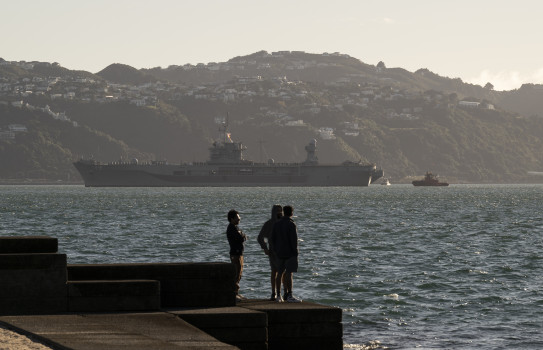
A large ship silhouette sits on the horizon as three people look on in the foreground. In the background, the hills of Wellington covered in homes stand tall.

USS Blue Ridge arriving in Wellington Harbour.

POSCS Croucher says the sailors were envious that New Zealand sailors got to do lots of roles on a ship.

“In my trade in the US Navy, you’ve got set jobs to do. You get your tools, do the job, sign it off. And the rank structure is completely different here. The sailors were really curious about how we worked in a small navy, with lots of variation in our jobs.”

He says the American sailors work hard and are away for long deployments.

“For these guys, coming ‘home’ is returning to Yokosuka. People have to build their lives there. It makes you grateful to be in the New Zealand Navy.”

There is a lot of competition for exchanges like these, he says.

“You can get a lot of applications in, but a lot of people might not be releasable. I was lucky, being in between postings – right place, right time.”

ENS Stuckling had a similar experience with tighter job roles, finding himself on the bridge watchkeeping duties from the word go.

“I was doing the middle watches (midnight) a lot of the time, and I got to be on the bridge when we came into Wellington. I think I’m the first New Zealand officer to be on a US Navy ship coming into New Zealand.”

He says it is definitely a culture shock. “I’m still seeing people on board I haven’t seen before. And in New Zealand ships I’m used to doing lots of things. On Blue Ridge you stick to your designated role.”

ASCS Akuhata jumped at the chance to get to sea when his career manager asked if he would like an exchange posting on board a US Navy ship.

“After coming off HMNZS Manawanui, I didn’t have a sea posting coming up. I was ready for sea and didn’t mind what it would be.”

His duties included gun maintenance and shipwide maintenance.

“It was a really good experience. I’d tell anyone, if the opportunity came up, grab it with both hands.”

LCWS O’Connor-Palmer says she was involved in “all things computers” aboard Blue Ridge, as well as shipboard maintenance tasks.

The highlights were making good friends and laughing over the differences in culture – from Kiwi slang to American food.

That included the humorous reactions to a US Embassy ‘Welcome to New Zealand’ tasting session on board, featuring Kiwiana items like Marmite, feijoas, Pineapple Lumps, Jaffas and L&P.

“If anyone got the opportunity, I’d tell them to enjoy themselves, come with an open mind, and make the most of it.”Blue Ridge hi res.00 00 09 20.Still001
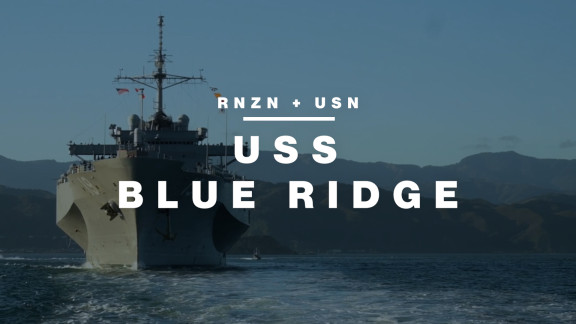
Watch Kiwi sailors on USS Blue Ridge | Royal New Zealand Navy video

Kiwi sailors on USS Blue Ridge | Royal New Zealand Navy

NZDF – National security brings economic benefits

Defence Minister Judith Collins – 22 May 2025

Pulling our weight in an increasingly volatile world will keep New Zealanders safe while boosting our domestic economy, Defence Minister Judith Collins says.

“To achieve this, the Government has allocated $2.7 billion of capital and $563 million of operating funding for priority projects identified in the Defence Capability Plan we released last month. 

“This includes the replacement of maritime helicopters and complements the $957 million for defence activities, personnel and estate previously announced,” Ms Collins says.

“This previous announcement, and today’s commitments, brings the total investment in Defence to $4.2 billion in Budget 2025.

“Today we announce investments in critical tools that support our national and economic security. This ranges from updated and interoperable missile systems to counter uncrewed aerial systems (UAS) to protect our people and assets, through to planes that are essential for deploying troops and equipment and supporting international trade and diplomatic missions.

“We will be looking to use New Zealand businesses where it makes sense to do so, further demonstrating the Government’s commitment to supporting those who are innovative and capable of developing tools and capability that Defence needs.

“Ultimately, spending on Defence will result in economic benefits to everyday New Zealanders and New Zealand businesses. I look forward to seeing our Defence industry grow in a range of areas, whether through New Zealand designed or built products, particularly in the advanced technology area, infrastructure development, or domestic contractors supporting high-value military procurement.”

The $2.7 billion in capital and $563 million in operating funding announced today for priority Defence projects covers essential items including:

  • replacing the two Boeing 757s to support military operations and deployments, humanitarian and disaster relief support, and trade and diplomatic missions
  • replacing the Seasprite maritime helicopters to operate from Navy ships (previously announced)
  • replacing the Javelin anti-armour missile system launch units with new units to ensure interoperability with partner militaries and provide the New Zealand Defence Force (NZDF) with the ability to fire at longer ranges
  • encrypted radios to provide deployed Army units with secure voice communication
  • a counter-UAS that can be set up in fixed locations and is able to disable drones/UAS that could pose a threat to personnel, aircraft/vehicles and infrastructure
  • detailed design work for the future of Devonport Naval Base; and
  • investment in homes for Defence families, Defence infrastructure, modernising the Defence vehicle fleet and digital and information management projects.

“These investments are critical to enable Defence to increase its lethality, protect New Zealand, and deliver what we expect of them,” Ms Collins says.

“The Defence Capability Plan outlines planned commitments of $12 billion over the next four years – including $9 billion of new spending – subject to future Budget decisions and Cabinet approving business cases. Our Budget commitments are yet another strong signal that we are cracking on and delivering on this plan, which will take Defence spending to 2 per cent of GDP by 2032/33.

“The Government’s backing of Defence shows a very real recognition of the value we place on the men and women who serve and protect this country and its interests.

“Our people are being called upon to go more places, more often and for longer to play New Zealand’s part in contributing to global security. This funding will enable them to do that.

“We will pull our weight.”

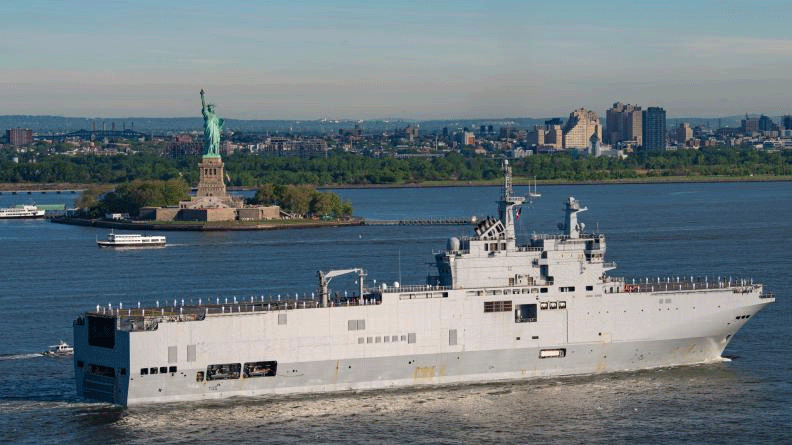
French Navy Training Squadron Visits New York

BySeaWaves Magazine – May 17, 2025

Marine Nationale photo

This symbolic stopover illustrates the strength of the alliance between the two nations, based on a common history and excellent shared know-how. In this context, on May 7, the amphibious helicopter carrier Mistral welcomed Laurent Bili, French Ambassador to the United States, as well as Brigadier General Vincent de Kytspotter, head of France’s military representation to the United Nations, Army General Bertrand Jardin, Defense Attaché in Washington, Cédrik Fouriscot, Consul General of France in New York and Mrs. Myriam Gil, Deputy Consul General.

Laurent Bili took advantage of this visit to deliver a conference to the midshipmen and discuss the various issues of Franco-American cooperation.

On May 8, a memorial ceremony at Cypress Hill Cemetery in Brooklyn brought together a delegation from the Joan of Arc group, veterans, and local authorities. Cédrik Fouriscot, Consul General of France, and Captain Vieux-Rochas, commander of the Joan of Arc group, provided an opportunity to lay wreaths in tribute to the fallen soldiers.

After a stopover marked by numerous representational activities, the TG set sail again, heading for its next stopover: Quebec, scheduled in a few days.

The Jeanne d’Arc 2025 mission is a long-term operational deployment through which France ensures its presence in several areas of major strategic interest, while providing a concrete, realistic, and high-quality training framework for the cadet officers on board.

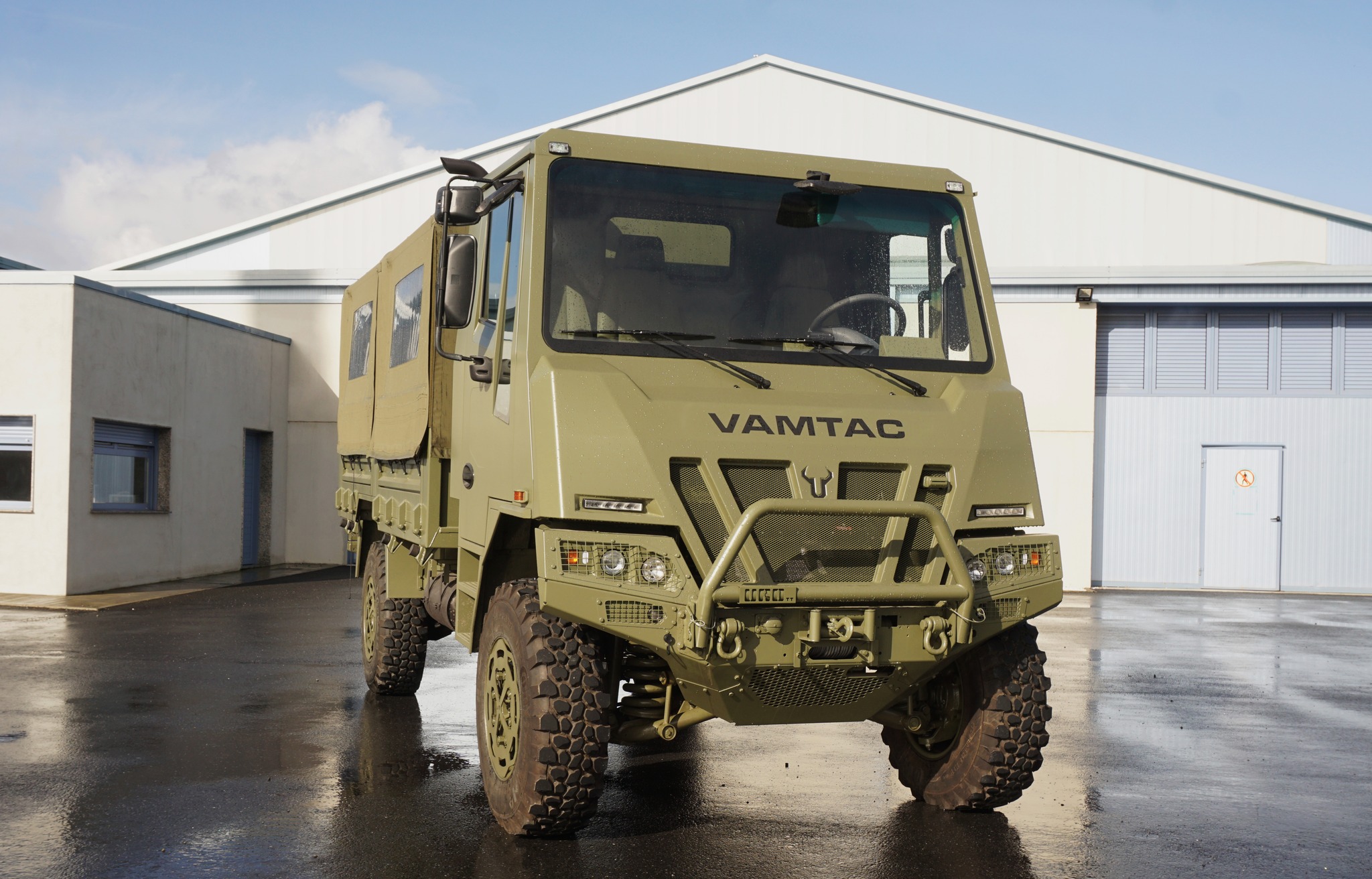
Spain Delivers VAMTAC ST5 Prototype to New Zealand Army

 Rojoef Manuel May 21, 2025

The New Zealand Army has taken delivery of a VAMTAC ST5 four-wheel drive vehicle prototype from Spain as part of a 2024 contract.

The platform was transferred from Galicia to the Wellington International Airport via a Royal New Zealand Air Force C-130J-30 Super Hercules aircraft.

It will now receive communications design and testing according to the military’s requirements, and will be used for associated clearances and operator training once necessary evaluations are completed.

Replacing Utility Fleet

The platform supports New Zealand’s goal to modernize the army’s ground-based workhorse fleet with 20 VAMTAC ST5 light and 40 VAMTAC CK3 medium utility vehicles, all developed by Spanish defense company Urovesa.

Systems to be replaced under this initiative are the Unimog and Pinzgauer trucks introduced in the 2000s, which make up approximately 25 percent of the service’s existing utility fleet.

A VAMTAC ST5 4x4 vehicle being unloaded from a Super Hercules C-130J-30 aircraft. Photo: New Zealand Defence Force
A VAMTAC ST5 4×4 vehicle being unloaded from a Super Hercules C-130J-30 aircraft. Photo: New Zealand Defence Force

Upon their arrival, the new systems will be distributed for defense operations, humanitarian tasks, search and rescue deployments, disaster relief, and vehicle training programs.

Urovesa received 100 million New Zealand dollars ($59.3 million) to assemble the first vehicles, with deliveries to begin in 2027.

The VAMTAC System

VAMTAC is the abbreviation of “Vehículo de Alta Movilidad Táctico,” which translates to “High Mobility Tactical Vehicle.”

Urovesa’s VAMTAC in the ST5 configuration is 6 meters (20 feet) long and has a gross weight of 6,000 kilograms (13,228 pounds).

It can carry up to 1,700 kilograms (3,740 pounds) of cargo and travel at a speed of 110 kilometers (68 miles) per hour.

Meanwhile, the VAMTAC CK3 weighs approximately 9,950 kilograms (21,930 pounds), has a payload capacity of 3,390 kilograms (7,473 pounds), and has a similar length and speed to the ST5.

“UROVESA vehicles are known for their versatile, efficient and robust design,” New Zealand Deputy Defence Secretary for Capability Delivery Sarah Minson stated.

“They are already used by more than 20 countries, including Singapore and a number of NATO member nations. The new VAMTAC fleet will be equipped to drive safely while off-road in challenging conditions, with high ground clearance using 4×4 drive and inter-axle and inter-wheel differential locks.”

VAMTAC CK3 medium utility vehicle. Photo: New Zealand Army

HMNZS/HMAS Inverell (J233 or M233)

HMNZS Inverell

HMAS Inverell, named for the town of Inverell, New South Wales, was one of 60 Bathurst-class corvettes constructed during World War II, and one of 36 initially manned and commissioned solely by the Royal Australian Navy (RAN).[1]

After World War II, the corvette was transferred to the Royal New Zealand Navy (RNZN), where she served from 1952 to 1976.

HMNZS Inverell
HMNZS Inverell
HMNZS INVERELL
HMNZS Inverell
Imagery Scanned from Navy Historic Archive
HMAS Inverell transferring liberated prisoners of war to HMAS Maidstone off Makassar, Dutch East Indies in September 1945
HMNZS Inverell – the end

Design and construction

[edit]

Main article: Bathurst-class corvette

In 1938, the Australian Commonwealth Naval Board (ACNB) identified the need for a general purpose ‘local defence vessel’ capable of both anti-submarine and mine-warfare duties, while easy to construct and operate.[2][3] The vessel was initially envisaged as having a displacement of approximately 500 tons, a speed of at least 10 knots (19 km/h; 12 mph), and a range of 2,000 nautical miles (3,700 km; 2,300 mi)[4] The opportunity to build a prototype in the place of a cancelled Bar-class boom defence vessel saw the proposed design increased to a 680-ton vessel, with a 15.5 knots (28.7 km/h; 17.8 mph) top speed, and a range of 2,850 nautical miles (5,280 km; 3,280 mi), armed with a 4-inch gun, equipped with asdic, and able to fitted with either depth charges or minesweeping equipment depending on the planned operations: although closer in size to a sloop than a local defence vessel, the resulting increased capabilities were accepted due to advantages over British-designed mine warfare and anti-submarine vessels.[2][5] Construction of the prototype HMAS Kangaroo did not go ahead, but the plans were retained.[6] The need for locally built ‘all-rounder’ vessels at the start of World War II saw the “Australian Minesweepers” (designated as such to hide their anti-submarine capability, but popularly referred to as “corvettes”) approved in September 1939, with 60 constructed during the course of the war: 36 (including Inverell) ordered by the RAN, 20 ordered by the British Admiralty but manned and commissioned as RAN vessels, and 4 for the Royal Indian Navy.[2][7][8][9][1]

Inverell was laid down by Mort’s Dock & Engineering Co at Balmain, New South Wales on 7 December 1941.[1] She was launched on 2 May 1942 by Mrs. T. S. Punch, Mayoress of Inverell, and commissioned into the RAN on 17 September 1942.[1]

Operational history

[edit]

World War II

Inverell began service in November 1942 as a convoy escort along the eastern Australian coast.[1] At the end of December, she was relocated to Darwin, and primarily performed escort runs between Darwin and Thursday Island.[1] On 11 November 1943, Inverell arrived at Williamstown Naval Dockyard for a month-long refit.[1] On conclusion, she returned to Darwin and resumed escort duties.[1]

In early February 1943, Inverell was required to rescue the crew of a United States Army Air Forces Liberator bomber, which had crashed on Croker Island.[1] Of the eight survivors, one died onboard while the corvette was returning to Darwin.[1] On 22 September 1944, Inverell sailed to Fremantle.[1]

While based in Fremantle, the corvette’s main duties was to perform training exercises with United States Navy and Royal Navy submarines, with secondary duties including convoy escort and patrol.[1] Inverell departed Fremantle for Darwin on 4 May 1945.[1] Between 22 May and 11 July, the corvette was involve in minesweeping, before she, sister ship HMAS Stawell, and Services Reconnaissance Department vessel HMAS River Snake were assigned to Morotai.[1] Inverell was required to tow River Snake for the first part of the voyage.[1]

Based in Morotai, Inverell was primarily used as a patrol vessel until the end of World War II, when she became involved in the transfer of Dutch East Indies territories from Japanese to Allied control.[1] From 21 September to 18 November, she was designated as the command ship for Port Directorate Macassar.[1] On 29 November, she left Morotai, and spent the next month operating off the coast of Queensland before arriving in Brisbane on 25 December 1945 and preparing for decommissioning.[1] Several delays meant that Inverell was not paid off into reserve until 14 June 1946.[1] On 4 November 1946, Inverell was towed to Sydney by sister ship HMAS Echuca, arriving on 17 November.[1]

The corvette received two battle honours for her wartime service: “Darwin 1942″ and Pacific 1942–45”.[10][11]

RNZN service

On 5 March 1952, Inverell and three other Bathurst-class corvettes (HMA Ships EchucaKiama, and Stawell) were transferred to the Royal New Zealand Navy.[1] Inverell was commissioned into the RNZN on 10 April 1952, but was decommissioned into reserve after a refit.[1]

In 1965, the corvette was refitted as a training and fisheries patrol ship to replace the frigate HMNZS Rotoiti.[1] The 4-inch gun was replaced by a second 40 mm Bofors gun, and minesweeping gear was removed.[12] She was recommissioned on 15 August 1965, and served until 19 August 1976, when she was decommissioned.[1]

On 1 November 1977, Inverell was sold to Pacific Scrap Limited of Auckland for scrapping.

JCs Royal New Zealand Navy Ships and New Zealand Defence, Also other World Defence Updates

Ships and Defence News Past and Present

Skip to content ↓