HMNZS/HMAS Echuca, named for the town of Echuca, Victoria, was one of 60 Bathurst-class corvettes constructed during World War II, and one of 36 initially manned and commissioned by the Royal Australian Navy (RAN)
HMNZS EchucaHMNZS Echuca
RNZN service On 5 March 1952, Echuca and three other Bathurst-class corvettes (HMA Ships Inverell, Kiama, and Stawell) were transferred to the Royal New Zealand Navy (RNZN).[12] She was commissioned into the RNZN in May 1952, and received the prefix HMNZS.[13]
The corvette remained in service with the RNZN until 1967, although from 1953 she was classified as being in reserve.[1][13] She was sold to Pacific Scrap Limited of Auckland for scrapping[1] on 11 April 1967 https://en.wikipedia.org/wiki/HMAS_Echuca
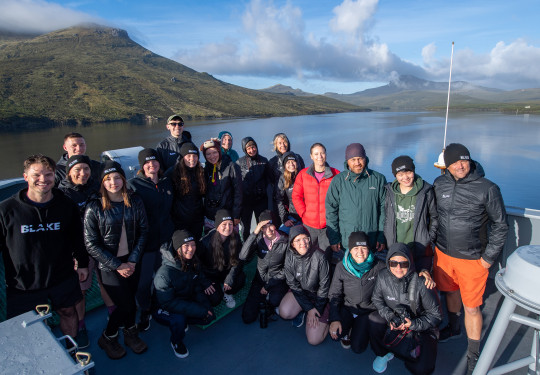
In 2023, Dunedin high school student Nora Paicu travelled to the sub-Antarctic islands aboard the Royal New Zealand Navy’s HMNZS Canterbury.
19 May, 2025
She was part of a science-focused BLAKE Expeditions group, but she found the naval experience so inspirational she decided to join the Naval Reserve Force.
Last month, Ordinary Maritime Trade Operator (OMTO) Paicu, 19, was among nine sailors and five officers graduating from a 10-month Naval Reserve Common Training (NRCT) course in a ceremony in Devonport, Auckland.
NRCT provides almost identical training to Regular Force personnel but is delivered part-time, with graduates balancing their training with work and study commitments, as well as being away from family.
As well as online study and parade evenings with a local reserve force unit, the graduates had to complete two nine-day-long training blocks at Devonport Naval Base and Tamaki Leadership Centre at Whangaparāoa, as well as four training weekends.
OMTO Nora Paicu is assigned to HMNZS Toroa in Dunedin and continues her studies at the University of Otago studying law, management and agricultural innovation – a triple degree.
She is also working as a reader/writer exam supporter at her former high school, Columba College.
As a maritime trade operator, OMTO Paicu provides the interface between merchant shipping and the military, including briefing ship masters on security threats and military operations that could impact their route.
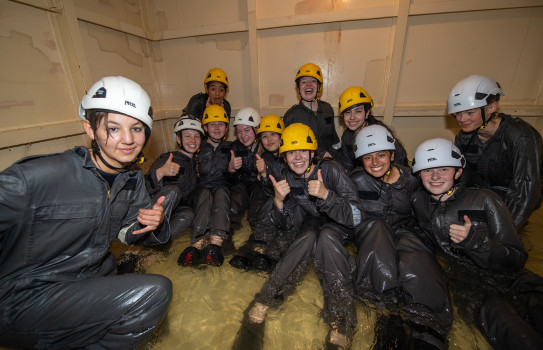
OMTO Paicu (left) in the Royal New Zealand Navy flood tank during her School to Seas Experience at Devonport Naval Base in 2023
She says her 2023 BLAKE expedition aboard HMNZS Canterbury to the sub-Antarctic islands – she was one of 11 students who carried out scientific work on Campbell Island over two days – followed by a School to Seas experience with the Navy in Auckland, made a strong impression on her.
HMNZS Canterbury
“Meeting the female commanding officer of HMNZS Canterbury and witnessing the camaraderie of the crew showcased the Navy’s inclusive culture and unique way of life that supports New Zealand,” she said.
“I was deeply impressed by the positive impact the Navy makes, from supporting conservation efforts to serving New Zealand communities.”
“Highlights of the NRCT course were definitely the people I trained with and the connections I made, and being able to push through all types of situations with new friends and amazing people by my side.”
She has set her sights on a future with the New Zealand Defence Force (NZDF).
“I hope to become a legal officer – supporting the NZDF legally, encouraging justice and providing legal support as necessary.”
Her advice for those wanting to join is to know your ‘why’.
“Know why you are doing it, do it for the right reason, push through, don’t give up, you got this.”
The aircraft carrier USS Harry S. Truman sails through the Mediterranean Sea on May 18, 2025, in the U.S. 6th Fleet area of operations. Truman just ended about five months on duty in the Red Sea as part of U.S. military operations against the Houthis in Yemen. (Michael Shen/U.S. Navy)
NAPLES, Italy — The Harry S. Truman Carrier Strike Group will participate in a NATO military exercise in the Mediterranean Sea just days after leaving the Middle East, officials said Monday. The strike group, which includes the aircraft carrier USS Harry S. Truman, will be under the command and control of NATO as part of the Neptune Strike exercise, Allied Joint Force Command Naples said in a post Monday on X. The command didn’t say when that will happen. The first iteration of the annual exercise, which includes at least 13 countries, took place last month, JFC Naples said in an April 3 statement. Naval Striking and Support Forces NATO, which oversees the exercise, did not immediately respond to an email asking about the strike group’s participation. Earlier on Monday, U.S. 6th Fleet confirmed that Truman, the destroyer USS Jason Dunham and the cruiser USS Gettysburg were on routine deployment to its area of operations, which includes the Mediterranean Sea. The Navy didn’t offer other details, such as when the carrier strike group left the Red Sea, which is in the U.S. 5th Fleet area of responsibility, or indicate how long Truman will remain in the 6th Fleet AOR, citing operational security. It’s also unclear whether the destroyer USS Stout, which is part of the strike group, is in the Mediterranean as well. Truman’s departure from the Red Sea follows an eventful deployment that has seen the carrier lose three aircraft in separate incidents. It also caps weeks of nearly constant flight operations as part of a U.S. bid to cripple Iran-backed Houthi militants in Yemen. The strike group’s exit comes about two weeks after President Donald Trump paused Operation Rough Rider, an aggressive airstrike campaign aimed at stopping Houthi attacks on military and commercial ships in the Red Sea. Since March 15, U.S. forces have hit more than 1,000 Houthi targets in Yemen, killing group leaders and fighters and degrading the group’s capabilities, the Pentagon said last month. In declaring a ceasefire on May 6, Trump said the Houthis didn’t want to fight anymore and had agreed to stop attacking ships in the vital waterway. On Monday, it appeared that a single U.S. aircraft carrier, USS Carl Vinson, remained in the Middle East. Last week, Vinson was operating in the Arabian Sea along with the destroyers USS Sterett and USS William Lawrence and the cruiser USS Princeton, USNI News reported May 12. Truman left its homeport in Norfolk, Va., on Sept. 23 for a routine deployment to 6th Fleet. It entered the Middle East on Dec. 14 following the departure of the aircraft carrier USS Abraham Lincoln. Soon after, an F/A-18 Super Hornet launching from Truman’s deck was mistakenly shot down by Gettysburg. The carrier lost two more Super Hornets in separate incidents on April 28 and May 6. All three incidents remain under investigation. And in February, Truman was involved in a late-night collision with a cargo ship near the Suez Canal following a port call at Naval Support Activity Souda Bay on the Greek island of Crete. The Feb. 12 collision left Truman with scrapes and gashes along the ship’s right, or starboard, back end, including a small slash that penetrated its hull well above the waterline. Little more than a week later, the Navy fired Capt. Dave Snowden, who had served as the carrier’s commanding officer since 2023. Capt. Christopher Hill, then commanding officer of the aircraft carrier USS Dwight D. Eisenhower, was named Truman’s interim commanding officer. The collision also remains under investigation. Truman returned to the Red Sea in late February after a structural assessment and repairs at NSA Souda Bay. ALISON BATH Alison Bath reports on the U.S. Navy, including U.S. 6th Fleet, in Europe and Africa. She has reported for a variety of publications in Montana, Nevada and Louisiana, and served as editor of newspapers in Louisiana, Oregon and Washington.
We’re delighted to welcome the USS Blue Ridge and her crew to Aotearoa New Zealand,” says U.S. Chargé d’affaires, David Gehrenbeck. “The USCGC Midgett visited Wellington as recently as February and, over the past several years, the USS Howard and the USS Sampson have also been to New Zealand. These visits underscore the first-class working relationship between our defense forces. I’m confident the ship’s crew will enjoy experiencing the beauty of this country and connecting with the local community during their time here.
WELLINGTON, New Zealand – U.S. 7th Fleet flagship USS Blue Ridge (LCC 19) arrived in Wellington, New Zealand for a port visit, May 16, 2025. This historic arrival marks the first time Blue Ridge has visited New Zealand as well as its capital city. The last two U.S Navy ships to visit Wellington were USS Howard (DDG 83) in 2021 and USS Sampson (DDG 102) in 2016.
During this port visit, leadership from the U.S. 7th Fleet flagship is scheduled to meet with their Kiwi counterparts and local leaders to discuss ways of improving operational readiness, advancing future military capabilities, and enhancing the U.S.-New Zealand bilateral relationship overall.
WELLINGTON, New Zealand – U.S. 7th Fleet flagship USS Blue Ridge (LCC 19) arrived in Wellington, New Zealand for a port visit, May 17, 2025.WELLINGTON, New Zealand – U.S. 7th Fleet flagship USS Blue Ridge (LCC 19) arrived in Wellington, New Zealand for a port visit, May 17, 2025.
“This historic port visit by the USS Blue Ridge and our 7th Fleet team speaks to deep ties the United States and New Zealand share,” said Vice Admiral Fred Kacher, commander, U.S. 7th Fleet. “Our partnership is rooted in our common values and respect, and our visit here represents an important opportunity for us to further strengthen the bond between our nations and our navies.”
In addition, Sailors from Blue Ridge and U.S. 7th Fleet are scheduled to participate in a series of in-port activities to include band performances, community relation events, ship tours, and touristic sightseeing. Wellington will also serve as a short stop for Blue Ridge as the ship brings fuel and supplies on board. Public access to the ship will not be possible.
U.S. 7th Fleet staff, embarked aboard USS Blue Ridge, commands the world’s largest forward-deployed fleet with the primary mission of providing operational control and planning for its forces in the Western Pacific and Indian Oceans, while promoting regional stability and maritime security through engagements with allies and partners.
“We’re delighted to welcome the USS Blue Ridge and her crew to Aotearoa New Zealand,” says U.S. Chargé d’affaires, David Gehrenbeck. “The USCGC Midgett visited Wellington as recently as February and, over the past several years, the USS Howard and the USS Sampson have also been to New Zealand. These visits underscore the first-class working relationship between our defense forces. I’m confident the ship’s crew will enjoy experiencing the beauty of this country and connecting with the local community during their time here.”
On arrival in New Zealand, Wellington was decommissioned and entered an extended refit which ended in 1986. The limited modernization proved difficult and took an unexpected 4 years. When inspected prior to purchase in 1981, she was in the condition expected for a Royal Navy (RN) frigate after a dozen years’ service. However, in 1982 the frigate conducted a four-month winter patrol in the postwar Falklands exclusion zone with the other four RN unmodernised Leanders. Sea conditions in the Falkland exclusion zone meant more expensive hull repair was needed. Large-scale energy projects in New Zealand, particularly Marsden Point, resulted in a loss of key dockyard staff and recruitment difficulties. The installation of additional fuel tanks to extend the range of South Pacific operations proved difficult and dirty work. A new gunnery control system (RCA-76) along with surface and navigation radar were fitted, escape hatches were enlarged and asbestos was removed.[1] The original estimated cost of transferring and refitting Bacchante and Dido to RNZN was $100m in 1981. By 1985 it reached $263m[2] Other minor changes were also made as a result of practical experiences of British frigates during the Falklands War.
Later refits saw new long-range air surveillance radar in place of the old 965 bedstead, with the Thales LW08 (1994) [clarification needed] and the original Seacat missile removed and replaced by the Phalanx CIWS (1998).[clarification needed]
Sea Cat missile launcher on HMNZS Wellington, 1987
Like her sister-ship HMNZS Canterbury, Wellington was stood to during the First Coup in Fiji in 1987 to evacuate New Zealand and other foreign nationals should the need have arisen.
In 1988, Wellington accompanied HMNZ Ships Canterbury, Endeavour and Waikato to Sydney, Australia to participate in the Bicentennial Salute to mark the 200th Anniversary of the settlement of Europeans in that country. Vessels from the navies of Australia, Britain, France, Greece, India, Italy, Japan, Malaysia, the Netherlands, New Zealand, Pakistan, Papua New Guinea, Solomon Islands, United States and Vanuatu were represented.
In 1994, Wellington contributed to the international Peace Keeping initiative in Bougainville along with Canterbury.
In 1995/1996, Wellington deployed to the Persian Gulf on the first of the RNZN deployments supporting the MIF (Multinational Interception Force) enforcing UN sanctions on Iraqi trade through the Gulf. Wellington successfully detained a number of vessels exporting dates from and attempting to import prohibited cargoes to Iraq. The frigate attended peace talks at Bougainville in July and August 1990. On 23 February 2017, it was announced by NZDF that the New Zealand Operations Service Medal (NZOSM)[3] had been awarded to personnel who were in Bougainville for the Operation BIGTALK peace talks.[4]
Although the ship was due to be sunk at 3pm on 12 November 2005, this was delayed for 24 hours due to weather. The next day, the sinking was delayed by another 30 minutes due to the entanglement of a detonation cable under the frigate. At 3:30pm on 13 November, the ship was scuttled and took a minute and 55 seconds to sink. During a storm in February 2006, the ship broke up and is now lying in two sections on the seabed close to where it was sunk at 41°21.18′S 174°46.80′E[5]
The depth of her keel is approximately 21 metres (69 ft), making the wreck accessible by scuba divers using standard equipment.